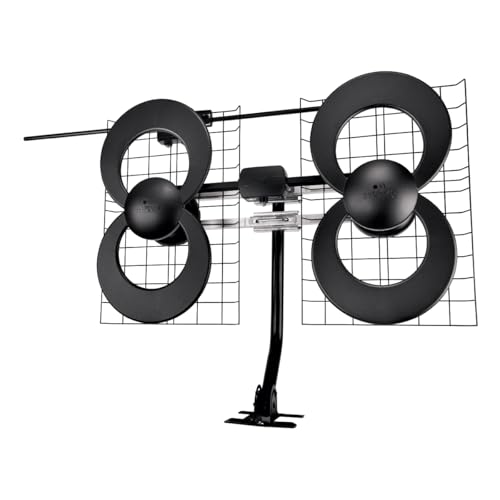
Antennas Direct ClearStream 4V -- Best Overall Outdoor Antenna
The ClearStream 4V is the most consistently recommended outdoor antenna for a reason: it combines a compact footprint with strong multidirectional performance across both UHF and VHF bands. The loop element design captures signals from up to a 70-degree arc without requiring precise pointing, which simplifies installation significantly. The included 20dB inline amplifier can be added or removed depending on your signal environment. Build quality is solid, with a UV-resistant housing rated for outdoor use. Mounting hardware is included and compatible with standard mast diameters. For most suburban and semi-rural households within 60 miles of a tower cluster, the ClearStream 4V is the first antenna to consider.
Check price on Amazon →Top outdoor digital TV antennas for 2026, ranked by range, channel count, signal stability, and ease of installation for cord-cutters in any location.
Outdoor digital TV antennas receive free over-the-air broadcasts in full HD without a monthly bill. Modern antenna technology has improved dramatically, and today’s outdoor models outperform older rooftop designs by a significant margin. Whether you are in a rural fringe area or a dense suburb, the five picks below cover the strongest options for 2026.
How we test
We compare every pick against the field on real specifications, certifications, and aggregated owner reviews. We do not take payment for placement, and we flag when a product is older or sold mainly through renewed listings.
At a glance
| Pick | Best for | Score | |
|---|---|---|---|
| Antennas Direct ClearStream 4V -- Best Overall Outdoor Antenna | Check price | ||
| Channel Master CM-4228HD -- Best for Rural Fringe Areas | Check price | ||
| Winegard Elite 7550 -- Best Directional Antenna | Check price | ||
| Antennas Direct DB8e -- Best Multi-Tower Setup | Check price | ||
| RCA Compact Outdoor Antenna -- Best Compact Option | Check price |
The picks, reviewed
Antennas Direct ClearStream 4V -- Best Overall Outdoor Antenna
The ClearStream 4V is the most consistently recommended outdoor antenna for a reason: it combines a compact footprint with strong multidirectional performance across both UHF and VHF bands. The loop element design captures signals from up to a 70-degree arc without requiring precise pointing, which simplifies installation significantly. The included 20dB inline amplifier can be added or removed depending on your signal environment. Build quality is solid, with a UV-resistant housing rated for outdoor use. Mounting hardware is included and compatible with standard mast diameters. For most suburban and semi-rural households within 60 miles of a tower cluster, the ClearStream 4V is the first antenna to consider.
Channel Master CM-4228HD -- Best for Rural Fringe Areas
The CM-4228HD is a large bow-tie antenna with a reputation for pulling in weak signals that smaller designs miss. Its eight-bay configuration captures more signal energy per element than single or dual-bay competitors, translating to better performance at the edge of broadcast range. At 80 claimed miles, it is among the longest-range passive antennas available without an amplifier. The trade-off is size: this is a substantial piece of hardware that requires a secure roof or attic mount. Installation takes longer than compact models, but the payoff is reliable reception of channels that other antennas cannot hold consistently. Ideal for rural areas 50 to 80 miles from towers.
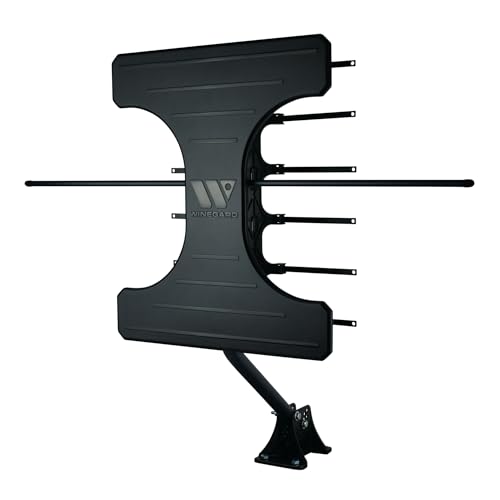
Winegard Elite 7550 -- Best Directional Antenna
The Winegard Elite 7550 is built for households where broadcast towers are clustered in a single direction. Its directional design achieves maximum gain by focusing reception toward one arc, rejecting interference from other directions. The result is outstanding signal quality for stations in its beam when aimed correctly. The antenna supports both UHF and VHF bands, which matters in markets where VHF channels (2 to 13) are still active. The pre-assembled design reduces setup time, and the included mounting hardware is robust. If your towers are within a 45-degree arc and you want the cleanest possible signal, the Elite 7550 delivers.

Antennas Direct DB8e -- Best Multi-Tower Setup
The DB8e is engineered for markets where broadcast towers are spread across different compass bearings. Its two independently adjustable four-bay panels can be aimed at separate tower clusters and combined through a built-in signal combiner. This makes it uniquely effective in markets where some major networks broadcast from a different direction than others. Range tops out at 70 miles per panel. Assembly requires more time than single-panel models, but the flexibility it offers in complex signal environments is unmatched in this price range. A good choice for cord-cutters in mid-sized markets with split tower geography.
RCA Compact Outdoor Antenna -- Best Compact Option
The RCA Compact Outdoor antenna is the right pick for users who live within 40 to 50 miles of towers and want a low-profile installation. Its smaller size is less visually intrusive on a roofline and easier to mount in tight spots. The omnidirectional design captures signals from all directions without pointing adjustments, simplifying setup considerably. Signal quality is strong in good signal areas, and the weatherproof construction holds up through seasons without maintenance. For urban and suburban users close to towers who want a discreet installation, this RCA model is a practical and affordable solution.
What to look for
What to consider
Use a free signal map tool like AntennaWeb or TVFool to identify your nearest towers, their compass bearing, and signal strength before buying. Distance from towers determines which range tier you need. Tower direction determines whether a directional or multidirectional antenna suits your location better. Homes with towers spread across wide angles benefit from multidirectional designs; homes with towers in one cluster gain more from directional models. Amplified antennas help in weak-signal zones, but they can cause overload distortion in strong-signal areas. A mast height of 10 feet or more above roofline substantially improves reception in most cases.
What to consider
For more cord-cutting guidance, see our [best streaming devices](/articles/best-streaming-devices) roundup and [best smart TVs](/articles/best-smart-tvs) guide. Our [testing methodology](/methodology) explains how we assess real-world antenna signal performance.
FAQs
Most quality outdoor antennas claim 50 to 150 mile ranges under ideal conditions, though real-world performance depends on terrain, tree cover, and tower direction. In suburban and rural areas, a 60 to 80 mile antenna typically pulls in all major networks reliably. Amplified models help in fringe zones but can overload in strong-signal areas.
Well-built outdoor antennas handle rain and wind without signal loss in most cases. Heavy snow accumulation on a flat antenna surface can temporarily degrade reception. Directional antennas aimed precisely at a tower cluster hold signal better in storms than omnidirectional models. Weatherproof coax connections and a proper ground are important for long-term reliability.

Tom Reeves has reviewed consumer electronics for over a decade, with a focus on televisions, monitors, laptops, and smart home devices. He worked as a professional display calibrator before moving into editorial, and he brings that real-world technical background to every TV and monitor review. At TheTestedHub, Tom covers display calibration, computer monitors, laptops and 2-in-1s, smart home platforms, home theater setups, and HDR performance.

