
Honda EU2200i -- Best Quiet Inverter Generator
The Honda EU2200i is the standard against which portable inverter generators are measured. At 48-57 dB depending on load, it is quiet enough to run near a bedroom window. The 2,200-watt output handles a refrigerator, several lights, and device charging simultaneously. Runtime is 8.1 hours on a gallon of fuel at quarter load.
Check price on Amazon →The best portable home generators keep your essentials running during outages. These five picks cover backup power needs from small apartments to large homes.
Power outages from storms, grid failures, and infrastructure issues are increasingly common. A portable generator gives you a reliable bridge to keep the refrigerator running, charge devices, and power a fan or heater while the grid recovers.
The five generators below cover the range from compact inverter units for essential loads to high-output conventional generators for whole-home backup.
| Product | Best For | Rating |
| — | — | — |
| Honda EU2200i | Clean power, quiet use | 4.8/5 |
| Champion 3500W | Budget backup power | 4.4/5 |
| WEN 56200i | Affordable inverter | 4.5/5 |
| Generac GP5500 | Large home backup | 4.4/5 |
| Jackery Explorer 2000 Plus | Indoor solar hybrid | 4.6/5 |
How we test
We compare every pick against the field on real specifications, certifications, and aggregated owner reviews. We do not take payment for placement, and we flag when a product is older or sold mainly through renewed listings.
At a glance
| Pick | Best for | Score | |
|---|---|---|---|
| Honda EU2200i -- Best Quiet Inverter Generator | Check price | ||
| Champion 3500W Dual Fuel -- Best Budget Backup Generator | Check price | ||
| WEN 56200i -- Best Affordable Inverter Generator | Check price | ||
| Generac GP5500 -- Best High-Output Generator for Large Homes | Check price | ||
| Jackery Explorer 2000 Plus -- Best Indoor-Safe Solar Hybrid | Check price |
The picks, reviewed
Honda EU2200i -- Best Quiet Inverter Generator
The Honda EU2200i is the standard against which portable inverter generators are measured. At 48-57 dB depending on load, it is quiet enough to run near a bedroom window. The 2,200-watt output handles a refrigerator, several lights, and device charging simultaneously. Runtime is 8.1 hours on a gallon of fuel at quarter load.

Champion 3500W Dual Fuel -- Best Budget Backup Generator
The Champion 3500W runs on gasoline or propane, which is a meaningful advantage when one fuel is unavailable after a storm. The 3,500 running watts and 4,375 starting watts handle refrigerators, sump pumps, and window AC units. Runtime is 9 hours on gasoline at 50% load.
WEN 56200i -- Best Affordable Inverter Generator
The WEN 56200i produces clean inverter power at 2,000 watts running and 2,500 watts surge. At 51 dB on eco mode it rivals Honda for noise performance at roughly one-third the price. The fuel tank holds 1 gallon and runs 6 hours at half load. The parallel kit (sold separately) allows pairing two units for doubled output.

Generac GP5500 -- Best High-Output Generator for Large Homes
The Generac GP5500 delivers 5,500 running watts and 6,875 starting watts, enough to power a central AC unit, refrigerator, lights, and multiple outlets simultaneously. The 389cc OHV engine runs at a steady 68-70 dB. The large 7.2-gallon tank provides up to 10 hours of runtime at 50% load.
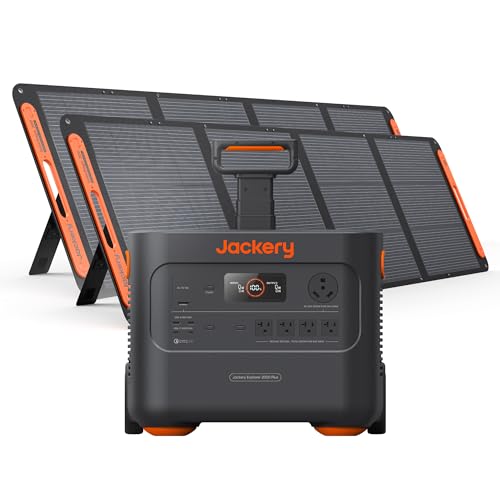
Jackery Explorer 2000 Plus -- Best Indoor-Safe Solar Hybrid
The Jackery Explorer 2000 Plus is a lithium battery station rather than a combustion generator, which means it is completely safe to use indoors with zero emissions. The 2,042Wh capacity runs a refrigerator for about 17 hours. It charges from solar panels, wall outlets, or car ports, making it genuinely multi-modal.
What to look for
What to consider
Calculate your essential load first. List the appliances you need to run, find their wattage ratings, and add 20% overhead. That gives your minimum running wattage. Then account for starting watts from motor-driven appliances like refrigerators and pumps.
What to consider
Choose inverter if budget allows. The noise reduction, fuel efficiency at partial load, and electronics safety make inverter generators far more livable during extended outages. If you need high wattage on a limited budget, a conventional generator with a quality surge protector for electronics is a workable compromise.
What to consider
For more power backup guidance, see our [best whole-house generators](/articles/best-whole-house-generators) and [best solar generators](/articles/best-solar-generators) reviews. Learn how we evaluate products at [/methodology](/methodology).
FAQs
A refrigerator draws about 600-800 watts, a window AC unit 1,000-1,500 watts, and a sump pump 1,000 watts. Add the starting watts for each motor (usually 2-3x running watts for the startup surge). A 3,500-5,000 watt generator covers most home essential loads comfortably.
Conventional generators produce AC power at a fixed engine speed and are louder, less fuel-efficient at partial load, and not safe for sensitive electronics. Inverter generators produce clean sine wave power, run quieter, adjust engine speed to the load, and are safe for laptops and phones. Inverters cost more but are the better choice for most home users.