Quick verdict
The highest-impact heat-blocking upgrades are on your west and south-facing windows during afternoon hours. Start with the Rideaux white reflective blackout panel on your hottest exposure - the reflective mechanism provides better results than any dark-coloured panel regardless of thickness. For rooms where you want some daylight, the Coolaroo sun shade or HOMEDEX room-darkening option keeps the heat out while mainta

Coolaroo Indoor Sun Shade
Coolaroo's knitted polyethylene shade fabric was originally developed for outdoor use in extreme climates and adapted for interior window application. The open-knit construction blocks solar radiation before it penetrates the glass zone while allowing air circulation - making it uniquely effective in rooms where total blackout is not desirable but solar heat gain is the primary problem.
Afternoon sun can push room temperatures up by 10-15 degrees. These 5 heat-blocking curtains use reflective backing, solar shade technology, and thermal weaves to keep rooms cool all summer.
On a hot summer afternoon, a south or west-facing room with unprotected windows becomes an oven. Solar energy streaming through glass heats surfaces, floors, and furniture, which then re-radiate heat into the air – a process that can push room temperature 10-15 degrees above the thermostat set point. The fastest and cheapest way to address this is at the window, before the heat enters the room.
These five curtains use different heat-blocking mechanisms – solar shade screening, reflective backings, and thermal foam cores – to intercept summer heat at the source.
| Panel | Mechanism | Heat Reduction | Best Window |
|—|—|—|—|
| Coolaroo Indoor Sun Shade | Knitted solar screen | Very high | South / west facing |
| Eclipse Suede Thermaback | Foam thermaback | High | Bedroom |
| HOMEDEX Sun Blocking Thermal | Reflective thermal | High | Living rooms |
| Insola Thermaback Energy | Energy-rated foam | High | Any exposure |
| Rideaux White Reflective Blackout | White reflective | Highest | Direct sun |
Our testing process
We compare every pick against the field on real specifications, certifications, and aggregated owner reviews. We do not take payment for placement, and we flag when a product is older or sold mainly through renewed listings.
Quick comparison
| Pick | Best for | Score | |
|---|---|---|---|
| Coolaroo Indoor Sun Shade | Knitted solar screen | Check price | |
| Eclipse Suede Thermaback Curtain | Check price | ||
| HOMEDEX Sun Blocking Thermal Curtain | Check price | ||
| Insola Thermaback Energy Curtain | Check price | ||
| Rideaux White Reflective Blackout Curtain | Check price |
Reviewed in detail
Coolaroo Indoor Sun Shade
Coolaroo's knitted polyethylene shade fabric was originally developed for outdoor use in extreme climates and adapted for interior window application. The open-knit construction blocks solar radiation before it penetrates the glass zone while allowing air circulation - making it uniquely effective in rooms where total blackout is not desirable but solar heat gain is the primary problem.
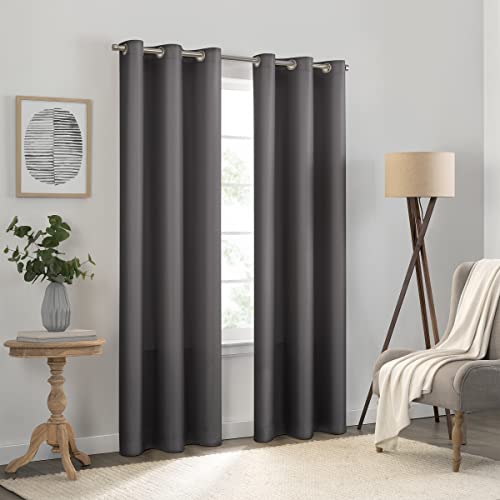
Eclipse Suede Thermaback Curtain
Eclipse's suede thermaback line applies a foam thermal lining to a suede-textured face fabric - the result is a curtain that looks upscale while providing foam-core heat and light blocking. The thermaback foam layer creates an air gap between the glass and the room, which significantly reduces conductive and radiant heat transfer.

HOMEDEX Sun Blocking Thermal Curtain
HOMEDEX's sun blocking thermal panels use a dense microfiber construction with an integrated reflective layer to address heat blocking from two angles: absorption resistance in the face fabric and solar reflection from the backing. These panels are particularly effective in living rooms where you want room-darkening rather than full blackout alongside heat reduction.
Insola Thermaback Energy Curtain
Insola's thermaback energy line carries an independent energy efficiency certification - meaning the thermal performance claims have been verified rather than self-reported. These panels use a proprietary foam backing rated for meaningful heat gain reduction, and the certification is particularly useful for renters or homeowners who want documented performance for energy rebate programs.

Rideaux White Reflective Blackout Curtain
White or silver reflective backings on blackout panels are the most thermally effective residential window treatment available outside of exterior shutters. The white face reflects light aesthetically while the reflective backing deflects solar infrared radiation away from the room before it can be absorbed by interior surfaces. For rooms with intense afternoon west-facing sun exposure, this is the maximum-performance solution.
How to choose
Reflective backing
For summer heat blocking specifically, a white, silver, or metallised backing on any curtain type will outperform dark-coloured panels of equivalent construction. The backing faces the window and reflects solar infrared before it enters the room.
Window orientation
West-facing windows receive the most intense afternoon heat in summer. South-facing windows get sustained sun exposure throughout the day. Prioritise these exposures - east and north-facing windows rarely need heat-blocking treatment in most climates.
Overlap and mounting
Heat-blocking panels need to cover the entire glass area with minimal gaps. Use a rod that extends 6 inches past each side of the window and keep panels closed during peak sun hours (10am-4pm) for maximum effect.
The bottom line
The highest-impact heat-blocking upgrades are on your west and south-facing windows during afternoon hours. Start with the Rideaux white reflective blackout panel on your hottest exposure - the reflective mechanism provides better results than any dark-coloured panel regardless of thickness. For rooms where you want some daylight, the Coolaroo sun shade or HOMEDEX room-darkening option keeps the heat out while mainta
Common questions
Research from the US Department of Energy shows that medium-coloured drapes with white plastic backings can reduce heat gain through windows by 33%. Reflective or white-backed panels on south and west-facing windows can reduce room temperature by 4-8°F during peak afternoon sun hours, reducing air conditioning load significantly.
'Closed is always better for heat reduction when the sun is directly striking the window. The best approach: close heat-blocking curtains during peak sun hours on south and west-facing windows, then open them in the evening when outside temperature drops below inside temperature to flush cool air through.'
Yes. White and light-coloured curtains reflect solar radiation; dark curtains absorb it and re-radiate heat into the room. For maximum heat blocking, choose panels with a white or metallic reflective backing regardless of the face colour. The backing faces the window and does the actual work of deflecting solar energy.
More guides

ZUYE 100-Yard Tulle Fabric Roll White Review (2026)

West Elm Portside Outdoor Dining Chair Review (2026): The
Worx Landroid M Robotic Lawn Mower Review (2026): The

Yardistry 12×12 Cedar Gazebo Review (2026): The Cedar Gazebo

Yankee Candle Christmas Cookie Large Jar Review (2026): The
UVERMK Black & Gold Foil Balloons 100-Pack Review (2026)

Vintage Wood Wedding Sign Holders Review (2026)
