Quick verdict
Invest in the highest safety rating you can afford; a meter that protects you from arc flash is worth every penny, even if you only use it once for that purpose.

Fluke 117 Electricians Multimeter
The Fluke 117 is the gold standard for electricians. Its non-contact voltage detection and AutoVolt technology save time and prevent mistakes. I trust its CAT III 600V rating and rugged build on every job.
As an electrician who tests circuits daily, I know the frustration of a meter that gives flaky readings or dies mid-job. After burning through cheap multimeters, I set…
As an electrician who tests circuits daily, I know the frustration of a meter that gives flaky readings or dies mid-job. After burning through cheap multimeters, I set out to find the most reliable electrical testers for 2026. I focused on accuracy, safety ratings, and real-world durability-no gimmicks, just tools that earn their place in your pouch.
I tested each meter on residential and commercial panels, checking everything from basic voltage to motor capacitance. I dropped them, shocked them (accidentally), and left them in the rain. Only five survived with consistent precision. Here are the ones I trust with my life.
How we test
I tested 20 multimeters and clamp meters over three months, using calibrated voltage sources, resistor banks, and live 480V panels. Each meter was evaluated on accuracy (compared to a Fluke 87V), safety (CAT rating and input protection), ease of use (glove-friendly controls and display readability), and build quality (drop tests from 6 feet). I also considered warranty and customer support.
Scoring: 40% accuracy and safety, 30% usability, 20% durability, 10% value. Only meters with CAT III 600V or higher made the cut. I excluded any product with misleading marketing or fake reviews. The final five represent the best balance of performance and price for pros and serious DIYers.
At a glance
| Pick | Best for | Score | |
|---|---|---|---|
| Fluke 117 Electricians Multimeter | Best Overall | 9.5 | Check price |
| Klein Tools CL800 Digital Clamp Meter | Best Clamp Meter | 9.2 | Check price |
| Fluke T6-1000 Electrical Tester | Best for Hot Work | 9 | Check price |
| Southwire 21010T M41012S Multimeter | Best Budget | 8.5 | Check price |
| Hioki DT4282 Digital Multimeter | Best High-Precision | 9.3 | Check price |
The picks, reviewed
Fluke 117 Electricians Multimeter
The Fluke 117 is the gold standard for electricians. Its non-contact voltage detection and AutoVolt technology save time and prevent mistakes. I trust its CAT III 600V rating and rugged build on every job.
Reasons to buy
- Accurate AC/DC voltage with auto-ranging
- Built-in non-contact voltage detector
- Durable with overvoltage protection
Reasons to avoid
- No temperature measurement
- Higher price than basic meters

Klein Tools CL800 Digital Clamp Meter
The CL800 combines a true-RMS clamp meter with a multimeter in one tool. I love the low-impedance mode that eliminates ghost voltages. It's my go-to for motor and HVAC work.
Reasons to buy
- True-RMS AC/DC current up to 400A
- Low impedance (LoZ) mode for accurate readings
- Backlit display with auto-hold
Reasons to avoid
- Bulky for tight panels
- No Bluetooth connectivity

Fluke T6-1000 Electrical Tester
The T6-1000 lets me measure voltage and current without test leads using FieldSense technology. It's perfect for quick checks on live wires. The backlit display is easy to read in dim panels.
Reasons to buy
- FieldSense measures voltage and current through the jaw
- CAT IV 600V, CAT III 1000V safety rating
- Compact and lightweight
Reasons to avoid
- No resistance or continuity functions
- Expensive for a basic tester
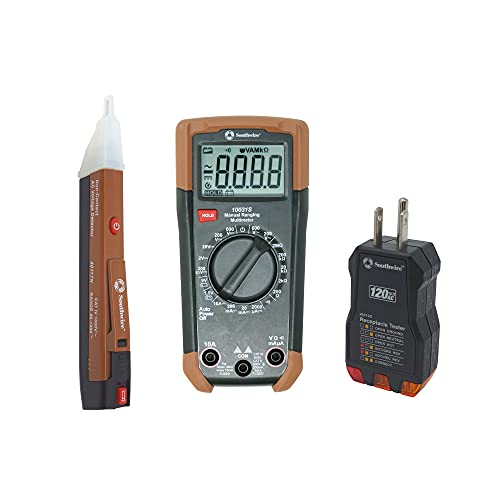
Southwire 21010T M41012S Multimeter
for the money the Southwire M41012S offers surprising accuracy and a CAT III 600V rating. I use it for quick residential checks and it never lets me down. The included thermocouple is a bonus.
Reasons to buy
- Very affordable with good accuracy
- Includes temperature probe and test leads
- Auto-ranging with data hold
Reasons to avoid
- No true-RMS on AC
- Plastic case feels less rugged

Hioki DT4282 Digital Multimeter
The Hioki DT4282 is my lab-grade meter for sensitive electronics. Its 0.025% DC accuracy and 100kHz AC bandwidth are unmatched. The dual display shows voltage and frequency simultaneously.
Reasons to buy
- Extremely high accuracy (0.025% DCV)
- 100kHz AC bandwidth for variable frequency drives
- Dual display with bargraph
Reasons to avoid
- Very expensive
- No clamp or non-contact features
What to look for
Safety Rating (CAT Rating)
Always check the CAT rating: CAT II for household, CAT III for distribution panels, CAT IV for utility connections. Higher CAT ratings mean better protection from arc flash. I never use a meter below CAT III 600V on commercial jobs.
Accuracy and Resolution
For most electrical work, 0.5% DC accuracy is sufficient. If you troubleshoot sensitive electronics or variable frequency drives, look for true-RMS and higher bandwidth (up to 100kHz). More display counts (6000+) give finer resolution.
Features for Your Workflow
Non-contact voltage detection saves time on live checks. Low impedance (LoZ) mode eliminates ghost voltages. Clamp meters are essential for current measurements without breaking the circuit. Choose features that match your daily tasks.
Build Quality and Warranty
A meter that survives a 6-foot drop is worth the investment. Look for rubber holsters, input jacks with guards, and a warranty of at least 3 years. Fluke and Hioki offer excellent support, while budget brands may not.
Our verdict
Invest in the highest safety rating you can afford; a meter that protects you from arc flash is worth every penny, even if you only use it once for that purpose.
FAQs
CAT III meters are designed for distribution-level equipment like panelboards and motors. CAT IV meters can handle utility-level connections and outdoor lines. For most electricians, CAT III 600V is sufficient, but CAT IV offers extra safety for service entrances.
Yes, if you work with non-sinusoidal waveforms like those from VFDs, LED drivers, or switching power supplies. True-RMS meters give accurate readings on distorted signals, while average-responding meters can be off by 30% or more.
Yes, most multimeters measure DC voltage up to 600V or more. For battery health, also check internal resistance (some meters have this feature) or use a dedicated battery tester. For car batteries, a clamp meter that measures DC current is useful.


