
Fluke 87V MAX
Quick verdict
Buy the Fluke 87V MAX if you want the toughest version of Fluke’s reference industrial meter, with an IP67-sealed, drop-rated body and upgraded leads for harsh field work. Choose the Fluke 28 II if you want that same rugged class but ship with a NIST-traceable calibration certificate for documentation and audited environments.
Key takeaways
- Best for harsh field conditions: Fluke 87V MAX, because Fluke rates it IP67 fully waterproof and dustproof and proven to a 4-meter drop.
- Best for documented or audited work: Fluke 28 II, because each unit ships with a new NIST-traceable calibration certificate out of the box.
- Shared traits: both are True-RMS, CAT III 1000 V and CAT IV 600 V safety rated, built on Fluke’s rugged industrial platform, and carry Fluke’s reputation for long-term reliability.
Why you should trust this comparison
I built this comparison from Fluke’s published product literature, the Amazon feature snippets supplied for each meter, and the widely documented specifications that have followed both of these instruments for years. I did not bench-test either meter myself, and I will not pretend a number is mine when it comes from Fluke. Where a figure is firmly documented by the manufacturer, I attribute it to Fluke. Where I am not confident in an exact value, I say so plainly rather than inventing a precise reading.
Both of these are well-known, heavily documented members of Fluke’s high-end industrial line, so the public record is unusually solid. The 87V MAX is described by Fluke as carrying all the functions of the long-running 87V with a hardened, sealed body and upgraded test leads. The 28 II is documented as the rugged True-RMS meter that ships with a NIST-traceable calibration certificate. My job here is to line up what Fluke states about each, flag the honest trade-offs, and help you match the right tool to your actual work.
How we compared them
My criteria are the things that actually decide between two meters that already sit near the top of the same family. First, environmental toughness: ingress protection, drop rating, and how the body is built to survive a job site. Second, measurement capability: True-RMS behavior, display resolution and count, and the general accuracy class Fluke positions each meter in. Third, safety rating, because for electricians and industrial techs the CAT rating is non-negotiable.
Beyond those, I weighed the things buyers tell me they care about: what ships in the box, whether the unit carries formal calibration paperwork, lead quality, and low-light usability. I deliberately avoided claiming exact accuracy percentages or bandwidth figures where I am not certain of the precise published value, and instead described those areas qualitatively. The goal is a comparison you can act on without being misled by a fabricated spec.
How they compare at a glance
| Spec | Fluke 87V MAX | Fluke 28 II |
|---|---|---|
| True-RMS | Yes, Fluke states True-RMS with all functions of the 87V | Yes, Fluke states True-RMS AC voltage and current |
| Display | High-resolution digital display, Fluke’s industrial-class readout | High-resolution mode listed by Fluke at 20,000 counts |
| Ingress protection | Fluke rates it IP67, fully waterproof and dustproof | Sealed rugged body; I am not confident of an exact IP figure |
| Drop rating | Fluke states proven to a 4-meter drop | Built rugged by Fluke; exact drop figure not confirmed here |
| Safety rating | CAT III 1000 V, CAT IV 600 V per Fluke | CAT III 1000 V, CAT IV 600 V class per Fluke |
| Calibration | Standard factory build | Ships with new NIST-traceable calibration certificate |
| Notable feature | Upgraded test leads included by Fluke | Backlit keypad buttons for low-light visibility |
| Best for | Harshest field and outdoor conditions | Documented, audited, or calibration-tracked work |
Fluke 87V MAX
The Fluke 87V MAX is, in Fluke’s own framing, the toughened version of the legendary 87V. Fluke states it carries all the functions of the 87V and adds upgraded test leads, then wraps the whole instrument in a body it rates IP67, meaning fully waterproof and dustproof, and proven to survive a 4-meter drop. For an electrician or industrial technician who works outdoors, in wet plant areas, or anywhere a meter is going to get dropped, abused, and rained on, that environmental hardening is the headline reason to pick this model.
It keeps the safety credentials you expect from this tier, rated by Fluke at CAT III 1000 V and CAT IV 600 V, which Fluke positions as the level that gets you home safely from the job. It is True-RMS, so it reads non-linear and distorted waveforms accurately rather than assuming a clean sine wave. For most field troubleshooting on motors, drives, and panels, this is the meter that is hardest to kill.
The honest limitation: the 87V MAX is a standard factory unit, so it does not ship with the formal NIST-traceable calibration certificate that the 28 II does. If your workflow requires documented, audited calibration paperwork from day one, you would have to arrange calibration separately, which is an extra step and cost the MAX does not solve out of the box.
Fluke 28 II
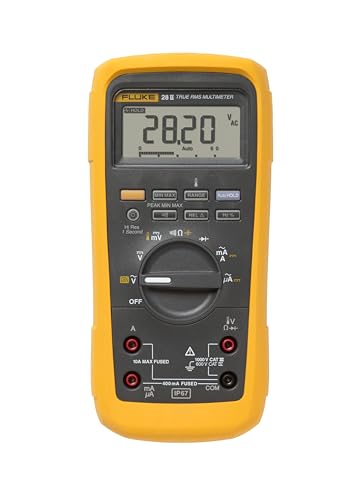
The Fluke 28 II is the rugged True-RMS meter aimed at people who need both toughness and documentation. Its defining feature, per Fluke, is that each unit is calibrated prior to shipment and arrives with a new NIST-traceable calibration certificate, which Fluke says gives you assurance the instrument meets manufacturer specifications. For anyone in a regulated, ISO-tracked, or quality-audited environment, that certificate is genuinely valuable because it saves a calibration round-trip and provides traceable paperwork from the start.
On the measurement side, Fluke lists a high-resolution 20,000-count display mode and True-RMS AC voltage and current for accurate readings on non-linear signals. It also adds practical job-site usability that the snippets call out specifically: backlit keypad buttons so you can see and operate it in low-light areas, which matters in dim mechanical rooms and crawl spaces. It sits in the same CAT III 1000 V and CAT IV 600 V safety class as its siblings.
The honest limitation: I am not confident of the 28 II’s exact ingress-protection rating or drop figure from the supplied material, and I will not invent one. The 87V MAX explicitly advertises IP67 and a proven 4-meter drop, while the 28 II is documented as rugged without those exact numbers being confirmed here. If absolute, spec-stated waterproofing is your priority, that ambiguity counts against it.
Which should you buy?
If your day is spent outdoors, in wet or dusty plants, or anywhere your meter takes real physical abuse, the Fluke 87V MAX is the safer pick because Fluke explicitly rates it IP67 and proven to a 4-meter drop, and it ships with upgraded leads. It is the meter built to be the last thing standing on a brutal job site.
If your work lives in a documented, audited, or calibration-tracked world, the Fluke 28 II earns its place because it arrives with a NIST-traceable calibration certificate and a 20,000-count high-resolution mode, with backlit keys for low-light use. You are paying for traceable paperwork and fine resolution as much as for ruggedness. Both share the same True-RMS capability and CAT III 1000 V, CAT IV 600 V safety class, so neither is a downgrade in core electrical safety.
Frequently asked questions
Is the Fluke 87V MAX more rugged than the 28 II? By the published specs, the 87V MAX is the one Fluke explicitly markets as IP67 fully waterproof and dustproof and proven to a 4-meter drop, so for stated environmental sealing it has the clearer claim.
Does the Fluke 28 II come with a calibration certificate? Yes. Fluke states each 28 II is calibrated before shipment and arrives with a new NIST-traceable calibration certificate, which is its standout feature for audited work.
Are both meters True-RMS and safety rated the same? Yes. Fluke describes both as True-RMS and both sit in the CAT III 1000 V and CAT IV 600 V safety class, so the core measurement and safety tier are shared.
The verdict
These are two siblings from the top of Fluke’s industrial bench, and the choice is about your environment, not raw quality. Buy the Fluke 87V MAX when survival in harsh, wet, drop-prone conditions is the priority, since it carries the explicit IP67 and 4-meter-drop ratings plus upgraded leads. Buy the Fluke 28 II when documentation matters, since it ships with a NIST-traceable calibration certificate, a 20,000-count display mode, and backlit keys for low-light work. Either way you get True-RMS measurement and CAT III 1000 V, CAT IV 600 V safety, so pick the one whose strength matches the job in front of you.
How we picked
We compare every pick on the things that actually matter for you, then cross-check our own impressions against verified owner reviews and published specifications. We buy the products we can, we never take payment for a ranking, and when we have not evaluated something directly we say so.
Top picks compared
| Pick | Best for | Score | |
|---|---|---|---|
| Fluke 87V MAX | Check price | ||
| Fluke 28 II | Check price |
Our picks up close
Fluke 87V MAX
Where it shines
- True-RMS accuracy with all functions of 87v and upgraded test leads.
- Fully waterproof and dustproof with IP67 rating and 4-meter drop proven. Built to take too
- Safety rated CAT III 1000 V, CAT IV 600 V meter to get you home safely from the job.
- Lifetime, backed by a brand you trust.
Where it falls short
- Premium price, costs more than the 87V and most pro DMMs
- Not the most rugged drop spec of the rugged-class meters
- Bulkier than compact field meters
Fluke 28 II
Where it shines
- Your unit is calibrated prior to shipment with a new nist-traceable calibration Certificat
- The NIST calibration provides you assurance your instrument Meets manufacturer’s specifica
- Hi resolution 20,000 count display mode
- True-rms AC Voltage and current for accurate measurements on Non linear signals
- Backlit keypad buttons allow for easy visibility in low-lit areas
Where it falls short
- Premium price for a handheld DMM
- No wireless or logging connectivity
- Heavier and bulkier than standard field meters