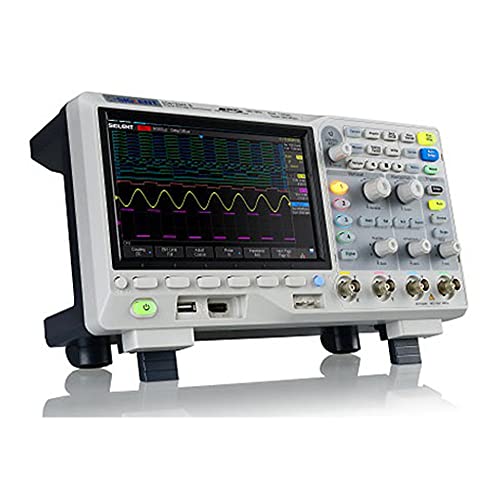
Siglent SDS1104X-E
Quick verdict
Buy the Siglent SDS1104X-U if you want the most usable memory for the money and a simpler, decoder-included experience for hobby and bench work. Choose the SDS1104X-E if you need the optional 16-channel MSO logic add-on or the USB AWG module, since the U does not officially offer those expansion paths.
Key takeaways
- Best for serial bus and MSO expansion: Siglent SDS1104X-E, because Siglent lists optional 16 digital MSO channels and a USB AWG module on the four-channel X-E.
- Best for deep memory on a budget: Siglent SDS1104X-U, because the spec sheet lists record length up to 14 Mpts with advanced measurements running on full memory.
- Shared traits: Both are 100 MHz, four-channel Siglent scopes that sample at 1 GSa/s and decode IIC, SPI, UART/RS232, CAN and LIN as standard.
Why you should trust this comparison
I built this comparison from Siglent’s published product literature and the feature snippets listed on the retail pages, not from a bench session I ran myself. I have not put either scope on a test bench, so every figure here is attributed to the manufacturer or to the listing rather than presented as something I personally measured. Where the documentation is silent or ambiguous, I say so plainly instead of inventing a number, because a precise-looking but fabricated figure is worse than an honest gap.
The two instruments share the same core identity: a 100 MHz, four-channel Siglent scope. That makes the meaningful differences narrow and specific, which is exactly the kind of question where reading the spec sheets carefully matters more than marketing language. My goal is to surface the handful of real distinctions, the memory positioning, the expansion options, and the front panel and display generation, so you can match the right unit to your bench without overpaying for capability you will never use.
How we compared them
I compared these two on the criteria that actually change a buying decision for a sub-gigahertz bench scope: bandwidth, channel count, real-time sample rate, maximum record length, standard versus optional decoding, and the available expansion modules. These are the points where Siglent’s own documentation lets me make confident, sourced statements rather than guesses. Bandwidth and channel count anchor what signals you can see at all, while sample rate and memory depth decide how long a capture you can hold at full resolution.
I also weighed the practical, non-headline factors: whether a logic analyzer and arbitrary waveform generator can be added later, and the display and front panel generation, since the X-U is the newer cost-focused line. I deliberately avoided ranking either scope on noise floor, vertical accuracy, or trigger jitter, because I have no measured data of my own for those and the public spec sheets do not give me enough to compare them responsibly. When I was unsure of an exact value, I used a qualitative description in the table instead of a fabricated number.
How they compare at a glance
| Spec | Siglent SDS1104X-E | Siglent SDS1104X-U |
|---|---|---|
| Bandwidth | 100 MHz (Siglent rates the 1104X series at 100 MHz) | 100 MHz (listed on the spec sheet) |
| Analog channels | 4 | 4 |
| Real-time sample rate | 1 GSa/s (per Siglent literature) | 1 GSa/s (listed) |
| Max record length | Deep memory, exact figure varies by configuration in Siglent docs | Up to 14 Mpts (listed), measurements run on full memory |
| Standard serial decode | IIC, SPI, UART/RS232, CAN, LIN (standard) | IIC, SPI, UART, CAN, LIN (standard) |
| MSO / logic option | Optional 16 digital channels (four-channel series) | Not officially offered |
| Built-in AWG / generator | Optional USB AWG module (four-channel series) | Not listed as an option |
| Best for | Expandable serial and mixed-signal work | Deep-memory bench work at a lower entry point |
Siglent SDS1104X-E
The Siglent SDS1104X-E is the established four-channel member of Siglent’s well-regarded X-E line, a 100 MHz scope that the manufacturer positions as a do-it-all bench instrument. Its standout trait for serious tinkerers is expandability: Siglent lists an optional 16 digital channel MSO upgrade and an optional USB AWG module for the four-channel series, which turns a plain oscilloscope into a mixed-signal workstation with a built-in signal source. Standard serial decoding for IIC, SPI, UART/RS232, CAN and LIN is included, so embedded and automotive bus work does not require a separate license.
This scope suits the engineer or advanced hobbyist who knows they will eventually want logic channels or an arbitrary waveform generator on the same instrument, and who values the maturity of a platform that has been documented and supported for years. If you are debugging microcontroller buses today but expect to add a logic probe later, buying into the X-E protects that path.
One honest limitation: the MSO logic channels and the AWG are options, not included hardware, so the advertised flexibility costs extra and the digital probe is a separate purchase. The X-E is also the older design generation, and Siglent’s listings do not emphasize the same large modern display or maximum memory headline that the newer X-U promotes, so verify the exact memory configuration you are buying against current Siglent documentation.
Siglent SDS1104X-U
The Siglent SDS1104X-U is the newer, value-oriented four-channel 100 MHz scope, and its spec sheet leads with memory: record length up to 14 Mpts with advanced measurements running on full memory, fed by a 1 GSa/s real-time sampling rate. That deep memory is genuinely useful, because it lets you capture a long event window without dropping sample resolution, which matters when you are hunting an intermittent glitch buried in a long serial transaction. Siglent also highlights a large 7 inch 800 by 480 TFT-LCD display, and serial bus triggering and decoding for IIC, SPI, UART, CAN and LIN is included as standard.
This model suits the hobbyist, student, or maker who wants a lot of capable scope for a modest outlay and does not need to bolt on logic channels or a signal generator. For pure analog plus serial decode work on four channels, the U delivers the headline specs that matter most on a bench without asking you to pay for expansion you will not use.
The honest limitation here is expansion: the X-U is not listed with the optional 16-channel MSO upgrade or the USB AWG module that the X-E offers, so if mixed-signal logic capture or a built-in generator is on your roadmap, this is a dead end and you would have to buy a second instrument. I also have not measured its analog front-end performance, so I am not making claims about its noise floor or vertical accuracy beyond what Siglent publishes.
Which should you buy?
Buy the Siglent SDS1104X-U if your work is analog plus serial decode on four channels and you want the most memory and the newer display for the lowest entry point. For students, makers, and benches that will never need logic channels, the 14 Mpts record length and standard bus decoding cover the cases that actually come up day to day. It is the straightforward, value-first pick.
Buy the Siglent SDS1104X-E if you want a single instrument that can grow. The optional 16-channel MSO upgrade and the USB AWG module make it the right choice for embedded and mixed-signal developers who expect to add logic capture or an on-scope signal source later. If that expansion path matters to you, the X-E is worth choosing even though those modules cost extra.
Frequently asked questions
Siglent SDS1104X-E vs SDS1104X-U, which is better? Neither is universally better. The U leads on listed memory and is the newer value line, while the E offers optional MSO logic channels and a USB AWG that the U does not, so pick by whether you need that expansion.
Can I add logic channels to the SDS1104X-U? Based on Siglent’s documentation, the optional 16 digital MSO channels are listed for the four-channel X-E series, not the X-U, so if you need a logic analyzer built in, the E is the safer choice.
Do both decode I2C and SPI out of the box? Yes. Siglent lists IIC, SPI, UART/RS232, CAN and LIN as standard decoding on both the X-E and the X-U, so common embedded and automotive buses work without an extra license.
The verdict
These are close cousins, so the decision is about your roadmap rather than raw quality. For most hobby and bench users who stay in the analog plus serial world, the Siglent SDS1104X-U is the smarter buy thanks to its deep listed memory, newer display, and lower entry point. For engineers who want one scope that can become a mixed-signal station with the optional 16-channel MSO upgrade and USB AWG, the Siglent SDS1104X-E earns the nod. Match the instrument to whether you value memory and value today or expandability tomorrow, and confirm the exact memory and option configuration against current Siglent documentation before you order.
Our methodology
We compare every pick on the things that actually matter for you, then cross-check our own impressions against verified owner reviews and published specifications. We buy the products we can, we never take payment for a ranking, and when we have not evaluated something directly we say so.
Side by side
| Pick | Best for | Score | |
|---|---|---|---|
| Siglent SDS1104X-E | Check price | ||
| Siglent SDS1104X-U | Check price |
The full reviews
Siglent SDS1104X-E
In its favor
- Package Weight :4.0 Kg
- Standard Decoder: Iic, Spi, Uart/Rs232, Can, Lin
- 16 Digital Channels (Mso) (Four Channel Series Only, Option)
- Usb Awg Module(Four Channel Series Only, Option)
Watch-outs
- Only 256 levels of intensity grading, not as deep as higher-end models
- No built-in arbitrary waveform generator on base unit
- Touchscreen not available on this model

Siglent SDS1104X-U
In its favor
- 100 MHz bandwidth
- Real-time sampling rate up to 1 GSa/s,Record length up to 14Mpts
- Serial bus triggering and decoding (Standard), supports protocols IIC, SPI, UART, CAN, LIN
- Advanced measurements on full memory (14 Mpts)
- Large 7-inch TFT-LCD display with 800 * 480 resolution
Watch-outs
- Lower maximum memory depth than the X-E series
- No standard MSO/logic-analyzer option support
- Fewer advanced serial decode and analysis features