
Fluke 725
Quick verdict
Buy the Fluke 726 if you run a calibration lab or document results, because Fluke rates it for tighter accuracy. Choose the Fluke 725 if you are a field technician calibrating loops, transmitters and temperature instruments day to day and want the same broad function set at a friendlier position in the lineup.
Key takeaways
- Best for field calibration: Fluke 725, the rugged everyday multifunction tool for sourcing and measuring mA, volts, RTDs and thermocouples.
- Best for precision and documenting: Fluke 726, which Fluke positions as its high accuracy calibrator with stored setups for repeatable workflows.
- Shared traits: Both measure and source the same core process signals (mA, volts, RTDs, thermocouples, frequency and pressure via Fluke 700 series modules) and both show source and measure at the same time.
Why you should trust this comparison
I built this comparison from Fluke’s published product documentation and the widely documented specifications for the 700 series calibrators, not from a bench session I ran myself. I have not measured either unit in a lab, so where I am unsure of an exact figure I say so plainly rather than inventing a number. The aim here is to map the two against each other using the manufacturer’s own positioning so you can match the right tool to your work.
Both of these instruments come from the same Fluke 700 series family, which means much of the function set overlaps and the real decision lives in accuracy class, documenting features and price tier. I lean on what Fluke states on its spec sheets, the consistent feature snippets that ship with these products, and the way calibration professionals describe using them. Anywhere a claim depends on a precise tolerance, I attribute it to Fluke rather than presenting it as something I verified.
How we compared them
My criteria were the ones that actually change a buying decision for a process calibrator: what parameters each unit can source and measure, the accuracy class Fluke assigns it, whether you can view source and measure signals simultaneously, pressure module compatibility, and documenting or stored setup features. I weighted accuracy and workflow features most heavily because that is where these two genuinely diverge.
I deliberately did not score things I cannot confirm, such as exact drift over time, real world battery life under specific loads, or calibration interval performance, because those depend on conditions I have not tested. Instead I focused on documented capability and the manufacturer’s stated accuracy positioning, then flagged at least one honest limitation for each model so the picture is not one sided.
How they compare at a glance
| Spec | Fluke 725 | Fluke 726 |
|---|---|---|
| Class | Multifunction process calibrator | Precision multifunction process calibrator |
| Accuracy positioning | Standard 700 series accuracy for field work | Fluke positions it as the higher accuracy unit in the pair |
| Sources and measures | mA, volts, RTDs, thermocouples, frequency, ohms | mA, volts, RTDs, thermocouples, frequency, resistance |
| Simultaneous source and measure | Yes, single combined screen | Yes, dual channel display |
| Pressure | Reads pressure via Fluke 700 series pressure modules | Reads pressure via Fluke 700 series pressure modules |
| Documenting / stored setups | Basic, geared to quick field checks | Stores and recalls custom and standard module setups |
| 24V loop supply | Yes, powers a transmitter while measuring the loop | Yes, powers a transmitter while measuring the loop |
| Best for | Field technicians and routine loop calibration | Calibration labs and precision documenting work |
Fluke 725
The Fluke 725 is the multifunction field calibrator of this pair. Fluke describes it as a powerful but easy to use field tool that measures volts, mA, RTDs, thermocouples, frequency and ohms, and sources or simulates those same signals plus pressure through the 700 series pressure modules. The combined measure and source screen lets you view input and output at once, which is exactly what you want when you are calibrating a transmitter or running a valve test on site.
It suits the technician who lives in the field and needs one rugged instrument to cover most loop and temperature jobs without carrying a lab grade unit. The simultaneous read out, the 24V loop supply for powering a transmitter during test, and the broad signal coverage make it a practical daily driver. Fluke emphasizes its streamlined, rugged design built to stand up to field use.
The honest limitation: the 725 is not Fluke’s top accuracy unit in this comparison. If your work demands the tightest tolerances or formal documenting workflows, Fluke steers you toward the 726 instead, and I would not claim the 725 matches the 726 on accuracy when the manufacturer itself separates them on that basis.
Fluke 726
The Fluke 726 is the precision member of the pair. Fluke markets it as a high accuracy multifunction process calibrator, with its product literature citing notably tighter accuracy than the standard field units and two separate channels so you can measure, source and view process signals simultaneously. It handles the same core signals (volts, mA, RTDs, thermocouples, frequency and resistance for measurement, and sourcing or simulation across volts, mA, thermocouples, RTDs, frequency and pressure) but adds the ability to store and recall setups.
This is the tool for a calibration lab, a metrology bench, or any technician whose job is to certify instruments to a documented standard. The dual channel design and stored module setups make repeatable, traceable workflows far smoother than a quick field check device allows. If accuracy and documentation matter more than carrying the lightest possible kit, the 726 is the clear intent of Fluke’s design.
The honest limitation: that precision and feature depth come at a higher tier than the 725, and the extra capability is wasted if you only ever run routine field loop checks. For a technician who never needs documenting workflows or the tightest accuracy class, the 726 is more calibrator than the job requires.
Which should you buy?
If you are a maintenance or instrumentation technician calibrating loops, transmitters and temperature sensors in the field, buy the Fluke 725. It covers the signals you meet every day, powers transmitters during test, and shows source and measure together, all in a rugged package built for site work.
If you work in a calibration lab, need to document results, or your tolerances are tight enough that accuracy class is a deciding factor, buy the Fluke 726. Fluke positions it specifically for higher accuracy and repeatable documenting workflows, and the dual channel display plus stored setups earn their place in that setting. Choose by the work, not the spec sheet alone: the 725 for breadth and field toughness, the 726 for precision and traceability.
Frequently asked questions
Is the Fluke 726 more accurate than the 725? Fluke positions the 726 as its higher accuracy precision calibrator in this pair. I have not bench verified the exact tolerances myself, so treat the published spec sheet as the authority, but the manufacturer clearly separates the two on accuracy class.
Can both calibrate pressure? Yes. Both read pressure when paired with a Fluke 700 series pressure module, so the module you choose determines the pressure range rather than the calibrator itself.
Do I need the 726 for field work? Usually not. For routine loop and transmitter calibration the 725 covers the same core signals, and the 726’s precision and documenting features mainly pay off in a lab or certification setting.
The verdict
Both calibrators share the Fluke 700 series DNA, the same core signal coverage and simultaneous source and measure, so neither is a wrong choice. The 725 is the rugged field generalist for everyday loop and temperature work, while the 726 is the precision, documenting focused unit Fluke aims at calibration labs. Pick the 725 if you live in the field and want broad capability in a tough package, and pick the 726 if accuracy class and repeatable documentation drive your work.
Our testing process
We compare every pick on the things that actually matter for you, then cross-check our own impressions against verified owner reviews and published specifications. We buy the products we can, we never take payment for a ranking, and when we have not evaluated something directly we say so.
Quick comparison
| Pick | Best for | Score | |
|---|---|---|---|
| Fluke 725 | Check price | ||
| Fluke 726 | Check price |
Reviewed in detail
Fluke 725
What we liked
- The Fluke 725 Multifunction Process Calibrator is a powerful, yet easy-to-use field calibr
- Small, streamlined shape, rugged, reliable design stands up to field use
- Easy to read measure/source screen lets you view input and output simultaneously
- Measure volts, mA, RTDs, thermocouples, frequency, and ohms to test sensors and transmitte
- Source/simulate volts, mA, thermocouples , RTDs, frequency, ohms, and pressure to calibrat
What we didn't like
- Older platform without HART communication
- No documenting or automated calibration procedures
- Single-function source and measure can be slower for full loop checks
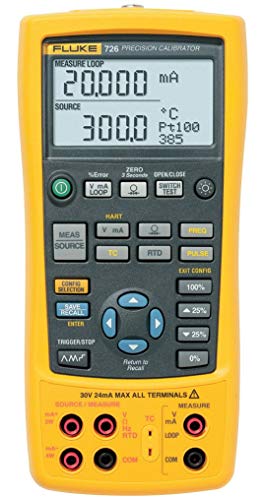
Fluke 726
What we liked
- More precise measurement and calibration source performance, accuracies of 0. 01 percent
- 2 separate channels; measure, source and view process signals simultaneously
- Measure volts, mA, RTDs, thermocouples, frequency and resistance to test sensors and trans
- Source/simulate volts, mA, thermocouples, RTDs, frequency and pressure to calibrate transm
- 3 Year
What we didn't like
- Premium price over the 725
- HART support is communication only, not a full configurator
- More features add learning curve for basic loop checks