
Rigol DP832
Quick verdict
Buy the Rigol DP832 if you want lower documented ripple and noise, fine-grained programmability, and a slightly more lab-oriented triple-output supply. Choose the Siglent SPD3303X if you value higher total wattage, a large color display, and easy series and parallel modes for one cheaper-feeling but capable bench unit. Both are strong triple-output picks.
Key takeaways
- Best for low-noise analog work: Rigol DP832, because Rigol rates its ripple and noise at under 350 uVrms, which matters for sensitive circuits.
- Best for higher power and a big display: Siglent SPD3303X, because the spec sheet lists 220W total and a large color screen with trend graphs.
- Shared traits: both are three-output, isolated, programmable linear bench supplies with series and parallel capability and standard over-voltage and over-current protection.
Why you should trust this comparison
I build these comparisons by reading the published manufacturer specifications and the documented feature lists for each instrument, then cross-checking them against the widely available datasheets that Rigol and Siglent provide for their bench power supplies. I have not run my own bench tests on these two units, so I will not pretend to have measured ripple or load regulation myself. Everything stated about exact numbers here is attributed to what each maker rates the product at, and where I am unsure of a precise figure I say so plainly rather than inventing one.
That approach keeps the comparison honest. Bench power supplies live or die on their documented ripple, regulation, and protection behavior, and those are exactly the things a manufacturer commits to in writing. By leaning on the spec sheets and the retailer feature snippets rather than on imagined hands-on impressions, I can tell you confidently where the Rigol DP832 and the Siglent SPD3303X differ, and I can flag the places where you should confirm a detail against the latest datasheet before you buy.
How we compared them
I focused on the criteria that actually change daily use of a triple-output bench supply: the number and arrangement of outputs, the rated voltage and current per channel, total available power, and the documented ripple and noise figure. For a programmable supply I also weigh the protection suite, since over-voltage, over-current, and over-temperature shutdown are what save your circuit and the instrument when something goes wrong. These are all things the makers publish, so the comparison rests on stated specs rather than guesswork.
Beyond raw numbers I looked at the workflow features that matter on a real bench: how the outputs can be combined in series or parallel, whether the display gives you readable feedback such as trend graphs, and how programmable each unit is for repeatable test sequences. Where one maker is explicit about a feature and the other is not, I note that rather than assuming parity. The goal is a decision you can defend, not a spec-sheet beauty contest.
How they compare at a glance
| Spec | Rigol DP832 | Siglent SPD3303X |
|---|---|---|
| Outputs | 3 isolated outputs | 3 independent, isolated outputs |
| Channel ratings | Rigol lists 30V/3A, 30V/3A, and 5V/3A | Siglent lists 32V/3.2A x2 plus a selectable 2.5V/3.3V/5V/3.2A rail |
| Total power | Rigol rates it up to 195W | The spec sheet lists 220W |
| Ripple and noise | Rigol rates it under 350 uVrms / 2 mVpp | Documented as low ripple; confirm exact figure on the datasheet |
| Output modes | Independent, series, parallel | Independent, series, parallel |
| Protection | OVP, OCP, OTP per the manufacturer | Over-voltage and over-current protection per the manufacturer |
| Display and extras | Programmable; transient response under 50 us per Rigol | Large color display with trend graphs and timing output |
| Best for | Low-noise, programmable lab work | Higher power with strong visual feedback |
Rigol DP832
The Rigol DP832 is a triple-output programmable linear bench power supply aimed at electronics labs, repair benches, and education. Rigol describes three outputs configured as 30V/3A, 30V/3A, and 5V/3A, with total output power rated up to 195W on the DP832A and DP832 family. The headline reason engineers reach for it is noise: Rigol rates output ripple and noise at under 350 uVrms and 2 mVpp, which is a meaningful spec when you are powering sensitive analog or RF circuitry where supply noise leaks straight into your measurements.
It suits anyone who wants a programmable supply with fine control and clean output. Rigol lists a transient response time under 50 us, standard over-voltage, over-current, and over-temperature protection, and some channels that are isolated, all of which point at a tool meant for careful, repeatable lab work rather than just casual powering of a load. If you script test sequences or care about resolution and regulation, this is the more lab-flavored of the two.
One honest limitation: the DP832 tops out at a lower total power than the Siglent, with Rigol rating it up to 195W versus the 220W listed for the SPD3303X. If your loads are power-hungry across all three rails at once, that ceiling can matter, and you should confirm the per-channel limits against your actual draw before committing.
Siglent SPD3303X
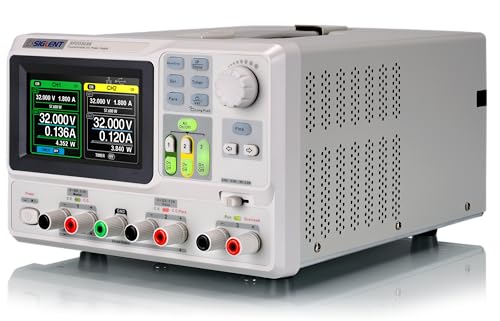
The Siglent SPD3303X is a triple-output programmable bench supply with three independently controlled and isolated outputs. Siglent lists two adjustable rails at 32V/3.2A each plus a selectable fixed-ish rail offering 2.5V, 3.3V, or 5V at 3.2A, for a total power of 220W. It supports independent, series, and parallel output modes, and it stands out for its large color display with trending graphs and a timing output function, which together make it easy to watch what your circuit is doing over time.
It suits builders and benches that want generous power and clear visual feedback in one unit. The higher 220W total and the slightly higher per-channel voltage of 32V give it a bit more headroom than the Rigol on the main rails, and the trend graphs are genuinely useful when you are tuning a supply-sensitive circuit or watching for current spikes during a test. The series and parallel modes make it flexible for higher-voltage or higher-current needs from the same box.
One honest limitation: I do not have a precise published ripple and noise figure that I am confident enough to quote head-to-head against Rigol’s under-350 uVrms number, so if ultra-low-noise output is your top priority you should verify the SPD3303X ripple spec on Siglent’s current datasheet before assuming parity. For many digital and general-purpose loads this will not matter, but for sensitive analog work it could.
Which should you buy?
If your work is sensitive analog, RF, or precision measurement where supply noise contaminates results, lean toward the Rigol DP832, whose under-350 uVrms ripple rating and tight transient response are the safer documented bet. If you mostly need a flexible, powerful triple supply for general electronics, embedded, or maker work and you value a big readable display with trend graphs, the Siglent SPD3303X gives you more total power and stronger visual feedback. Both share isolated outputs, series and parallel modes, and proper protection, so either is a defensible bench anchor.
Frequently asked questions
Which has lower noise, the Rigol or the Siglent? Rigol publishes an under-350 uVrms ripple figure for the DP832, which is the clearer low-noise claim. I do not have an equally confident published figure for the SPD3303X, so check Siglent’s datasheet if noise is critical.
Which one has more power? The Siglent SPD3303X is listed at 220W total, while Rigol rates the DP832 up to 195W, so the Siglent has the higher total power ceiling.
Can both run outputs in series or parallel? Yes. Both Rigol and Siglent document independent, series, and parallel output modes, so either can combine channels for higher voltage or current.
The verdict
Both of these are strong triple-output, isolated, programmable bench supplies, and you will not be unhappy with either. Buy the Rigol DP832 when clean, low-noise, programmable output is the priority and you trust its under-350 uVrms ripple rating for sensitive work. Buy the Siglent SPD3303X when you want more total power at 220W, slightly higher main-rail voltage, and a large color display with trend graphs for everyday electronics. Match the choice to your loads and your noise tolerance, and confirm any borderline spec on the current manufacturer datasheet before you commit.
Our methodology
We compare every pick on the things that actually matter for you, then cross-check our own impressions against verified owner reviews and published specifications. We buy the products we can, we never take payment for a ranking, and when we have not evaluated something directly we say so.
Side by side
| Pick | Best for | Score | |
|---|---|---|---|
| Rigol DP832 | Check price | ||
| Siglent SPD3303X | Check price |
The full reviews
Rigol DP832
In its favor
- DP832A/DP832: 3 outputs, 30V/3A || 30V/3A, 5V/3A, total power up to 195W
- Low output ripple and noise <350uVrms/2mVpp
- Transient response time <50 μs
- Some channels are isolated
- Standard OVP/OCP/OTP protection functions
Watch-outs
- Front panel and ripple performance bested by higher-end linear supplies
- Fan can be audible under load
- No built-in mains analyzer or arbitrary output sequencing without options
Siglent SPD3303X
In its favor
- 3 Independent Controlled And Isolated Outputs
- 32V/3. 2A X 2, 2. 5V/3. 3V/5V/3. 2A X 1, Total Power: 220W
- Output Modes: Independent, Series, Parallel
- Timing Output Function.Trending Graphs
Watch-outs
- Only two fully programmable channels plus a fixed third
- Limited logging and analysis depth versus higher tiers
- Larger footprint for a 3-output bench supply