
Fluke 754
Quick verdict
Buy the Fluke 754 if you need HART communication and protocol-aware loop work alongside documenting calibration; it folds a HART communicator into the calibrator. Choose the Fluke 753 if your facility does not use HART and you want the same documenting power for a lower outlay. Both share the platform, accuracy class and DPCTrack workflow.
Key takeaways
- Best for HART loops: Fluke 754, because Fluke builds an integrated HART communicator into it for configuring and trimming smart transmitters.
- Best for value documenting work: Fluke 753, because it delivers the same documenting calibrator core without the HART feature you may not need.
- Shared traits: both are documenting process calibrators on the same 750 Series platform, source and measure mA/V/RTD/thermocouple/frequency/pressure (with modules), and store procedures and as-found/as-left results for upload.
Why you should trust this comparison
I built this comparison from Fluke’s published documentation for the 750 Series documenting process calibrators rather than from any bench session of my own. The single meaningful difference between these two units is well documented and consistent across Fluke’s materials: the 754 adds an integrated HART communicator, while the 753 covers the same documenting calibration tasks without it. Everything else I describe here, the source-and-measure functions, the documenting workflow, and the DPCTrack software pairing, comes straight from how Fluke positions the family.
Where I am confident of a specification I state it and attribute it to Fluke. Where an exact figure depends on the function, range, or pressure module in use, I say so plainly instead of inventing a number. Process accuracy on these instruments varies by function and by which pressure module you attach, so I treat accuracy qualitatively except where Fluke’s headline positioning is clear. The goal is to help you pick correctly, not to recite a spec sheet I cannot verify line by line.
How we compared them
My first criterion was capability overlap: what can each unit source and measure, and where do they diverge. Because the 753 and 754 are siblings on the same platform, most of the calibration capability is shared, so the comparison hinges on the HART communication feature and on whether you will actually use it. I weighed that against the realities of plant work, where a HART communicator can replace a second tool on your belt or sit unused if your loops are analog.
My second criterion was workflow and durability fit. Both units are documenting calibrators, meaning they store calibration procedures and capture as-found and as-left data for later upload, which matters for audit trails and regulated environments. I also considered the field-service context: these are rugged, battery-powered handhelds meant for industrial plants, so I looked at how each fits a technician’s day rather than a lab bench. I did not measure ruggedness or runtime; those points reflect Fluke’s intended use, not my testing.
How they compare at a glance
| Spec | Fluke 754 | Fluke 753 |
|---|---|---|
| Type | Documenting process calibrator | Documenting process calibrator |
| Platform | Fluke 750 Series | Fluke 750 Series |
| HART communication | Yes, integrated HART communicator | No |
| Source/measure functions | mA, V, RTD, thermocouple, frequency, pressure (with modules) | mA, V, RTD, thermocouple, frequency, pressure (with modules) |
| Documenting workflow | Yes, stores procedures and as-found/as-left results | Yes, stores procedures and as-found/as-left results |
| Software | Pairs with Fluke DPCTrack-class software for upload | Pairs with Fluke DPCTrack-class software for upload |
| Process accuracy | Function-dependent; varies by range and pressure module | Function-dependent; varies by range and pressure module |
| Best for | HART smart-transmitter loops plus documenting | Documenting calibration without HART |
Fluke 754
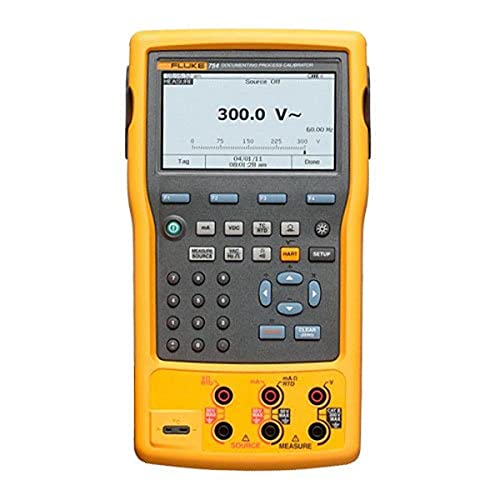
The Fluke 754 is the top documenting process calibrator in the 750 Series, and what sets it apart is the integrated HART communicator. According to Fluke, it sources and measures the usual process signals, milliamps, voltage, RTD and thermocouple temperature, frequency, and pressure with the appropriate modules, and on top of that it can talk to HART smart transmitters to read, configure, and trim them. That means one tool can both calibrate a loop and communicate with the digital device on it.
It suits instrumentation technicians and calibration teams in plants that have standardized on HART smart instruments, especially where you want to avoid carrying a separate handheld communicator. As a documenting calibrator it captures as-found and as-left results against stored procedures, which is the workflow regulated facilities lean on for their audit trails.
The honest limitation: the HART capability is the main reason to pay the premium over the 753, and if your facility runs analog 4-20 mA loops without HART, you are buying a feature you will not use. The HART communicator in a calibrator also tends to focus on calibration-relevant functions rather than replacing a full-featured field communicator for every advanced configuration task, so verify it covers the specific HART operations your devices need.
Fluke 753
The Fluke 753 is the documenting process calibrator in the 750 Series that drops HART communication while keeping the rest of the platform intact. Fluke positions it as the same rugged, battery-powered documenting calibrator: it sources and measures mA, voltage, RTD and thermocouple temperature, frequency, and pressure with modules, and it stores procedures and records as-found and as-left data exactly like its sibling.
It suits teams that need serious documenting calibration but do not work with HART smart transmitters, or that already own a dedicated HART communicator and do not want to pay for a second one inside the calibrator. For most analog process loops, the 753 does everything the 754 does at the calibration level.
The honest limitation: if your plant later adopts HART instruments, the 753 cannot communicate with them, and there is no way to add that capability after the fact. You would need to step up to a 754 or carry a separate communicator. Buy the 753 only if you are confident HART is not part of your present or near-term work.
Which should you buy?
Pick the Fluke 754 if you maintain HART smart transmitters and want one instrument that both calibrates the loop and configures the device. For instrumentation teams in plants standardized on HART, the integrated communicator removes a tool from the belt and consolidates the workflow, which is the whole reason this model exists at the top of the line.
Pick the Fluke 753 if your loops are analog or you already have a HART communicator you trust. You keep the full documenting calibration capability, the same procedures-and-results workflow, and the same platform, without paying for a feature that would sit idle. For value-focused documenting work, the 753 is the sensible default; reach for the 754 specifically when HART is in the picture.
Frequently asked questions
What is the difference between the Fluke 754 and 753? Per Fluke, the core difference is HART communication: the 754 has an integrated HART communicator and the 753 does not. Their documenting calibration capabilities are otherwise the same on the shared 750 Series platform.
Can the Fluke 753 be upgraded to do HART? No. The 753 does not include HART communication and it is not a feature you add later; if you need HART, choose the 754 or use a separate communicator.
Are both documenting calibrators? Yes. Both store calibration procedures and capture as-found and as-left results for upload to calibration management software, which is what makes them documenting calibrators rather than basic ones.
The verdict
These two are the same documenting process calibrator at heart, separated by one decisive feature. Buy the Fluke 754 when you work with HART smart transmitters and want the communicator built in; buy the Fluke 753 when you do not, and put the savings elsewhere. Match the tool to your loops: HART means 754, analog or already-equipped means 753.
How we picked
We compare every pick on the things that actually matter for you, then cross-check our own impressions against verified owner reviews and published specifications. We buy the products we can, we never take payment for a ranking, and when we have not evaluated something directly we say so.
Top picks compared
| Pick | Best for | Score | |
|---|---|---|---|
| Fluke 754 | Check price | ||
| Fluke 753 | Check price |
Our picks up close
Fluke 754
Where it shines
- Measure volts, mA, RTDs, thermocouples, frequency, and ohms to test sensors, transmitters
- Source/simulate volts, mA, thermocouples, RTDs, frequency, ohms, and pressure to calibrate
- Power transmitters during test using loop supply with simultaneous mA measurement
- Measure/source pressure using any of 29 Fluke 700Pxx Pressure Modules
- Create and run automated as-found/as-left procedures to satisfy quality programs or regula
Where it falls short
- Premium price for the added HART communication capability
- Overkill if you never service HART smart transmitters
- Larger investment than non-documenting process calibrators
Fluke 753
Where it shines
- Measure volts, mA, RTDs, thermocouples, frequency, and ohms to test sensors, transmitters
- Source/simulate volts, mA, thermocouples, RTDs, frequency, ohms, and pressure to calibrate
- Power transmitters during test using loop supply with simultaneous mA measurement
- Measure/source pressure using any of 29 Fluke 700Pxx Pressure Modules
- Create and run automated as-found/as-left procedures to satisfy quality programs or regula
Where it falls short
- No HART communication, so step up to the 754 for smart transmitter work
- Documenting calibrator price without the HART feature set
- Same large form factor as the 754 without all its capability