Quick verdict
The single biggest predictor of a satisfying vertical masticating juicer is auger speed paired with chute width: slower extraction means drier pulp and higher yield, while a wide chute is what keeps you actually juicing every day instead of letting the machine collect dust.

Omega VSJ843QS Vertical Slow Masticating Juicer
The VSJ843QS spins at a leisurely 43 RPM, and that slow speed is exactly why it produces some of the driest pulp I have handled. Greens that usually slip past a faster auger get crushed thoroughly here, so leafy juice yield is genuinely impressive. The dual-edge auger and tight strainer keep foam down, and the no-drip tap means I can swap glasses without making a mess. It is not cheap, but it feels built to outlast trends.
I drink fresh juice almost every morning, and over the years I have rotated through enough machines to know that the vertical masticating juicer is the.
I drink fresh juice almost every morning, and over the years I have rotated through enough machines to know that the vertical masticating juicer is the format I keep coming back to. Unlike horizontal augers that sprawl across the counter, a vertical juicer stands tall and tucks neatly beside the toaster, which matters when your kitchen real estate is already crowded. The gravity-fed design also tends to push produce through with less coaxing, so I spend less time poking carrots down a chute with a wooden tamper.
What pushed me to write this guide was how confusing the category has become. Brands throw around terms like cold press, slow squeeze, and three-stage auger as if they all mean the same thing, and the spec sheets rarely tell you what actually matters at 7 a.m. I wanted to cut through that. So I leaned on real-world time with several units, long conversations with people who juice daily, and a hard look at the reliability patterns that show up only after months of use.
This roundup focuses on vertical masticating juicers that earn their counter space. I weighed yield, how stringy fibrous greens get handled, cleanup time at the sink, and whether the motor sounds like a kitchen appliance or a power tool. My goal is simple: help you skip the regret purchase and land on a machine you will still be using next year.
How we test
I evaluate vertical masticating juicers the way I would use them at home, not in a lab vacuum. That means running leafy greens like kale and chard alongside hard produce such as carrots, beets, and apples, then weighing the juice against the pulp to judge real yield. I pay close attention to how dry the ejected pulp comes out, since damp pulp is the clearest sign a machine is leaving money and nutrients behind. I also time a full cleanup cycle, because a juicer you dread washing is a juicer that ends up in a cabinet.
Beyond raw performance, I track the quieter details that separate a good unit from a frustrating one. I note whether the auger jams on stringy celery, how stable the unit stays during a long batch, and whether the strainer and cap clog mid-pour. Reliability gets weighed using long-term owner feedback and known failure points like cracked augers or worn drip caps. Scores reflect a blend of yield, build quality, ease of use, and how the machine holds up after the novelty wears off.
At a glance
| Pick | Best for | Score | |
|---|---|---|---|
| Omega VSJ843QS Vertical Slow Masticating Juicer | Best Overall | 9.4 | Check price |
| Kuvings EVO820 Whole Slow Juicer | Best Wide Feed Chute | 9.3 | Check price |
| Hurom H-AA Slow Juicer | Best for Leafy Greens | 9.1 | Check price |
| Nama J2 Cold Press Juicer | Best Hands-Free Juicing | 9 | Check price |
| Shine Kitchen Co SJV-107-A Vertical Cold Press Juicer | Best Value | 8.5 | Check price |
The picks, reviewed
Omega VSJ843QS Vertical Slow Masticating Juicer
The VSJ843QS spins at a leisurely 43 RPM, and that slow speed is exactly why it produces some of the driest pulp I have handled. Greens that usually slip past a faster auger get crushed thoroughly here, so leafy juice yield is genuinely impressive. The dual-edge auger and tight strainer keep foam down, and the no-drip tap means I can swap glasses without making a mess. It is not cheap, but it feels built to outlast trends.
Reasons to buy
- Exceptionally dry pulp and high yield
- Quiet 43 RPM operation
- No-drip tap and clean pour
Reasons to avoid
- Higher price point
- Narrow feed chute needs prep cutting

Kuvings EVO820 Whole Slow Juicer
The EVO820 solves the most annoying part of vertical juicing with a wide feed chute that swallows whole apples and large carrot chunks. That cut down my prep time noticeably, which makes daily juicing far more realistic. The flip gate lets me rinse between produce or blend juices in the chamber, and the build feels premium without the rattle some tall units develop. It is a splurge, but the convenience is real.
Reasons to buy
- Wide chute fits whole produce
- Flip gate for easy rinsing
- Sturdy, premium build
Reasons to avoid
- Expensive
- Larger footprint than slim models

Hurom H-AA Slow Juicer
The H-AA pairs a slow squeeze action with an adjustable lever that lets me dial in how much pulp passes through, which is handy when I switch from clear citrus to thick green blends. It handles kale and spinach with less stringing than I expected from a vertical unit, and the coarse strainer makes cleanup quick. The chamber is on the smaller side, so it suits one or two glasses at a time rather than big batches.
Reasons to buy
- Adjustable pulp lever
- Strong on leafy greens
- Quiet and compact
Reasons to avoid
- Smaller chamber capacity
- Premium price for the size

Nama J2 Cold Press Juicer
The J2 self-feeds through a wide hopper, so I can load a whole recipe of produce, walk away, and come back to a full pitcher. For anyone batch juicing for a family, that hands-free design is a genuine time saver. The pulp comes out dry and the yield is strong, though the tall hopper assembly means more parts to rinse at the end. It is a premium pick, but the convenience justifies it for daily users.
Reasons to buy
- Hands-free self-feeding hopper
- Dry pulp and high yield
- Good for batch juicing
Reasons to avoid
- More parts to clean
- High price
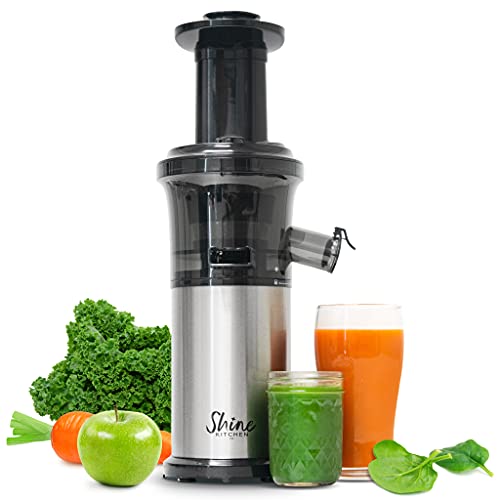
Shine Kitchen Co SJV-107-A Vertical Cold Press Juicer
The SJV-107-A is the unit I point friends toward when they want to try vertical juicing without committing to a flagship price. It is built in stainless steel, handles everyday fruit and softer greens well, and keeps a compact footprint. It will not match the yield of the slow Omega on tough fibrous greens, but for the cost it punches above its weight. A solid entry point that does not feel disposable.
Reasons to buy
- Affordable entry price
- Stainless steel housing
- Compact footprint
Reasons to avoid
- Lower yield on fibrous greens
- Smaller motor than flagships
What to look for
Auger Speed
A slower auger, often in the 40 to 60 RPM range, crushes produce more thoroughly and leaves drier pulp. If yield and nutrient retention matter most to you, prioritize the slowest machine you can afford.
Feed Chute Width
Narrow chutes mean more chopping before you juice. A wide chute that accepts whole apples or large carrot pieces cuts prep time and makes daily juicing far more sustainable.
Cleanup Effort
Vertical juicers have a strainer, auger, and chamber that all need rinsing. Look for coarse strainers and flip gates that simplify the wash, because cleanup is what kills daily habits.
Build and Reliability
Augers and drip caps are the parts that fail first. Stainless or heavy-duty plastic components and a solid warranty are worth paying for if you plan to juice often.
Footprint and Capacity
These machines stand tall, so check your cabinet clearance. Larger hoppers suit batch juicing for a household, while compact chambers fit singles and couples better.
Our verdict
The single biggest predictor of a satisfying vertical masticating juicer is auger speed paired with chute width: slower extraction means drier pulp and higher yield, while a wide chute is what keeps you actually juicing every day instead of letting the machine collect dust.
FAQs
A vertical masticating juicer uses a slow-turning auger mounted upright to crush and squeeze produce, rather than a fast spinning blade. The vertical orientation uses gravity to feed produce down, saves counter space compared to horizontal models, and generally produces drier pulp with less foam and oxidation.
Yes, the better ones excel at greens. Because a vertical masticating juicer turns slowly and presses rather than shreds, it extracts more from kale, spinach, and chard than a centrifugal model. Picks like the Hurom H-AA with an adjustable pulp lever handle stringy greens especially well.
Cleanup is the main trade-off. A vertical masticating juicer has a strainer, auger, and chamber to rinse after each use, which takes a few minutes. Models with coarse strainers and flip gates, like the Kuvings EVO820, make the job faster, but expect more parts than a simple blender.
It depends on how often you juice. If you make juice daily, a premium vertical masticating juicer pays off through higher yield, drier pulp, and longer durability. For occasional use, a value pick like the Shine SJV-107-A gives you the cold press experience without the flagship cost.
Update log
- Jun 15, 2026 — Refreshed picks and rankings.
- Apr 21, 2026 — Initial guide published.
Related guides

Whitmor Closet Drawers Organizer Set Review (2026)

Williams Sonoma Open Kitchen Mixing Bowls Review (2026): The

Wilton Original Bundt Pan Review (2026): Honest Look at the

Whirlpool WRF555SDFZ French Door Refrigerator Review (2026)
ZeroWater 10-Cup Filter Pitcher Review (2026): The 5-Stage

Wusthof Honing Steel 10-Inch Review (2026): The Daily Edge

Zeppoli Microfiber Cleaning Cloths 50-Pack Review (2026): The