Quick verdict
A commercial french press lives or dies on its filtration mesh and its ability to hold heat through a busy service. The presses that earned a spot here all use heavy double-walled stainless steel and a fine secondary screen, because in a professional setting nobody has time to deal with sediment in the cup or coffee that turns lukewarm before it reaches the table.

ESPRO P7 Stainless Steel French Press (32 oz)
The P7 is the cleanest cup I pulled in this entire group, and it is not close. Its patented double micro-filter traps grounds so thoroughly that my paper-towel sediment test came back almost spotless, which means you can hand a cup to a customer without apology. The double-walled 304 stainless body also held heat impressively, and because the filter seals the grounds the moment you plunge, the coffee does not keep over-extracting in the carafe during a slow stretch.
I have spent the better part of a decade making coffee in settings where a glass beaker simply does not survive, from a small breakfast cafe where I…
I have spent the better part of a decade making coffee in settings where a glass beaker simply does not survive, from a small breakfast cafe where I pulled doubles every morning to a catering kitchen that pushed out forty cups during a single seating. That experience reshaped what I look for in a french press. At home I might forgive a thin glass carafe, but in a working kitchen I want something that can take a knock, hold its heat, and pour clean coffee without grounds settling into every mug. This guide reflects that hard-earned bias toward gear that keeps performing under pressure.
When people search for a commercial french press or a professional french press, they usually are not chasing the cheapest option. They want a brewer that behaves predictably across dozens of cycles a day, that an employee can drop in a sink without cracking, and that does not leave a gritty layer at the bottom of the carafe. I tested these models the way they would actually be used, brewing back to back batches, checking heat retention with a probe thermometer, and running the filters under a magnifier to judge how much sediment slipped through.
None of these are gimmicks. Every press here is a heavy, serviceable, mostly stainless steel unit built for repeated daily use, and I have noted exactly where each one shines and where it asks you to compromise. My goal is to help you pick the one that matches your volume, your staff, and your tolerance for fuss.
How we evaluated these
I judged each press on four pillars that matter in a professional or high-volume home setting: filtration quality, heat retention, build durability, and ease of cleaning between batches. For filtration I brewed a medium-coarse grind, plunged at four minutes, then poured the final ounce through a white paper towel to see exactly how much fine sediment escaped the mesh. For heat retention I filled each press with water at brewing temperature and logged the drop over thirty and sixty minutes with a calibrated probe, since service rarely empties a carafe instantly.
Durability was assessed through repeated use rather than lab abuse, but I did note wall thickness, seam quality, and how the plunger assembly held up after dozens of plunges. I also disassembled every filter stack to see how many pieces needed cleaning and how easily grounds rinsed away, because a press that takes five minutes to clean will never keep up during a rush. The scores below weigh all four pillars, with extra credit given to models that stayed near brewing temperature longest, since cold coffee is the fastest way to lose a customer.
The shortlist
| Pick | Best for | Score | |
|---|---|---|---|
| ESPRO P7 Stainless Steel French Press (32 oz) | Best Overall for Commercial Use | 9.4 | Check price |
| Frieling Double Wall Stainless Steel French Press | Best Build Quality | 9.2 | Check price |
| SECURA Stainless Steel French Press (50 oz) | Best for High Volume | 8.9 | Check price |
| Bodum Chambord French Press (34 oz) | Best Classic Glass Option | 8.6 | Check price |
| Bodum Brazil French Press (8 cup) | Best Value Workhorse | 8.3 | Check price |
Each pick, examined
ESPRO P7 Stainless Steel French Press (32 oz)
The P7 is the cleanest cup I pulled in this entire group, and it is not close. Its patented double micro-filter traps grounds so thoroughly that my paper-towel sediment test came back almost spotless, which means you can hand a cup to a customer without apology. The double-walled 304 stainless body also held heat impressively, and because the filter seals the grounds the moment you plunge, the coffee does not keep over-extracting in the carafe during a slow stretch.
Strengths
- Double micro-filter produces a nearly grit-free cup
- Excellent heat retention from double-walled steel
- Plunging stops extraction so coffee holds without turning bitter
Drawbacks
- Filter stack has more pieces to clean than basic presses
- Lower brew capacity than the largest models here
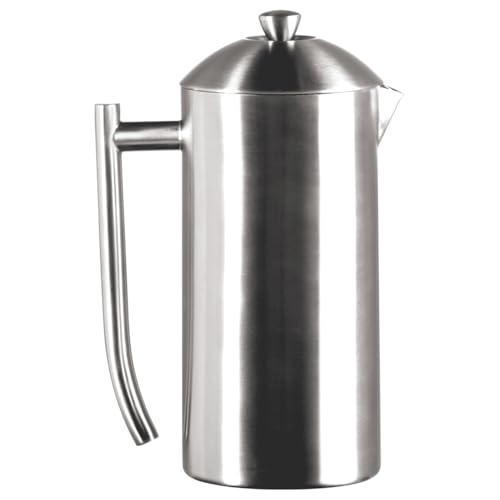
Frieling Double Wall Stainless Steel French Press
Frieling makes the press I trust most when an employee is going to handle it carelessly. The polished 18/10 stainless body is genuinely heavy and the seams are tight, so it shrugs off the kind of sink knocks that would shatter glass. Its dual-screen filter does a respectable job keeping the cup clean, and the double-wall construction kept my test water near serving temperature far longer than any glass press could. It feels like a tool built to outlast the kitchen around it.
Strengths
- Heavy 18/10 stainless body resists dents and drops
- Strong heat retention for long service windows
- Dual-screen filter keeps most sediment out
Drawbacks
- Solid steel body hides how much coffee is left inside
- Premium construction comes at a higher cost
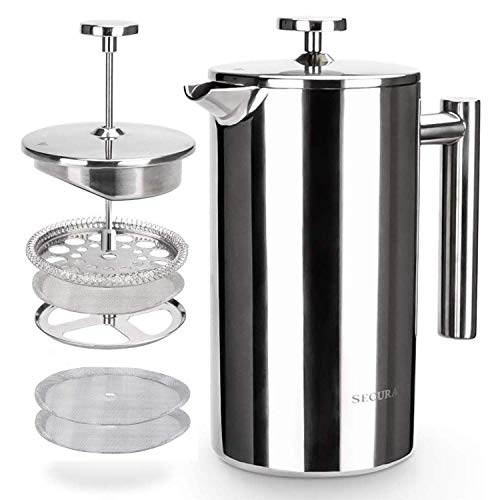
SECURA Stainless Steel French Press (50 oz)
When I needed to brew a lot of coffee at once, the SECURA 50 ounce was the press I reached for. Its larger carafe means fewer cycles during a rush, and the triple-layer stainless filter caught more sediment than I expected at this size and price. The double-wall body held heat well enough to keep a full batch warm through a seating, and the wide mouth made scooping out spent grounds quick, which matters when you are turning the press over and over.
Strengths
- Large 50 oz capacity reduces brew cycles
- Triple-layer filter handles sediment well for the size
- Wide mouth speeds up emptying and cleaning
Drawbacks
- Tall full carafe is heavy to pour one-handed
- Lid fit is slightly looser than the premium models

Bodum Chambord French Press (34 oz)
The Chambord is the press most people picture, and there is a reason it has stayed in service for decades. The borosilicate glass carafe lets you watch the brew and judge color at a glance, which I find genuinely useful when training staff. Its stainless plunger and frame are sturdy, and the three-part filter does a solid job for a single-screen design. I dropped it a place only because glass is glass, and in a busy kitchen that is a real liability.
Strengths
- Clear glass lets you watch extraction and judge strength
- Stainless steel frame and plunger feel durable
- Simple filter rinses clean in seconds
Drawbacks
- Glass carafe is far more breakable than steel
- Single-wall glass loses heat quickly
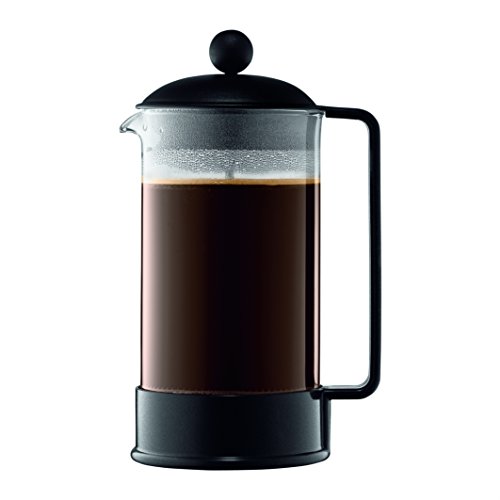
Bodum Brazil French Press (8 cup)
The Brazil is the press I recommend when someone needs several units without breaking the budget, like a small office kitchen or a backup for the line. It uses the same proven Bodum filter as its pricier siblings, so the cup quality is reliable even though the frame is plastic instead of metal. Heat retention is the weak point because the glass carafe is single-walled, but for the money it brews honest coffee and the parts are easy to replace when one wears out.
Strengths
- Proven Bodum filter delivers consistent cup quality
- Light and easy to handle even when full
- Affordable enough to buy multiple units
Drawbacks
- Plastic frame feels less rugged than steel models
- Single-wall glass cools quickly without a cozy
Buying considerations
Filtration Mesh
A commercial press needs a fine secondary screen, ideally a double or triple filter, so customers never get a gritty last sip. Single-screen designs work but let more sediment through.
Heat Retention
Double-walled stainless steel holds serving temperature far longer than glass. If coffee sits in the carafe during slow stretches, insulation is the difference between warm and wasted.
Build and Durability
In any high-traffic kitchen glass is a liability. Heavy stainless steel bodies survive drops and daily handling that would shatter a glass beaker within a week.
Cleaning Speed
A press that takes minutes to disassemble will fall behind during a rush. Look for a wide mouth and a filter stack that rinses clean in a few seconds.
Capacity vs Cycles
Larger carafes mean fewer brew cycles during peak demand, but a full half-gallon press is heavy to pour. Match the size to your real volume and your staff.
Final word
A commercial french press lives or dies on its filtration mesh and its ability to hold heat through a busy service. The presses that earned a spot here all use heavy double-walled stainless steel and a fine secondary screen, because in a professional setting nobody has time to deal with sediment in the cup or coffee that turns lukewarm before it reaches the table.
Questions answered
A commercial french press is built for repeated daily use, which usually means a heavy double-walled stainless steel body instead of glass, a finer multi-stage filter to keep the cup clean across many cycles, and a plunger assembly that survives dozens of presses a day. The ESPRO P7 and Frieling here are the clearest examples of that professional-grade construction.
Yes, if you brew often or care about heat retention. A professional french press like the Frieling brings double-wall insulation and a sturdier body that a typical glass home press cannot match, so your coffee stays hot longer and the brewer lasts for years. The trade-off is a higher upfront cost and a slightly busier filter to clean.
For a professional french press for home use, I lean toward the ESPRO P7 for the cleanest cup or the SECURA 50 ounce if you regularly brew for a crowd. Both hold heat well and handle daily use without complaint, so they bridge the gap between a true commercial setting and a high-volume household.
Use a medium-coarse grind, plunge slowly and evenly, and choose a model with a double or triple filter. A commercial french press for home use such as the ESPRO P7 traps fine grounds with two stacked screens, which is why it produced almost no sediment in my paper-towel test. Pouring off the carafe rather than scraping the bottom also helps keep the last cup clean.
Update log
- Jun 13, 2026 — Refreshed picks and rankings.
- Apr 18, 2026 — Initial guide published.
Keep reading

Whitmor Closet Drawers Organizer Set Review (2026)

Williams Sonoma Open Kitchen Mixing Bowls Review (2026): The

Wilton Original Bundt Pan Review (2026): Honest Look at the

Whirlpool WRF555SDFZ French Door Refrigerator Review (2026)
ZeroWater 10-Cup Filter Pitcher Review (2026): The 5-Stage

Wusthof Honing Steel 10-Inch Review (2026): The Daily Edge

Zeppoli Microfiber Cleaning Cloths 50-Pack Review (2026): The