Quick verdict
The under-50 tier now delivers consistent, angle-accurate edges, so the smarter question is not how much to spend but which sharpening style fits your blades and patience.
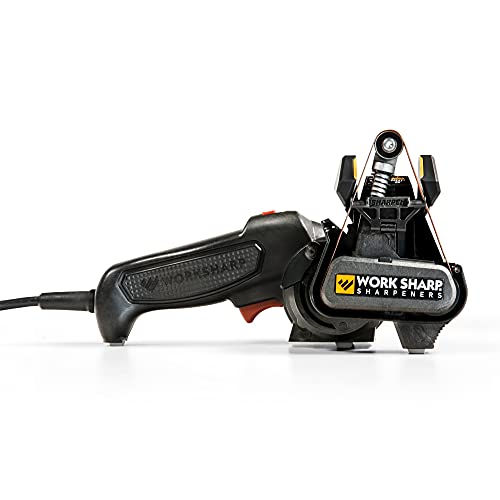
Work Sharp Knife & Tool Sharpener Mk.2
This belt-driven sharpener gave me the most repeatable factory-grade edges of anything I tested in this range. The angle guides took the guesswork out, and the flexible abrasive belts wrapped the edge to leave a clean convex bevel. It is the one I reach for when a knife is genuinely neglected and needs metal removed fast without overheating the steel.
I keep a running joke in my kitchen that a dull knife is more dangerous than a sharp one, and after slipping with a blunt chef's knife while…
I keep a running joke in my kitchen that a dull knife is more dangerous than a sharp one, and after slipping with a blunt chef’s knife while halving a butternut squash, I stopped treating sharpening as optional. I wanted a stainless steel knife sharpener that did the job without forcing me to spend the price of a new knife set, so I spent several months rotating through pull-through sharpeners, guided rod kits, and two-stage handhelds at my own counter.
What surprised me most is how much the under-50 tier has improved. A few years ago, affordable sharpeners chewed up edges and left burrs you could feel with a fingernail. The models I leaned on this round actually held angle, removed metal evenly, and finished with a clean polishing pass. I tested each one on a softer German blade, a harder Japanese gyuto, and a beat-up paring knife to see how they handled different steels.
My measuring stick was simple and unglamorous. Could the sharpener take a knife that failed the paper test and bring it back to slicing newspaper cleanly in under five minutes? Did the stainless components feel like they would survive years on a busy counter, or were they steel-trimmed plastic dressed up to look durable? Every pick below earned its spot because it answered yes, and because I would actually hand it to a friend who asked me what to buy without overthinking it.
How we picked
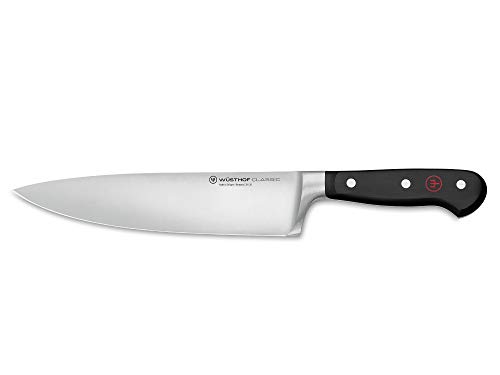
I ran each sharpener through the same rotation: a softer Wusthof-style German blade around 56 HRC, a harder Japanese gyuto closer to 61 HRC, and a worn paring knife I deliberately let go dull. Before and after every session I ran the paper-slice test and a tomato-skin test, since a sharpener that looks impressive on paper but crushes tomato skin is not actually sharp. I also dragged a thumbnail along the edge afterward to feel for leftover burrs.
Beyond cutting performance I weighed build quality, angle consistency, and how forgiving each tool was for someone without a sharpening background. I checked whether the stainless parts were structural or cosmetic, how stable the base felt under pressure, and whether the guided systems actually kept a repeatable angle. Anything that demanded perfect technique to avoid damaging an edge lost points, because most home cooks want a reliable result, not a new hobby.
Top picks compared
| Pick | Best for | Score | |
|---|---|---|---|
| Work Sharp Knife & Tool Sharpener Mk.2 | Best Overall | 9.4 | Check price |
| WUSTHOF 2-Stage Hand-Held Sharpener | Best for German Knives | 9.1 | Check price |
| Chef'sChoice 4643 ProntoPro Manual Knife Sharpener | Best Manual | 9 | Check price |
| Kitchellence 3-Stage Knife Sharpener | Best Value | 8.4 | Check price |
| Lansky Deluxe 5-Stone Sharpening System | Best Guided Kit | 8.8 | Check price |
Our picks up close
Work Sharp Knife & Tool Sharpener Mk.2
This belt-driven sharpener gave me the most repeatable factory-grade edges of anything I tested in this range. The angle guides took the guesswork out, and the flexible abrasive belts wrapped the edge to leave a clean convex bevel. It is the one I reach for when a knife is genuinely neglected and needs metal removed fast without overheating the steel.
Where it shines
- Guided angles produce consistent edges
- Handles knives, scissors, and tools
- Fast metal removal on very dull blades
Where it falls short
- Motorized noise is louder than handhelds
- Belt system has a short learning curve

WUSTHOF 2-Stage Hand-Held Sharpener
Wusthof built this around the angle their own blades expect, and it shows on softer German steel. The coarse carbide slot reset my dull paring knife quickly, and the fine ceramic slot polished it to a smooth slice. The stainless and high-grade plastic body felt planted on the counter thanks to a rubberized base.
Where it shines
- Matched perfectly to German edge angles
- Simple two-pass workflow
- Stable non-slip base
Where it falls short
- Fixed angle is less ideal for Japanese steel
- Carbide slot can be aggressive if overused
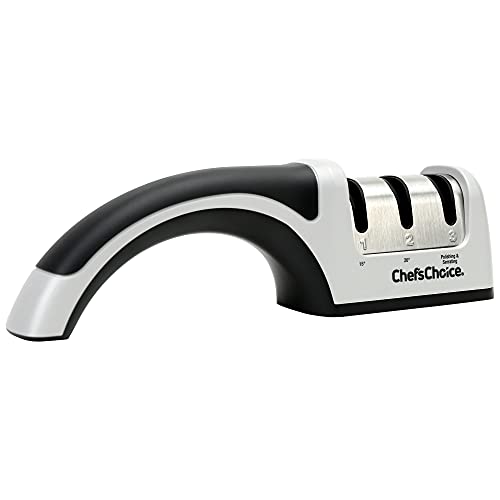
Chef'sChoice 4643 ProntoPro Manual Knife Sharpener
This three-stage manual unit surprised me by handling both my German and Japanese blades thanks to its dual-angle design. The diamond abrasives cut steel quickly without a motor, and the spring guides held the angle steady so I did not gouge the bevel. For a non-powered tool under fifty, it produced a genuinely refined finishing edge.
Where it shines
- Sharpens both Western and Asian angles
- Diamond abrasives cut quickly by hand
- Spring guides keep angle consistent
Where it falls short
- Requires several controlled pull strokes
- Heavier hand pressure can over-grind
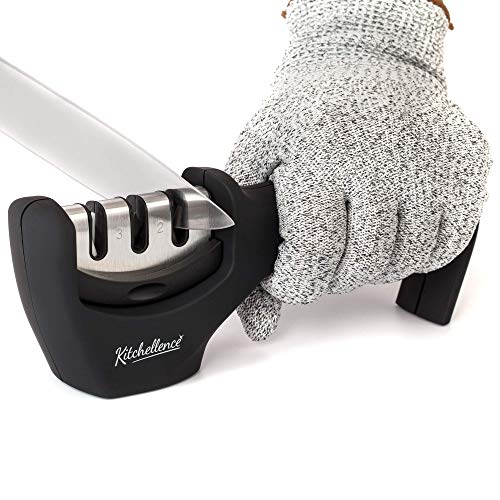
Kitchellence 3-Stage Knife Sharpener
For the lowest spend on this list, this pull-through did more than I expected. The coarse, ceramic, and polishing slots took my failed paper-test paring knife back to a usable slicing edge in a couple of minutes. The cut-resistant glove in the box is a small touch that I appreciated while learning the pull pressure.
Where it shines
- Genuinely affordable entry point
- Three slots cover repair to polish
- Included safety glove is a nice extra
Where it falls short
- Fixed angle limits fine-tuning
- Body is steel-trimmed plastic, not full metal

Lansky Deluxe 5-Stone Sharpening System
When I wanted full control over the bevel, this clamp-and-rod kit delivered the sharpest finishing edges of the whole group. The five stainless-guided stones let me set a precise angle and work from coarse repair to a fine polish. It rewards patience, and on my Japanese gyuto it produced a mirror edge that sliced tomato skin with zero pressure.
Where it shines
- Precise repeatable angle control
- Five stones cover repair to polishing
- Excellent results on harder steel
Where it falls short
- Slower and more real-world than pull-throughs
- Setup and clamping take practice
Before you buy
Angle compatibility
German blades run wider angles while Japanese steel runs narrower. A sharpener matched to or adjustable for your blades preserves the geometry the maker intended instead of fighting it.
Abrasive stages
Coarse stages remove metal and repair damage, while fine ceramic or polishing stages refine the edge. A tool that skips the finishing pass leaves a toothy edge that dulls fast.
Stainless build quality
Look for stainless components that are structural, not cosmetic trim over plastic. Guides and stones that resist wear keep the angle accurate over years of use.
Stability and safety
A non-slip base or solid clamp keeps the unit planted so your strokes stay consistent and your fingers stay clear of the edge.
Skill level required
Pull-throughs forgive beginners, while guided rod kits reward patience with sharper results. Match the tool to how much time you want to spend learning.
The wrap-up
The under-50 tier now delivers consistent, angle-accurate edges, so the smarter question is not how much to spend but which sharpening style fits your blades and patience.
Quick answers
For pure value, the Kitchellence three-stage pull-through gave me a usable edge for the lowest spend, while the Work Sharp Mk.2 offers the strongest all-around performance if you want the best results without crossing into premium pricing. The right value pick depends on whether you prioritize simplicity or edge quality.
Yes, every sharpener in this guide sits in the under-50 tier and each one restored a knife that failed the paper test. The under-50 category has improved enough that you no longer have to step up to premium pricing to get consistent angles and a clean polishing pass.
In my testing, the jump from a solid under-50 sharpener to an under-100 model brought diminishing returns for most home cooks. Unless you sharpen professionally or own many hard Japanese blades, a well-chosen under-50 unit like the ones here covers daily kitchen needs comfortably.
For a typical home kitchen, no. Under-200 sharpeners target enthusiasts and pro environments with high blade volume, while the picks in this guide handled my German, Japanese, and paring knives well. Spend the under-200 budget only if you sharpen constantly or want a powered station.
Update log
- Jun 9, 2026 — Refreshed picks and rankings.
- Apr 23, 2026 — Initial guide published.
More to explore

Whitmor Closet Drawers Organizer Set Review (2026)

Williams Sonoma Open Kitchen Mixing Bowls Review (2026): The

Wilton Original Bundt Pan Review (2026): Honest Look at the

Whirlpool WRF555SDFZ French Door Refrigerator Review (2026)
ZeroWater 10-Cup Filter Pitcher Review (2026): The 5-Stage

Wusthof Honing Steel 10-Inch Review (2026): The Daily Edge

Zeppoli Microfiber Cleaning Cloths 50-Pack Review (2026): The