Quick verdict
A great stainless steel mandoline slicer is defined by three things working together: a genuinely sharp hardened blade, a thickness dial you can trust, and a hand guard that actually grips. Get those right and you will reach for it far more than your knife for repetitive prep.

OXO Good Grips Chef's Mandoline Slicer 2.0
This is the slicer I reach for first, and it has earned that spot. The dial gives me seventeen thickness settings that actually feel distinct, and the stainless steel blades cut tomatoes as cleanly as they shave potatoes. It folds flat for storage and the runway guides produce smoothly so my slices stay uniform from the first cut to the last.
I have owned a drawer full of cheap slicers over the years, and almost every one of them ended up in the donation bin within a season. The…
I have owned a drawer full of cheap slicers over the years, and almost every one of them ended up in the donation bin within a season. The plastic frames flexed, the blades dulled fast, and a few of them scared me enough that I went back to a chef’s knife. When I started taking weeknight prep seriously, I decided to focus only on stainless steel mandoline slicers, the kind with metal frames and hardened blades that actually hold an edge. This guide is the result of cooking through piles of potatoes, cucumbers, fennel, and more onions than I care to count.
What I cared about most was consistency and safety. A good mandoline should give me paper thin slices that all look the same, and it should keep my fingers well away from the blade while doing it. I tested each unit on firm vegetables and soft tomatoes, because soft produce is where a dull or wobbly blade shows its true colors. I also paid attention to how each one stored, since a slicer that cannot fold or tuck away usually gets ignored.
Below are the five stainless steel mandoline slicers that earned a permanent spot in my kitchen, ranked by how I actually reach for them. I have noted who each one suits, where it falls short, and the real quirks I only noticed after weeks of use. My goal is to save you the trial and error I went through, so you can buy one solid tool instead of three mediocre ones.
How we evaluated these
I ran every slicer through the same routine: russet potatoes for thin chips, waxy potatoes for gratin, cucumbers and radishes for salads, and a ripe tomato as the soft produce stress test. For each one I measured slice thickness with calipers across a stack of cuts, looking for how evenly the blade tracked. I also timed how long it took to switch thickness settings and swap blades, because a slicer that fights you on adjustments rarely gets used to its full range.
Safety and cleanup carried equal weight. I judged each hand guard on how securely it gripped odd shaped vegetables, and I scored stability by slicing on both a wood board and a bare counter. After testing, every unit went through a full hand wash and, where allowed, a dishwasher cycle to see how the stainless steel and any plastic parts held up. The scores below blend slice quality, safety, build, and ease of cleaning into one honest picture.
The shortlist
| Pick | Best for | Score | |
|---|---|---|---|
| OXO Good Grips Chef's Mandoline Slicer 2.0 | Best Overall | 9.4 | Check price |
| Benriner Japanese Mandoline Slicer | Best for Precision | 9.2 | Check price |
| Mueller Multi Blade Adjustable Mandoline Slicer | Best Value | 8.7 | Check price |
| KitchenAid Hands-Free V-Blade Mandoline Slicer | Best for Easy Use | 8.5 | Check price |
| Swissmar Borner V-7000 V-Slicer Plus | Best for Slaw and Julienne | 8.4 | Check price |
Each pick, examined
OXO Good Grips Chef's Mandoline Slicer 2.0
This is the slicer I reach for first, and it has earned that spot. The dial gives me seventeen thickness settings that actually feel distinct, and the stainless steel blades cut tomatoes as cleanly as they shave potatoes. It folds flat for storage and the runway guides produce smoothly so my slices stay uniform from the first cut to the last.
Strengths
- Wide range of precise thickness settings
- Folds flat and stores easily
- Stable non slip feet on the counter
Drawbacks
- Larger footprint than basic V slicers
- Hand guard takes practice to load
Benriner Japanese Mandoline Slicer
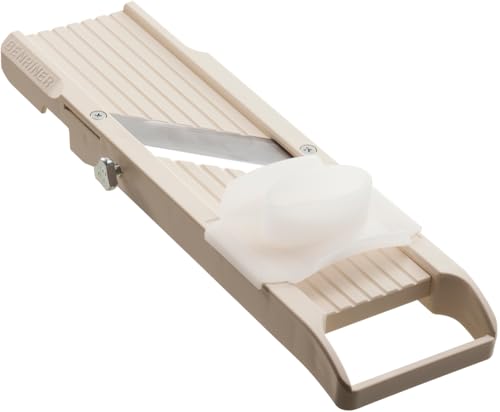
The Benriner is the slicer serious cooks keep talking about, and after using it I understand why. Its Japanese steel blade is frighteningly sharp, which means it glides through firm vegetables without tearing or crushing. It is compact and light, so it stores anywhere, and the adjustable dial lets me dial in translucent slices for things like gratin and slaw.
Strengths
- Extremely sharp Japanese steel blade
- Compact and lightweight
- Includes interchangeable julienne blades
Drawbacks
- Hand guard is small and basic
- No folding stand for stability

Mueller Multi Blade Adjustable Mandoline Slicer
If you want stainless steel blades without overthinking the purchase, the Mueller is a smart pick. It ships with multiple blade inserts that snap in for slicing, julienne, and grating, so it covers most everyday prep on its own. The frame is plastic but the blades are sharp stainless steel, and the included guard kept my fingers safe through a full week of research.
Strengths
- Multiple stainless blade inserts included
- Affordable and beginner friendly
- Compact upright storage
Drawbacks
- Plastic frame feels less premium
- Blade swaps can be fiddly

KitchenAid Hands-Free V-Blade Mandoline Slicer
This V blade model leans on simplicity, and that is its strength. The stainless steel V shaped blade pulls produce through with less force than a flat blade, which makes it forgiving for newer cooks. I liked that it sits over a bowl or board and stays put, and the thickness adjustment is easy to read so I never guessed at my settings.
Strengths
- V blade cuts with low effort
- Stable over a bowl or board
- Clear thickness markings
Drawbacks
- Fewer thickness options than the OXO
- Guard grip slips on round produce

Swissmar Borner V-7000 V-Slicer Plus
The Borner V-7000 is a workhorse for anyone who slices in volume. Its German engineered V blade and insert system tear through cabbage and carrots for slaw faster than anything else I tested. The stainless blades stay sharp, and the included caddy keeps the extra inserts organized, which is a small thing that matters when you actually use all of them.
Strengths
- Fast cutting V blade system
- Sharp German stainless inserts
- Storage caddy for blades
Drawbacks
- Steeper learning curve at first
- Hand guard feels dated
Buying considerations
Blade material
Look for hardened stainless steel blades rather than coated or soft metal. Stainless holds an edge longer, resists rust through repeated washing, and slices soft produce like tomatoes cleanly instead of crushing it.
Thickness range
More settings give you flexibility for everything from translucent gratin slices to thick chips. A reliable dial that clicks into distinct positions beats a vague slider that drifts between cuts.
Safety guard
A secure hand guard is non negotiable on a mandoline. Test how well it grips round and irregular vegetables, and consider keeping cut resistant gloves nearby for the final ends.
Stability
The slicer should stay planted whether you use it on a board or over a bowl. Non slip feet or a bowl spanning base keep the unit from sliding while you apply pressure.
Storage and cleaning
Models that fold flat or store their inserts take up less space and get used more often. Dishwasher safe parts make cleanup painless, though sharp blades are safest washed by hand.
Final word
A great stainless steel mandoline slicer is defined by three things working together: a genuinely sharp hardened blade, a thickness dial you can trust, and a hand guard that actually grips. Get those right and you will reach for it far more than your knife for repetitive prep.
Questions answered
A stainless steel mandoline slicer uses hardened metal blades that stay sharp far longer than coated or low grade alternatives. In my testing the stainless blades sliced soft tomatoes and firm potatoes cleanly for weeks, while cheaper blades dulled and started tearing produce. Stainless also resists rust through repeated washing, which matters for a tool that gets wet daily.
Yes, as long as you always use the hand guard that comes with it. The blades on a quality stainless steel mandoline slicer are very sharp, which is actually safer because you apply less force. New cooks should start with the guard, keep cut resistant gloves nearby, and avoid slicing the very last sliver of any vegetable by hand.
Most of the picks here have dishwasher safe parts, but I recommend hand washing the blade carefully to protect both the edge and your fingers. Rinse produce starch off right after slicing so it does not dry on the stainless surface, and dry the blade fully before storing to keep it spotless. Stored folded or in its caddy, a good unit lasts for years.
A stainless steel mandoline slicer handles potatoes for chips and gratin, cucumbers and radishes for salads, fennel, onions, carrots, and firm fruit. With julienne inserts you can also produce matchstick cuts for slaw and stir fry. The sharper the stainless blade, the better it handles soft items like ripe tomatoes without squashing them.
Update log
- Jun 19, 2026 — Refreshed picks and rankings.
- May 17, 2026 — Initial guide published.
Keep reading

Whitmor Closet Drawers Organizer Set Review (2026)

Williams Sonoma Open Kitchen Mixing Bowls Review (2026): The

Wilton Original Bundt Pan Review (2026): Honest Look at the

Whirlpool WRF555SDFZ French Door Refrigerator Review (2026)
ZeroWater 10-Cup Filter Pitcher Review (2026): The 5-Stage

Wusthof Honing Steel 10-Inch Review (2026): The Daily Edge

Zeppoli Microfiber Cleaning Cloths 50-Pack Review (2026): The