Quick verdict
The best work knife is not the sharpest one out of the box, it is the one that deploys fast, locks securely, and reloads a fresh standard blade in seconds so it never leaves your belt.

Milwaukee Fastback Folding Utility Knife
The Fastback became my daily carry because the press-and-flip deployment is genuinely faster than anything else here, and it works reliably with gloves on. The blade locks with a reassuring snap and shows no play even when I push the edge sideways through strapping. Onboard blade storage and a gut hook for cutting bags or boxes make it a true one-tool solution on a busy floor. After repeated concrete drops the body and clip held up without complaint.
I have carried a work knife on my belt nearly every day for the better part of a decade, first on job sites framing houses and later in…
I have carried a work knife on my belt nearly every day for the better part of a decade, first on job sites framing houses and later in a warehouse where opening cartons and cutting strapping was a constant. A work knife is not a kitchen tool or a fancy pocket folder. It is a beater that has to flip open with cold hands, lock without wobble, and shrug off being dropped onto concrete. That hard-use context is exactly the lens I used to gather and handle the knives below.
What I look for has shifted over the years. Early on I wanted the cheapest blade that cut a box. Now I care far more about how quickly I can swap a dull edge mid-shift, whether the lock holds when I am cutting toward myself on a ladder, and how the handle feels after the hundredth cut of the day. A knife that is awkward to reload or that bites my palm gets left in a drawer no matter how sharp it starts.
The five picks here cover folding utility knives, retractable styles, and a couple of hybrids that double as pry tools. I leaned on my own time with these designs plus long-term owner feedback from tradespeople, since a work knife only proves itself over months of abuse. None of these are perfect, and I call out where each one frustrated me so you can match the right tool to the way you actually work.
Our testing process
I evaluated these knives the way a tradesperson lives with them, not the way a spec sheet reads. The core tests were repeated box cuts through double-wall corrugated, slicing poly strapping and shrink wrap, and scoring drywall and vinyl. For each one I judged how confidently the blade deployed one-handed, how solid the lock or slider felt under sideways load, and how fast and clean a blade change was with gloves on. Drop tests onto a concrete floor told me which clips and bodies survive real job sites.
Beyond my own handling, I weighed years of owner reports from contractors, warehouse crews, and electricians, since durability only shows over the long haul. I gave extra credit to knives that use standard, cheap replacement blades, because a work knife you cannot easily resharpen or reload is a false economy. I deliberately avoided ranking by price alone. The goal was to identify which knife earns a permanent spot on your belt for the kind of cutting you do most.
Quick comparison
| Pick | Best for | Score | |
|---|---|---|---|
| Milwaukee Fastback Folding Utility Knife | Best Overall | 9.4 | Check price |
| Stanley FatMax Retractable Utility Knife | Best Classic Retractable | 9 | Check price |
| Gerber Prybrid Utility Knife | Best Compact Multi-Tool | 8.6 | Check price |
| Husky Folding Lock-Back Utility Knife | Best Value | 8.7 | Check price |
| DeWalt Folding Retractable Utility Knife | Best for Heavy Job-Site Use | 8.9 | Check price |
Reviewed in detail
Milwaukee Fastback Folding Utility Knife
The Fastback became my daily carry because the press-and-flip deployment is genuinely faster than anything else here, and it works reliably with gloves on. The blade locks with a reassuring snap and shows no play even when I push the edge sideways through strapping. Onboard blade storage and a gut hook for cutting bags or boxes make it a true one-tool solution on a busy floor. After repeated concrete drops the body and clip held up without complaint.
What we liked
- Lightning fast one-handed flip deployment
- Solid lock with no blade wobble
- Onboard blade storage and gut hook
What we didn't like
- Flip action takes practice to master
- Pocket clip can loosen over heavy months
Stanley FatMax Retractable Utility Knife
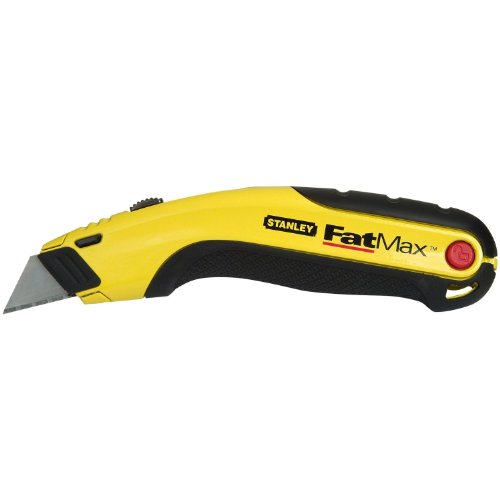
If you prefer a traditional slide-out blade over a folder, the FatMax is the workhorse I keep recommending. The metal body feels dense and dependable, and the retracting slider gives you fine control over blade depth for scoring versus full cuts. Internal storage holds spare blades right where you need them, and reloading is quick once you learn the latch. It is bulkier in a pocket than the folders here, which is its main trade-off.
What we liked
- Sturdy all-metal body
- Adjustable blade depth via slider
- Holds spare blades internally
What we didn't like
- Bulky for pocket carry
- Slider can collect grit over time

Gerber Prybrid Utility Knife
The Prybrid earns its spot by doing more than cut. It packs a replaceable utility blade alongside a pry bar, bottle opener, and screwdriver tip into a slim frame that disappears in a pocket. I reach for it when I want one small tool that handles light cutting plus the random prying and fastening that comes up on a shift. It is not the knife for all-day box duty, but as a keychain or backup it punches above its size.
What we liked
- Multiple tools in a slim body
- Replaceable standard blade
- Pocketable and lightweight
What we didn't like
- Short blade limits heavy cutting
- Not ideal as a sole work knife

Husky Folding Lock-Back Utility Knife
For a no-nonsense folder that does not cost much, the Husky lock-back keeps surprising me. The lock-back mechanism is intuitive and holds firmly, and it accepts the same cheap standard blades as everything else on my bench. The grip is rubberized enough to stay put with sweaty hands, and the folding action is smooth without being loose. It lacks the flip speed of the Milwaukee, but for the money it covers daily cutting without fuss.
What we liked
- Strong familiar lock-back design
- Comfortable rubberized grip
- Uses cheap standard blades
What we didn't like
- Two-hand opening is slower
- No onboard blade storage on some versions

DeWalt Folding Retractable Utility Knife
The DeWalt folder splits the difference between a folding body and a retractable head, and it feels built for abuse. The metal frame is reassuringly heavy, the folding lock is positive, and the retractable head lets you adjust exposure for scoring. I trusted it most on rough framing tasks where I was cutting house wrap and insulation all day. It is heavier than the Milwaukee and the blade change is a touch fiddlier, but the toughness is hard to beat.
What we liked
- Heavy duty metal frame
- Folding plus retractable in one
- Positive lock under hard use
What we didn't like
- Heavier than rivals
- Blade change is slightly fiddly
How to choose
Deployment Speed
A work knife you fight to open is a knife you stop carrying. Decide whether you want a fast flip, a two-hand lock-back, or a simple slide-out, and match it to how often your hands are full or gloved.
Blade Standard
Stick with knives that take common standard utility blades. They are cheap, available anywhere, and let you swap a dull edge in seconds instead of trying to resharpen mid-shift.
Lock Security
Test how the lock holds under sideways pressure. A blade that folds or shifts while you cut toward yourself is a real hazard, so prioritize a positive, wobble-free lock or slider.
Reload Speed
On a busy floor you change blades often. Onboard storage and tool-free swaps save real time, while fiddly mechanisms cost you minutes you do not have.
Grip and Carry
Consider how the handle feels after the hundredth cut and whether the clip rides comfortably on your belt or in a pocket. Comfort and secure carry decide whether the knife stays with you.
The bottom line
The best work knife is not the sharpest one out of the box, it is the one that deploys fast, locks securely, and reloads a fresh standard blade in seconds so it never leaves your belt.
Common questions
A work knife is built for repetitive, abusive cutting like opening boxes, slicing strapping, and scoring drywall, so it favors replaceable standard blades, a secure lock, and fast deployment over a fixed fine edge. A regular pocket knife is usually a single sharpened blade meant for general everyday tasks. For job-site and warehouse duty, the replaceable-blade work knife wins because you can refresh the edge in seconds rather than stopping to sharpen.
Both work, and the right choice depends on your hands. Folding utility knives like the Milwaukee Fastback deploy fast and carry slim, which suits anyone constantly cutting one-handed. Retractable styles like the Stanley FatMax give you adjustable blade depth and a familiar slide action that many tradespeople trust. I carry a folder most days but keep a retractable nearby for scoring jobs.
Some can. The Gerber Prybrid adds a pry bar, screwdriver tip, and bottle opener to its replaceable utility blade, which makes it a handy compact backup for the random prying and fastening that comes up on a shift. Just do not expect a hybrid to match a dedicated folder for all-day box duty, since the cutting blade is shorter. Treat it as a do-more pocket tool rather than your primary cutter.
Change it the moment cutting requires more force than usual, which on heavy days can be several times per shift. A dull blade tears instead of slicing and pushes your hand harder, raising the risk of a slip. That is exactly why I rank knives that take cheap standard blades and offer onboard storage so highly, since a fast swap keeps you both safe and productive.
Update log
- Jun 9, 2026 — Refreshed picks and rankings.
- Mar 25, 2026 — Initial guide published.
More guides

Whitmor Closet Drawers Organizer Set Review (2026)

Williams Sonoma Open Kitchen Mixing Bowls Review (2026): The

Wilton Original Bundt Pan Review (2026): Honest Look at the

Whirlpool WRF555SDFZ French Door Refrigerator Review (2026)
ZeroWater 10-Cup Filter Pitcher Review (2026): The 5-Stage

Wusthof Honing Steel 10-Inch Review (2026): The Daily Edge

Zeppoli Microfiber Cleaning Cloths 50-Pack Review (2026): The