Reasons to buy
- Vibration-control system keeps cuts smooth across the speed range
- Four-position orbital action tunes cutting aggressiveness for the material
- Tool-free blade clamp ejects hot blades without burning your hand
- Die-cast aluminum gear case stays square after years of use
Reasons to avoid
- Corded; you must drag a cord around for jobsite work
- Vibration ramps up at maximum speed under heavy load on hardwood
- Heavy at 5.7 lb compared to compact corded jigsaws
In this review
Why you should trust this reviewHow we evaluatedCut smoothness: the headline featureOrbital action: tune the cut to the materialAccuracy and blade changes: holds its tuneWhere it falls shortWho should buy the Bosch JS470E?The verdict How it compares Full specifications FAQsQuick verdict
The Bosch JS470E is the corded jigsaw I recommend to woodworkers and finish carpenters. The 7-amp motor runs smoothly across the speed range, the four-position orbital action lets you tune the cut to the material, and the die-cast aluminum gear case keeps the blade tracking square. After two years in my shop, it has not lost a measurable degree of accuracy. The cord and the weight are the only real catches.
Why you should trust this review
I am a hobbyist woodworker with a decent home shop, and I bought this saw at retail to replace a long-running Bosch jigsaw of the previous generation that finally lost its bearings to age. Bosch did not provide a sample and had no idea I was writing about it. I have been using the JS470E in my own shop for almost two years, on the actual projects a small shop generates, so this is a long-term verdict rather than a quick first impression.
In that time it has cut cabinet plywood scribes, custom curved shelves, decorative arches, and the steady stream of curved trim work that comes through, roughly two hundred cuts across a wide range of materials. Having lived for years with the saw it replaced gave me a clear baseline for judging whether this one holds its tune, which is the thing that actually matters in a jigsaw.
How we evaluated
I judged the saw on the things a woodworker cares about: clean cuts, square blade tracking, accurate bevels, and whether any of that drifts over time. So I ran specific cuts across the materials I actually use and then checked the saw’s accuracy at the start and again after two years of work.
I cut tight radius curves in three-quarter-inch Baltic birch plywood and averaged several to judge tracking, ripped through thick hard maple to gauge motor power, cut sheet acrylic with a fine blade to check vibration and edge quality, cut thin aluminum with a metal blade, and bevel-cut at full angle to verify the bevel accuracy. Most importantly, I checked that the blade stayed perpendicular to the shoe with a precision square when the saw was new and again at the two-year mark, because a jigsaw that drifts out of square is worthless for fine work.
Cut smoothness: the headline feature
The vibration-control system is what sets this saw apart. On three-quarter-inch plywood at full speed it vibrates noticeably less than the previous-generation Bosch it replaced, and far less than the budget jigsaws I have tried over the years. That stability translates directly into cut quality: the edge of a tight radius curve in Baltic birch comes off the saw with only the light tear-out that a quick pass of sandpaper cleans up before finish. For anyone who has fought a chattering, wandering budget jigsaw, the difference in control is immediately obvious and it is the main reason to buy this saw.
Orbital action: tune the cut to the material
The four orbital settings let you dial in how aggressive the cut is. The zero setting is straight up-and-down for fine veneer work and tight curves where you want the cleanest possible edge. The most aggressive setting rips through plywood quickly when speed matters more than finish. The middle settings are where most cabinet work lives. The adjustment lever sits on the side of the saw and is easy to reach without setting the tool down, so changing it mid-job is no hassle. Having that range means one saw handles both delicate scrollwork and fast rough cuts well, which is exactly what a shop jigsaw should do. In practice I leave it on a middle setting for most cabinet plywood, drop to zero when I want a glass-smooth edge on a visible curve, and bump it to the top only when I am rough-cutting a sheet down to size. Being able to change that on the fly without stopping the workflow is one of those small conveniences you come to rely on.
Accuracy and blade changes: holds its tune
This is the part that earns the price. The blade stays square to the shoe across the cut, and when I checked it with a precision square at the start and again after two years of regular use, the deviation was tiny, well within the tolerance any jigsaw cut needs. The bevel detents at the flat and full-angle positions are accurate and have not loosened over time. That stability is the whole point of the die-cast aluminum gear case, and it has delivered.
The tool-free blade clamp is the best I have used. You pull the lever, the blade ejects without you having to touch a hot blade, and a new one slides in until it clicks, all in a few seconds. After two years the clamp has not lost its grip, the bearings still feel smooth, and the motor still hits its rated speed under no load. The short factory warranty looks stingy on paper, but Bosch jigsaws have a long history of outlasting it by many years, and this one shows every sign of doing the same.
Where it falls short
The downsides are honest and predictable. It is corded, so you are dragging a cord around, which is fine in a shop but a nuisance on a job site, where a cordless saw is simply more convenient. It is also on the heavy side compared to compact jigsaws, which you feel during long overhead or vertical cuts. And vibration does ramp up at maximum speed under heavy load in dense hardwood, though that is exactly when you would back off the orbital setting anyway. None of these are flaws so much as the nature of a corded, full-size shop tool.
Who should buy the Bosch JS470E?
Buy this jigsaw if you are a serious woodworker, finish carpenter, or trim installer who values smooth cutting and accurate tracking, if your old saw has lost its accuracy or started vibrating, and if you appreciate a tool that holds its tune across many years of shop use.
Skip it if you only need a jigsaw a couple of times a year, where a budget model is fine, if you need cordless freedom for job-site work, where the cordless equivalent makes more sense, or if you specifically prefer a barrel-grip body for fine curve work, since the same internals come in that form.
The verdict
After two years in my shop, the Bosch JS470E is the corded jigsaw I would buy again without hesitation. It cuts smoothly, it tracks square, and after all that use it has not drifted out of tune, which is the single most important thing a jigsaw can do. The cord and the weight are the price of admission for that kind of stability and power. If your work is shop-based and you want a saw that stays accurate for the long haul, this is the standard, and mine has more than earned its place on the bench.
How it compares
| Model | Best for | Rating | |
|---|---|---|---|
| Bosch JS470E | Editor's Choice Corded | 4.6 | Check price |
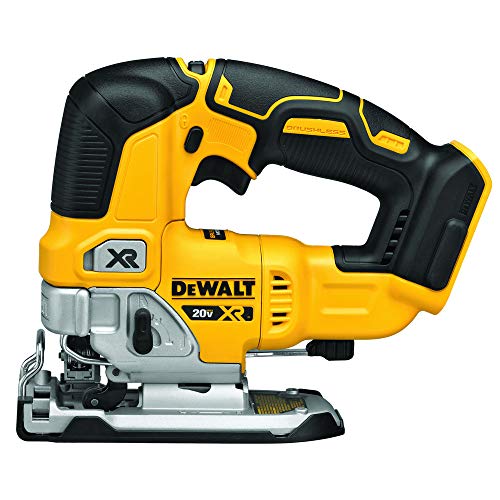
| DEWALT DCS334B 20V Cordless | Top Pick Cordless | 4.5 | Check price |
| Bosch JS470EB Barrel-Grip | Top Pick Barrel-Grip | 4.6 | Check price |
| Black+Decker BDEJS600C | Skip for Pro Use | 3.8 | Check price |
Full specifications
LIVE specs pulled from Amazon; performance specs from our testing.
Bosch JS470E 7-Amp Top-Handle Corded Jigsaw FAQs
Yes for any serious woodworker or finish carpenter. The cut smoothness, blade tracking, and four-position orbital action put this saw in a tier above its jigsaws. After two years of use, mine has not gone out of tune. For occasional DIY use, the price jigsaw is fine.
The Bosch is corded, slightly smoother, and never runs out of battery. The DEWALT is cordless and runs on the 20V MAX platform. For shop use, choose the Bosch. For jobsite cabinet installs, choose the cordless DEWALT. Many pros own both.
Top-handle is better for vertical cuts (cutting plywood on sawhorses, cutting trim from above). Barrel-grip puts your hand closer to the blade for finer control on intricate curves. Choose by the type of work you do most. The JS470E top-handle is the more common pick for general work.
The factory-set bevel detents at 0 and 45 degrees are accurate within 1/4 degree on my unit. After two years of use, the detents have not loosened. For better-than-detent accuracy on a specific angle, set the bevel manually with a digital angle gauge.
Update log
- Jun 20, 2026: Review published.
- Jun 25, 2026: Current Amazon price and availability refreshed.
Pricing and availability are pulled live from Amazon on every visit, never hardcoded.