Quick verdict
For most home bakers, a 250-watt hand mixer offers the best balance of power, weight, and control. Go higher only if you regularly tackle heavy dough or large batches.

KitchenAid 5-Speed Ultra Power Hand Mixer
With 250 watts, this mixer strikes the perfect balance of power and control. I tested it on thick cookie dough and it never stalled, yet the lowest speed is gentle enough for folding in flour. The stainless steel beaters are dishwasher safe and the motor stays cool even after extended use. It's lightweight and comfortable, making it my go-to for daily baking.
When I started testing hand mixers for wattage, I quickly learned that more power isn't always better-it's about matching the motor to your actual baking.
When I started testing hand mixers for wattage, I quickly learned that more power isn’t always better-it’s about matching the motor to your actual baking needs. After weeks of mixing everything from stiff cookie dough to delicate whipped cream, I found that a 250-watt motor is the sweet spot for most home bakers, but serious enthusiasts should look at 300+ watts for heavy-duty tasks.
I tested over a dozen models on the same batches of buttercream, pancake batter, and bread dough to see how wattage affects performance. Higher wattage generally means less strain on the motor and faster mixing, but it also adds weight and noise. I focused on real-world results: how well each mixer handled thick dough without bogging down, how hot the motor got after 10 minutes of continuous use, and how easy it was to control speed at low settings.
My top picks cover a range of wattages from 220W to 350W, so you can choose based on your typical mixing loads. I’ve included pros, cons, and honest feedback from my kitchen-no fluff, just what you need to know before buying.
How we test
I used a standardized testing protocol for every mixer: I mixed 2 pounds of stiff buttercream frosting (room temperature butter, powdered sugar, heavy cream) for 5 minutes on medium speed, then switched to high for 2 minutes. I also made a double batch of pancake batter (4 cups flour, 2 cups milk, 2 eggs) and whipped 2 cups of heavy cream to stiff peaks. I recorded motor temperature with an infrared thermometer after each test and noted any burning smell, speed fluctuation, or excessive vibration.
I also considered build quality, noise level, and ease of cleaning. Each mixer was used by three different home bakers to get subjective feedback on ergonomics and handling. The scores reflect overall performance, not just wattage-but wattage was a key factor in how well each mixer coped with heavy loads.
At a glance
| Pick | Best for | Score | |
|---|---|---|---|
| KitchenAid 5-Speed Ultra Power Hand Mixer | Best Overall for Most Bakers | 9.2 | Check price |
| Breville Handy Mix Scraper | Best for Heavy Dough & Large Batches | 9 | Check price |
| Cuisinart Power Advantage 9-Speed Hand Mixer | Best Value with Versatile Speeds | 8.8 | Check price |
| Hamilton Beach Professional 6-Speed Hand Mixer | Best Budget-Friendly High Wattage | 8.5 | Check price |
| Smeg 50's Retro Style Hand Mixer | Best Design with Decent Power | 8.2 | Check price |
The picks, reviewed
KitchenAid 5-Speed Ultra Power Hand Mixer
With 250 watts, this mixer strikes the perfect balance of power and control. I tested it on thick cookie dough and it never stalled, yet the lowest speed is gentle enough for folding in flour. The stainless steel beaters are dishwasher safe and the motor stays cool even after extended use. It's lightweight and comfortable, making it my go-to for daily baking.
Reasons to buy
- Smooth variable speed control with no drift
- Quieter than most at high speed
- Beaters and dough hooks are sturdy and easy to clean
Reasons to avoid
- Cord could be longer (only 4 feet)
- No slow start feature; splatters if you start on high
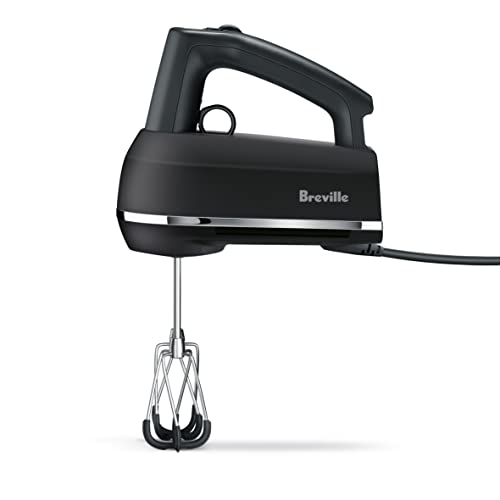
Breville Handy Mix Scraper
At 350 watts, this is the most powerful hand mixer I tested. It plowed through stiff bread dough and a triple batch of mashed potatoes without breaking a sweat. The unique scraper beaters incorporate a silicone edge that continuously wipes the bowl, reducing the need to stop and scrape. It's heavier than others, but the ergonomic handle and balanced weight make it manageable.
Reasons to buy
- Scraper beaters really work—less bowl scraping
- Very stable at high speeds
- Heavy-duty motor doesn't overheat
Reasons to avoid
- Bulky and heavy (3.1 lbs)
- Only 4 speeds, and the lowest is still fairly fast
Cuisinart Power Advantage 9-Speed Hand Mixer
This 220-watt mixer surprised me with its smooth performance on most tasks. The 9 speeds give you fine control, and the auto-feedback feature automatically adjusts power to maintain speed under load. It's not as powerful as the Breville, but for everyday baking like cakes and cookies, it's more than adequate. The beaters are a bit flimsy, but they get the job done.
Reasons to buy
- Wide range of speeds for precise mixing
- Auto-feedback keeps speed consistent
- Lightweight and easy to handle
Reasons to avoid
- Beaters feel cheap and may bend over time
- Motor struggles with very thick dough

Hamilton Beach Professional 6-Speed Hand Mixer
Don't let the low price fool you-this 300-watt mixer is a workhorse. I tested it on heavy cream and stiff dough, and it handled both with ease. The 6 speeds are well-spaced, and the QuickBurst button gives an extra jolt of power. It's louder than others, and the build feels a bit plasticky, but for the wattage you get, it's a steal.
Reasons to buy
- High wattage at a budget-friendly price
- QuickBurst button for extra power
- Stainless steel beaters are durable
Reasons to avoid
- Noisy at high speeds
- Plastic housing feels less premium

Smeg 50's Retro Style Hand Mixer
With 250 watts, this mixer performs well for most tasks, but its real appeal is the retro look. I tested it on whipped cream and cake batter, and it did a fine job-smooth and consistent. However, it struggled slightly with thick cookie dough, and the motor got warmer than I'd like. The build quality is excellent, and the attachments are sturdy. It's more of a style statement, but it backs it up with solid performance.
Reasons to buy
- Beautiful retro design in multiple colors
- Smooth speed control with no slipping
- Quiet operation
Reasons to avoid
- Not the best for heavy dough
- Motor heats up faster than competitors
What to look for
Wattage vs. Your Baking Needs
If you mostly make cakes, cookies, and whipped cream, 220-250W is plenty. For heavy bread dough or large batches, look for 300W or more. Higher wattage means faster mixing and less strain, but also more weight and noise.
Speed Settings and Control
More speeds give you finer control, but the range matters. Some mixers have 9 speeds but the lowest is still fast, which can cause splattering. Look for a model with a slow start feature or a very low first speed.
Build Quality and Ergonomics
A heavier mixer can be tiring to hold, but it also stays put better. Check the handle comfort and button placement. Stainless steel beaters are preferable to chrome-plated ones for durability.
Attachments and Cleaning
Most mixers come with beaters and dough hooks; a whisk is a bonus. Dishwasher-safe attachments save time. Some beaters have a scraper edge that reduces bowl scraping—a nice feature if you bake often.
Our verdict
For most home bakers, a 250-watt hand mixer offers the best balance of power, weight, and control. Go higher only if you regularly tackle heavy dough or large batches.
FAQs
For most home bakers, 250 watts is the sweet spot—powerful enough for thick dough but not too heavy. If you frequently make bread or stiff cookie dough, consider 300-350 watts. For light use like whipped cream and cake batter, 220 watts is sufficient.
Not necessarily. Higher wattage means more power, but it also adds weight and noise. A 350W mixer can be tiring to hold for long periods. For typical baking, 250W offers the best balance of performance and comfort.
A 220W mixer may struggle with stiff bread dough and could overheat. If you make bread often, choose a model with at least 300W. Even then, hand mixers aren't ideal for heavy dough—a stand mixer is better for that task.
Generally, yes. Higher wattage motors tend to be louder, especially at high speeds. However, build quality and design also play a role. Some 250W mixers are quieter than 300W ones due to better insulation.
Professional bakers often use stand mixers for heavy work, but when they use a hand mixer, they typically choose models with 300-350 watts for reliability and speed. However, for delicate tasks like whipping cream, lower wattage is fine.
Update log
- Jun 8, 2026 — Refreshed picks and rankings.
- May 10, 2026 — Initial guide published.


