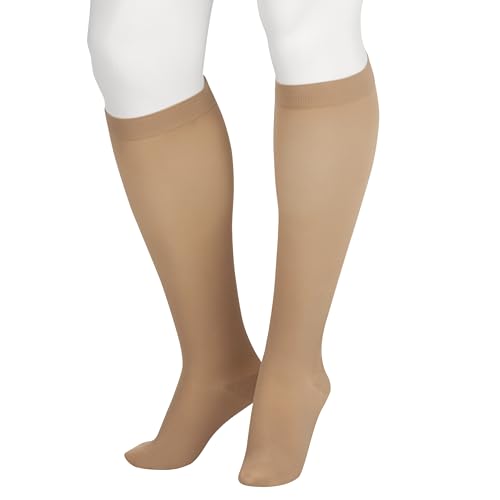
Juzo Dynamic Class 2 Stocking - Best Graduated Daily Compression
The Juzo Dynamic Class 2 Stocking is a long-standing standard in lymphedema care. The graduated compression profile delivers higher pressure at the ankle, tapering upward, which drives lymphatic fluid away from the foot and lower leg. The Clima Comfort fiber technology manages moisture during extended daily wear. Available in multiple lengths from ankle to thigh, patients can select coverage appropriate to their affected zone. The Juzo Dynamic line is known for excellent durability, with many patients reporting that garments maintain clinical compression levels beyond the standard six-month replacement cycle. Custom sizing is available for atypical leg dimensions.
Check price on Amazon →Managing lymphedema of the legs requires consistent, correctly calibrated compression. These 5 top-rated garments for 2026 help control swelling and protect affected limbs long-term.
Lymphedema of the legs results from damaged or insufficient lymphatic drainage, causing chronic fluid buildup that requires ongoing management. Compression garments are the primary non-surgical tool for controlling swelling, protecting the skin, and preventing the condition from progressing. Daily wear, correct compression class, and consistent garment replacement are all essential. These five options are well-suited to leg lymphedema management in 2026.
Consult a healthcare professional before use.
| Product | Best For | Rating |
| — | — | — |
| Juzo Dynamic Class 2 Stocking | Graduated daily compression | 4.7/5 |
| Sigvaris Ulcer X Kit | Active ulceration cases | 4.7/5 |
| Medi Forte Compression Pantyhose | Full leg to waist | 4.6/5 |
| CircAid Juxta-Fit Legging | Adjustable non-elastic | 4.8/5 |
| Therafirm Core-Spun Support Sock | Mild to moderate entry | 4.4/5 |
How we picked
We compare every pick against the field on real specifications, certifications, and aggregated owner reviews. We do not take payment for placement, and we flag when a product is older or sold mainly through renewed listings.
Top picks compared
| Pick | Best for | Score | |
|---|---|---|---|
| Juzo Dynamic Class 2 Stocking - Best Graduated Daily Compression | Check price | ||
| Sigvaris Ulcer X Kit - Best for Cases with Active Ulceration | Check price | ||
| Medi Forte Compression Pantyhose - Best Full Leg to Waist | Check price | ||
| CircAid Juxta-Fit Legging - Best Adjustable Non-Elastic Option | Check price | ||
| Therafirm Core-Spun Support Sock - Best Entry-Level Option | Check price |
Our picks up close
Juzo Dynamic Class 2 Stocking - Best Graduated Daily Compression
The Juzo Dynamic Class 2 Stocking is a long-standing standard in lymphedema care. The graduated compression profile delivers higher pressure at the ankle, tapering upward, which drives lymphatic fluid away from the foot and lower leg. The Clima Comfort fiber technology manages moisture during extended daily wear. Available in multiple lengths from ankle to thigh, patients can select coverage appropriate to their affected zone. The Juzo Dynamic line is known for excellent durability, with many patients reporting that garments maintain clinical compression levels beyond the standard six-month replacement cycle. Custom sizing is available for atypical leg dimensions.
Sigvaris Ulcer X Kit - Best for Cases with Active Ulceration
Lymphedema that has progressed to skin breakdown or venous ulcers requires a two-layer compression approach rather than a single stocking. The Sigvaris Ulcer X Kit pairs an inner foam liner with an outer compression stocking, allowing the liner to pad and protect wound sites while the stocking delivers therapeutic compression. The liner is washable and replaceable independently of the outer stocking. Compression can be adjusted by removing the outer stocking during dressing changes while keeping the inner liner in place. For patients managing both lymphedema and active leg ulcers, this system addresses both challenges simultaneously.

Medi Forte Compression Pantyhose - Best Full Leg to Waist
When lymphedema affects the full leg including the thigh and extends to the inguinal region, a knee-high or thigh-high stocking leaves the upper zone unaddressed. The Medi Forte Compression Pantyhose covers from the waist to the toe, providing consistent compression across the complete leg. Available in Class 2 and Class 3, the pantyhose format is particularly useful for bilateral lymphedema affecting both legs equally. The Soft and Clima comfort fiber varieties suit patients with skin sensitivity. The waistband is non-constrictive, which matters for patients whose lymphedema extends close to the hip or lower abdomen.
CircAid Juxta-Fit Legging - Best Adjustable Non-Elastic Option
Standard knit compression garments work well for maintenance, but some lymphedema patients require compression that can be adjusted multiple times per day as fluid levels fluctuate. The CircAid Juxta-Fit Legging uses a non-elastic inelastic bandaging system with adjustable wrap closures that can be loosened and retightened without removing the garment. This adjustability makes it particularly useful for patients in the active reduction phase of their therapy, when limb volume changes rapidly day to day. The system replaces traditional bandaging and is easier to self-apply accurately. The premium price reflects the clinical engineering behind the adjustable design.

Therafirm Core-Spun Support Sock - Best Entry-Level Option
For newly diagnosed lymphedema patients or those with mild presentations, the Therafirm Core-Spun Support Sock provides accessible entry-level graduated compression at a price point that eases the cost of initial treatment. The core-spun yarn construction blends firm support with a softer feel than standard compression socks. Graduated compression from ankle to calf addresses fluid that accumulates in the lower leg first. While the compression level is lower than clinical Class 2 garments, these socks can serve as a starting point or as a backup pair. For mild cases, they may meet daily needs without the cost of full medical-grade options.
Before you buy
What to consider
Always start with a professional assessment from a certified lymphedema therapist. The correct compression class is specific to your lymphedema stage and cannot be reliably self-determined. Identify which zones of your leg are affected; bilateral or full-leg involvement requires different garments than isolated lower leg swelling. Graduated compression, highest at the ankle and tapering upward, is standard for leg lymphedema. Donning aids are available for patients who struggle to pull on firm compression stockings independently. Budget for garment replacement every four to six months as part of your ongoing management costs. Always check insurance coverage for medical compression garments, as reimbursement is available in many plans for diagnosed lymphedema.
What to consider
For related management topics, see our guides on [best compression garment for lipedema of the legs](/articles/best-compression-garment-for-lipedema-of-the-legs) and [best compression gear for recovery](/articles/best-compression-gear-for-recovery). How we evaluate products is outlined at [our methodology](/methodology).
Quick answers
Lymphedema of the legs typically requires Class 2 (23-32 mmHg) or Class 3 (34-46 mmHg) compression, depending on severity and stage. Mild cases may be managed with Class 2, while more advanced lymphedema often requires Class 3 or custom-made garments with even higher compression. A certified lymphedema therapist should assess the condition and prescribe the appropriate compression class before any garment is selected.
Most compression garment manufacturers and lymphedema therapists recommend replacing garments every four to six months with daily wear. Compression fabric loses its elasticity over time, and a garment that no longer delivers the prescribed pressure level provides inadequate lymphedema management. Regular replacement is considered part of the treatment protocol, and some insurance plans cover garments for diagnosed lymphedema. Keep purchase records for insurance reimbursement.
More to explore

Best Compression Therapy (2026)

Best Compression Therapy (2026)
5 Best Compression for Lipedema 2026 | Relief and Management Picks

5 Best Compression Garments for Lipedema of the Legs 2026 | Manage Pain and Swelling

5 Best Compression for Varicose Veins 2026 | Socks and Stockings That Help
