
Quikrete Vinyl Concrete Patcher -- Best All-Around Material
Quikrete Vinyl Concrete Patcher is the benchmark product most DIYers reach for first, and it earns that position. The vinyl polymer in the mix improves adhesion, reduces shrinkage, and extends the workable life compared to plain Portland cement. It handles repairs from feather edges to 2-inch depths, mixes with water to any consistency needed, and cures to match the look of aged concrete reasonably well. For homeowners with occasional patching needs across different surfaces, a single bag covers everything from chipped steps to floor holes. It is predictable, widely available, and priced fairly.
Check price on Amazon →From vinyl cement to epoxy and polyurea, we rank the best concrete patch material for every repair type, surface, and budget so you pick the right product the first time.
Walk into any hardware store and you will find a wall of concrete repair products with overlapping claims. Cutting through the noise requires understanding what separates one concrete patch material from another. Chemistry, aggregate size, cure speed, and finish type all vary significantly across the category. Whether you are filling a small chip in a step, resurfacing a pitted driveway, or repairing a structural crack, the right material is the one matched to your specific repair conditions.
| Product | Best For | Rating |
| — | — | — |
| Quikrete Vinyl Concrete Patcher | All-around patching | 4.7/5 |
| Sika SikaQuick 1000 | Fast-set structural repairs | 4.8/5 |
| Mapei Planitop X | Professional resurfacing | 4.7/5 |
| Loctite PL Concrete Self Leveling | Crack sealing | 4.5/5 |
| PC Products PC-Concrete | Epoxy structural fill | 4.8/5 |
Our testing process
We compare every pick against the field on real specifications, certifications, and aggregated owner reviews. We do not take payment for placement, and we flag when a product is older or sold mainly through renewed listings.
Quick comparison
| Pick | Best for | Score | |
|---|---|---|---|
| Quikrete Vinyl Concrete Patcher -- Best All-Around Material | Check price | ||
| Sika SikaQuick 1000 -- Best Fast-Set Material | Check price | ||
| Mapei Planitop X -- Best for Professional-Grade Resurfacing | Check price | ||
| Loctite PL Concrete Self Leveling -- Best Crack Sealant Material | Check price | ||
| PC Products PC-Concrete -- Best Epoxy Patch Material | Check price |
Reviewed in detail
Quikrete Vinyl Concrete Patcher -- Best All-Around Material
Quikrete Vinyl Concrete Patcher is the benchmark product most DIYers reach for first, and it earns that position. The vinyl polymer in the mix improves adhesion, reduces shrinkage, and extends the workable life compared to plain Portland cement. It handles repairs from feather edges to 2-inch depths, mixes with water to any consistency needed, and cures to match the look of aged concrete reasonably well. For homeowners with occasional patching needs across different surfaces, a single bag covers everything from chipped steps to floor holes. It is predictable, widely available, and priced fairly.
Sika SikaQuick 1000 -- Best Fast-Set Material
When time is the constraint, SikaQuick 1000 reaches structural strength in 60 minutes and can open to foot traffic in as little as 15 minutes at 70 degrees Fahrenheit. It is a polymer-modified cement that bonds to vertical and overhead surfaces as well as horizontal ones without slumping. For repairs on stairs, loading docks, or commercial floors where downtime is expensive, this speed advantage is decisive. It requires a bonding primer for best adhesion on smooth existing concrete, and its faster set means you need to work quickly once mixed. Mix in small batches to avoid waste.
Mapei Planitop X -- Best for Professional-Grade Resurfacing
Mapei Planitop X is a fiber-reinforced, polymer-modified repair mortar used widely in commercial restoration work. It applies from zero thickness to 2 inches in a single pass, develops 4,000 PSI compressive strength at 28 days, and produces a fine, paintable surface. The fiber reinforcement reduces shrinkage cracking, which matters on large patch areas where cement-only products often develop spider cracks as they cure. It costs more than big-box patching products, but the performance gap on wide or deep repairs justifies the premium for anyone who wants the patch to outlast the surrounding slab.
Loctite PL Concrete Self Leveling -- Best Crack Sealant Material
Not all repairs need a trowel. Loctite PL Concrete is a polyurethane sealant that flows into cracks from a standard caulk gun, self-levels on horizontal surfaces, and cures to a flexible seal that tolerates slab movement. For cracks under a quarter inch that are not structural failures but need to be sealed against water infiltration, this is the fastest and cleanest solution. It is gray, paintable, and remains flexible after cure rather than becoming rigid like cement. It is not a structural material, but as a sealant and waterproofing tool for surface cracks it is excellent.
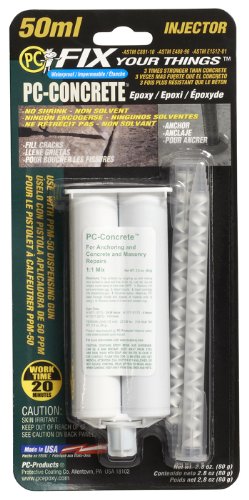
PC Products PC-Concrete -- Best Epoxy Patch Material
For the strongest possible repair, PC-Concrete two-part epoxy delivers a bond that can be stronger than the surrounding concrete itself. The two syringes mix at a 1:1 ratio and must be used within about 5 minutes of mixing, so work quickly in small batches. It fills cracks, holes, and spalled sections, resists oil, gasoline, and solvents, and does not require a bonding primer. The cured material can be drilled, tapped, and loaded. For anchor bolt holes, edge repairs on structural slabs, and areas exposed to chemicals, no cement-based product matches its durability.
How to choose
What to consider
Match the material to the repair type. Surface spalling and shallow chips need a fine-aggregate polymer mortar. Deep holes and structural cracks benefit from epoxy or fiber-reinforced cement. Moving cracks need a flexible polyurethane sealant. Speed requirements favor fast-set products. Surface area matters too: large resurfacing jobs need a bag product mixed with a drill rather than a pre-mixed bucket. In all cases, surface prep is as important as product selection. Clean the repair area to bare concrete, remove loose material, and use a bonding agent on slick surfaces for adhesion that lasts.
What to consider
For cracks specifically on an outdoor patio, see [best concrete patio crack repair](/articles/best-concrete-patio-crack-repair). Garage floor-specific repairs are covered in [best concrete patch for garage floor](/articles/best-concrete-patch-for-garage-floor). Our full evaluation process is at [/methodology](/methodology).
Common questions
Two-part epoxy compounds generally produce the strongest bond and highest compressive strength, often exceeding the original concrete. For most residential repairs, however, a polymer-modified Portland cement mix provides excellent strength at lower cost. Epoxy is best reserved for structural cracks, industrial floors, or areas with chemical exposure.
No. Standard concrete mix needs to be poured in sections at least 2 inches thick to cure properly and does not bond well to existing hardened concrete. Patch materials contain bonding polymers, accelerators, and fine aggregates that allow thin application, adhesion to old concrete, and faster strength development specifically for repair work.


