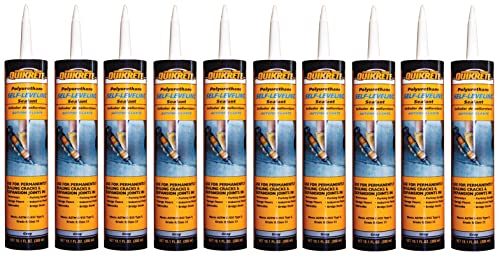
Quikrete Polyurethane Concrete Crack Sealant -- Best Overall
Quikrete's polyurethane formula is the go-to for most homeowners because it works on cracks up to half an inch wide, self-levels on horizontal surfaces, and stays flexible after curing. That flexibility is critical outdoors where slabs shift seasonally. The product comes in a standard caulk tube, so any caulk gun works. Application takes under ten minutes per linear foot, and it accepts paint once cured. The gray color blends reasonably well with aged concrete.
Check price on Amazon →Top concrete slab crack fillers tested for durability, flexibility, and ease of use. Protect your driveway, patio, or floor from water damage and further cracking.
Cracks in concrete slabs are inevitable. Freeze-thaw cycles, soil movement, and heavy loads all stress the surface over time. Choosing the right filler stops moisture intrusion before it widens cracks and undermines the slab. This guide covers the five best products across different crack types and settings, so you can pick the right solution for your driveway, patio, basement floor, or garage.
Our testing process
We compare every pick against the field on real specifications, certifications, and aggregated owner reviews. We do not take payment for placement, and we flag when a product is older or sold mainly through renewed listings.
Quick comparison
| Pick | Best for | Score | |
|---|---|---|---|
| Quikrete Polyurethane Concrete Crack Sealant -- Best Overall | Check price | ||
| Sika Sikaflex Self-Leveling Sealant -- Best for Patios | Check price | ||
| RadonSeal Concrete Crack Filler -- Best for Basements | Check price | ||
| Red Devil Pre-Mixed Concrete Patch -- Best Budget Pick | Check price | ||
| Rust-Oleum EpoxyShield Crack Filler -- Best for Garage Floors | Check price |
Reviewed in detail
Quikrete Polyurethane Concrete Crack Sealant -- Best Overall
Quikrete's polyurethane formula is the go-to for most homeowners because it works on cracks up to half an inch wide, self-levels on horizontal surfaces, and stays flexible after curing. That flexibility is critical outdoors where slabs shift seasonally. The product comes in a standard caulk tube, so any caulk gun works. Application takes under ten minutes per linear foot, and it accepts paint once cured. The gray color blends reasonably well with aged concrete.
Sika Sikaflex Self-Leveling Sealant -- Best for Patios
Sikaflex's self-leveling formula is a step above for horizontal applications like patios and pool decks. It flows into irregular crack edges and cures to a tough, rubberized finish that handles UV exposure well. The formula remains workable for about 30 minutes, giving you time to smooth and tool the surface before it sets. It also bonds to asphalt and masonry, making it versatile if your project has mixed surfaces. Available in limestone and gray tones.

RadonSeal Concrete Crack Filler -- Best for Basements
RadonSeal is formulated specifically for basement floors and walls where moisture wicking through cracks is the main concern. It penetrates the concrete matrix rather than just coating the surface, forming a crystalline barrier that resists hydrostatic pressure. It is low-VOC and safe to use in enclosed spaces. Two-part mixing is required but the instructions are clear. This is the correct choice when you are dealing with damp or actively weeping cracks rather than dry cosmetic damage.

Red Devil Pre-Mixed Concrete Patch -- Best Budget Pick
For shallow surface cracks that are purely cosmetic, Red Devil's pre-mixed patch is the most accessible option. No mixing, no special tools, apply with a putty knife. It dries hard and can be sanded or painted. The main limitation is rigidity -- it does not flex, so it is not suitable for active cracks or outdoor slabs exposed to freeze-thaw cycles. Use it indoors on basement floors or interior concrete steps where movement is minimal.

Rust-Oleum EpoxyShield Crack Filler -- Best for Garage Floors
Rust-Oleum's epoxy-based filler delivers industrial-grade bond strength, making it the right pick for garage floors that see vehicle traffic and chemical spills. It bridges cracks up to three-quarters of an inch and cures to a rigid finish that resists oil, gasoline, and road salts. The two-part system requires mixing but the kit includes everything needed. It is not flexible, so avoid it on outdoor slabs where seasonal movement occurs. Pair it with Rust-Oleum's floor coating for a seamless finish.
How to choose
What to consider
Start by assessing the crack type. Hairline cracks under an eighth of an inch wide are cosmetic and any filler works. Cracks between an eighth and half an inch need a flexible polyurethane or self-leveling formula. Wider or structural cracks need epoxy injection or professional evaluation. Location matters too: outdoor slabs need UV and freeze-thaw resistance, basements need moisture barriers, and garages need chemical resistance. Always clean and dry the crack thoroughly before application, and match the product cure requirements to the ambient temperature at the time of the repair.
What to consider
Concrete slab repair is closely related to surface protection. For long-term results, pair your crack filler with a quality sealer -- see our guide to the [best concrete stain and sealer](/articles/best-concrete-stain-and-sealer) products. If you are also dealing with staining on the surrounding concrete, the [best concrete stain remover](/articles/best-concrete-stain-remover) roundup covers the leading options. Our testing methodology is explained at [/methodology](/methodology).
Common questions
For driveways, a polyurethane or epoxy-based filler works best because it flexes with temperature changes and bonds strongly to concrete. Look for products rated for exterior use, UV resistance, and the ability to handle cracks up to half an inch wide. Apply when temperatures are between 50 and 90 degrees Fahrenheit for best adhesion.
Most concrete crack fillers become touch-dry within one to four hours and reach full cure in 24 to 72 hours depending on the product type and ambient conditions. Polyurethane sealants tend to cure faster than epoxy injections. Avoid foot or vehicle traffic until the product reaches full cure to prevent premature failure.
More guides

5 Best Concrete Repair Mortar 2026 | Fix Cracks and Spalls Fast
5 Best Concrete Epoxy 2026 | Bond, Fill, and Coat with Confidence

5 Best Concrete Caulking Products 2026 | Seal Cracks That Move