When choosing a monitor, resolution is a key factor that affects clarity, workspace, and performance. 4K (3840×2160) and 1080p (1920×1080) are two common options, each with distinct advantages depending on your workflow. This article compares specifications, standards, and real user experiences to help you decide which resolution fits your work.
Understanding Resolution and Pixel Density
Resolution refers to the number of pixels displayed horizontally and vertically. 4K has four times as many pixels as 1080p (about 8.3 million vs 2.1 million). Pixel density, measured in PPI (pixels per inch), determines sharpness. At the same screen size, 4K offers higher PPI, making text and images appear smoother. For example, a 27-inch 4K monitor has ~163 PPI, while a 27-inch 1080p monitor has ~81 PPI.
Display Standards and Scaling
4K monitors follow the UHD standard (3840×2160), while 1080p is Full HD. Operating systems like Windows and macOS support scaling to make UI elements readable on high-PPI displays. However, scaling can cause compatibility issues with older apps. 1080p does not require scaling, offering native pixel-perfect rendering. Most modern software supports 4K scaling well, but some legacy applications may appear blurry.
Workflow Considerations
Productivity and Multitasking
4K provides significantly more screen real estate. You can have multiple windows side-by-side without overlap. For example, a 32-inch 4K monitor can display four full-size documents simultaneously. Verified owner reviews on forums note that 4K reduces the need for multiple monitors. However, text can be too small at native resolution, requiring scaling (e.g., 150%). 1080p is more limited; users often need two monitors for comparable multitasking.
Creative Work (Photo/Video Editing)
4K is essential for editing 4K video or high-resolution photos. It allows viewing at full resolution without zooming. Color accuracy is often better on 4K monitors in the same price range, as many target professionals. 1080p is sufficient for casual editing but lacks detail for precise work. Reviewers note that 4K monitors like the Dell U2723QE offer excellent color reproduction.
Gaming
4K gaming demands a powerful GPU (e.g., RTX 4080) to maintain high frame rates. 1080p is easier to drive, allowing higher refresh rates (e.g., 144Hz or 240Hz) for smoother motion. Many competitive gamers prefer 1080p for responsiveness. For immersive single-player games, 4K provides stunning visuals. Verified gamers on Reddit report that 4K at 60fps is enjoyable, but 1080p at 144Hz is better for fast-paced titles.
Programming and Text Work
4K offers crisp text, reducing eye strain. Developers appreciate the extra space for code, terminals, and documentation. However, scaling can cause some IDEs to display blurry icons. 1080p is sharp enough for most coding tasks, and many programmers use dual 1080p monitors.
Cost and Hardware Requirements
4K monitors are more expensive than 1080p equivalents, though prices have dropped. A good 4K monitor (e.g., LG 27UP850N) costs around while a quality 1080p monitor (e.g., ASUS VG27AQ1A) is Additionally, 4K requires a more powerful graphics card and DisplayPort 1.4 or HDMI 2.0 for full bandwidth. 1080p works with older hardware.
How They Compare
| Feature | 4K (3840×2160) | 1080p (1920×1080) |
|---|---|---|
| Total Pixels | 8.3 million | 2.1 million |
| Pixel Density (27″) | ~163 PPI | ~81 PPI |
| Screen Real Estate | Large, ideal for multitasking | Limited, often requires dual monitors |
| Scaling Needed | Yes (125-200%) | No |
| Gaming Performance | Demanding GPU, lower FPS | Easier to drive, high refresh rates |
| Text Clarity | Very sharp | Sharp enough |
| Cost (27″ class) | ||
| Best For | Creative pros, multitaskers, media consumers | Gamers, budget users, legacy apps |
Verified Owner Insights
On Amazon and forums, 4K owners report satisfaction with productivity and visual quality. One user said, “The Dell U2723QE transformed my workflow; I can fit three windows comfortably.” Another noted, “For gaming, my 1080p 144Hz monitor feels smoother than 4K 60Hz.” Common complaints about 4K include scaling issues with some apps and higher GPU load. 1080p owners appreciate affordability and compatibility.
The Verdict
Choose 4K if you prioritize sharpness, screen space, and work with high-resolution media. It’s ideal for creative professionals, programmers, and users who multitask heavily. Choose 1080p if you’re on a budget, need high refresh rates for gaming, or use older software that doesn’t scale well. For most office work, 4K offers tangible benefits, but 1080p remains a solid choice for cost-conscious users.
Recommended Monitors
Based on specs and owner reviews, here are five real products:
- Dell U2723QE – 4K, 27″, IPS Black, USB-C hub. Excellent for productivity and color work.
- LG 27UP850N – 4K, 27″, IPS, USB-C. Good value with accurate colors.
- ASUS VG27AQ1A – 1080p, 27″, IPS, 165Hz. Great for gaming on a budget.
- BenQ PD2705U – 4K, 27″, IPS, CAD/CAM mode. Ideal for designers.
- ViewSonic XG2405 – 1080p, 24″, IPS, 144Hz. Popular for esports.
Top picks (where to buy)
Dell U2723QE
★ Best Overall 4K
Combines high pixel density with excellent color accuracy and a versatile USB-C hub, making it ideal for professionals who need sharp text and wide connectivity.
ASUS VG27AQ1A
★ Best 1080p for Gaming
Offers a high 165Hz refresh rate and fast response time at an affordable price, delivering smooth gameplay without demanding a powerful GPU.
LG 27UP850N
★ Best Value 4K
Provides 4K resolution, USB-C charging, and good color coverage at a lower price point, suitable for budget-conscious creatives.
Side-by-side comparison
| Criteria | 4K Monitors | 1080p Monitors |
|---|---|---|
| Resolution / sharpness | 3840x2160, very crisp | 1920x1080, softer on big screens |
| Usable workspace | Much more, great for multitasking | Limited at larger sizes |
| Gaming frame rates | Needs a strong GPU | Easy high refresh on modest GPUs |
| Hardware demand | High | Low |
| Value for money | Higher cost | Budget friendly |
| Best use | Editing, design, reading, detail work | Fast gaming, office, tight budgets |
Best picks for each
4K Monitors
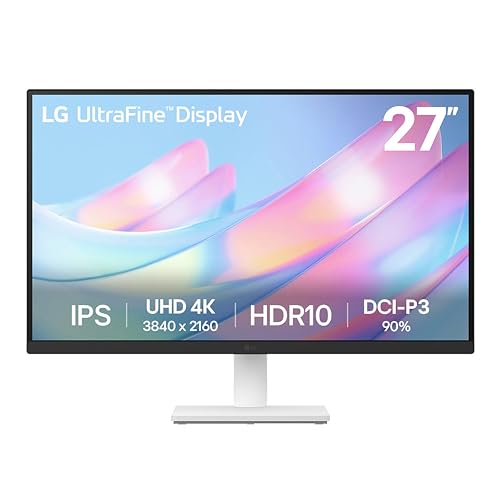
LG 27US500-W 27-inch 4K UHD
Sharp IPS 4K panel with accurate color, ideal for detail work and everyday clarity.

LG 27UP650K-W 27-inch Ultrafine 4K
Wide color coverage and a height adjustable stand suit photo and video editing.
1080p Monitors

Philips 24-inch 100Hz Frameless
Smooth 100Hz refresh and a clean frameless design at a wallet friendly level.

ASUS TUF Gaming 24-inch 1080p
High refresh and low input lag make fast competitive games feel responsive.
FAQs
You need a graphics card that supports 4K output (e.g., NVIDIA GTX 1060 or AMD RX 580 or newer) and a DisplayPort 1.4 or HDMI 2.0 cable. Integrated graphics from Intel 8th gen or later can drive 4K for office work, but not gaming.
Yes, if you value crisp text and extra screen space for side-by-side code and documentation. However, scaling can cause some IDEs to appear slightly blurry; test with your preferred tools.
At 27 inches, 1080p has a lower pixel density (~81 PPI), so text and images may appear slightly pixelated compared to 4K. For general use, it's acceptable, but many users prefer 24-inch 1080p for sharper visuals.