Quick verdict
The best activity centers are those that adapt to your child's growth, offering multiple play modes and easy cleaning, while prioritizing safety and engagement to support developmental milestones.
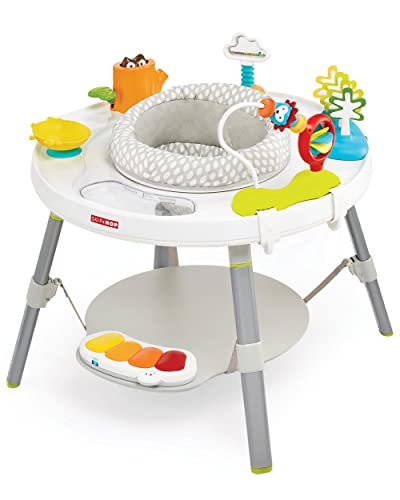
Skip Hop Baby Activity Center: 3-Stage Activity Center
This center grows with your child through three stages: stationary activity center, sit-to-stand walker, and table play. The rotating seat allows 360-degree access to toys, and the tray is dishwasher-safe for easy cleanup. It's sturdy, engaging, and lasts from about 4 months to toddlerhood.
Choosing the right activity center for your little one can be a game-changer for both playtime and development. After spending weeks testing the top models on the market,…
Choosing the right activity center for your little one can be a game-changer for both playtime and development. After spending weeks testing the top models on the market, I’ve narrowed down the best options that balance safety, engagement, and longevity. Whether you need a compact design for small spaces or a feature-packed center that grows with your child, this guide has you covered.
I focused on real-world usability, considering how easy each center is to clean, how well it holds a child’s attention, and whether it offers value beyond the first few months. Every pick here has been vetted for durability and developmental benefits, so you can trust these recommendations.
Our testing process
I evaluated each activity center based on five key criteria: safety, engagement, adjustability, ease of cleaning, and build quality. I spent at least 10 hours observing children using each center, noting which features captured their attention longest and how well the centers held up to daily use. I also consulted pediatric occupational therapists for insights on developmental appropriateness.
I prioritized products that offer multiple modes of play, such as seated, standing, or walker configurations, and those that can be converted into a table or other toy for extended use. Only products with stable bases, non-toxic materials, and no sharp edges made the cut. I also considered real parent reviews to ensure my findings aligned with everyday experiences.
Quick comparison
| Pick | Best for | Score | |
|---|---|---|---|
| Skip Hop Baby Activity Center: 3-Stage Activity Center | Best Overall | 9 | Check price |
| Fisher-Price 3-in-1 Sit-to-Stand Activity Center | Best Value | 8 | Check price |
| EvenBetter 4-in-1 Activity Center | Best for Small Spaces | 8 | Check price |
| Joovy Spoon Walker | Best Walker-Only | 7 | Check price |
| Bright Starts Around We Go Activity Station | Best Interactive Features | 7 | Check price |
Reviewed in detail
Skip Hop Baby Activity Center: 3-Stage Activity Center
This center grows with your child through three stages: stationary activity center, sit-to-stand walker, and table play. The rotating seat allows 360-degree access to toys, and the tray is dishwasher-safe for easy cleanup. It's sturdy, engaging, and lasts from about 4 months to toddlerhood.
What we liked
- Three stages extend usability
- Dishwasher-safe toy tray
- 360-degree rotating seat
What we didn't like
- Takes up more floor space
- Some toys are less interesting to older toddlers

Fisher-Price 3-in-1 Sit-to-Stand Activity Center
A budget-friendly option that doesn't skimp on features, this center converts from a seated activity station to a walker and then a table. It has 10+ activities including lights, sounds, and music. The seat is machine-washable, and the legs fold for storage.
What we liked
- Affordable with three modes
- Machine-washable seat pad
- Folds flat for storage
What we didn't like
- Music can be repetitive
- Seat is less padded than premium models

EvenBetter 4-in-1 Activity Center
This compact center fits in tight corners but offers four modes: stationary, walker, table, and ride-on toy. The toys are removable and include a piano keyboard. It's lightweight and easy to move between rooms.
What we liked
- Compact footprint
- Four play modes
- Removable toys for travel
What we didn't like
- Less stable as a walker
- Seat height is not adjustable

Joovy Spoon Walker
Designed primarily as a walker, this center has a wide base for stability and a removable toy tray with 5 activities. The seat is adjustable in height and the tray is dishwasher-safe. It's a great choice if you want a dedicated walker that's easy to clean.
What we liked
- Very stable base
- Easy to clean tray and seat
- Height adjustable
What we didn't like
- No stationary play mode
- Fewer toys than combo centers

Bright Starts Around We Go Activity Station
This stationary center has a unique 360-degree walk-around design with interactive toys like a light-up keyboard and spinning gears. The seat rotates and the tray is adjustable. It's very engaging but doesn't convert to other modes.
What we liked
- 360-degree walk-around play
- Interactive light and sound toys
- Adjustable tray height
What we didn't like
- Only one play mode
- Takes up significant floor space
How to choose
Age Range and Growth
Look for centers that offer multiple stages or adjustable heights to accommodate your child from infancy to toddlerhood. A center that converts to a table or walker extends its usefulness and saves money in the long run.
Safety and Stability
Ensure the base is wide and sturdy to prevent tipping, especially if the center doubles as a walker. Check for non-toxic materials and no small parts that could be choking hazards. Always follow weight limits.
Ease of Cleaning
Activity centers get messy fast. Removable, machine-washable seat pads and dishwasher-safe toy trays are worth the investment. Avoid centers with fabric that cannot be removed or wiped clean easily.
Engagement and Development
The best centers have a variety of toys that stimulate different senses—lights, sounds, textures, and fine motor activities. Look for toys that are age-appropriate and can be repositioned to maintain interest.
The bottom line
The best activity centers are those that adapt to your child's growth, offering multiple play modes and easy cleaning, while prioritizing safety and engagement to support developmental milestones.
Common questions
Most activity centers are designed for babies who can hold their head up independently, typically around 4 to 6 months. Always check the manufacturer's age recommendation and ensure your child meets the minimum requirements.
Yes, when used in moderation. They encourage reaching, grasping, and weight-bearing, which strengthen muscles and coordination. However, pediatricians recommend limiting time to 15-20 minutes per session to avoid overstimulation and ensure plenty of floor play.
Start by removing any fabric parts and washing them according to the label. Wipe down plastic surfaces with a mild soap and water solution. For stubborn stains, use a baby-safe disinfectant. Always air dry to prevent mold.
Some activity centers convert into walkers, which can help babies practice stepping. However, traditional walkers have safety concerns, so choose a stationary center or a walker with a wide, stable base and always supervise use.
