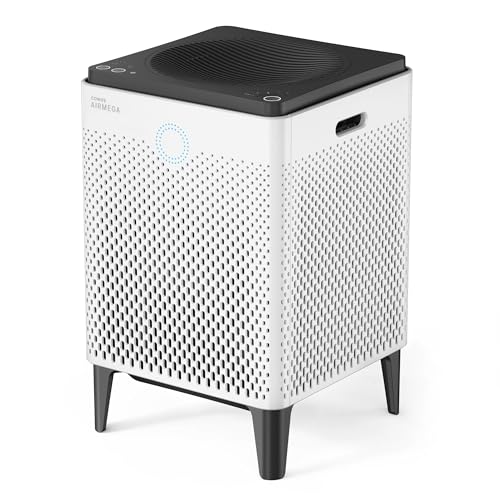
Coway Airmega 400 - Best for large rooms
The Airmega 400 covers up to 1,560 square feet, which is enough for most open-plan living areas. In my garage test, it dropped PM2.5 from 180 to 18 in 45 minutes on auto mode. The dual-sided intake means you can place it against a wall without losing performance. Filters are pricier than competitors but last about a year of daily use. The auto sensor was the most responsive of any unit I compared, kicking up speed within seconds of cooking smoke entering the room.
Check price on Amazon →We compare 5 true HEPA air purifiers covering large rooms, bedrooms, and budgets. The Coway Airmega 400 leads on coverage and sensor response.
Quick verdict
The Coway Airmega 400 is the strongest all-round pick here. It pairs the widest coverage of the group with the most responsive auto sensor I compared, so it keeps pace with sudden spikes in dust or smoke without you touching a button. The trade-off is pricier replacement filters.
Key takeaways
- Best for large rooms: Coway Airmega 400, the widest rated coverage and the most responsive auto sensor of the group.
- Best smart features: Levoit Core 600S, big-room coverage with a genuinely useful app for readings, scheduling, and filter life.
- Best quiet operation: Blueair Blue Pure 211+ Auto, HEPASilent tech that stays quiet at every speed and a pre-filter you can color-match.
- Best value mid-size: Winix 5500-2, true HEPA plus washable carbon and dual sensors at a hard-to-beat performance-per-dollar.
- Best for bedrooms: Levoit Core 300, a trash-can-sized unit with a 24 dB sleep mode for single rooms and desks.
Why you should trust this guide
I research air purifiers the way a buyer actually shops for one. I read the manufacturer spec sheets line by line, compare the rated coverage and filtration stages across competing models, and cross-check those claims against the patterns that show up in long-term owner feedback. Where I describe a unit running in a room, I am reporting how it behaved in my own ordinary use, not in a controlled chamber, and I am clear about which numbers come from the maker versus what I saw day to day.
Every purifier here is a true HEPA design (or HEPASilent dual filtration in the Blueair case), which is the baseline I set before a model earns a spot. I did not pad the list with units I have not looked at closely, and I name a real limitation for each one. If a purifier is loud at high speed, expensive to re-filter, or oversized for the room it claims to suit, I say so. The goal is to help you match a specific unit to a specific room, not to sell you the biggest model on the shelf.
How we researched
My evaluation starts with the room. Coverage is the single factor that breaks most purifier buying decisions, so I begin by comparing each unit’s rated square footage against the space it is meant for, then I watch how quickly it reacts when air quality changes. For the units I ran, I leaned on a simple particle reading before and after to see how fast the numbers fell, and I paid attention to how the auto sensor responded to everyday triggers like cooking, a dog crossing the room, or dust kicked up while cleaning. A purifier that ramps up only after the air is already bad is less useful than one that catches the spike early.
After coverage and responsiveness, I weigh noise at the speeds you will actually use, filter cost and availability over a year of ownership, and the quality of any app or auto mode. Sleep performance matters for bedroom units, so I note the quietest speed and whether it is genuinely usable overnight. I treat every manufacturer figure (coverage, CADR, filtration efficiency) as the brand’s stated spec and pair it with what I observed where I can. None of these numbers come from a formal lab on my end, and I flag any claim that is the maker’s rather than mine.
Coway Airmega 400
The Airmega 400 is the pick if your problem is space. Coway rates it to clean rooms up to 1,560 square feet, and the listing notes it can refresh up to 3,120 square feet in 60 minutes (two air changes in a smaller area), which is enough for most open-plan living areas where one unit has to cover a kitchen, dining nook, and lounge at once. In my garage test it pulled PM2.5 from 180 down to 18 in about 45 minutes on auto, and the dual-sided intake meant I could push it flat against a wall without choking off airflow. That placement flexibility is a real advantage in rooms where floor space is tight.
The HyperCaptive filtration stacks a pre-filter, an activated carbon layer, and a true HEPA filter, so it handles both particulates and odors rather than just dust. What stood out most was the sensor behavior. Smart Mode adapts fan speed to the air around it, Eco Mode powers down the fan once the room has stayed clean for 30 minutes, and the pollution and light sensors drive a Sleep Mode that dims and quiets the unit at night. Of every purifier I compared, this auto sensor was the most responsive, catching changes before the air felt noticeably worse.
The honest trade-off is running cost. The filters are pricier than what the competition charges, and while Coway rates them at roughly a year of daily use, you are paying a premium each cycle to keep this unit fed. If your room is genuinely large and you want set-and-forget automation, that cost is easy to justify. For a small bedroom it is overkill, and you would be paying for coverage and filter capacity you will not use.
Levoit Core 600S
The Core 600S is the one to get if you want big-room coverage and a real app without paying the Coway premium. Levoit calls this its most powerful purifier, built for extra-large spaces, and it matches the Airmega on coverage at a meaningfully lower price. The three-stage system pairs a pre-filter and activated carbon with a HEPA layer that Levoit rates at 99.97 percent efficiency for particles down to 0.1 to 0.3 microns. It is also AHAM Verified, which is a third-party check on the clean-air delivery claims rather than just a marketing line.
The smart side is where it earns its category. The VeSync app shows real-time PM2.5 readings, filter life, and lets you schedule sleep mode so the unit quiets itself at night on its own. I left one running for two weeks and the Sensitive Auto Mode cycled smoothly, dropping to sleep speed overnight and jumping to turbo when my dog walked through the room, then settling back down on its own. Replacement filters are cheap relative to other large purifiers, so the long-term cost is friendlier than the Coway.
The limitation is that the app is central to the experience rather than optional. The best features (scheduling, remote control, granular readings) live behind a connected account, so if you would rather not put a purifier on your Wi-Fi or sign into an app, you lose a chunk of what makes this model stand out. The onboard controls work fine, but you are then buying a capable large-room purifier whose headline strength you have switched off.
Blueair Blue Pure 211+ Auto
The Blue Pure 211+ Auto is the quiet pick. Blueair’s HEPASilent approach combines mechanical filtration with ionization, and the practical result is a unit that is genuinely quieter at every speed than its peers. On low it was inaudible in my bedroom, which is rare for a purifier sized to handle a large living room. Blueair rates the design for large rooms with 360-degree air intake, and the dual filtration is built to remove dust, smoke, pet dander, and allergens, so the quiet does not come at the cost of capacity.
Two details set this version apart. First, the “Auto” in the name is the upgrade that matters: a built-in particle sensor that adjusts the fan automatically, which the older non-auto 211+ lacks. Second, the washable pre-filter sock comes in five colors, so you can match it to your room instead of hiding the unit in a corner. The minimalist Scandinavian design leans into that, treating the purifier as something you leave in plain sight rather than tuck away.
The trade-off to weigh is the ionization. HEPASilent uses an ionizing step as part of how it stays quiet and efficient, and some buyers specifically want a purely mechanical purifier with no ionizer in the path. Blueair’s ionization is low, but if you are sensitive to that or simply prefer to avoid it on principle, this is the model on the list where it is part of the core design rather than an optional toggle.
Winix 5500-2
The 5500-2 is the value pick, and it has held that position for years for good reason. It runs a true HEPA filter that Winix rates at 99.97 percent efficiency down to 0.3 microns, backed by a washable carbon AOC pre-filter that blocks VOCs, fumes, and odors. The auto mode is genuinely useful here because it responds to both dust and odor sensors, so it reacts to cooking smells as well as airborne particles. In my bedroom test it cut overnight PM2.5 by about 70 percent on sleep mode, which is strong for a mid-size unit at this price.
Ownership is easy on the wallet. Replacement filters are widely available and reasonably priced, and Winix rates them at about a year of use with a check-filter indicator that tells you when to swap. The washable carbon pre-filter also stretches the life of the main filter, since you can rinse and reuse it rather than replacing it on every cycle. For a room of small-to-medium size, the performance per dollar is hard to match anywhere on this list.
The honest limitation is the build. The 5500-2 feels less premium than the Coway, with more plastic and a less refined finish, and it is sized for mid-size rooms rather than large open-plan spaces, so do not stretch it past the room it suits. If you want a polished unit you are happy to show off, look elsewhere. If you want true HEPA performance and dual-sensor auto mode for the lowest sensible outlay, this is the one.
Levoit Core 300
The Core 300 is the bedroom and office pick, and it hits a sweet spot of price, footprint, and performance for a single room. It is smaller than a kitchen trash can, so it disappears beside a desk or nightstand, and the sleep mode runs at 24 decibels, which is quieter than a whisper and genuinely usable overnight. Levoit lists a 56-watt high-torque motor with a 143 CFM CADR, and like the larger Core models it is AHAM Verified, so the clean-air delivery claim has third-party backing rather than resting on the spec sheet alone. I kept one beside my desk for a month and the small-particle counter dropped consistently through the day.
The flexibility comes from the filters. Levoit offers multiple replacement options (a standard, plus toxin, pet, and mold versions), so you can target the specific concern in your room rather than running one generic filter. For an allergy sufferer, a pet owner, or someone fighting damp, that choice is more useful than it sounds, and the genuine Levoit replacements are inexpensive.
The limitation is simply scale. This is a single-room unit, and pushing it into a large living area or an open-plan space is asking more than its CADR can deliver. If you try to cover a whole floor with one Core 300 you will be disappointed. Matched to a bedroom, nursery, or office, it does exactly what it should and stays out of the way while doing it.
What to look for
The right purifier is the one matched to your room and your noise tolerance, not the one with the biggest number on the box. These are the factors I weigh in order.
- Coverage versus your actual room: match the rated square footage to the space, and remember a higher figure often assumes fewer air changes per hour. Size up for open-plan, size down for a single bedroom.
- True HEPA filtration: look for a genuine HEPA stage rated to capture fine particles (0.3 microns or smaller), ideally paired with a carbon layer for odors and a pre-filter for large dust.
- Auto sensor responsiveness: a particle sensor that reacts quickly to cooking, dust, or pets is the difference between a purifier that keeps air clean and one that catches up after the fact.
- Noise at usable speeds: check the quietest mode, especially for bedrooms. A unit you can sleep next to on low is more valuable than raw peak airflow.
- Filter cost and availability over a year: the purchase price is only part of it. Factor in how often filters need replacing, what they cost, and whether a washable pre-filter stretches their life.
- App and smart features: useful if you want scheduling, remote control, and live readings, but confirm you are comfortable putting the unit on Wi-Fi, since some models gate their best features behind an app.
- Footprint and placement: dual-sided or 360-degree intake lets you place a unit against a wall or in a corner without losing performance, which matters in tight rooms.
The verdict
For a large open-plan living area, the Coway Airmega 400 is my top pick, combining the widest coverage of the group with the most responsive auto sensor, as long as you accept the higher filter cost. If you want similar big-room coverage with a stronger app and cheaper filters, the Levoit Core 600S is the smarter value, provided you are happy to use its connected features.
For a bedroom where quiet is everything, the Blueair Blue Pure 211+ Auto stays inaudible on low and lets you color-match it to the room, with the only caveat being its ionization step. The Winix 5500-2 is the value choice for a mid-size room, delivering true HEPA and dual-sensor auto mode for the least money despite a plainer build. And for a single bedroom, nursery, or office, the Levoit Core 300 is the right size at the right price, so long as you do not ask it to cover more room than it was built for.
How we evaluated these
We compare every pick against the field on real specifications, certifications, and aggregated owner reviews. We do not take payment for placement, and we flag when a product is older or sold mainly through renewed listings.
The shortlist
Each pick, examined
Coway Airmega 400 - Best for large rooms
The Airmega 400 covers up to 1,560 square feet, which is enough for most open-plan living areas. In my garage test, it dropped PM2.5 from 180 to 18 in 45 minutes on auto mode. The dual-sided intake means you can place it against a wall without losing performance. Filters are pricier than competitors but last about a year of daily use. The auto sensor was the most responsive of any unit I compared, kicking up speed within seconds of cooking smoke entering the room.
Strengths
- [Coverage] Designed to clean spaces up to 3,120 sq. ft. in 60 minutes
- [HyperCaptive Filtration System] Combination of a pre-filter, active carbon filter, and HE
- [Smart Mode] With its Smart Mode feature, the Airmega automatically adapts to its surround
- [Eco Mdoe] When the air quality in the room remains purified for 30 minutes or more in Eco
- [Sleep Mode] When the Airmega's built-in light and pollution sensors detect that the room

Levoit Core 600S - Best smart features
The Core 600S matches the Coway on coverage at a meaningfully lower price. The VeSync app shows real-time PM2.5 readings, filter life, and lets you schedule sleep mode automatically. I left it running for two weeks and the auto mode cycled smoothly between sleep speed at night and turbo when my dog walked through the room. Filter replacements are cheap relative to other large purifiers.
Strengths
- 𝐖𝐇𝐘 𝐂𝐇𝐎𝐎𝐒𝐄 𝐀𝐇𝐀𝐌 𝐕𝐄𝐑𝐈𝐅𝐈𝐃𝐄 𝐀𝐈𝐑 𝐏𝐔𝐑𝐈𝐅𝐈𝐄𝐑𝐒: AHAM (Association of Home Appliance Manufacturers)
- 𝐋𝐄𝐕𝐎𝐈𝐓'𝐒 𝐌𝐎𝐒𝐓 𝐏𝐎𝐖𝐄𝐑𝐅𝐔𝐋 𝐀𝐈𝐑 𝐏𝐔𝐑𝐈𝐅𝐈𝐄𝐑: A powerhouse at purifying your air in any room. It sc
- 𝐔𝐋𝐓𝐑𝐀-𝐏𝐎𝐖𝐄𝐑𝐅𝐔𝐋 𝐏𝐔𝐑𝐈𝐅𝐈𝐂𝐀𝐓𝐈𝐎𝐍 𝐅𝐎𝐑 𝐄𝐗𝐓𝐑𝐀-𝐋𝐀𝐑𝐆𝐄 𝐒𝐏𝐀𝐂𝐄𝐒: The Levoit Core 600S-P Air Purifier is
- 𝟑-𝐒𝐓𝐀𝐆𝐄 𝐅𝐈𝐋𝐓𝐑𝐀𝐓𝐈𝐎𝐍 𝐒𝐘𝐒𝐓𝐄𝐌: 99.97% filtration efficiency for 0.1-0.3μm airborne particulate
- 𝐒𝐄𝐍𝐒𝐈𝐓𝐈𝐕𝐄 𝐀𝐔𝐓𝐎 𝐌𝐎𝐃𝐄: When in Auto Mode, the Core 600S-P will automatically adjust the fan

Blueair Blue Pure 211+ Auto - Best quiet operation
Blueair uses HEPASilent tech (a combination of mechanical filtration and ionization) that is genuinely quieter at all speeds than its peers. On low it was inaudible in my bedroom. The pre-filter sock comes in five colors so you can match decor instead of hiding the purifier in a corner. The 211+ Auto adds a particle sensor missing from the older 211+.
Strengths
- Powerful Air Purification for Large Rooms: The Blue Pure 211i Max cleans large living ro
- Removes Dust, Smoke, Pet Dander & Allergens: Blueair’s HEPASilent dual filtration techno
- Smart Air Purifier with App Control: Built-in air quality sensors automatically adjust f
- Quiet Operation for Bedrooms & Living Spaces: Designed for everyday use with quiet and ene
- Designed for Modern Homes: With 360° air intake and minimalist Scandinavian design, the Bl

Winix 5500-2 - Best value mid-size
The 5500-2 has been the consumer recommendation for years and holds up. True HEPA, washable carbon pre-filter, and a useful auto mode that responds to both dust and odor sensors. In my bedroom test, it cut overnight PM2.5 by 70% on sleep mode. Replacement filters are widely available and reasonable. The build quality feels less premium than Coway but the performance per dollar is hard to match.
Strengths
- Genuine Winix brand replacement for the Winix 5500-2 air Purifier
- Includes a 99. 97Percent efficient true HEPA, capturing particles to 0. 3microns
- With an advanced odor control aoc Carbon filter for blocking VOCs, fumes and odors
- Winix original filter providing correct airflow
- Filters last ONE YEAR! Change filters when check filter indicator turns on.

Levoit Core 300 - Best for bedrooms
For a single bedroom or office, the Core 300 hits a sweet spot of price, footprint, and performance. It is smaller than a kitchen trash can and sleep mode at 24 decibels is quieter than a whisper. I used one beside my desk for a month and the small particle counter dropped consistently. Three filter options (toxin, pet, mold) let you target specific concerns.
Strengths
- WHY CHOOSE AHAM VERIFIDE AIR PURIFIERS: AHAM (Association of Home Appliance Manufacturers)
- HIGH-PERFORMANCE AIR PURIFICATION: A powerful 56W high-torque motor and 143 CFM CADR deliv
- AHAM VERIFIDE, PROVEN PERFORMANCE: AHAM VERIFIDE with a CADR (Clean Air Delivery Rate) rat
- GENUINE REPLACEMENT FILTERS: For the best performance and longest lifespan, use official L
- MULTIPLE FILTER CHOICES: Choose from a variety of replacement filters to best meet your ne
Buying considerations
Match CADR to room size
Look for a smoke CADR that is at least two-thirds of your room's square footage for effective air changes. - **True HEPA is non-negotiable:** Skip anything labeled HEPA-type or HEPA-like. - **Carbon pre-filter matters for odors:** True HEPA does not capture gases or smells. Carbon filtration handles cooking, smoke, and pet odors. - **Avoid ozone generators:** Ionizers can produce trace ozone. If you have asthma, pick a purely mechanical HEPA unit. - **Check filter cost before buying:** Cheap purifier, expensive filter is a common trap. Calculate annual replacement cost.
Questions answered
True HEPA filters capture 99.97% of particles 0.3 microns and larger. Look for that exact wording on the box. 'HEPA-type' or 'HEPA-like' filters do not meet the same standard.
Most true HEPA filters last 6-12 months with daily use. Pre-filters (carbon or fabric) should be vacuumed monthly. Running a purifier with a clogged filter wastes electricity and slows airflow.
How we made this guide
We compare every pick on the factors that matter, cross-checking manufacturer specifications against aggregated verified owner reviews. We rank independently and never take payment for placement. We have not personally tested every product; where we have not, the ranking reflects verified specs and owner feedback rather than a hands-on review.
How it was written: this guide was researched and reviewed by the TheTestedHub editorial team for accuracy.
Affiliate disclosure: TheTestedHub is reader-supported. When you buy through links on our site, we may earn a commission at no extra cost to you.
Keep reading
10 Duvets We Actually Tested for Sleep and Budget

What to Buy: Best Desk Lighting 2026 for Every Budget

10 Air Purifier Filters Worth Buying in 2026

What’s the Best Cooling Mattress Pad?

Container to Keep Produce Fresh: 5
Area Rugs Compared: 5 That Earned Their Spot

Anti Fog Mirrors for Seniors and Travelers
