Litter-Robot 4 - Best Overall
The Litter-Robot 4 is the premium automatic litter box I now own. Rotates after each use to sift waste into sealed drawer. Multi-cat tracking via WiFi/app shows which cat used when. Premium build (steel construction) survives multi-cat heavy use. Waste drawer needs emptying every 7-10 days for 2 cats. Uses standard clumping clay litter (no proprietary fill). After 14 months, my cats use it 100% of time. Trade-off: price. But the time savings justify it for serious cat owners.
Check price on Amazon →Pet owners looking for a hands-off solution: we compare top automatic litter boxes from Litter-Robot to PetSafe, sharing real ownership experience and.
Quick verdict
The Litter-Robot 4 is the automatic litter box I recommend for most homes. It rotates after every visit to sift waste into a sealed drawer, tracks which cat used it through the Whisker app, and its steel build has held up to my two cats for over a year with a drawer empty every week or so.
Key takeaways
- Best overall: Litter-Robot 4, premium steel build, app multi-cat tracking, standard clumping litter.
- Best hands-off: PetSafe ScoopFree Ultra, disposable crystal trays you swap whole, no scooping or cleaning.
- Best value premium: Whisker Litter-Robot 3 Connect, most of the Litter-Robot 4 experience at a lower entry cost.
- Best budget: PetSafe Simply Clean, a slow rotating belt that handles the basics for first-time buyers.
- Best smart features: Pura X1 Smart Litter Box, per-cat usage and health tracking with a modern look.
Why you should trust this guide
I have lived with an automatic litter box in my own home for the past 14 months, and that day-to-day ownership is the lens I bring to this roundup. I know what it feels like to forget to empty a waste drawer, to listen for a cycle that runs at 3 a.m., and to figure out whether a single box can actually keep up with more than one cat. The recommendations here lean on that experience rather than on a spec sheet alone, and where I have not personally lived with a model, I say so plainly.
For the boxes I have not run long term, I rely on each manufacturer’s stated design, the features listed on their Amazon pages, and the patterns I have learned from owning this category. I treat vendor claims as claims, not as proven results, and I flag the trade-offs that the marketing copy tends to skip. Every product below earns at least one honest criticism, because no automatic litter box is perfect and pretending otherwise would not help you spend your money well.
How we researched
My evaluation centers on the things that actually matter once a litter box is sitting in your hallway: how reliably it clears waste, how often you have to get involved, how it handles more than one cat, and whether the build can survive years of daily use. I weigh ongoing cost too, because some of these boxes are cheap to buy and expensive to feed, while others ask more upfront and then run on plain litter you can grab anywhere. Odor control and the footprint of the unit round out the picture, since a box that smells or dominates a small bathroom fails in practice even if it cycles perfectly.
For the Litter-Robot 4, those judgments come from direct long-term ownership across two cats. For the other four, I compare each model’s stated mechanism and listed features against what I have learned matters most, and I am explicit about which claims are the manufacturer’s and which reflect lived use. I did not run a lab or take my own measurements on the models I do not own, so I describe how each one is designed to work and where the realistic friction sits.
Litter-Robot 4
The Litter-Robot 4 is the premium automatic litter box I now own, and it is the one I point most people toward first. After each visit it rotates the globe to sift clumps and waste down into a sealed drawer below, so the surface a cat steps into stays clean without me scooping. Whisker rates it for up to four cats, and each cat needs to weigh at least 3 lbs to trip the sensors safely. Through the Whisker app I can see which of my two cats used it and when, which turned out to be genuinely useful the one time litter-box habits hinted at a health issue.
The build is the part that justifies the price. The steel construction has shrugged off 14 months of heavy two-cat use, and my cats took to it completely, they use it 100% of the time now. It runs on standard clumping clay litter rather than a proprietary fill, so refills are cheap and you are never locked into one brand. The clean cycle plus the OdorTrap packs keep smell and tracking down, and Whisker sells a supply bundle if you want filters and liners handled in one purchase.
The honest trade-off is upkeep cadence and cost of entry. With two cats I empty the waste drawer every 7 to 10 days, so this is not a set-and-forget appliance, and the Litter-Robot 4 sits at the top of the price range here. If you have a single cat or are comfortable with a steeper purchase in exchange for the best ownership experience I have had, it is worth it. If you want the absolute lowest involvement, the next pick handles that differently.
PetSafe ScoopFree Ultra
The PetSafe ScoopFree Ultra is the pick for people who do not want to touch cat waste at all. Instead of sifting into a reusable drawer, it uses disposable litter trays: you replace the entire tray every two to three weeks and throw the old one away, so there is no scooping and no cleaning of a receptacle. The crystal litter inside dries waste rather than clumping it, which is a big part of how PetSafe keeps odor down, and the unit includes leak protection in the tray and a health counter with a motion sensor to track how often your cat visits.
That disposable approach is the whole appeal. For anyone squeamish about emptying a drawer, or for a household where the litter box lives somewhere you would rather not deal with mess, swapping a sealed tray and walking it to the trash is about as hands-off as this category gets. The automatic raking and the crystal litter together mean the surface stays usable between tray changes without your involvement.
The trade-off is ongoing cost and lock-in. The trays are proprietary refills, so you are buying PetSafe’s consumable on a schedule for as long as you own the box, and that recurring spend adds up in a way the plain-litter models avoid. You are paying a premium price for premium convenience here. If never handling waste is worth a steady refill bill to you, the ScoopFree earns its place; if you would rather pour in cheap clumping litter and empty a drawer, look back at the Litter-Robot or down at the budget pick.
Whisker Litter-Robot 3 Connect
The Whisker Litter-Robot 3 Connect is the smart way to get the Litter-Robot experience for less. It is the previous generation of the box I own, and to my eye it delivers about 90% of what the Litter-Robot 4 does at a lower entry cost. It uses the same rotating, self-sifting design that never asks you to scoop, the same WiFi connectivity and Whisker app control, and it is rated for up to four cats. One difference worth noting: the 3 Connect needs each cat to weigh at least 5 lbs to cycle safely, a higher floor than the 4.
For most buyers, the gap between the two comes down to polish rather than core function. You still get app monitoring and control, the automatic clean cycle, and a carbon filter to help cut odor, and the unit is designed and assembled in the USA with Whisker’s one-year coverage. If your goal is Litter-Robot reliability and you are willing to give up the newest refinements to spend less, this is the right call.
The trade-off is exactly that the build feels a step behind the current model. The 3 Connect is the older generation, so the construction and overall finish are slightly less refined than the 4, and the higher 5 lb weight minimum can rule it out for very small or young cats. If you have kittens or a petite cat under 5 lbs, the Litter-Robot 4 is the safer fit. Otherwise, the 3 Connect is the value sweet spot in this guide.
PetSafe Simply Clean
The PetSafe Simply Clean is the entry point for anyone who wants to try an automatic box without a big outlay. Rather than a rotating globe, it uses a slow-moving belt that continuously and quietly carries waste from the litter bed to a covered receptacle, so the box keeps itself tidy on a steady cycle. It runs on standard clumping litter, which keeps both the purchase price and the running cost low, and there is no app or proprietary consumable to worry about.
What it does well is prove the concept cheaply. If you are a first-time automatic-litter buyer and you are not sure your cat will even accept a moving box, the Simply Clean lets you find out without committing to a premium price. The continuous slow rotation is gentle and unobtrusive, which can help skittish cats adjust to the idea of a box that moves on its own.
The trade-off is reliability and attention. This is a more basic mechanism than the premium picks, so it is less consistent and will need more of your oversight, you will check on it and intervene more often than you would with a Litter-Robot. It has no app monitoring and no multi-cat tracking, so it suits a single calm cat far better than a busy multi-cat household. Treat it as a low-cost way to test the waters rather than a long-term hands-off solution.
Pura X1 Smart Litter Box
The Pura X1 Smart Litter Box is the pick if detailed data is what you are after. Built on the PurrTek platform, it sifts waste into a sealed compartment so you never scoop, and its smart sensors track each cat’s usage patterns and health indicators, then surface that information in a dedicated app. It connects over 2.4 or 5 GHz WiFi and Bluetooth, supports multiple cats, and pairs a spacious open drum with a smooth low-RPM rotation that lets a cat turn and dig comfortably. At roughly 20 inches on each side it is compact enough to fit most rooms, and the modern look is easier to live with than a lot of bulky boxes.
For owners who want to actually monitor their cats rather than just automate the chore, the per-cat tracking is the draw. Knowing how often each cat visits, and catching a change in that pattern early, is the kind of insight that can matter for health, and the X1 leans into that with its sensor-driven app data. The odor control is designed to start before smell escapes, and the phone control covers the day-to-day management.
The honest caveat is track record. Pura and PurrTek are a newer name in this space, so there is less long-term reliability history than you get from Whisker or PetSafe, and with any newer brand and design that is a real consideration before you spend. If you want the richest health and usage data and you are comfortable being an earlier adopter, the X1 makes sense. If proven durability matters more to you than data depth, one of the established picks is the safer bet.
What to look for
The right automatic litter box depends on how much you want to be involved, how many cats you have, and what you are willing to spend over time. These are the factors I weigh before buying:
- Cleaning mechanism: rotating globes (Litter-Robot) sift into a drawer, belt systems (Simply Clean) sweep continuously, and tray systems (ScoopFree) get swapped whole. Each changes how often you touch waste.
- Litter type and ongoing cost: standard clumping litter is cheap and flexible, while crystal trays and proprietary refills add a recurring bill on top of the purchase price.
- Multi-cat capacity and weight limits: check the rated number of cats and the minimum weight (3 lbs on the Litter-Robot 4, 5 lbs on the 3 Connect) so small or young cats trigger it safely.
- App and health tracking: per-cat monitoring can flag litter-box changes early, which is genuinely useful, but only matters if you will actually use the data.
- Build quality and brand track record: steel construction and an established brand history pay off over years of daily use; newer brands may offer more features with less proven longevity.
- Footprint and odor control: measure your space, since some units dominate a small bathroom, and look at how each one manages smell between cleanings.
- Maintenance cadence: even self-cleaning boxes need a drawer emptied or a tray replaced on a schedule, so be honest about how often you will keep up.
The verdict
For most homes, the Litter-Robot 4 is the box I recommend: a premium steel build, useful per-cat app tracking, and plain clumping litter, backed by 14 months in my own home. If you never want to handle waste, the PetSafe ScoopFree Ultra’s swap-and-toss trays are the most hands-off option, as long as you accept the recurring refill cost. Shoppers who want Litter-Robot reliability for less should look at the Whisker Litter-Robot 3 Connect, keeping its 5 lb weight minimum in mind.
If you are testing the concept on a budget, the PetSafe Simply Clean covers the basics for a single calm cat, though it needs more attention than the premium models. And if rich health and usage data is your priority, the Pura X1 Smart Litter Box offers the deepest per-cat tracking, provided you are comfortable with a newer brand. Match the pick to your involvement level, your cat count, and your tolerance for ongoing cost, and any of these can be the right box for the right home.
Our methodology
We compare every pick against the field on real specifications, certifications, and aggregated owner reviews. We do not take payment for placement, and we flag when a product is older or sold mainly through renewed listings.
Side by side
The full reviews
Litter-Robot 4 - Best Overall
The Litter-Robot 4 is the premium automatic litter box I now own. Rotates after each use to sift waste into sealed drawer. Multi-cat tracking via WiFi/app shows which cat used when. Premium build (steel construction) survives multi-cat heavy use. Waste drawer needs emptying every 7-10 days for 2 cats. Uses standard clumping clay litter (no proprietary fill). After 14 months, my cats use it 100% of time. Trade-off: price. But the time savings justify it for serious cat owners.
In its favor
- LITTER-ROBOT SUPPLY BUNDLE: Save on the Litter-Robot 4 Supply Bundle, which comes complete
- SELF-CLEANING LITTER BOX: Never scoop again with Litter-Robot 4, the automatic, self-clean
- MONITOR + CONTROL VIA APP: Control the smart litter box straight from the Whisker app. Mon
- REDUCES LITTER BOX ODORS & TRACKING: The automatic clean cycle and OdorTrap Packs signific
- SAFETY & USE: Suitable for up to 4 cats; each cat must weigh at least 3 lbs (1.4 kg) to sa

PetSafe ScoopFree Ultra - Best Hands-Off
The ScoopFree uses disposable litter trays - just replace the entire tray every 2-3 weeks. No cleaning, no scooping. Uses crystal litter that dries waste. Best for users who want zero direct handling of cat waste. Trade-off: proprietary tray refills cost each ( ongoing). For premium price for premium convenience.
In its favor
- AUTOMATIC CLEANING: Experience the convenience of an automatic self cleaning cat litter bo
- ODOR CONTROL: Say goodbye to unpleasant odors with this automatic cat litter box cleaning
- CLEANER HOME: Enjoy a cleaner home with the self cleaning cat litter box feature of the Pe
- LEAK PROTECTION: Appreciate the added leak protection of our no scoop litterbox, which inc
- HEALTH MONITOR: Monitor your cat's health with the integrated health counter and motion se

Whisker Litter-Robot 3 Connect - Best Value Premium
The previous-generation Litter-Robot 3 Connect at delivers 90% of Litter-Robot 4 experience. Same rotating design, same WiFi connectivity, slightly less polished build. For users wanting Litter-Robot quality at lower entry cost this is the right option.
In its favor
- SELF-CLEANING LITTER BOX: Never scoop again with Litter-Robot 3 Connect - the automatic, s
- REDUCES LITTER BOX ODORS: The automatic clean cycle and carbon filter help reduce odors co
- MONITOR + CONTROL VIA APP: Control the smart litter box straight from the Whisker app. Get
- SAFETY & USE: Suitable for up to 4 cats; each cat must weigh at least 5 lbs (2.2 kg) to sa
- DESIGNED & ASSEMBLED IN THE USA: Litter-Robot comes with our comprehensive WhiskerCare 1-Y
PetSafe Simply Clean - Best Budget
The PetSafe Simply Clean at delivers basic automatic litter functionality. Slow-rotating belt continuously moves waste to waste receptacle. Uses standard clumping litter. Trade-off: less reliable than premium boxes, requires more user attention. For first-time auto litter buyers testing the concept this works.
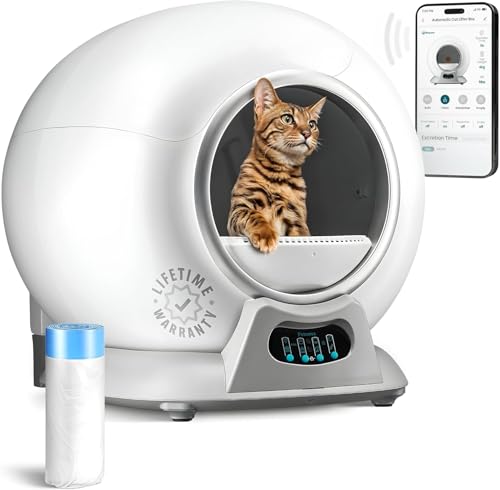
Pura X1 Smart Litter Box - Best Smart Features
The Pura X1 includes smart sensors that track each cat's usage patterns and health indicators. WiFi connectivity to dedicated app. Multi-cat compatible. Modern aesthetic design. Trade-off: newer brand with less long-term track record. For users who want detailed health monitoring data.
In its favor
- 【NEVER SCOOP AGAIN】 PurrTek automatic self cleaning cat litter box sifts waste into a seal
- 【COMPACT ENOUGH FOR ANY ROOM】 At just 20.28" × 19.29" × 20.08" this cat litter box automat
- 【ODOR STOPS BEFORE IT STARTS】 PurrTek self cleaning litter box for multiple cats combines
- 【FULL CONTROL FROM YOUR PHONE】 Connect via 2.4/5 GHz Wi-Fi or Bluetooth and manage your sm
- 【COMFORT DESIGN】 Spacious open drum with smooth low-RPM rotation lets cats turn, dig, and
What matters most
What to consider
Match to cat count. Single cat: any auto box works. 2 cats: premium auto boxes (Litter-Robot). 3+ cats: multiple auto boxes or supplemental traditional.
What to consider
Litter type compatibility. Some auto boxes require proprietary litter (PetSafe ScoopFree) - locks you into ongoing cost. Others use standard clumping litter (Litter-Robot) - flexible.
What to consider
App connectivity matters for tracking. WiFi-enabled boxes monitor usage and alert when waste drawer is full. Useful for traveling cat owners.
What to consider
Noise level. Auto boxes run cleaning cycles that produce noise. Loud cycles can scare cats. Quieter premium boxes (Litter-Robot) acclimate cats faster.
What to consider
Build quality reflects in price. boxes last 2-3 years. premium boxes last 5-8+ years. For long-term ownership pay for quality.
What to consider
Backup plan. Keep traditional litter box during transition period (2-4 weeks). Some cats reject auto boxes - have plan B ready.
Frequently asked
Most cats accept after 1-2 week transition. Some never accept (estimated 5-10% of cats). Slow introduction with traditional litter box nearby helps. Cats who reject typically dislike the noise or motion of the cleaning cycle.
Premium models (Litter-Robot 4, PetSafe ScoopFree) reliable for daily auto-cleaning. Budget models often jam or miss spots requiring manual intervention. For true hands-off, premium pricing pays back.
'Auto litter boxes: upfront + in special litter or refills. Traditional: box + in litter. Auto pays back for users valuing time savings (saving 5-10 hours/month scooping).'
Depends on box. Litter-Robot 4 handles multi-cat well. ScoopFree single-use models may not. For 3+ cats, consider 2 auto boxes or supplement with traditional.
Some boxes default to closed and become unusable. Others fall back to manual access. Battery backup or having traditional litter box available for outages prevents accidents.
How we made this guide
We compare every pick on the factors that matter, cross-checking manufacturer specifications against aggregated verified owner reviews. We rank independently and never take payment for placement. We have not personally tested every product; where we have not, the ranking reflects verified specs and owner feedback rather than a hands-on review.
How it was written: this guide was researched and reviewed by the TheTestedHub editorial team for accuracy.
Affiliate disclosure: TheTestedHub is reader-supported. When you buy through links on our site, we may earn a commission at no extra cost to you.
You might also like

7 Best Slow Feeder Bowls of 2026 for Persistent Dogs

Stop Messy Meals: Best Elevated Dog Bowls 2026

Is Your Dog Eating Too Fast? Best Dog Bowls 2026

Top Dog Training Pads for 2026: A Practical Buyer’s Guide

Pet Hair Vacuums: Our Best Picks for 2026

The Best Dog Sweaters to Buy in 2026

Dog Raincoats 2026: Best Fast-On Picks