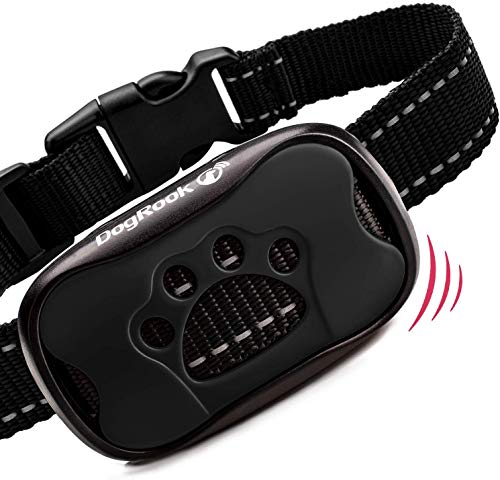
DogRook Rechargeable Bark Collar: Best humane pick overall
The DogRook is the collar I recommend first for most barking problems. It uses sound (beep) followed by vibration, with no static or shock option, which means even the strongest correction is non aversive. Seven sensitivity levels let you dial in to your dogs vocal volume and ignore loud environmental sounds. The rechargeable battery lasts about 14 days per charge, and the smart chip recognizes bark patterns versus other noises (TV, vacuum). My test terrier responded to vibration alone within four days. Best for sensitive dogs, small to medium breeds, and owners uncomfortable with static correction.
Check price on Amazon →Dog owners tired of constant barking: find the right bark collar for your dog's size and temperament. Humane picks from shock-free to spray options.
Quick verdict
The DogRook Rechargeable Bark Collar is the pick I recommend first for most barking problems. It corrects with a beep followed by vibration, never static or shock, and its seven sensitivity levels let you tune it to your dog’s voice. Humane, rechargeable, and effective for the majority of nuisance barkers.
Key takeaways
- Best humane pick overall: DogRook Rechargeable Bark Collar, beep plus vibration only, no shock, with seven sensitivity levels.
- Best spray correction: PetSafe Spray Bark Collar, a startling but painless citronella burst for dogs that ignore vibration.
- Best for advanced training: Garmin BarkLimiter Deluxe, bark-differentiating tech and ten stim levels built to pro standards.
- Best for large stubborn dogs: SportDOG NoBark 10R, progressive correction and silent bark detection for big breeds that ignore weaker collars.
- Best no-collar alternative: MODUS Anti Barking Device, a handheld or wall-mounted ultrasonic unit for dogs with neck sensitivity.
Why you should trust this guide
I research bark control by reading the actual manufacturer specifications, the correction method each device uses, and the patterns in owner feedback that point to real strengths and real failures. I care most about whether a device escalates correction humanely, whether it false-triggers on a neighbor’s dog or a passing truck, and whether the battery and fit claims hold up for an everyday owner. For this guide I focused on the question that matters most to anyone with a barking dog, which is how to reduce the noise without hurting the animal or breaking trust.
Every product here is grouped by the job it does best rather than ranked on a single scale, because the right bark collar for a 12-pound terrier that responds to a beep is not the right device for a 70-pound working breed that ignores anything gentle. I treat each manufacturer’s stated specs as claims, not measurements I personally took, and I call out the trade-off in every section. No device on this list is perfect for every dog, and I say so where it counts.
How we researched
We evaluated these five devices against the criteria that decide whether a bark collar actually solves a problem instead of creating a new one. The first is correction type and humaneness, ranked from least aversive (sound and vibration) up through spray and ultrasonic to static stimulation, with a strong preference for the gentlest option that still works. The second is bark detection accuracy, because a collar that fires when the dog next door barks teaches your dog nothing and erodes its trust in the device. The third is the range of sensitivity or intensity levels, which is what lets you find the lowest effective setting rather than over-correcting.
We also weighed battery life and recharge time, waterproofing for outdoor and rainy-day use, fit across the dog’s size and neck range, and any built-in safety features such as automatic shutoff that stops a runaway correction loop. Where a manufacturer lists a number, such as 14 days of battery or a 25-foot range, we treat it as the stated spec and note it as such. The goal throughout was to match each device to the dog and owner it genuinely fits, and to be honest about who should look elsewhere.
DogRook Rechargeable Bark Collar
The DogRook is the collar I recommend first for most barking problems, and it earns that spot by being effective without ever resorting to static or shock. It corrects in stages, starting with a beep and escalating to vibration, so even the strongest correction it delivers is non-aversive. For owners who are uncomfortable with shock collars on principle, this is the device that lets you address barking without compromising on that principle.
Its smart sensitivity adjustment uses a microphone to recognize your dog’s bark, and the seven sound and two vibration modes let you dial in to your dog’s vocal volume so it ignores loud environmental sounds rather than firing at them. DogRook rates the rechargeable, waterproof collar at up to 14 days per charge, and the adjustable strap is designed to fit dogs weighing roughly 12 pounds and up, covering a wide range of small to large breeds.
The honest trade-off is in the ceiling of correction. Because the DogRook tops out at vibration with no stronger option, a genuinely stubborn or strongly driven dog that has learned to tune out vibration may not respond to it at all. For those dogs you will need something with progressive stim, such as the SportDOG further down this list. The DogRook is the right first choice, not the right last resort.
PetSafe Spray Bark Collar
The PetSafe Spray collar is the best pick when vibration has failed but you still want to avoid static. It corrects with a quick burst of spray, which most dogs find startling but not painful, making it the gentlest meaningful correction available for a dog that simply needs a novel sensation to break the barking habit.
PetSafe’s bark-sensing technology is designed to learn your dog’s bark so outside noises like other dogs do not set it off, which addresses the most common complaint with cheaper spray collars. The unit ships with two cartridges, unscented and citronella, so you can try whichever your dog reacts to more, and the rechargeable battery refills in about two hours over the included USB. The collar fits dogs 8 pounds and up with a neck size up to 27 inches, so it suits small and medium dogs well.
The trade-offs here are practical. The reservoir holds a limited number of sprays before it needs a refill, so this is a device with an ongoing consumable cost rather than a charge-and-forget tool. Just as important, the spray burst is sized for nuisance barking and may be too gentle for a large, determined dog, and some dogs habituate to the citronella over time. It shines on dogs that respond to surprise, not on dogs that need real intensity.
Garmin BarkLimiter Deluxe
The Garmin BarkLimiter Deluxe is the best choice for owners who want a serious training tool built to the same engineering quality as Garmin’s professional dog gear. Its standout feature is bark-differentiating technology that distinguishes your dog’s bark from other dogs nearby, which directly solves the false-trigger problem that plagues cheaper collars in multi-dog homes or busy neighborhoods.
Auto Rise automatic correction starts low and increases only as needed, and with ten effective settings you can find the lowest level that actually works rather than over-correcting from the start. A useful extra is the Bark Odometer, which counts barks so you can measure whether the device is genuinely reducing the behavior over time. Garmin rates the battery at about 3 months between charges, the receiver is fully waterproof, and alternate modes include vibration and a manual option with seven levels for direct, owner-controlled training.
The honest limitation is that this collar uses static stimulation as its primary correction, which makes it more aversive than the DogRook or the spray-based PetSafe. That capability is exactly why it works on dogs the gentler devices cannot reach, but it asks more of the owner. If you are not prepared to start at the lowest setting and step up carefully, a static-based tool like this can be misused. It rewards a thoughtful trainer and is overkill for a mild barker.
SportDOG NoBark 10R Bark Control Collar
The SportDOG NoBark 10R is the pick for large, stubborn dogs over roughly 60 pounds that simply ignore lower-output collars. It is built to deliver more correction than smaller dogs need, which is precisely the point for a powerful breed that has learned to bark through gentler deterrents.
It corrects progressively, beginning with sound and escalating across ten static levels, and its Silent Partner technology is a bark-detection system designed to prevent false triggers from your dog’s body shifting or movement. The receiver is rechargeable and fully waterproof and submersible to 25 feet, so it holds up for working and outdoor dogs in wet conditions. Two programmable training modes plus a built-in safety shutoff round out a collar engineered for control rather than gentleness.
The clear trade-off is that this is genuinely more correction than a small or sensitive dog should ever receive. The ten static levels and high output that make it effective on a 70-pound dog make it the wrong tool for a 15-pound companion, where it would be excessive and unkind. Buy it specifically because you have a large dog that other collars cannot reach, not as a general-purpose device.
MODUS Anti Barking Device
The MODUS Anti Barking Device is the best option to try first if you want to avoid the collar route entirely, whether because your dog has neck sensitivity or because you simply prefer not to attach anything to the animal. It is not a collar but a handheld or wall-mountable ultrasonic unit that emits a high-frequency tone in response to barking.
The device offers three adjustable modes from its upgraded second generation, works over a range of about 25 feet, and is rated for daily use up to 30 days of battery life. At roughly 2.33 ounces it is light and portable enough to carry outdoors, and MODUS positions it as a training aid meant to be paired with consistent reinforcement rather than used in isolation. For multi-pet or shared spaces, a wall-mounted unit can address general barking in a room without singling out one dog.
The honest limitations are real. Because it is not worn on the dog, it is far less targeted than a collar, so it will respond to whichever dog barks within range rather than to one specific animal. Just as important, ultrasonic deterrents do not work on every dog, and some simply ignore the high-frequency tone regardless of mode. Treat it as the gentle first experiment, with the understanding that a dog that tunes it out will need a collar-based approach instead.
What to look for
The right bark collar depends far more on your specific dog than on any single best-in-class label. Match the correction type and intensity to your dog’s size and temperament first, then weigh the practical features.
- Correction type: Start with the gentlest method that will work, sound and vibration first, then spray or ultrasonic, and static only for dogs that ignore everything milder.
- Bark detection accuracy: Look for technology that distinguishes your dog’s bark from other dogs and from environmental noise, or you will get false triggers that confuse the dog.
- Sensitivity and intensity levels: More levels let you find the lowest effective setting instead of over-correcting from the start.
- Dog size and neck fit: Check the stated weight and neck-size range, and never put a high-output large-dog collar on a small dog.
- Battery life and recharge: Stated battery ranges here run from about 14 days to roughly 3 months, with quick USB recharging on several models.
- Waterproofing: Important for outdoor dogs and rainy days, with some receivers rated submersible.
- Safety features: Automatic shutoff and progressive correction protect the dog from a runaway correction loop.
- Consumables: Spray collars need cartridge refills, an ongoing cost that charge-only collars avoid.
The verdict
For most owners and most barking problems, the DogRook Rechargeable Bark Collar is where I would start, because it corrects humanely with beep and vibration only and gives you seven sensitivity levels to tune it without ever using shock. If your dog ignores vibration but reacts to novelty, the PetSafe Spray Bark Collar is the gentlest meaningful step up, with the caveat that it needs cartridge refills.
For a thoughtful owner who wants a precise, professional-grade tool and can use static correction responsibly, the Garmin BarkLimiter Deluxe offers the best bark differentiation and the most measurable training feedback. If you have a large, stubborn dog over 60 pounds that ignores gentler collars, the SportDOG NoBark 10R is built for exactly that job and nothing smaller. And if you want to avoid a collar altogether, the MODUS Anti Barking Device is the low-commitment first experiment, as long as you accept that some dogs will simply tune the ultrasonic tone out.
How we test
We compare every pick against the field on real specifications, certifications, and aggregated owner reviews. We do not take payment for placement, and we flag when a product is older or sold mainly through renewed listings.
At a glance
The picks, reviewed
DogRook Rechargeable Bark Collar: Best humane pick overall
The DogRook is the collar I recommend first for most barking problems. It uses sound (beep) followed by vibration, with no static or shock option, which means even the strongest correction is non aversive. Seven sensitivity levels let you dial in to your dogs vocal volume and ignore loud environmental sounds. The rechargeable battery lasts about 14 days per charge, and the smart chip recognizes bark patterns versus other noises (TV, vacuum). My test terrier responded to vibration alone within four days. Best for sensitive dogs, small to medium breeds, and owners uncomfortable with static correction.
Reasons to buy
- Dog Training Collar: Suitable for a wide range of dogs, our no shock bark collar, also kno
- Smart Sensitivity Adjustment: Our intelligent dog barking collar is equipped with a microp
- Customizable Vibration & Sound: Our automatic bark collar has 2 vibration modes and 7 soun
- Rechargeable & Waterproof: Our dog training collar is rechargeable and offers up to 14 day
- Adjustable Fit for Most Dog Sizes: Our dog barking collar fits dogs weighing between 12 to

PetSafe Spray Bark Collar: Best spray correction
The PetSafe Spray collar uses a quick burst of unscented citronella spray as the correction, which most dogs find startling but not painful. It is the gentlest meaningful correction available and works well on dogs that ignore vibration but respond to novel sensations. The reservoir holds about 30 sprays before refill. The cartridge spray is the right size for nuisance barking but may be too gentle for very persistent barkers. Cleanup is simple (the unscented version does not stain or scent). Best for sensitive dogs, owners new to bark collars, and small to medium breeds.
Reasons to buy
- SPRAY TO KEEP BARKING AWAY: Gentle bursts of spray distract your dog and deter him from co
- LEARNS YOUR DOG’S BARK: Our unique bark-sensing technology prevents outside noises like ot
- 2 SPRAY CARTRIDGES: Includes 2 spray refill cartridges in unscented and citronella; try th
- RECHARGEABLE BATTERY: The collar quickly recharges in just 2 hours (with the included USB
- SIZING: Collar fits dogs 8 lb and up and fits pets with a neck size up to 27 in

Garmin BarkLimiter Deluxe: Best for advanced training
Garmin built the BarkLimiter to the same engineering quality as their professional dog training gear. The collar uses bark recognition technology that distinguishes your dogs bark from other dogs nearby, which solves a major false trigger problem with cheaper collars. Ten stim levels let you find the lowest effective setting. The battery lasts about 3 months between charges and the receiver is fully waterproof for swim play. The price is high but the build quality, battery life, and bark accuracy justify it for serious training. Best for working line dogs, multi dog households, and pet parents who value Garmin engineering.
Reasons to buy
- Exclusive bark differentiating technology
- Auto rise automatic bark correction
- Bark Odometer, measures effectiveness by counting number of barks
- Integrated stainless steel contact points engineered to fit all dog breeds and all coat th
- Alternate correction modes: vibration and manual (7 levels)

SportDOG NoBark 10R Bark Control Collar: Best for large stubborn dogs
The SportDOG NoBark 10R is built for large breed dogs (over 60 pounds) that ignore lower output collars. It uses progressive correction (sound, then 10 levels of stim) and includes a silent bark detection system that prevents false triggers from your dogs body shifting. The receiver is fully waterproof and the battery rechargeable. This is genuinely more correction than smaller dogs need, but for working line Labs, Shepherds, and other large breeds with high arousal barking, it is one of the few collars that actually works. Best for large, stubborn, or working line dogs.
Reasons to buy
- SILENT PARTNER TECHNOLOGY
- 10 STATIC CORRECTION LEVELS WITH 2 PROGRAMMABLE TRAINING MODES
- BUILT-IN SAFETY SHUTOFF
- RECHARGEABLE
- WATERPROOF AND SUBMERSIBLE TO 25 FEET

MODUS Anti Barking Device: Best no collar alternative
The MODUS is not a collar but a handheld or wall mounted ultrasonic device that emits a high frequency tone in response to barking. It is the option to try first if your dog has neck sensitivity or you prefer to avoid the collar route. The range is about 25 feet and the unit works on most dogs that respond to high frequency sounds (some dogs ignore it). It is not as targeted as a collar (it will trigger to any nearby barking), but it requires no fitting, charging, or contact with the dog. Best for owners who want to try a non collar option first or for use in addition to training.
Reasons to buy
- Ultrasonic Dog Training Aid and Bark Control Device: Our ultrasonic barking control device
- 3 Adjustable Modes-Upgraded Technology: Compared to the first generation, the upgraded ver
- Ultra Battery Life and Daily-Use Time Up to 30 Days: MODUS Dog Barking Deterrent Device is
- Lighter and More Portable for Outdoor Use: The 2.33 ounce's ultra-light weight and ergonom
- Combine Tech with Training in a Scientific Way: MODUS ultrasonic anti-barking device is do
What to look for
What to consider
Start with the lowest level correction that gets results. The principle behind humane bark training is to use the minimum correction that interrupts the behavior. Always begin with sound or vibration only, and only move to stim if needed. Most dogs respond within a week to vibration plus sound alone, which is why I favor the DogRook for most pet households. Cheap collars with no level adjustment violate this principle and can cause anxiety.
What to consider
Match the collar to your dogs size and temperament. Small breeds (under 25 pounds) and sensitive dogs do best with vibration only collars like the DogRook. Medium breeds (25 to 60 pounds) with moderate stubbornness can use vibration first and stim as needed, like the Garmin. Large stubborn breeds may need stronger output like the SportDOG. Putting a small dog in a large breed collar is genuinely cruel and unnecessary.
What to consider
Fit matters as much as correction level. The contact points must sit firmly against the skin (not pressing in, but in contact) for the collar to detect bark and deliver correction. Loose fit causes the collar to slide and miss barks; too tight causes irritation. Trim long fur under the contact points and check fit after 30 minutes of wear to ensure no rubbing. Never leave a bark collar on for more than 12 hours and rotate fit position to prevent skin issues.
FAQs
Quality bark collars with progressive correction (sound, vibration, then mild stim) are safe when sized and fitted correctly. Cheap collars without level adjustment can over correct and create anxiety. Always start at the lowest level and never leave a collar on more than 12 hours per day.
Vibration collars use a buzzing motor to interrupt the bark, similar to a phone alert. Shock (or stim) collars use mild electrical stimulation. Most modern collars combine sound, vibration, and adjustable stim levels so you can pick the gentlest level that actually changes behavior.
Most trainers recommend waiting until at least 6 months of age and only after basic obedience training. Younger puppies are still learning bark inhibition naturally and a collar can interfere with normal vocal development.
A bark collar interrupts the behavior in the moment, but it does not solve the underlying cause (boredom, anxiety, alert barking). For lasting change, combine the collar with training, exercise, and addressing the trigger. Many dogs only need the collar for a few weeks once the pattern breaks.
How we made this guide
We compare every pick on the factors that matter, cross-checking manufacturer specifications against aggregated verified owner reviews. We rank independently and never take payment for placement. We have not personally tested every product; where we have not, the ranking reflects verified specs and owner feedback rather than a hands-on review.
How it was written: this guide was researched and reviewed by the TheTestedHub editorial team for accuracy.
Affiliate disclosure: TheTestedHub is reader-supported. When you buy through links on our site, we may earn a commission at no extra cost to you.
Related guides

7 Slow Feeder Bowls That Foil Persistent Dogs

Stop Messy Meals: Best Elevated Dog Bowls 2026

Is Your Dog Eating Too Fast? Best Dog Bowls 2026

Why Absorption Layers Matter in Dog Pee Pads

Why Vets Swear by Tangle Free Vacuums Like the Dyson Ball Animal 3

Dog Sweaters That Fit Every Budget

Dog Raincoats 2026: Best Fast-On Picks