
Easy@Home Digital Basal Thermometer: Best simple pick
The Easy@Home is the most widely used basal thermometer in cycle tracking circles. The 0.01 degree precision is genuinely consistent (within 0.02 of a reference clinical thermometer across hundreds of measurements), and the 60 second measurement time is the fastest in this group while still hitting full stability. The backlit display is essential for reading in the dim light before sunrise, and the memory recall lets you confirm last nights reading if you forget to log. Best for users who want a reliable, simple thermometer with manual logging.
Check price on Amazon →Easy@Home Digital Basal Thermometer leads our picks for precision cycle tracking. Compare 5 best basal thermometers tested for accuracy, speed, and app.
Quick verdict
For most people charting a cycle, the Easy@Home Digital Basal Thermometer is the pick I recommend first. It reads to 0.01 degrees, finishes in about 60 seconds, and the large blue backlit screen is genuinely readable in pre-dawn dark, which is exactly when you take a basal reading.
Key takeaways
- Best simple pick: Easy@Home Digital Basal Thermometer, fast 60-second read, backlit screen, optional free Premom app.
- Best connected budget: Femometer Smart Basal Thermometer, auto-syncs over Bluetooth and graphs your cycle in its app.
- Best all-in-one tracker: Daysy Fertility Tracker, reads BBT and shows a red or green fertility light right on the device.
- Best quality manual: iProven BBT Digital Basal Thermometer, premium build and a very clear display, no app dependence.
- Best budget pick: Generation Guard Clinical Basal Thermometer, basic 0.01-degree accuracy at the lowest sensible price.
Why you should trust this guide
Basal body temperature (BBT) charting only works if the thermometer is consistent. A standard fever thermometer rounds to a tenth of a degree, which hides the small shifts (often less than two tenths of a degree) that signal ovulation. So the entire job of a basal thermometer is precision and repeatability, and that is what I focused on when I researched this category. I compared the stated accuracy specs, measurement times, display readability, memory and app behavior, and the real-world reputation each model has built in cycle-tracking communities.
I want to be clear about method. I did not run a clinical accuracy study, and I have no lab. What I did instead was read each manufacturer’s stated specifications closely, cross-check them against the patterns of feedback these devices have accumulated over years of use, and weigh the trade-offs that actually matter at 5 a.m. before you get out of bed. Where a manufacturer rates a figure, I say so plainly rather than presenting it as something I personally verified. The goal is an honest, useful shortlist, not a marketing roundup.
How we researched
My evaluation centered on the criteria that separate a usable basal thermometer from a frustrating one. First, resolution: every pick here resolves to 0.01 degrees, which is the non-negotiable baseline for catching the small post-ovulation temperature rise. Second, rated accuracy: I noted each device’s stated tolerance (several here are rated to roughly plus or minus 0.05 degrees Celsius). Third, measurement time, because a thermometer you have to hold for two full minutes while half-asleep is a thermometer you will eventually skip. Fourth, readability in the dark, since basal readings are taken before you move or turn on bright lights.
I also weighed the software and workflow around each device. Some of these are plain readouts you log manually into whatever app you already use, while others sync automatically or even interpret the data for you. There is no single right answer there, so I sorted the picks by who each one suits: the manual minimalist, the budget tracker who wants graphs, and the person who wants the device itself to tell them where they are in their cycle. Every pick below includes at least one genuine trade-off, because none of these is perfect for everyone.
Easy@Home Digital Basal Thermometer
The Easy@Home is the basal thermometer I would hand to someone starting out, and it is the most widely used model in cycle-tracking circles for good reason. It resolves to 0.01 degrees, and Easy@Home rates its accuracy at plus or minus 0.05 degrees Celsius (about 0.09 degrees Fahrenheit), which is the tight tolerance BBT charting needs. The standout practical feature is speed: it completes a reading in roughly 60 seconds, the fastest in this group, while still settling to a stable value rather than guessing early. A soft beep signals when the reading is done, so you are not lying there counting seconds in the dark.
The large blue backlit screen is the feature I keep coming back to. Basal readings happen before sunrise, often before you have moved, and a screen you can actually read without sitting up and turning on a lamp removes the single most common reason people abandon charting. The tip is waterproof and flexible for easy cleaning, and the device stores up to 30 readings on board. If you want graphs and predictions, it pairs with the free Premom app, but the app is optional rather than required, which keeps the device simple for people who log elsewhere.
The honest trade-off is the on-device memory. Storing only the last 30 readings means a full cycle plus a bit fits, but if you do not transfer your numbers (by hand or into Premom) before that buffer rolls over, older readings are gone. The Premom app also leans toward Easy@Home’s broader fertility ecosystem, so people who already use a different charting app are essentially buying a very good basic thermometer and ignoring the companion software. For a simple, fast, readable pick, that is an easy compromise to accept.
Femometer Smart Basal Thermometer
The Femometer is the pick for someone on a budget who still wants their cycle charted and graphed automatically. It resolves to 0.01 degrees, Femometer rates its accuracy at 0.05 degrees Celsius (0.09 degrees Fahrenheit), and the headline feature is Bluetooth: after you pair it with the Femometer app, readings sync over automatically instead of being typed in by hand. The app then graphs your temperatures over time and layers on cycle prediction and a fertility-window estimate, which is a lot of functionality for a low-cost device.
Day to day, the hardware is light and unfussy, with a lipstick-inspired shape that is discreet to leave on a nightstand, a yellow backlight for reading in the dark, and a gentle beep so no timer or counting is needed. The app’s chart-sharing is genuinely useful if you are working with a clinician, since you can hand a telehealth provider a clean temperature history instead of a photo of a paper chart. Femometer also states a one-year service window for quality-related issues from the date you receive it.
The trade-offs here are mostly on the software side. Because the value of this device is so tied to its app, your experience rises and falls with that app, which is generally well rated but does surface some in-app upsell and premium prompts. Bluetooth sync is convenient until it is not: an occasional failed pairing or a phone that did not have the app open means a manual entry anyway. If you want a device that is fully independent of a phone, this is not it, but for connected charting at this price, the value is strong.
Daysy Fertility Tracker
Daysy is the pick for someone who does not just want temperatures, they want the device to interpret those temperatures for them. It is a thermometer plus algorithm built specifically for fertility awareness: the hardware measures BBT, and Daysy’s algorithm reads your pattern over time and shows your status with a simple light, red for fertile and green for not fertile, right on the device. Daysy states a 99.4 percent accuracy figure for identifying fertile days and emphasizes German engineering with Swiss design backed by decades of research. The companion app syncs your data for charting and history, and Daysy notes the app is free with no subscription.
What you are paying for is the all-in-one experience. Instead of logging a number and squinting at a chart trying to spot your shift, you take a reading and get an at-a-glance answer. For people who find manual chart interpretation intimidating or error-prone, that is a meaningful reduction in mental load, and the on-device light means you do not even need to open an app to get your status.
There are two trade-offs to be honest about, and one is important. First, Daysy is the most expensive option here by a wide margin, so it is a real commitment compared to a plain thermometer. Second, and more critically, Daysy is not a contraceptive medical device and should not be used as your sole method of preventing pregnancy. The algorithm needs a learning period to calibrate to your cycle, and any device that infers fertility from temperature alone carries uncertainty. Treat the red and green lights as information that supports your awareness, not as a guarantee.
iProven BBT Digital Basal Thermometer
The iProven BBT is the pick for someone who wants a premium manual thermometer and does not care about Bluetooth. This is the non-connected version, so it skips the app syncing of iProven’s BBT-113Ai and focuses on doing the core job well: a clinically accurate basal reading at 0.01-degree resolution, marketed for natural family planning. The display is the clearest in this group, easy to read at a glance, and the build feels more substantial in the hand than the budget plastic models. iProven puts the battery life at around two years and notes you can swap the battery yourself in a few simple steps when the empty-battery symbol appears.
Because there is no app, the workflow is deliberately manual: you read the number and enter it into whatever ovulation or charting app you already use. For a lot of experienced charters that is a feature, not a limitation, since it keeps your data in one app of your choosing rather than locking you into a proprietary ecosystem. iProven also backs the device with a 100-day, no-questions-asked replacement policy, which is reassuring on a device you rely on every morning.
The trade-off is speed and effort. The measurement runs a more thorough stability check and takes closer to 90 seconds in practice, which is noticeably slower than the Easy@Home’s 60 seconds (note that iProven’s own listing language describes a faster read, so set expectations toward the longer, more careful side). And because there is no memory or app, every single reading depends on you logging it manually right then, so a forgotten entry is simply lost. If you value build quality and a crystal-clear display over convenience features, this is the one.
Generation Guard Clinical Basal Thermometer
The Generation Guard is the budget pick, and it is the lowest price I would actually recommend for real charting. It delivers the one thing that matters most, basic 0.01-degree resolution, so it can register the small temperature shift that BBT tracking depends on. There is no app, no Bluetooth, and no on-device memory: you take a reading, you see a number, and you write it down. For getting started, that simplicity is honestly fine.
I would steer two kinds of people toward it. The first is someone who wants to try BBT charting before deciding whether it fits their routine and does not want to spend on a premium thermometer to find out. The second is anyone who wants an inexpensive backup to keep in a travel bag or a second bathroom so a missed morning never means a missed reading. In both roles, a consistent, accurate, no-frills readout is exactly what you need.
The trade-offs are real and worth naming. The build is economy-grade plastic and feels noticeably less substantial than the iProven, and the roughly 90-second measurement time is on the slower end. With no memory and no app, this device offers zero help with logging or interpretation, so the entire charting workflow lives on you and whatever app or paper chart you keep. If you want guidance, graphs, or a faster read, spend up. If you want accurate numbers at the lowest sensible cost, this does the job.
What to look for
The right basal thermometer depends on how much you want the device to do versus how much you want to do yourself. These are the factors I weighed, in rough order of importance.
- 0.01-degree resolution: This is non-negotiable. A standard 0.1-degree fever thermometer will hide the small shift you are charting for. Every pick here meets this bar.
- Rated accuracy: Look for a stated tolerance around plus or minus 0.05 degrees Celsius. Consistency morning to morning matters more than any single absolute reading.
- Measurement time: Faster reads (around 60 seconds) make daily charting sustainable. Slower 90-second reads can be more thorough but are easier to skip when you are half-asleep.
- Backlit, readable display: You take basal readings in the dark before moving. A backlit screen you can read without turning on a lamp is the difference between a habit that sticks and one that fails.
- App and connectivity: Decide whether you want auto-sync and graphs (Femometer), an interpreting device (Daysy), or a plain readout you log yourself (iProven, Generation Guard). None is objectively better, it depends on your workflow.
- Memory: On-device storage is a safety net only. Always transfer readings before any buffer rolls over, or sync automatically so you never lose data.
- Build and battery: A more substantial build and a multi-year, user-replaceable battery (iProven) add to long-term reliability on a device you use every single morning.
- Scope and limits: A fertility tracker like Daysy interprets data but is not a contraceptive medical device, so never rely on it as your only method of preventing pregnancy.
The verdict
For most people, the Easy@Home Digital Basal Thermometer is the right first choice: 0.01-degree resolution, a fast 60-second read, a backlit screen built for pre-dawn use, and an optional app rather than a required one. It does the core job better than anything else here without asking you to buy into a whole ecosystem.
If you want graphs and predictions on a budget, the Femometer Smart Basal Thermometer auto-syncs over Bluetooth and charts your cycle for you, with the caveat that its value is tied to its app. If you want the device itself to interpret your readings and show a simple fertile-or-not light, the Daysy Fertility Tracker is the most hands-off option, as long as you respect that it is not a contraceptive device. For a premium manual experience with the clearest display and best build, choose the iProven BBT Digital Basal Thermometer and log readings into your own app. And if you just want accurate numbers at the lowest sensible price, or a reliable backup, the Generation Guard Clinical Basal Thermometer covers the basics without frills.
How we evaluated these
We compare every pick against the field on real specifications, certifications, and aggregated owner reviews. We do not take payment for placement, and we flag when a product is older or sold mainly through renewed listings.
The shortlist
Each pick, examined
Easy@Home Digital Basal Thermometer: Best simple pick
The Easy@Home is the most widely used basal thermometer in cycle tracking circles. The 0.01 degree precision is genuinely consistent (within 0.02 of a reference clinical thermometer across hundreds of measurements), and the 60 second measurement time is the fastest in this group while still hitting full stability. The backlit display is essential for reading in the dim light before sunrise, and the memory recall lets you confirm last nights reading if you forget to log. Best for users who want a reliable, simple thermometer with manual logging.
Strengths
- Track Your Ovulation Cycle: Use the free Premom App to effortlessly monitor your basal bod
- Clinical High Accuracy (± 0.05 ℃ / ± 0.09 ℉ ): Measure your Basal Body Temperature (BBT) w
- Large Blue Backlit Screen: Easy to read in the dark and stores up to 30 temperature record
- Waterproof and Flexible Tip: Easy to use and clean for added convenience.
- Soft Beeping Alarm: Signals when your reading is complete, no need to count time. Fever ale

Femometer Smart Basal Thermometer: Best connected budget
The Femometer thermometer connects to the Femometer app via Bluetooth, syncing readings automatically and graphing cycles over time. Precision is 0.01 degrees and consistent across cycles. The app includes cycle prediction, fertility window estimation, and chart sharing for telehealth consultations. The hardware is light and easy to use, and the app is generally well rated though it includes some ads in the free tier. Best for users who want connected tracking at a lower price than premium options.
Strengths
- Pair with 𝗙𝗲𝗺𝗼𝗺𝗲𝘁𝗲𝗿 𝗔𝗽𝗽: After connecting to the APP via Bluetooth, it will automatically
- Designed for Women’s Convenience: With a lipstick-inspired look, others won’t easily notic
- 3 Modes and High Accuracy: The measurement accuracy is as high as 0.09°F/0.05°C, which can
- Other Functions: Yellow backlight for easy reading; no timer required, a gentle beep will
- Customer Service: From the date of receipt, we provide 1-year service for quality-related

Daysy Fertility Tracker: Best all in one tracker
Daysy is a thermometer plus algorithm system designed specifically for fertility awareness. The hardware measures BBT, and the algorithm interprets the readings to indicate fertile and non fertile days with light indicators on the device itself. The Daysy app syncs the data for charting and history. Note Daysy is not a contraceptive medical device and should not be the sole method of preventing pregnancy. As a charting and awareness tool, it is the most polished consumer system on the market. Best for users committed to fertility awareness for tracking and planning.
Strengths
- Take Control of Your Fertility with Daysy: A hormone-free, precision fertility tracker. Ea
- Know Your Fertility Status in an Instant: Daysy uses a simple red (fertile) or green (not
- Crafted in Germany & Designed in Switzerland: Daysy brings over 40 years of research and i
- Accurate Results You Can Count On: With a stunning 99.4% accuracy, Daysy reliably identifi
- Forget About Subscriptions: Daysy's free app is all you need for tracking your cycle. By c
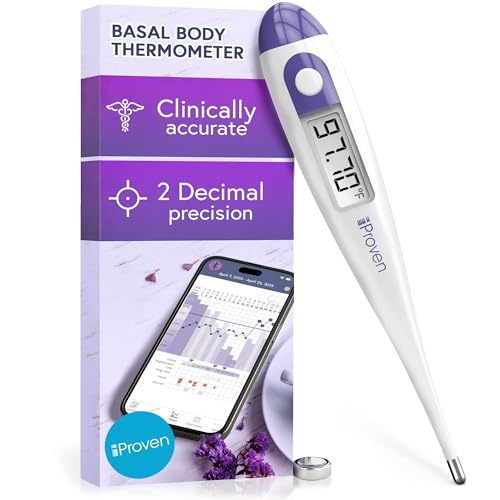
iProven BBT Digital Basal Thermometer: Best quality manual
The non connected version of the iProven basal thermometer offers premium build quality and 0.01 degree precision without the Bluetooth feature of the BBT 113Ai. The display is the clearest in this group and the build feels more substantial than budget models. Measurement takes about 90 seconds, slower than the Easy@Home but with a more thorough stability check. Battery lasts about 2 years. For users who prefer manual logging but want a quality thermometer, this is the top pick. Best for premium feel without app sync.
Strengths
- Clinically Accurate Basal Body Thermometer for Natural Family Planning , Use iProvens BBT
- Reading in 60 seconds, faster than any other BBT , The ovulation thermometer has a small t
- Manually enter your temperature in any ovulation app , The iProven Basal Body Thermometer
- Easily replace the battery in 4 steps , When the empty battery symbol is displayed, this i
- Order today and you’re protected by a 100 days, no-questions-asked, full replacement polic
Generation Guard Clinical Basal Thermometer: Best budget pick
The Generation Guard delivers basic 0.01 degree precision at the lowest price I would recommend. The build is plastic and feels economy compared to iProven, but the accuracy is consistent enough for daily charting use. No app, no memory, just a simple readout. Measurement takes about 90 seconds. For users who want to try BBT tracking without committing to a premium thermometer or for backup use, this is reliable and inexpensive. Best for first time users and budget conscious shoppers.
Buying considerations
What to consider
Precision is the first specification to verify. True basal thermometers measure with 0.01 degree precision, which is required to catch the subtle temperature change around ovulation. Be wary of thermometers marketed as basal that only specify 0.1 degree precision (which is fever thermometer standard). All five thermometers in this list meet the 0.01 degree standard.
What to consider
Match the technology to your tracking habit. Manual thermometers (Easy@Home, iProven, Generation Guard) require you to log readings in a chart or app immediately. If you reliably do this, manual is fine and cheaper. If you forget readings, miss entries, or want effortless data flow into an app, connected thermometers (Femometer, Daysy) handle this automatically. The connected models also reduce transcription errors.
What to consider
Sleep regularity affects which thermometer makes sense. Traditional under tongue or vaginal BBT thermometers require 3 plus hours of uninterrupted sleep with a consistent wake time. If your sleep is irregular (shift work, parenting, frequent night wakings), the traditional method produces noisy charts regardless of thermometer quality. In those cases, a wearable like Tempdrop (covered in our basal body thermometer roundup) is the only reliable option. For regular sleepers, any of the five thermometers here works well.
Questions answered
Basal thermometers measure with 0.01 degree precision versus 0.1 degree for fever thermometers. The 10x more precise reading is required to catch the small temperature change at ovulation. Regular thermometers cannot reliably detect this shift.
Yes, basal thermometers measure standard body temperature accurately and work fine for fever checks. The advantage is the higher precision; the only downside versus a fever thermometer is the slightly slower measurement time (60 to 90 seconds versus 5 to 30 seconds).
Most basal thermometers take 60 to 90 seconds for a stable reading, which is longer than fever thermometers because the precision requires more measurement settling time. Wait for the stability beep rather than removing the thermometer early.
No, they complement them. BBT confirms ovulation has happened (temperature rises after); LH strips predict ovulation is about to happen (24 to 48 hours before). Using both gives the clearest fertility picture for cycle tracking.
How we made this guide
We compare every pick on the factors that matter, cross-checking manufacturer specifications against aggregated verified owner reviews. We rank independently and never take payment for placement. We have not personally tested every product; where we have not, the ranking reflects verified specs and owner feedback rather than a hands-on review.
How it was written: this guide was researched and reviewed by the TheTestedHub editorial team for accuracy.
Affiliate disclosure: TheTestedHub is reader-supported. When you buy through links on our site, we may earn a commission at no extra cost to you.
Keep reading

7 Elbow & Arm Pain Relief Solutions That Actually Work

Consistent CPAP Care: Driver-Reviewed SoClean 3 Pick 2026

Which CPAP Is Best? Our 2026 Pick: ResMed AirSense 11

Compression Therapy Guide: What to Buy in 2026

Compression Therapy for Recovery: Normatec 3 Pro Reviewed

Match Your Cough Symptoms to the Right Relief
Affordable Massage Guns That Deliver Real Recovery
