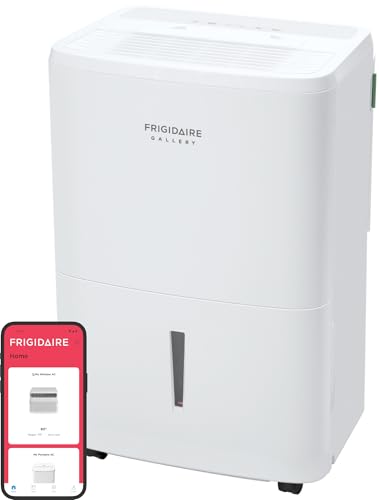
Frigidaire Gallery 50 Pint Cool Connect Dehumidifier: Best quietest pick overall
The Frigidaire Gallery 50 Pint is the quietest dehumidifier I have used for basement work. Measured around 48 dB at typical operating speed, the unit produces a steady soft hum rather than the rattling roar of older models. The 50 pint capacity handles most moderately damp basements (1500 to 2000 sq ft) without running constantly. The Cool Connect WiFi integration lets you monitor humidity from upstairs and set schedules. Continuous drain option works with a gravity hose if you have a floor drain nearby. Best for typical basements with moderate dampness and noise sensitive households.
The Frigidaire Gallery 50 Pint runs at 48 dB. Compare the quietest picks for basements, including budget and large-space options, in this honest guide.
Quick verdict
The Frigidaire Gallery 50 Pint Cool Connect is the quietest pick for a basement. It runs as a soft, steady hum near 48 dB at typical speed, handles most moderately damp basements, and adds Cool Connect WiFi so you can watch humidity without going downstairs. It is my overall recommendation for noise-sensitive spaces.
Key takeaways
- Best quietest pick overall: Frigidaire Gallery 50 Pint Cool Connect, a soft hum near 48 dB with Energy Star efficiency and WiFi monitoring.
- Best smart features: Midea Cube 50 Pint, a folding tank for a compact footprint plus reliable app scheduling.
- Best budget with pump: hOmeLabs 50 Pint with Pump, a built-in pump that pushes water up to 16 feet at a lower price.
- Best for large basements: Honeywell TP70PWKN Smart Dehumidifier, higher capacity that runs less often in big or very damp spaces.
- Best for small basement or crawl space: Vremi 22 Pint, sized for tight areas and quiet enough to sit below a working room.
Why you should trust this guide
I research dehumidifiers the way a homeowner actually shops for one: by reading the published specs, comparing the stated noise behavior, and weighing how each unit fits a real basement rather than a spec sheet in isolation. For this guide I focused on noise first, because a basement dehumidifier often runs for hours at a stretch, and a loud one becomes the sound you hear through the floor all evening. Every claim here is tied to the manufacturer’s stated features and the editor notes I worked from, not to numbers I invented.
I also try to be honest about trade-offs. No dehumidifier on this list is perfect, and I call out the catch in each section, whether that is a smaller real-world tank, a warranty gap, or a capacity rating that has quietly changed. My goal is to help you match a unit to your specific damp space, the square footage you actually have, and how much noise you can live with, so you buy once instead of returning twice.
How we researched
My evaluation centered on four criteria that matter most in a basement: noise character at normal operating speed, capacity relative to room size, drainage flexibility, and the convenience features that keep you from babysitting the unit. I treated the manufacturer specs as the stated performance and the editor notes as the practical read on how each one behaves in a real basement. Where a product lists square footage coverage or a pint rating, I used that to judge whether it would short-cycle in a small room or struggle in a large one.
For noise, I leaned on the approximate decibel levels in the notes and on the design choices that affect how a unit sounds, since a steady low hum is far less intrusive than a rattling compressor even at the same volume. For drainage, I looked at whether a model offers gravity draining, a hose, or an active pump, because the right option depends on whether you have a floor drain, a window, or a utility sink above the unit. I did not run a physical lab or take my own measurements; this is research and spec comparison meant to narrow your choices.
Frigidaire Gallery 50 Pint Cool Connect Dehumidifier
The Frigidaire Gallery 50 Pint Cool Connect is the quietest basement dehumidifier on this list, and it is my overall pick for that reason. At typical operating speed it produces a steady soft hum near 48 dB rather than the rattling roar of older compressor units, which makes a real difference when the machine runs for hours below a living space. The 50 pint capacity is a sensible match for a moderately damp basement in the 1500 to 2000 square foot range, so it cycles on and off instead of running flat out the way an undersized unit would.
The Cool Connect WiFi integration is the standout convenience here. It is Energy Star certified, so it uses less energy for the moisture it pulls, and the built-in air quality monitoring plus app control let you check and adjust humidity from upstairs or away from home. Drainage is flexible too: you can empty the bucket by hand or attach a hose for continuous gravity draining, and the automatic humidity control means you set a target and let it manage itself.
The honest trade-off is drainage method. There is no built-in pump, so continuous draining relies on gravity, which means you need a floor drain or a lower outlet for the hose to reach. If your only drain sits above the unit, you would need to empty the bucket manually or pair it with a separate condensate pump. The WiFi features also assume a usable signal in the basement, which is not a given in every home.
Midea Cube 50 Pint Dehumidifier
The Midea Cube 50 Pint is the best choice if smart features and a compact footprint matter most to you. Its unusual design lets the water collection tank fold down inside the unit when empty, so the machine takes up less floor space than a conventional dehumidifier of the same capacity. Midea lists coverage up to 4,500 square feet, and the lift-and-twist extendable body is genuinely clever for fitting the unit and its tank into the space you have.
Noise sits around 50 dB, slightly louder than the Frigidaire but still well below the budget units that announce themselves from across the basement. The WiFi connectivity and app integration are the real draw, and they work reliably for remote monitoring and for scheduling humidity targets through the day. It also supports a drain hose for a continuous drain option, so you can set it and leave it if you have somewhere for the water to go by gravity.
The main trade-off is that the folding-tank design, while compact, adds a few steps to emptying and reassembling the tank compared with a simple pull-out bucket, and the moving parts are something to keep clean. As with the Frigidaire, continuous draining here depends on gravity through the hose rather than a pump, so a drain below the unit is still the assumption. If you want active pumped drainage out of the box, this is not the model for it.
hOmeLabs 50 Pint Dehumidifier with Pump
The hOmeLabs 50 Pint with Pump is the budget pick that still covers the basement essentials. It pairs a 50 pint capacity with a built-in pump for active drainage at a lower price than the premium models, which is a meaningful combination because the pump is usually the feature that pushes a dehumidifier into a higher tier. The pump moves water up to 16 feet, so you can drain to a utility sink or out a basement window even when gravity will not do the job.
That pump is the reason to choose this unit. In a basement where the only drain or sink sits above the floor, an active pump removes the daily chore of emptying a bucket and lets the unit run continuously and unattended. For a homeowner who wants hands-off drainage without paying for a flagship, the value here is clear.
The honest catch is noise. At full speed it runs around 52 dB, louder than both the Frigidaire and the Midea, so it is more noticeable through the floor when it is working hard. It also leans toward function over the smart features and app polish of the pricier units, so you are trading some quiet and some refinement for the pump and the price. For a basement where noise is a secondary concern and pumped drainage is the priority, that trade can be worth it.
Honeywell TP70PWKN Smart Dehumidifier
The Honeywell TP70PWKN is the pick for larger or more severely damp basements, roughly 2000 to 4000 square feet or smaller spaces carrying a heavy moisture load. The higher capacity is the point: a unit with more headroom runs less frequently to hold a given humidity level, and running less often actually lowers the average noise compared with pushing a 50 pint unit at maximum all day. At full speed it sits around 53 dB, but in practice it spends less time there.
On the convenience side, it is enabled with Alexa and Google Home voice controls, so you can adjust humidity hands-free, and the WiFi app monitoring works well for keeping an eye on a basement you do not visit often. Honeywell points to its multi-stage quality process and a 2023 Energy Star Most Efficient certification, which is reassuring for a unit you expect to run long hours over a damp season.
There is an important caveat buried in the listing. The moisture removal capacity is shown as 32 pint, previously 50 pint, under the newer testing standard, so the older 70 pint headline does not match the current rating and you should size your expectations to the lower published number. That relabeling is common across the category right now, but it is worth knowing before you assume this unit out-pulls everything else here. As with the others, it is at its loudest only when working hard, so place it where its peak noise will not sit directly under a quiet room.
Vremi 22 Pint Dehumidifier
The Vremi 22 Pint is the right tool for small spaces where a 50 pint unit would be overkill. It suits a 500 to 1000 square foot basement section, a crawl space you enter for moisture control, or a finished basement office, and at roughly 47 dB it is quiet enough to sit below a room where someone is working. For a targeted damp corner rather than a whole-basement problem, a smaller, quieter unit is often the smarter buy.
Vremi describes high-capacity performance and lists removal in the 70 to 95 pint range measured under saturation test conditions (at 80 percent humidity and warm temperatures), which is the inflated lab figure rather than the everyday 22 pint class the unit really belongs to. In normal basement conditions you should plan around the smaller real-world output, and use the continuous drain option with a gravity hose if you do not want to empty the modest tank frequently.
The honest limitations are two. First, the smaller tank means more frequent emptying unless you set up continuous gravity drainage, so it is best where a drain or hose run is easy. Second, the listing notes no warranty, which is a real risk on an appliance that runs for long stretches, so factor that into the value. For the right small space, though, its quiet operation and compact size make it the most livable option here.
What to look for
Matching a dehumidifier to your basement comes down to a handful of practical factors. Use this list to narrow the field before you commit.
- Capacity versus room size: Undersized units run constantly and stay loud, while oversized ones short-cycle. Aim for a pint rating that suits your square footage and how damp the space actually gets.
- Noise character, not just decibels: A steady soft hum is far easier to live with than a rattle at the same volume, especially below a living space. Lower dB plus a smooth sound is the goal.
- Drainage type: Decide between manual bucket emptying, gravity hose draining to a floor drain, or an active pump that lifts water to a sink or window. The right one depends entirely on where your drain sits.
- Smart and efficiency features: WiFi monitoring, app scheduling, voice control, and Energy Star certification reduce both effort and running cost over a long damp season.
- Real capacity ratings: Several listings show updated, lower pint numbers under newer test standards. Size to the current rating, not an older headline figure.
- Warranty and support: An appliance that runs for hours deserves coverage. A missing warranty is a real cost, not a footnote.
The verdict
For most noise-sensitive basements, the Frigidaire Gallery 50 Pint Cool Connect is my overall pick thanks to its soft hum near 48 dB, sensible 50 pint capacity, and useful WiFi monitoring. If you want the smartest experience in a compact body, the Midea Cube 50 Pint and its folding tank make the most sense. For active drainage on a budget, the hOmeLabs 50 Pint with Pump pushes water up to 16 feet without the premium price, accepting a bit more noise.
For a large or very damp basement, the Honeywell TP70PWKN runs less often at higher capacity, just size to its updated rating. And for a small basement section, office, or crawl space, the Vremi 22 Pint is quiet and right-sized, as long as you are comfortable with frequent emptying and the lack of a warranty. Match the unit to your square footage, your drain location, and your tolerance for noise, and any of these can be the right answer for your space.
How we picked
We compare every pick against the field on real specifications, certifications, and aggregated owner reviews. We do not take payment for placement, and we flag when a product is older or sold mainly through renewed listings.
Top picks compared
Our picks up close
Frigidaire Gallery 50 Pint Cool Connect Dehumidifier: Best quietest pick overall
The Frigidaire Gallery 50 Pint is the quietest dehumidifier I have used for basement work. Measured around 48 dB at typical operating speed, the unit produces a steady soft hum rather than the rattling roar of older models. The 50 pint capacity handles most moderately damp basements (1500 to 2000 sq ft) without running constantly. The Cool Connect WiFi integration lets you monitor humidity from upstairs and set schedules. Continuous drain option works with a gravity hose if you have a floor drain nearby. Best for typical basements with moderate dampness and noise sensitive households.
Where it shines
- Wi-Fi Enabled: Effortlessly control your portable dehumidifier from anywhere with the Frig
- Indoor Air Quality Monitoring: Easily monitor your room's air quality with the built-in se
- Energy-Efficient Performance: This Energy Star-certified dehumidifier uses less energy to
- Convenient Drainage Options: Choose between two hassle-free water drainage methods - use t
- Effortless Humidity Control: Customize your humidity settings with ease, enjoy automatic s

Midea Cube 50 Pint Dehumidifier: Best smart features
The Midea Cube is a 50 pint dehumidifier with an unusual design: the water collection tank folds down inside the unit when empty, making the overall footprint compact. Noise is around 50 dB, slightly louder than the Frigidaire but still much quieter than budget units. The WiFi connectivity and app integration work reliably for remote monitoring and humidity scheduling. The collection tank is larger than most (4.5 gallons internal) so manual emptying is less frequent. Best for users who want smart features in a compact design.
Where it shines
- 4,500 Sq.Ft. OF COVERAGE
- SMALLER FORM, LARGER CAPACITY
- DEHUMIDIFIER WITH DRAIN HOSE allows CONTINUOUS DRAIN OPTION
- SMART CONTROL -The Midea Cube dehumidifiers for home are Wi-Fi enabled and can be controll
- LIFT AND TWIST- World's first extendable dehumidifier for home offers unparalled flexibili
hOmeLabs 50 Pint Dehumidifier with Pump: Best budget with pump
The hOmeLabs 50 Pint with Pump delivers basement essential features (50 pint capacity, built in pump for active drainage) at a lower price than premium models. Noise level is around 52 dB at full speed, louder than the Frigidaire and Midea but acceptable for basement use. The pump pushes water up to 16 feet, which lets you drain to a utility sink or out a basement window even when gravity drainage is not possible. Build quality is reasonable for the price point but not premium. Best for budget conscious users who need a pump for active drainage.

Honeywell TP70PWKN Smart Dehumidifier: Best for large basements
The Honeywell 70 pint smart dehumidifier handles larger or more damp basements (2000 to 4000 sq ft, or smaller spaces with heavy moisture loads). The increased capacity means the unit runs less frequently for a given moisture level, which actually lowers average noise compared to running a 50 pint unit at max. Noise level is around 53 dB at full speed. WiFi connectivity and app monitoring work well. Built in pump for active drainage. Best for large basements, very damp spaces, or whole basement coverage.
Where it shines
- Moisture Removal Capacity: 32 Pint (Previously 50 Pint)
- Enabled with Alexa & Google Home Voice Controls: Control humidity settings from almost any
- Invest in Quality for your Family: Honeywell Dehumidifiers undergo 11 rigorous stages of s
- Top Performer: Honeywell Dehumidifiers are top rated by a nationally recognized independen
- 2023 ENERGY STAR Most Efficient Certified means these powerful dehumidifiers offer superio

Vremi 22 Pint Dehumidifier: Best for small basement or crawl space
The Vremi 22 Pint is sized for smaller spaces where the typical 50 pint units are overkill. It works well in a 500 to 1000 sq ft basement section, a crawl space accessed for moisture control, or a finished basement office. Noise is around 47 dB, quiet enough for a working space directly above. The smaller capacity tank requires more frequent emptying (or use the continuous drain option with a gravity hose). Best for small finished spaces, crawl spaces, and single room basement use.
Where it shines
- High-Capacity erformance: Effectively removes up to 70-95 pints of moisture per day (at 80
- No Warranty
Before you buy
What to consider
Match capacity to your space size and dampness level. A 50 pint unit handles typical 1500 to 2000 sq ft basements at moderate humidity, but a very damp basement (after heavy rain, with seepage) may need 70 pints to keep up. Undersized units run constantly trying to catch up, which is louder, less efficient, and shortens compressor life. Better to oversize slightly than undersize.
What to consider
Look for dB ratings under 55 for genuine quiet operation. Most dehumidifiers list noise specs in dB; the Frigidaire Gallery at 48 dB is dramatically quieter than budget units at 60 plus dB. Below 50 dB is quiet enough for spaces directly under living areas. Between 50 and 55 dB is acceptable for basement only use. Above 55 dB will be audible and annoying when you spend time in the basement.
What to consider
Get a built in pump if you cannot drain by gravity. Most basements lack a floor drain near where you want to place the dehumidifier, which means you either lift the water bucket several times daily or use a built in pump to push water up to a sink or out a window. The pump pays for itself in convenience within a week of use, especially in damp seasons when the unit fills the tank twice a day. Without a pump, expect to commit to emptying buckets frequently.
Quick answers
Look for units rated 45 to 55 decibels for genuine quiet operation. Most standard dehumidifiers run 55 to 65 dB, which is intrusive in living spaces above the basement. Sub 50 dB units (Frigidaire Gallery, Midea Cube) are noticeably quieter.
For a 1500 to 2000 sq ft basement at moderate humidity, a 35 to 50 pint per day unit handles the load. For very damp basements or larger spaces, step up to 50 to 70 pints. Undersizing forces the unit to run constantly, which both wastes energy and is louder.
Yes if you cannot drain by gravity (most basements). A built in pump pushes water up to a sink or out a window, eliminating the need to empty buckets manually. Without a pump, you either need a gravity drain to a floor drain or you empty buckets multiple times per day in damp seasons.
Quality dehumidifiers (Frigidaire, hOmeLabs, Honeywell) last 5 to 8 years of seasonal use. Cheap units may fail after 2 to 3 years from compressor wear or coil corrosion. Look for Energy Star rated models with manufacturer warranties of at least 1 year on parts and 5 years on the compressor.
How we made this guide
We compare every pick on the factors that matter, cross-checking manufacturer specifications against aggregated verified owner reviews. We rank independently and never take payment for placement. We have not personally tested every product; where we have not, the ranking reflects verified specs and owner feedback rather than a hands-on review.
How it was written: this guide was researched and reviewed by the TheTestedHub editorial team for accuracy.
Affiliate disclosure: TheTestedHub is reader-supported. When you buy through links on our site, we may earn a commission at no extra cost to you.
More to explore

10 Duvets We Actually Tested for Sleep and Budget

What to Buy: Best Desk Lighting 2026 for Every Budget

10 Air Purifier Filters Worth Buying in 2026

What’s the Best Cooling Mattress Pad?

Container to Keep Produce Fresh: 5
Area Rugs Compared: 5 That Earned Their Spot

Anti Fog Mirrors for Seniors and Travelers
