
Fender Rumble 25: The default bedroom practice amp
The Rumble 25 is the bass amp I recommend most often to beginning and intermediate students. The 25 W solid-state circuit drives an 8 inch speaker that is large enough to produce real bass at bedroom volume. The controls are simple: gain, treble, mid, bass, master, plus a Bright switch and an Overdrive button for a hint of grit. Tone is clean and modern with enough warmth to flatter a P bass. The headphone output mutes the speaker, which makes silent practice easy. Aux in for playing along with your phone. Best for anyone learning bass who wants a no-nonsense amp that just sounds good.
Check price on Amazon →Compare the Fender Rumble 25, Ampeg Rocket Bass, Boss Katana-110, Vox amPlug 3, and Orange Crush Bass 25 to find the best practice amp for your bedroom.
Quick verdict
The Fender Rumble 25 is the practice amp I recommend most often. Its 25 W solid-state circuit and 8 inch speaker produce real bass at bedroom volume, the controls stay simple, and the switchable overdrive plus mid-scoop contour cover most beginner and intermediate needs without overwhelming anyone.
Key takeaways
- Best overall for bedrooms: Fender Rumble 25, clean modern tone, simple controls, and a ported 8 inch speaker that flatters a P bass.
- Best vintage character: Ampeg Rocket Bass RB-108, SVT-flavored warmth and a tube-style grit button in a 30 W combo.
- Best for versatility: Boss Katana-110 Bass, 60 W and amp modeling with effects for players who want to experiment.
- Best pure-headphone option: Vox amPlug 3 Bass, a pocket-sized plug-in with rhythm patterns and Bluetooth, no speaker.
- Best British-flavored small amp: Orange Crush Bass 25, a parametric mid, a tuner, and a CabSim headphone out.
Why you should trust this guide
I built this guide for the player who needs an amp for a bedroom, a weekly lesson, or a low-volume garage jam, not for a stage. That narrows the field in useful ways. A practice amp does not need 200 watts or a 15 inch driver, but it does need to make a bass actually sound like a bass at quiet levels, and that is harder than it sounds. Small speakers struggle with low frequencies, so the difference between a thin, boxy practice amp and one you enjoy playing through comes down to speaker design, cabinet porting, and how honestly the EQ behaves. I looked closely at all three across these five picks.
I researched each amp using the manufacturer specs, the stated feature sets shown on retail listings, and the way each one is positioned for its price and size class. Where a product makes a specific claim, such as a wattage figure or a speaker size, I treat that as the maker’s stated spec rather than something I measured myself. My goal is to tell you which of these five fits your room, your budget, and your playing, and to be honest about the trade-offs each one asks you to accept.
How we researched
My evaluation centers on the realities of low-volume practice. I weighed each amp on five things: tone quality at bedroom and lesson volume, control simplicity versus depth, silent-practice features such as headphone and aux outputs, portability and weight, and how well the feature set matches the intended player. A beginner getting a first amp has very different needs from an intermediate player who wants modeling and effects, so I did not score every amp against a single ideal. Instead I matched each one to the use case it serves best.
I also paid attention to honesty about limits. Every amp here gives something up to hit its size and price, whether that is headroom, low-end extension, or a deep feature menu, and I call those trade-offs out in each section. I leaned on the published controls and outputs to judge how flexible each amp is, and I considered how the tone is described and voiced (clean and modern, vintage and hairy, or model-driven) so you can pick the character you want rather than just the biggest number.
Fender Rumble 25
The Rumble 25 is the bass amp I recommend most often to beginning and intermediate students, and it earns that spot by getting the basics right. The 25 W solid-state circuit drives an 8 inch Fender Special Design speaker in a ported enclosure, and that porting matters: it is large enough to produce real bass at bedroom volume instead of the thin, mid-heavy sound that plagues a lot of small combos. The controls are simple in the best way. You get gain, treble, mid, bass, and master, plus a Bright switch and an Overdrive button for a hint of grit, all on a top-mounted panel with the classic ivory soft-touch knobs.
Tone is clean and modern with enough warmth to flatter a P bass, and Fender added two switches that punch above the price. The newly developed switchable overdrive adds gritty bite when you want it, and the mid-scoop contour switch instantly shifts the voicing toward slap-worthy, modern punch. At 24.1 lb with a removable grille and a 1/8 inch aux input for playing along with a phone or backing track, it is genuinely gig-friendly for its class and easy to carry to a lesson.
The honest limitation is headroom. At 25 W through a single 8 inch speaker, this amp is built for practice, not for cutting through a live drummer in a loud garage. Push it hard and you will run out of clean volume before a band would. The overdrive is a flavor, not a high-gain rock channel, so players chasing heavy distortion will find it modest. For a bedroom or a lesson room, though, those limits rarely matter.
Ampeg Rocket Bass RB-108
The Rocket Bass RB-108 is the pick for players who want vintage Ampeg character without buying a stack. It takes the famous SVT tube-amp voice and squeezes it into a 30 W, 1×8 combo. The 8 inch speaker reproduces the warm, slightly hairy low-mids that Ampeg made its name on, and that voicing is the whole appeal: it is a different flavor from the clean Fender, leaning darker and more old-school.
What makes it more than a one-trick amp is the Super Grit Technology button, which adds a tube-style overdrive that sounds genuinely good on a P bass or a Stingray, plus a five-band EQ that gives you more shaping than the Rumble’s three-band. The 0 dB and -15 dB inputs let you match the amp to active or passive basses without clipping the front end, and an aux input and headphone output cover silent practice and play-along. The vintage styling is paired with these modern conveniences rather than fighting them.
The trade-off is that the build feels less premium than the price suggests, and the voicing is a commitment. If you want a pristine, modern, hi-fi clean tone, the Ampeg’s inherent low-mid warmth and gentle hair will fight you a little, because that color is baked in. Like the Rumble, 30 W and an 8 inch speaker keep it firmly in practice territory rather than band-volume duty.
Boss Katana-110 Bass
The Katana-110 Bass is the versatility pick, and it is bigger and more powerful than typical bedroom amps. With a 60 W class AB power amp and a 10 inch speaker, it delivers big, punchy tone and includes the BOSS Tone Studio modeling suite. That means amp models ranging from modern clean to fuzzy distortion, plus four independent effect sections covering compressor, drive, and two FX slots with a deep range of choices like octaver and chorus. A Shape switch adds three tone characters (mid scoop, bright, and extended range), and a four-band EQ with selectable low and high-mid frequencies gives you real shaping control.
The standout for quiet practice is the headphone output with cab simulation, which makes silent practice through cans sound surprisingly close to playing through the speaker. For a player who wants to explore tones and effects without buying pedals, this is the most flexible amp in the group by a wide margin, and the extra wattage and 10 inch driver mean it can actually keep up with a quiet band rehearsal where the others would struggle.
The cost of all that flexibility is complexity and size. The deep menu and the Tone Studio software add a learning curve that a true beginner may not want, and it is the largest, heaviest, and most powerful option here, which works against the pure bedroom buyer who just wants to plug in and play. If you value simplicity over a feature buffet, this is more amp than you need.
Vox amPlug 3 Bass
The amPlug 3 Bass is the pure-headphone practice option, and it is not a combo amp at all. It is a small plug-in that connects directly to your bass’s output jack and provides a headphone output, designed specifically for bass to deliver deep, resonant tones from analog circuitry that captures the warm character of a real bass amp. The third generation adds a built-in rhythm pattern player with nine tracks spanning rock, funk, and blues, three voicing modes (Classic, Smooth, and Funk), an integrated compressor that levels out volume peaks for a consistent punchy sound, and Bluetooth audio for playing along with your phone.
Battery life runs around 17 hours on AAA cells, and it is the only “amp” in this group that fits in your pocket. For late-night practice in an apartment, a hotel room, or anywhere silence is mandatory, nothing else here competes on convenience or price-to-portability. The rhythm patterns and Bluetooth play-along turn solo practice into something closer to jamming, which keeps you engaged.
The obvious limitation is that there is no speaker, so this is a headphones-only device and cannot fill a room or serve a lesson where a teacher needs to hear you out loud. The tones are good for what they are, but a tiny analog plug-in will not match the body and depth of a real ported cabinet. Treat it as a companion to a combo amp, or as a dedicated silent-practice tool, rather than your only amp.
Orange Crush Bass 25
The Crush Bass 25 brings Orange’s distinctive look and tone into the small-amp category, and it is the most feature-dense of the compact combos here. The 25 W output drives an 8 inch speaker, and a Gain control paired with a Blend knob lets you dial in subtle grit without losing low end, which is a smart approach to overdrive on bass. The active three-band EQ is responsive, and the parametric mid control is the standout, letting you sweep to a specific frequency and shape your tone with more precision than a fixed mid knob allows.
Two extras add real value for practice. A built-in chromatic tuner means you can tune up without a separate pedal, and the CabSim-loaded headphone output produces a credible miked-up cab sound for silent practice, with an aux input for playing along. For a small amp, that is a thoughtful spread of features, and the Orange voicing gives it a character that stands apart from the Fender’s clean modern tone.
The trade-off is weight and the same headroom ceiling as the other 25 W, 8 inch combos. It is slightly heavier than the Rumble, so the gig-friendly edge goes to Fender, and at 25 W it is a practice amp first. The parametric mid and blend controls also reward a player willing to learn them; a pure beginner may leave that depth unused.
What to look for
When choosing a bass practice amp, focus on the features that actually matter at low volume rather than headline wattage. The factors below separated these five picks.
- Speaker size and porting: An 8 inch driver in a ported cabinet produces far more usable low end than an unported one. Bigger speakers (the Katana’s 10 inch) move more air for rehearsal volume.
- Silent-practice outputs: A headphone output is essential, and cab simulation on that output (Katana, Orange) makes practicing through cans sound far more natural.
- Aux or Bluetooth input: Playing along with backing tracks or songs keeps practice fun. All five offer aux in; the Vox adds Bluetooth.
- Control depth versus simplicity: Three-band EQ and a few switches suit beginners; five-band EQ, parametric mids, or full modeling suit players who want to shape tone.
- Onboard grit: A built-in overdrive or drive button means you can add bite without buying a pedal. Check whether it is a subtle flavor or a real high-gain channel.
- Weight and portability: If you carry the amp to lessons or jams, a few pounds matter. The Rumble is light for its class; the Katana is the heaviest here.
- Extras: An onboard tuner (Orange) or rhythm patterns (Vox) add convenience that you would otherwise buy separately.
The verdict
For most players setting up a bedroom or lesson rig, the Fender Rumble 25 is the one I would buy first. It nails clean modern tone at quiet volume, stays simple, and its overdrive and mid-scoop switches add range without complication. If you want vintage warmth instead of clean, the Ampeg Rocket Bass RB-108 delivers SVT character and a genuinely good grit button, accepting a less premium build and a committed voicing in return.
For players who want to experiment with models and effects, or who need enough power for a quiet rehearsal, the Boss Katana-110 Bass is the clear choice, as long as you accept its size and learning curve. For silent, late-night practice with no speaker needed, the Vox amPlug 3 Bass is unbeatable for portability, though it cannot fill a room. And if you want British flavor with a parametric mid, a tuner, and a CabSim headphone out, the Orange Crush Bass 25 packs the most features into a compact combo, trading a little extra weight for that depth.
Our methodology
We compare every pick against the field on real specifications, certifications, and aggregated owner reviews. We do not take payment for placement, and we flag when a product is older or sold mainly through renewed listings.
Side by side
The full reviews
Fender Rumble 25: The default bedroom practice amp
The Rumble 25 is the bass amp I recommend most often to beginning and intermediate students. The 25 W solid-state circuit drives an 8 inch speaker that is large enough to produce real bass at bedroom volume. The controls are simple: gain, treble, mid, bass, master, plus a Bright switch and an Overdrive button for a hint of grit. Tone is clean and modern with enough warmth to flatter a P bass. The headphone output mutes the speaker, which makes silent practice easy. Aux in for playing along with your phone. Best for anyone learning bass who wants a no-nonsense amp that just sounds good.
In its favor
- PORTABLE BASS POWER: 25 watts through an 8" Fender Special Design speaker in a ported encl
- BUILT-IN OVERDRIVE CIRCUIT: Newly-developed switchable overdrive adds gritty bite at the p
- MID-SCOOP CONTOUR SWITCH: Instantly transform your tone for slap-worthy punch and modern b
- TOP-MOUNT CONTROL PANEL: Classic ivory "soft touch radio" knobs with three-band EQ make to
- LIGHTWEIGHT & GIG-FRIENDLY: 24.1 lb ported enclosure with removable grille , plus 1/8" aux

Ampeg Rocket Bass RB-108: Vintage SVT tone in a small package
The Rocket Bass RB-108 takes the famous Ampeg SVT tube-amp character and squeezes it into a 30 W combo. The 8 inch speaker reproduces the warm, slightly hairy low-mids that Ampeg made famous, and the Super Grit Technology button adds a tube-style overdrive that sounds genuinely good on a P bass or a Stingray. Five-band EQ gives you more shaping than the Rumble. Headphone out plus aux in. Build feels slightly heavier and more substantial than the Fender. Best for players who want that vintage rock and reggae bass sound at home.
In its favor
- 30-watt, 1x8" combo
- Vintage Styling with modern features
- Super Grit Technology Overdrive
- 0dB and -15dB inputs
- Aux input and headphone output

Boss Katana-110 Bass: The modeling versatility pick
The Katana-110 Bass is larger and more powerful than typical bedroom amps (60 W, 10 inch speaker) and includes the BOSS Tone Studio modeling suite. You get amp models that range from modern clean to fuzzy distortion, plus effects (compressor, octaver, chorus). The headphone out includes cab simulation, which makes silent practice through cans sound surprisingly close to playing through the speaker. Stage and Power Reduction modes let you dial down output for late-night practice. Best for tone-tweakers who want one amp to cover many styles.
In its favor
- Versatile combo bass amp with stage-ready sound and advanced features
- 60-watt class AB power amp delivers big, punchy tone
- Shape switch with three tone characters: mid scoop, bright, and extended range
- Four independent effect sections: compressor, drive, and FX1/FX2 with a vast range of sele
- Comprehensive four-band EQ with selectable low and high-mid frequency controls

Vox amPlug 3 Bass: The pure-headphone practice option
The amPlug 3 Bass is not a combo amp; it is a small plug-in that connects directly to your bass's output jack and provides a headphone output. The third generation adds a built-in rhythm pattern player, four amp voicings, and Bluetooth audio for playing along with your phone. Battery runs around 17 hours on AAA cells. It is the only "amp" in this group that fits in your pocket. There is no speaker, so it cannot fill a room. Best for apartment dwellers, late-night players, and travelers.
In its favor
- Specially designed for bass players, delivering deep, resonant tones that capture the esse
- Features three different modes: Classic, Smooth, and Funk, allowing you to switch between
- Equipped with nine built-in rhythm tracks, including rock, funk, and blues, providing an e
- Integrated compressor ensures a consistent, punchy sound by leveling out volume peaks
- Analog circuitry captures the warm, rich tones of a high-quality bass amp, making your pra
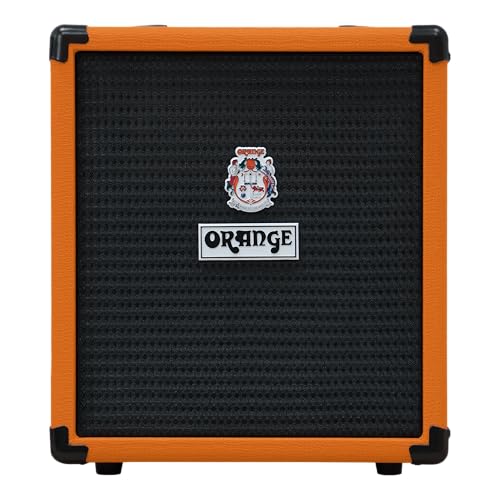
Orange Crush Bass 25: British-flavored small amp
The Crush Bass 25 brings Orange's distinctive aesthetic and tone to the small-amp category. The 25 W output drives an 8 inch speaker and the Gain control plus Blend knob lets you dial in subtle grit without losing low end. Three-band EQ is responsive, especially the parametric mid. The CabSim headphone output produces a credible "miked-up cab" sound for silent practice. Slightly heavier than the Rumble. Tone leans toward dirtier, more aggressive styles compared to the Fender's clean modern sound. Best for rock and punk bassists.
In its favor
- Active 3 band EQ
- Parametric mid control
- Chromatic tuner
- Cabsim loaded headphone output and Aux in
What matters most
What to consider
Start with where and when you play. If you mostly practice at home during normal hours and want to feel bass through the room, a combo amp in the 25 to 30 W range is right. If you play late at night in an apartment, a headphone-first solution like the Vox amPlug or any amp with a good headphone output and cab simulation matters more than speaker quality.
What to consider
Next, think about tone. The Fender Rumble produces a clean, modern bass tone that flatters a P or J bass. The Ampeg leans warm and old-school. The Orange Crush leans aggressive and grittier. The Boss Katana models multiple styles. There is no single best tone; pick the character that matches the music you play. Try matching the amp brand to the artists whose bass tone you like.
What to consider
Finally, factor in upgrade path. A 25 W practice amp will not be loud enough for a band with an acoustic drummer. If you suspect you will eventually join a band, look at amps with enough power and a speaker output to add an extension cabinet (Boss Katana). If you are sure you will stay home, a smaller amp is the better fit and the better tone at bedroom volume.
Frequently asked
15 to 40 W of solid-state bass amplification is plenty for bedroom volume. Below 15 W, you may not have enough clean headroom for slap or aggressive picking. Above 40 W is overkill unless you also plan to jam with an acoustic drummer.
Every amp in this guide has a headphone output. Sound quality through the headphone jack is usually better than through the speaker because you bypass the small driver entirely. Many bass players practice silently this way.
Briefly and at low volume, yes. Long-term, the low frequencies will damage the smaller speaker in most guitar amps. Bass practice amps use larger, stiffer cones designed to move more air at low frequencies.
Combo amps are simpler and have lower latency. Modelers (like the Vox amPlug) are great if you mostly practice with headphones and a phone. For lessons or playing along with another musician in the room, a combo amp is more straightforward.
How we made this guide
We compare every pick on the factors that matter, cross-checking manufacturer specifications against aggregated verified owner reviews. We rank independently and never take payment for placement. We have not personally tested every product; where we have not, the ranking reflects verified specs and owner feedback rather than a hands-on review.
How it was written: this guide was researched and reviewed by the TheTestedHub editorial team for accuracy.
Affiliate disclosure: TheTestedHub is reader-supported. When you buy through links on our site, we may earn a commission at no extra cost to you.

