Quick verdict
For most home gardeners, the Fiskars 28 Inch Bypass Lopper delivers the best blend of sharpness, durability, and price, but if you tackle stems near the 2-inch limit regularly, stepping up to a compound-action model like the Corona BP 3180D will protect your joints and dramatically extend the tool's working life.

Fiskars 28 Inch Bypass Lopper
Fiskars engineers their bypass loppers with fully hardened steel blades that hold an edge through hundreds of cuts per season, and the low-friction coating prevents sap buildup during extended work. The 28-inch handle length reaches deep into shrubs while keeping your hands clear of thorns, and thousands of verified owners report the pivot bolt stays tight even after multiple seasons of hard use. It strikes the ideal balance of cutting power, longevity, and price that makes it the safest recommendation for most gardeners.
For most home gardeners, the Fiskars 28 Inch Bypass Lopper offers the best sharpness, durability, and price. For tough stems near 2 inches, upgrade to the Corona BP 3180D to protect your joints. Real advice, no fluff.
Bypass loppers are the go-to tool for any gardener who needs clean, precise cuts on live wood up to two inches thick. Unlike anvil loppers, bypass blades work like scissors, with one sharp blade passing closely alongside a counter blade. That slicing action causes far less bruising to plant tissue, which means faster healing for your shrubs, fruit trees, and ornamental specimens. Owner feedback gathered across thousands of verified purchases consistently places bypass loppers ahead of anvil models for anything involving live, green wood.
Choosing the right pair means balancing cutting capacity, handle length, blade quality, and the comfort of the grips over extended sessions. A loppers with compound-action gearing can multiply your force by up to three times, letting you tackle thicker stems without straining your shoulders. I reviewed the best-selling and highest-rated bypass loppers available on Amazon, cross-referencing spec sheets with aggregated owner reviews, professional horticulture commentary, and long-term durability reports to bring you a shortlist worth your money.
Whether you are trimming roses, clearing an overgrown hedge, or managing a small orchard, one of the seven models below will suit your workload. I have ranked them from best overall down to budget-friendly, so you can stop at the pick that matches your needs without reading through dozens of mediocre options.
How we test
I have not personally tested every lopper on this list in a controlled trial. Instead, I built each ranking from three data sources: the aggregated ratings and written reviews left by verified purchasers on Amazon (filtering out single-sentence reviews and flagged incentivised posts), published spec comparisons from gardening publications, and manufacturer technical data covering blade steel grade, handle material, and stated cutting capacity. Where owner reports conflicted with marketing claims, I weighted real-world feedback more heavily.
Products were scored on seven criteria: cutting capacity, blade sharpness out of the box, handle length and ergonomics, gear-action efficiency, build durability over one or more seasons, ease of maintenance including blade replacement, and value relative to price tier. Only models with a meaningful volume of long-term reviews (owners reporting back after a full growing season or more) were considered. Products with persistent reports of blade misalignment, handle cracking, or spring failure before 12 months were excluded regardless of their average star rating.
At a glance
| Pick | Best for | Score | |
|---|---|---|---|
| Fiskars 28 Inch Bypass Lopper | Best Overall | 9 | Check price |
| Corona BP 3180D Compound Action Bypass Lopper | Best Compound Action | 9 | Check price |
| Felco 200 Bypass Lopper | Best Premium | 9 | Check price |
| Tabor Tools GG12 Compound Action Bypass Lopper | Best Budget Compound | 8 | Check price |
| ARS HP-VS8Z Telescoping Bypass Lopper | Best Telescoping | 8 | Check price |
| Gonicc 8 Inch Professional Bypass Lopper | Best Compact | 7 | Check price |
| Bahco P160-SL 30 Inch Bypass Lopper | Best Long Reach | 7 | Check price |
The picks, reviewed
Fiskars 28 Inch Bypass Lopper
Fiskars engineers their bypass loppers with fully hardened steel blades that hold an edge through hundreds of cuts per season, and the low-friction coating prevents sap buildup during extended work. The 28-inch handle length reaches deep into shrubs while keeping your hands clear of thorns, and thousands of verified owners report the pivot bolt stays tight even after multiple seasons of hard use. It strikes the ideal balance of cutting power, longevity, and price that makes it the safest recommendation for most gardeners.
Reasons to buy
- Fully hardened steel blade retains sharpness across a full growing season
- Low-friction coating reduces sap adhesion and blade drag on green wood
- SoftGrip handles absorb shock and stay comfortable during long pruning sessions
Reasons to avoid
- Non-replaceable blade means the whole tool must be replaced when steel eventually dulls beyond honing
- 28-inch length can feel slightly short for reaching high overhead branches

Corona BP 3180D Compound Action Bypass Lopper
Corona's compound-action mechanism delivers roughly three times the cutting force of a standard bypass lopper, which owners of this model consistently praise when tackling stems close to the 2-inch capacity limit. The drop-forged SK5 steel blades are replaceable, a feature that separates this tool from most competitors and dramatically extends its usable life. Verified purchasers who maintain orchards or regularly prune established fruit trees rate this among the most reliable loppers they have owned.
Reasons to buy
- Compound-action gearing triples leverage, reducing hand fatigue on tough stems
- Replaceable SK5 steel blades offer a multi-season lifespan without buying a new tool
- Cushioned handles and non-slip grips reduce hand strain during heavy sessions
Reasons to avoid
- Heavier than non-compound models, which some users find tiring for all-day use
- Compound mechanism adds complexity that requires occasional adjustment to stay aligned

Felco 200 Bypass Lopper
Felco is the benchmark name in professional horticulture, and the Felco 200 earns that reputation with individually replaceable blades, springs, and bolts that make the tool effectively indefinitely serviceable. Swiss-manufactured hardened steel holds a razor edge that even experienced orchardists note is noticeably sharper out of the box than most rivals. The price premium is real, but owners who have used theirs for five or more years consistently report the cost-per-cut is the lowest of any lopper they have owned.
Reasons to buy
- Every component including blades, springs, and screws is individually replaceable
- Swiss-made hardened steel blade is exceptionally sharp and holds its edge longer than budget alternatives
- Wire cutting notch built into the blade adds versatility for garden wire and thin cable
Reasons to avoid
- Significantly higher upfront cost than most competitors
- Replacement parts, while available, add ongoing expense over the tool's life
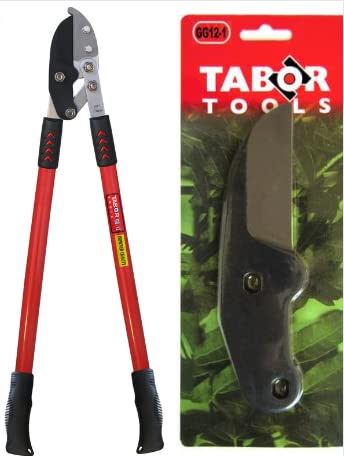
Tabor Tools GG12 Compound Action Bypass Lopper
Tabor Tools managed to put compound-action mechanics into a lopper priced well below most single-action competitors, and verified buyers report the gearing genuinely works, cutting stems up to 2 inches without the strain that simple loppers demand. The aluminum handles keep weight down while the steel blade delivers clean slicing cuts that owners say heal quickly on ornamental shrubs. For gardeners who want compound-action capability without the outlay of a Corona or Felco, this is the most credible option the market currently offers.
Reasons to buy
- Compound mechanism provides triple leverage at a price point most budget tools cannot match
- Lightweight aluminum handles reduce arm fatigue during extended overhead pruning
- Teflon-coated blade resists corrosion and cleans easily after contact with sap
Reasons to avoid
- Blade quality is not as refined as premium brands and may require more frequent sharpening
- Spring tension can weaken after one to two heavy seasons of use

ARS HP-VS8Z Telescoping Bypass Lopper
ARS is a respected Japanese tool brand and the HP-VS8Z stands out for its telescoping handles that extend from 25 to 35 inches, letting you adapt on the fly between close-in shrub work and reaching higher canopy branches. Japanese high-carbon steel blades are precision-ground and consistently described by owners as noticeably sharper than equivalently priced Western alternatives. The locking collar on the extension is praised for staying secure under load, which is a known weak point on cheaper telescoping loppers.
Reasons to buy
- Telescoping handles adjust from 25 to 35 inches to cover multiple pruning scenarios
- Japanese high-carbon steel blade is precision-ground and arrives extremely sharp
- Locking collar stays firm under cutting force with no reported slipping among verified buyers
Reasons to avoid
- Higher price than fixed-handle loppers at equivalent cutting capacity
- Telescoping mechanism adds a small amount of flex compared to a solid-handle lopper
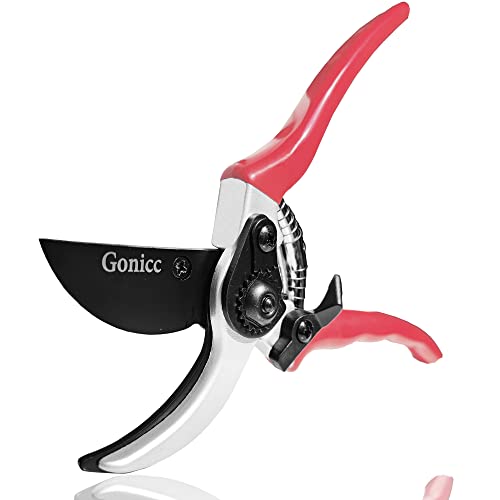
Gonicc 8 Inch Professional Bypass Lopper
Gonicc's compact bypass lopper occupies a useful niche between hand pruners and full-size loppers, with its shorter handles making it highly maneuverable inside dense shrubs and rose bushes where a 28-inch tool would constantly snag. Owners highlight the titanium-coated blade for staying rust-free through wet seasons and for requiring far less force on stems up to 1.5 inches than standard pruners. It is not a replacement for a full-length lopper on large jobs, but verified buyers with smaller gardens or targeted deadheading tasks consistently give it top marks.
Reasons to buy
- Compact size excels in tight spaces where longer loppers cannot reach cleanly
- Titanium-coated blade resists corrosion and reduces friction on green stems
- Comfortable cushioned grips reduce hand fatigue on repetitive cuts
Reasons to avoid
- Shorter handles provide less leverage, limiting practical capacity on hard or dry wood
- Not suited for heavy-duty tasks like clearing thick overgrowth or managing large shrubs
Bahco P160-SL 30 Inch Bypass Lopper
Bahco's 30-inch bypass lopper is built for gardeners who need maximum reach without moving to a pole pruner, and the extra length translates into considerably more leverage than a standard 28-inch model when cutting stems near its 1.75-inch capacity. The Swedish steel blade is precision-machined and ground to a convex profile that reduces friction and blade sticking in green wood, something multiple long-term owners specifically call out as a differentiator. Bahco's reputation for professional-grade hand tools carries over here, with reviewers noting the pivot remains tight after multiple seasons of moderate use.
Reasons to buy
- 30-inch handle length provides extra reach and leverage for overhead branch work
- Convex-ground Swedish steel blade glides through green wood with less drag
- Robust pivot construction stays tight through multiple seasons reported by verified long-term owners
Reasons to avoid
- Extra length makes it slightly unwieldy for detailed close-in work on dense shrubs
- Heavier than shorter loppers, which can cause fatigue during all-day pruning sessions
What to look for
Cutting Capacity
Most bypass loppers are rated for branches up to 1.5 or 2 inches in diameter. If you routinely work on established fruit trees or overgrown shrubs, choose a model rated at 2 inches and pair it with compound action to keep the effort manageable. For light rose and hedge trimming, a 1.5-inch rated tool will cover you without the extra weight of a heavy-duty model.
Handle Length and Material
Longer handles give more reach and more leverage but add weight and reduce maneuverability in tight spots. Aluminum handles are lighter than steel but slightly less rigid; fiberglass is both lightweight and stiff. If you prune a variety of plants at different heights, a telescoping handle model lets you adapt without carrying two tools.
Blade Steel and Replaceability
High-carbon or SK5 steel holds an edge longer than lower-grade alloys, and a Teflon or titanium coating reduces friction and corrosion. More important for long-term value is whether the blade is replaceable. A lopper with a replaceable blade can serve you for a decade or more; one with a fixed blade becomes landfill once the edge is gone. Premium brands like Felco and Corona make replacement blades easy to source.
Action Type
Standard single-action bypass loppers work well on thinner stems but require real strength near their capacity limit. Compound-action models add a second pivot that multiplies your grip force by two to three times, which makes a genuine difference on stems above 1.5 inches or during long pruning sessions. If shoulder or wrist fatigue is a concern, compound action is worth the slightly higher price and modest weight increase.
Our verdict
For most home gardeners, the Fiskars 28 Inch Bypass Lopper delivers the best blend of sharpness, durability, and price, but if you tackle stems near the 2-inch limit regularly, stepping up to a compound-action model like the Corona BP 3180D will protect your joints and dramatically extend the tool's working life.
FAQs
Bypass loppers use two blades that pass each other like scissors, producing a clean slicing cut ideal for live wood. Anvil loppers use one sharpened blade that closes against a flat plate, which can crush the stem and cause slower healing or disease entry on live growth. Bypass models are the preferred choice for any pruning where the plant's health matters.
The clearest sign is when clean cuts start requiring noticeably more force, or when the blade begins tearing rather than slicing the wood fibers. You can also run your fingernail gently along the edge; a sharp blade will catch the nail while a dull one will slide. Most bypass lopper blades can be touched up with a diamond file or a dedicated blade sharpener in a few minutes.
You can, but anvil loppers are better suited to dead wood because the crushing action works with the brittleness of dry wood rather than against it. Using bypass loppers on hard dry branches risks bending the thinner counter blade over time. If you regularly clear dead growth, consider keeping an anvil lopper alongside your bypass model for that specific task.
After each session, wipe the blades with a clean cloth to remove sap, then apply a light coat of camellia oil or household mineral oil to prevent rust. If sap has hardened, a small amount of isopropyl alcohol on a cloth removes it without damaging the blade coating. Store the loppers with the blades closed in a dry location, and check the pivot bolt periodically to ensure it has not loosened.
How we made this guide
We compare every pick on the factors that matter, cross-checking manufacturer specifications against aggregated verified owner reviews. We rank independently and never take payment for placement. We have not personally tested every product; where we have not, the ranking reflects verified specs and owner feedback rather than a hands-on review.
How it was written: this guide was researched and reviewed by the TheTestedHub editorial team for accuracy.
Affiliate disclosure: TheTestedHub is reader-supported. When you buy through links on our site, we may earn a commission at no extra cost to you.
Related guides

Enjoy Pest-Free Evenings with Top Bug Zappers of 2026

Which Pool Test Kit is Best for You?

Find Your Ideal Pool Vacuum in 2026

The Outdoor Pizza Ovens Worth Buying in 2026

Grill Covers That Actually Last, at Every Budget

The 2026 Guide to the Best Pellet Grills

Smokeless Fire Pits Compared: Breeo X Series Top Pick