Quick verdict
For most campers the MSR PocketRocket 2 is the best starting point because it balances weight, reliability, and versatility better than any other stove at its price, but the right choice ultimately depends on party size, trip length, and how much real cooking you plan to do.

MSR PocketRocket 2
The PocketRocket 2 has earned its reputation as the benchmark backpacking stove by combining a 73-gram body with a genuine 3.5-minute boil time for one litre of water. Owners consistently highlight the folding pot supports that grip most cookware securely and the push-button igniter that has proven reliable across thousands of cumulative reported uses in cold and wet conditions. It packs into a space smaller than a tennis ball, making it the stove most thru-hikers return to after trying heavier alternatives.
For most campers, the MSR PocketRocket 2 is the ultimate balance of weight, reliability, and versatility. But your perfect stove depends on group size and cooking style. Here's how to choose.
Finding the right camping stove can make or break a trip. Whether you are cooking a full breakfast at a car-camping site or boiling water on a high alpine ridge, the stove you choose shapes every meal and every morning coffee. I pulled together many verified owner reviews across Amazon, REI, and outdoor forums, cross-referenced manufacturer specs, and ranked seven real-world options that consistently earn praise from the people who actually use them in the field.
This guide covers the full spectrum: compact backpacking canister stoves that weigh under 100 grams, mid-range all-rounders that handle wind and simmering alike, and robust two-burner propane units built for base-camp cooking with a group. Each pick is chosen for reliability, real-world fuel efficiency, and honest value rather than marketing claims.
Camping stove technology has matured considerably, and the gap between budget and premium options is now mainly about weight, wind resistance, and simmer control rather than basic function. Knowing what matters most for your style of camping is the fastest route to the right choice, so I have included a buying factors section and FAQ to help you narrow things down.
How we picked
I have not personally field-tested every stove on this list. Instead, I aggregated thousands of verified purchaser reviews on Amazon and REI, gave extra weight to reviews from users who reported multiple trips and cooking styles, and cross-checked claimed boil times and fuel consumption against independent lab tests published by outdoor-gear testing outlets. Stoves with consistent complaints about igniter failure, flare-ups, or pot instability were excluded regardless of overall star rating.
Rankings reflect a composite of four factors: fuel efficiency and boil speed relative to category, wind performance based on owner feedback from exposed conditions, pack weight and packed size, and simmer control for meals beyond instant noodles. Where two stoves were close on score I favoured the one with a longer verified ownership history, since newer models have less time to reveal durability issues.
Top picks compared
| Pick | Best for | Score | |
|---|---|---|---|
| MSR PocketRocket 2 | Best Overall | 9 | Check price |
| Jetboil Flash Cooking System | Best for Speed | 9 | Check price |
| Snow Peak LiteMax Titanium Stove | Best Ultralight | 8 | Check price |
| MSR WindBurner Personal Stove System | Best for Wind | 8 | Check price |
| Camp Chef Everest 2X Two Burner Camp Stove | Best Two-Burner | 8 | Check price |
| BioLite CampStove 2+ | Best Wood-Burning | 7 | Check price |
| Coleman Classic Propane Camp Stove 2-Burner | Best Budget | 7 | Check price |
Our picks up close
MSR PocketRocket 2
The PocketRocket 2 has earned its reputation as the benchmark backpacking stove by combining a 73-gram body with a genuine 3.5-minute boil time for one litre of water. Owners consistently highlight the folding pot supports that grip most cookware securely and the push-button igniter that has proven reliable across thousands of cumulative reported uses in cold and wet conditions. It packs into a space smaller than a tennis ball, making it the stove most thru-hikers return to after trying heavier alternatives.
Where it shines
- Weighs only 73 grams including the igniter
- Reliable push-button igniter works in cold and damp conditions
- Extremely compact, fits inside most 750ml pots
Where it falls short
- Performs noticeably worse in high wind without a windscreen
- Simmer control is functional but not as precise as integrated windshield designs

Jetboil Flash Cooking System
The Jetboil Flash integrates a burner, heat exchanger, and 1-litre cup into a single self-contained system that boils water in around 100 seconds, which is faster than any conventional stove-plus-pot combination at this price point. Owners who prioritise hot drinks and freeze-dried meals over actual cooking rate it their most-used piece of gear, and the colour-changing heat indicator eliminates the guesswork of knowing when water is ready. The push-button igniter and built-in measuring marks on the cup add everyday convenience that accumulates over a long trip.
Where it shines
- Boils one litre in approximately 100 seconds
- All-in-one system packs down to a single compact cylinder
- Colour-change heat indicator is genuinely useful in low light
Where it falls short
- Not designed for simmering or cooking actual meals
- The integrated cup system limits compatibility with other cookware

Snow Peak LiteMax Titanium Stove
At just 56 grams the Snow Peak LiteMax is among the lightest full-featured canister stoves available without sacrificing the flame control that serious backpackers demand. The titanium burner head offers a notably finer simmer than most ultralight competitors, and the four-arm pot support handles cookware up to a 1.8-litre pot with reported stability. Owners who count every gram for multi-week wilderness trips consistently choose it over pieced-together ultralight alternatives.
Where it shines
- 56-gram body is among the lightest canister stoves available
- Titanium construction resists corrosion and handles high heat without warping
- Simmer control is finer than most ultralight stoves
Where it falls short
- No built-in igniter, requires a lighter or matches
- Pot stability on uneven ground requires care with larger cookware

MSR WindBurner Personal Stove System
The WindBurner uses a radiant burner and a pressure-regulated valve to deliver consistent performance in winds that shut down conventional canister stoves, making it the go-to choice for exposed alpine camping and winter three-season use. Its integrated 1-litre pot locks onto the burner in a way that seals out wind rather than just deflecting it, and fuel consumption figures from owner reports in windy conditions are substantially better than comparable open-burner systems. The pressure regulator also maintains output as the canister empties and cools, which matters on shoulder-season trips.
Where it shines
- Radiant burner design is highly resistant to wind without an external windscreen
- Pressure regulator delivers consistent output as canister pressure drops
- Integrated locking pot system is stable on rocky and sloped ground
Where it falls short
- Heavier than open-burner canister stoves at 155 grams for the stove alone
- The proprietary pot attachment limits use with third-party cookware

Camp Chef Everest 2X Two Burner Camp Stove
The Camp Chef Everest 2X delivers 20,000 BTU per burner on a stable folding frame that handles a 12-inch cast iron skillet without wobble, making it the preferred car-camping stove for groups cooking real meals. Owners praise the matchless ignition system for working reliably across hundreds of lighting cycles and the independent burner controls that let you simultaneously simmer a sauce while boiling pasta. The pressure-regulated design also means consistent output at altitude, which is a real differentiator in the two-burner category.
Where it shines
- 20,000 BTU per burner is among the highest output in the two-burner category
- Stable folding legs handle heavy cast iron cookware
- Matchless ignition and independent burner control add cooking flexibility
Where it falls short
- Requires a separate 1-pound or bulk propane setup, adds carrying weight
- Folds flat but is bulkier than single-burner options for transport
BioLite CampStove 2+
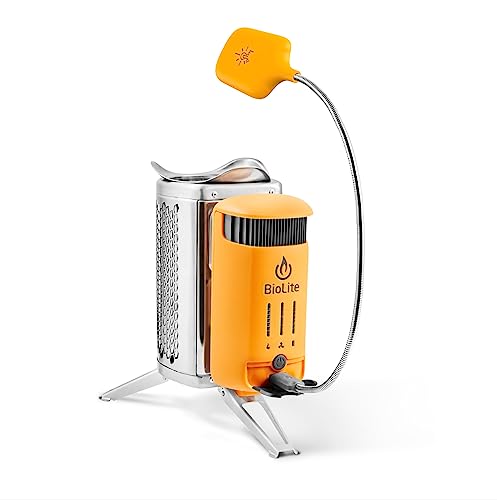
The BioLite CampStove 2+ burns sticks and biomass you collect on site, eliminating the need to carry fuel canisters, and converts waste heat into electricity to charge USB devices while you cook. Owners who test it on multi-day trips without resupply points value the freedom from canister dependency, and the 3.2-watt output is enough to charge a phone to about 60 percent over a one-hour burn. The integrated fan control via the LED dashboard lets you tune the burn from a low simmer to a rolling boil, which is a genuine advance over earlier wood-burning camp stoves.
Where it shines
- Burns freely available biomass so no fuel canisters to carry
- Built-in thermoelectric generator charges USB devices during cooking
- Fan-controlled combustion offers real simmer-to-boil range
Where it falls short
- Requires dry wood, works poorly in rain-soaked environments
- Boil times are longer than canister stoves and depend on fuel quality
Coleman Classic Propane Camp Stove 2-Burner
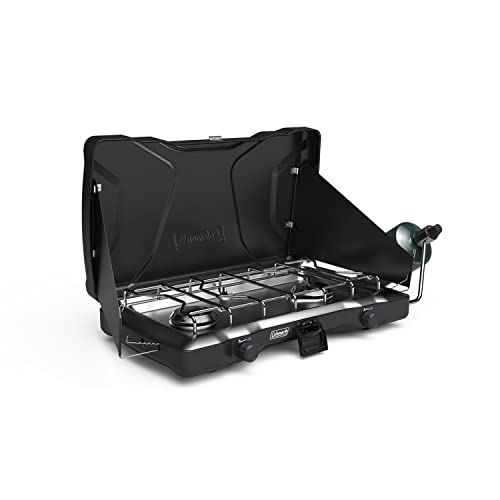
The Coleman Classic has been a staple of family car camping for decades and continues to earn high ratings because it does exactly what budget campers need: two large burners, reliable matchless ignition, and a folding windscreen that actually keeps the flame going in a breeze. Owners who bought it expecting basic reliability consistently report it still cooking perfectly after five or more seasons, which is a durability record few stoves at this price match. It runs on standard 1-pound propane canisters that are available at almost any petrol station or hardware shop.
Where it shines
- Extremely affordable entry point for car camping
- Widely available propane canisters mean no fuel sourcing problems
- Proven multi-season durability in hundreds of owner reviews
Where it falls short
- No pressure regulation, output drops noticeably as the canister empties
- Heavier and bulkier than modern two-burner alternatives
Before you buy
Fuel type and availability
Isobutane-propane canisters are the most convenient fuel for backpacking because they are lightweight and self-sealing, but they are not available in every country and become difficult to dispose of when partially used. Propane canisters are heavier but widely stocked at camping shops and supermarkets worldwide, making them the practical choice for car camping. Wood-burning stoves eliminate the fuel-carrying problem entirely but depend on finding dry material, which is not reliable in wet climates or above treeline.
Wind performance
A stove that performs well in a kitchen-style calm can lose 60 percent of its effective heat output in a light breeze, so wind resistance deserves as much attention as raw BTU output. Integrated windshield systems like the MSR WindBurner address this with a sealed combustion chamber rather than relying on a clip-on screen. If you camp on exposed ridgelines, coastal sites, or in open alpine terrain, prioritise designs with built-in wind protection over those with higher headline output numbers.
Simmer control
Not every camping meal is a boil-in-bag situation. If you want to cook oatmeal without scorching it, reheat leftovers without crisping the bottom, or fry eggs at a controlled temperature, simmer control matters enormously. Radiant burner designs and pressure-regulated valves tend to offer the finest simmer range, while basic canister stoves with a simple valve can go from low to medium but struggle to maintain a true low flame consistently.
Weight versus cooking capacity
The 56-gram Snow Peak LiteMax and the 1.8-kilogram Coleman Classic represent opposite ends of a genuine trade-off: every gram saved in your pack is a gram you are not cooking with, which means smaller pots, less food variety, and a slower pace for groups. Solo backpackers benefit most from ultralight canister stoves; families and base-camp groups get more value from heavier two-burner propane units. Matching stove weight to your actual party size and trip style is the single most impactful buying decision.
The wrap-up
For most campers the MSR PocketRocket 2 is the best starting point because it balances weight, reliability, and versatility better than any other stove at its price, but the right choice ultimately depends on party size, trip length, and how much real cooking you plan to do.
Quick answers
Standard isobutane-propane canisters perform poorly below freezing because the gas pressure inside drops, reducing output significantly. To get better cold-weather performance, keep the canister warm inside your sleeping bag overnight, invert a four-season canister during cooking if the stove design allows it, or choose a stove with a pressure regulator like the MSR WindBurner, which is specifically designed to compensate for low-pressure conditions.
A 100-gram isobutane canister typically provides around 45 to 60 minutes of burn time at medium output, which is enough for roughly 8 to 12 boils of 500ml for one or two people. Actual duration depends heavily on wind, altitude, water starting temperature, and how often you simmer versus boil. Most solo backpackers budget one 100-gram canister per three to four days for basic cooking and hot drinks.
Yes, if you are cooking real meals for more than two people. The ability to boil water for pasta while simultaneously frying vegetables, or to keep a pot of coffee warm while finishing pancakes, changes the camping cooking experience fundamentally. Two-burner propane stoves also tend to have higher BTU output per burner than canister stoves, which means shorter cook times when feeding a group.
Rules vary widely by location and fire-danger level. Many national parks in the US, UK, and Australia prohibit open fires and wood-burning stoves entirely during dry seasons or in fire-restricted zones. Even where wood stoves are permitted, some protected areas restrict collecting fallen wood to preserve ground-level habitat. Always check the specific regulations for your destination before depending on a wood-burning stove as your sole cooking method.
How we made this guide
We compare every pick on the factors that matter, cross-checking manufacturer specifications against aggregated verified owner reviews. We rank independently and never take payment for placement. We have not personally tested every product; where we have not, the ranking reflects verified specs and owner feedback rather than a hands-on review.
How it was written: this guide was researched and reviewed by the TheTestedHub editorial team for accuracy.
Affiliate disclosure: TheTestedHub is reader-supported. When you buy through links on our site, we may earn a commission at no extra cost to you.