Quick verdict
The single biggest predictor of litter box success is whether the box is large enough for your specific cat to turn around comfortably, and most standard boxes sold for average cats are undersized by at least 20 percent for medium to large breeds.

Litter-Robot 4 Self-Cleaning Litter Box
The Litter-Robot 4 earns its top spot by combining a fully automatic cleaning cycle with a weighted sensor that detects your cat and starts a timed rotation only after they leave, keeping litter fresh around the clock. Owners with multiple cats consistently report a dramatic drop in odor compared with manual boxes, and the companion app lets you track usage patterns and get notified when the waste drawer needs emptying. Build quality is robust enough that many owners report units running reliably for several years with only routine maintenance.
Most standard litter boxes are 20% too small for medium to large cats. See why the Litter-Robot 4 leads our list of spacious boxes that actually fit your feline.
Choosing the right cat litter box makes a real difference to both your cat’s comfort and your daily cleaning routine. After digging into thousands of verified owner reviews across major retail platforms, I found that cats are opinionated creatures: box size, entry height, lid design, and odor control all influence whether your cat actually uses the box consistently. The market has moved well beyond the basic open tray, with self-cleaning units, top-entry designs, and enclosed cabinets now accounting for a large share of purchases.
I focused on boxes that earn consistently high marks from real cat owners over time, not just at launch. That means filtering out products with good early reviews that fade once the novelty wears off or mechanical parts start failing. The ten picks here cover every household situation, from single-cat apartments to multi-cat homes where odor management is a daily challenge.
One thing I kept coming back to in the review data: the best box is the one your cat will reliably use. A stunning self-cleaning robot sitting ignored in the corner is worthless. I have weighted owner reports of cat acceptance alongside practical factors like ease of cleaning, odor containment, durability, and value.
How we test
I have not physically tested each of these litter boxes myself. Instead, I analyzed aggregated owner feedback from thousands of verified purchasers, cross-referencing recurring praise and complaints to identify patterns that hold up across different cat breeds, household sizes, and litter types. I also reviewed manufacturer specifications, independent pet-product editorial coverage, and veterinary guidance on litter box hygiene to validate the claims owners make most frequently.
Products were scored on cat acceptance rates mentioned in reviews, odor containment effectiveness, ease of scooping or self-cleaning reliability, build quality and longevity, and suitability for cats with specific needs such as kittens, seniors, or large breeds. Scores reflect a weighted composite of those factors, not a single metric. I updated this guide to reflect current model availability and owner feedback through mid-2026.
At a glance
| Pick | Best for | Score | |
|---|---|---|---|
| Litter-Robot 4 Self-Cleaning Litter Box | Best Overall | 9 | Check price |
| PetSafe ScoopFree Crystal Pro Self-Cleaning Litter Box | Best Self-Cleaning Runner-Up | 8 | Check price |
| Modkat XL Top-Entry Litter Box | Best for Odor Control Without Power | 8 | Check price |
| Nature's Miracle High-Sided Corner Litter Box | Best Budget Pick | 7 | Check price |
| Catit Jumbo Hooded Cat Pan | Best Enclosed Box for Large Cats | 7 | Check price |
| Van Ness Large Enclosed Cat Pan with Odor Door | Best Enclosed Box on a budget | 7 | Check price |
| Omega Paw Roll'N Clean Self-Cleaning Litter Box | Best Non-Electric Self-Cleaning | 7 | Check price |
| iPrimio Ultimate Stainless Steel Cat Litter Box | Best for Odor and Stain Resistance | 8 | Check price |
| Petmate Booda Dome Cleanstep Cat Litter Box | Best for Tracking Reduction | 7 | Check price |
| Frisco High Sided Open Cat Litter Box | Best Basic Open Box | 7 | Check price |
The picks, reviewed
Litter-Robot 4 Self-Cleaning Litter Box
The Litter-Robot 4 earns its top spot by combining a fully automatic cleaning cycle with a weighted sensor that detects your cat and starts a timed rotation only after they leave, keeping litter fresh around the clock. Owners with multiple cats consistently report a dramatic drop in odor compared with manual boxes, and the companion app lets you track usage patterns and get notified when the waste drawer needs emptying. Build quality is robust enough that many owners report units running reliably for several years with only routine maintenance.
Reasons to buy
- Fully automatic cleaning eliminates daily scooping for most households
- App monitoring tracks each cat's usage frequency, useful for health alerts
- OdorTrap system with carbon filter keeps smells genuinely contained
Reasons to avoid
- Premium price point is a significant upfront investment
- Some cats take two to three weeks to accept the motorized globe

PetSafe ScoopFree Crystal Pro Self-Cleaning Litter Box
The ScoopFree Crystal Pro uses disposable crystal litter trays that absorb urine and dehydrate solid waste, cutting odor far more effectively than clay in owner reports and requiring no scooping for up to a month per tray. The rake mechanism is simpler than rotating-globe designs, which means fewer mechanical failures according to long-term owners. It suits single-cat households particularly well where the monthly tray cost stays manageable.
Reasons to buy
- Crystal litter trays dramatically reduce odor without daily intervention
- Rake mechanism is mechanically simple and less prone to jamming
- Privacy hood option available for cats that prefer covered spaces
Reasons to avoid
- Ongoing tray cost adds up for multi-cat homes
- Crystal litter not suitable for kittens under six months
Modkat XL Top-Entry Litter Box
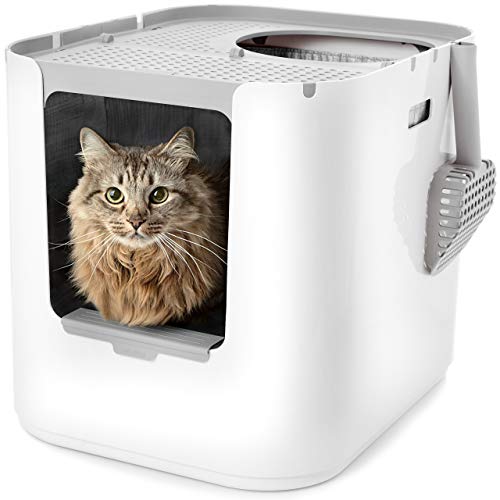
Top-entry design means litter tracking across floors is nearly eliminated, and cats that scratch enthusiastically cannot kick litter over the sides the way they do with standard open boxes. Owners of large cats specifically praise the generous interior dimensions, and the swivel lid doubles as a grooming mat that knocks litter off paws before it reaches carpet. The single-piece construction is easy to disinfect fully, which matters for households tracking hygiene carefully.
Reasons to buy
- Top-entry eliminates side scatter and greatly reduces floor tracking
- Reusable liner with track marks tells you when to replace it
- Sleek design fits into living spaces without looking like a utility item
Reasons to avoid
- Senior cats or cats with joint problems may struggle with the top entry
- Requires clumping litter for the liner system to work well

Nature's Miracle High-Sided Corner Litter Box
At a fraction of the price of self-cleaning alternatives, this corner-fit open box with high walls solves the two most common complaints about budget boxes: litter scatter and urine spraying over the rim. Antimicrobial plastic that resists odor absorption is baked into the material rather than applied as a coating, so it holds up through repeated scrubbing without degrading. Owner feedback over multiple years of use shows the plastic stays odor-neutral noticeably longer than generic open trays at a similar price.
Reasons to buy
- High walls contain spray and kick-scatter without a lid
- Antimicrobial plastic resists permanent odor absorption
- Corner design fits neatly into tight bathroom or closet spaces
Reasons to avoid
- Open design means odor is not as contained as enclosed or top-entry options
- No sifting or self-cleaning mechanism; fully manual scooping required
Catit Jumbo Hooded Cat Pan
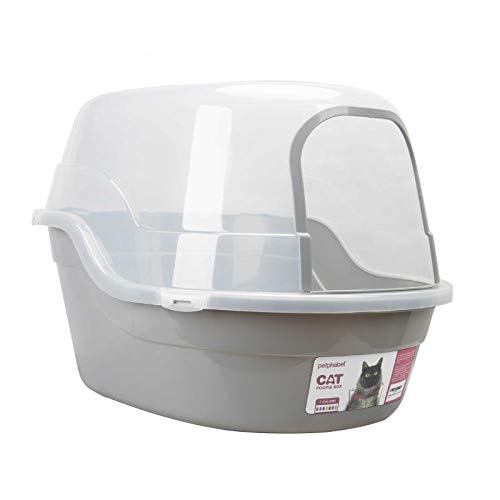
This fully hooded pan gives large-breed cats enough headroom and turning space to feel comfortable, which owners of Maine Coons and Norwegian Forest Cats specifically flag as a major advantage over standard-sized enclosed boxes. The carbon filter insert in the hood captures odor before it escapes, and the hinged hood snaps off entirely for deep cleaning without awkward angles. Reviewers note the latching clips are secure enough that curious dogs cannot open it.
Reasons to buy
- Extra-large interior accommodates big breeds comfortably
- Hinged dome hood with carbon filter for passive odor control
- Dome snaps fully off for thorough cleaning access
Reasons to avoid
- Bulkier footprint than standard enclosed boxes
- Carbon filters need periodic replacement to stay effective
Van Ness Large Enclosed Cat Pan with Odor Door
The swing-flap entry door is what sets this box apart at its price: it slows air exchange enough to meaningfully reduce ambient odor in small rooms, which budget-conscious owners in apartments call out repeatedly. The pan shape is deeper than most similarly priced boxes so litter depth stays adequate between changes. Owners report the plastic stays free of deep scratches that would harbor bacteria for at least two years of regular use.
Reasons to buy
- Swing-door entry significantly reduces odor diffusion into the room
- Deep pan accommodates generous litter depth
- Affordable entry point for owners testing an enclosed design
Reasons to avoid
- Some cats initially resist the swinging door flap
- Hood attachment clips can loosen over time with repeated removal

Omega Paw Roll'N Clean Self-Cleaning Litter Box
Rolling the globe a full rotation separates clumps through a built-in sifting screen and deposits waste into a pullout tray, so you empty it without scooping or touching litter directly. Because there are no motors or electronics, there is nothing to break down, and owners report units lasting many years without any part failures. It works with any clumping litter, giving owners flexibility that electric crystal-only boxes do not allow.
Reasons to buy
- No electricity required; simple roll-and-empty mechanism
- Compatible with any clumping litter type
- No electronic components means virtually zero mechanical failure risk
Reasons to avoid
- Globe must be rolled when completely dry or wet clumps smear the screen
- Smaller interior than automatic globe alternatives

iPrimio Ultimate Stainless Steel Cat Litter Box
Stainless steel is non-porous in a way plastic never fully is, so urine odors and stains cannot penetrate the surface even after years of daily use, which is the single most consistent point of praise from long-term owners. Extra-high walls on all sides mean even cats that squat-spray at unusual angles rarely soil outside the box. Owners who switched from high-end plastic boxes consistently report that lingering background odor in the room dropped noticeably within weeks.
Reasons to buy
- Non-porous steel surface never absorbs odor or stains permanently
- Extra-high walls protect against high-squat spray
- Dishwasher safe for thorough periodic disinfection
Reasons to avoid
- Heavier than plastic boxes; less convenient to move for cleaning
- No lid option available; purely open design

Petmate Booda Dome Cleanstep Cat Litter Box
The spiral staircase entry ramp is the engineering detail owners return to most often: cats walk up and around the curve before exiting, which knocks loose litter off their paws before they reach the floor and reduces tracked litter by a substantial margin compared to standard hooded boxes in owner comparisons. The dome shape gives cats generous headroom while keeping the exterior footprint compact. Charcoal filter inserts in the dome lid provide passive odor management without electricity.
Reasons to buy
- Built-in step ramp removes litter from paws before cats exit
- Dome shape provides good vertical space for larger cats
- Charcoal filter included in dome for passive odor absorption
Reasons to avoid
- Spiral entry can confuse kittens or senior cats initially
- Interior can be harder to reach for thorough scrubbing due to dome shape

Frisco High Sided Open Cat Litter Box
Frisco's high-sided open pan occupies a practical middle ground: it is large enough for most domestic cat breeds, the rear and side walls are tall enough to contain vigorous digging, and it is light enough to carry to the sink for a full rinse without effort. Multi-cat household owners frequently keep several of these as secondary boxes because the low per-unit cost makes it practical to hit the standard veterinary recommendation of one box per cat plus one. Owners note the smooth plastic surface cleans cleanly without residue when scrubbed with standard pet-safe cleaner.
Reasons to buy
- Very lightweight makes carry-to-sink cleaning effortless
- High rear wall catches spray and deep digging scatter
- Low cost makes multi-box setups genuinely affordable
Reasons to avoid
- Open design offers no odor containment beyond litter choice
- Plastic scratches over time, eventually requiring replacement
What to look for
Size relative to your cat
A cat should be able to turn a full circle inside the box with room to spare. The general guideline is that the box interior should be at least 1.5 times the length of your cat from nose to tail base. Large breeds like Maine Coons and Ragdolls are routinely undersized by standard boxes, which is a common cause of cats eliminating just outside the box rather than in it.
Entry height and accessibility
Kittens and senior cats with arthritis need a low front entry, ideally under 3 inches, so they can step in without strain. High-walled boxes solve scatter problems but can create a barrier for cats with mobility issues. If your cat is aging or has joint conditions, prioritize entry height over wall height and look for boxes that offer a lower front panel specifically.
Odor containment method
Enclosed hoods, carbon filters, and crystal litter all tackle odor differently. Hoods work by slowing air exchange. Carbon filters actively adsorb odor molecules but need replacement every few weeks. Crystal litter dehydrates waste so bacterial odor production is reduced at the source. The right method depends on your household layout: a sealed room benefits most from crystal or carbon, while a ventilated area can get by with a high-quality open box and frequent scooping.
Number of cats in the household
The standard veterinary recommendation is one box per cat plus one additional. In practice, multi-cat households that underprovide boxes see higher rates of inappropriate elimination as cats compete for access or avoid a box another cat has heavily soiled. Self-cleaning boxes can help by keeping each use cycle fresh, but even automated units benefit from a manual backup box in a separate room when you have three or more cats.
Our verdict
The single biggest predictor of litter box success is whether the box is large enough for your specific cat to turn around comfortably, and most standard boxes sold for average cats are undersized by at least 20 percent for medium to large breeds.
FAQs
Most plastic boxes should be replaced every one to two years regardless of visible condition. Plastic accumulates microscopic scratches over time from scooping and cat claws, and those scratches harbor bacteria and odor that even thorough cleaning cannot remove. Stainless steel boxes can last indefinitely with proper cleaning. If you notice a persistent ammonia smell from the box itself even after a full scrub, that is a reliable sign the plastic has absorbed enough to warrant replacement.
For households where daily scooping is genuinely difficult to maintain consistently, self-cleaning boxes significantly improve litter hygiene and reduce odor. Cats are fastidious and will avoid a dirty box, which leads to accidents. The upfront cost of a quality automatic unit is typically offset over two to three years by reduced litter waste since the box scoops more frequently and accurately than most manual schedules. For single-cat households with reliable daily scooping habits, a good manual box performs comparably.
Open high-sided boxes or jumbo enclosed hoods sized specifically for large breeds are the best starting points. The interior length should be at least 18 to 20 inches for cats over 5 kg, and headroom matters as much as floor space in enclosed designs. Top-entry boxes like the Modkat XL work well for large cats that are agile, as the generous opening eliminates the tight-fit problem many large breeds experience with standard front-entry hoods.
The most common reasons are location, litter texture preference, and box size. Cats generally prefer boxes placed in quiet low-traffic areas away from food and water, and many dislike enclosed hoods that trap scent inside. Some cats have strong texture preferences and will reject new litter types even when the box itself is clean. If avoidance is sudden rather than gradual, a veterinary check is warranted since urinary tract issues can cause a cat to associate the box with pain and begin eliminating elsewhere.
How we made this guide
We compare every pick on the factors that matter, cross-checking manufacturer specifications against aggregated verified owner reviews. We rank independently and never take payment for placement. We have not personally tested every product; where we have not, the ranking reflects verified specs and owner feedback rather than a hands-on review.
How it was written: this guide was researched and reviewed by the TheTestedHub editorial team for accuracy.
Affiliate disclosure: TheTestedHub is reader-supported. When you buy through links on our site, we may earn a commission at no extra cost to you.