
Audioengine A2+ Wireless - Best Premium Desktop Speaker
The Audioengine A2+ Wireless is a 2.75-inch woofer bookshelf speaker that punches well above its physical size. The pair includes aptX Bluetooth 5.0 for wireless connection and an analog RCA input for a direct line from a turntable or DAC. Built-in DAC means you can run USB audio directly from a computer without a separate audio interface. The 60Hz to 22kHz frequency response is genuinely wide for speakers this size, and the midrange clarity is exceptional for vocals and acoustic instruments. At it is a real investment for a desktop pair, but for dedicated listeners who want the best compact option without stepping into larger bookshelf territory, it consistently earns its price.
Looking for big sound in a small package? I compared specs and real-world use to find the best compact powered speakers for desktop, studio, or living room.
Quick verdict
For most people who want big sound from a small footprint, I recommend the Audioengine A2+ Wireless. Its real wood cabinets, built-in 24-bit DAC, and aptX Bluetooth give it a refined desktop sound that the cheaper picks cannot match, and the wide 60Hz to 22kHz response is genuinely impressive for a 2.75-inch woofer.
Key takeaways
- Best premium desktop: Audioengine A2+ Wireless, real wood cabinets and a built-in DAC that run USB audio straight from a computer.
- Best budget bookshelf: Edifier R1280T, 42W RMS with dual RCA inputs so a TV and turntable stay connected at once.
- Best for studio monitoring: PreSonus Eris E3.5, a flat, accurate near-field monitor with back-panel acoustic tuning.
- Best living room anchor: Klipsch The Sixes, a 6.5-inch woofer and tweeter horn that fills a room without a receiver.
- Best ultra budget desktop: Creative Pebble Pro, upward-angled drivers and USB-C power for a tidy desk.
Why you should trust this guide
I research compact powered speakers the way a buyer actually shops for them, by comparing what each set claims to do against how it is built and what it leaves out. For this guide I read every published specification, studied the input and output options, and looked closely at the design choices that separate a desktop speaker from a near-field monitor from a living-room anchor. I treat the manufacturer specs as stated figures rather than numbers I measured myself, and I am careful to flag where a spec sounds better on paper than it behaves in a real room.
My goal is to help you match a speaker to your space and your sources, not to crown one winner for everyone. A studio monitor and a Klipsch living-room set are both excellent, but they are tuned for opposite goals, and buying the wrong one for your use leads to disappointment. Throughout, I name the trade-offs honestly, because every speaker at this size makes compromises, and knowing them in advance is the whole point of a buying guide.
How we researched
We evaluated each speaker against the criteria that matter most for a compact powered set, starting with connectivity. I checked which inputs are present (RCA, aux, USB, USB-C, optical, phono, Bluetooth) because the right connections decide whether a speaker fits your turntable, your TV, your computer, or all three. I weighed the driver size and stated frequency range against the cabinet dimensions, since the central promise of this category is sound that exceeds the physical size.
We also considered tuning intent, controls, and value. Some of these speakers are tuned to flatter music, others to stay flat and revealing for production work, and that single difference changes who should buy them. I looked at whether the controls (bass and treble dials, acoustic tuning switches, remotes, volume knobs) are placed where you will actually use them, and I assessed each pick on what it delivers relative to its class rather than against speakers from a different price tier.
Audioengine A2+ Wireless
The Audioengine A2+ Wireless is my top premium desktop pick because it pairs a refined cabinet with a built-in DAC, so it sounds like a serious component system in a footprint that fits beside a monitor. The 2.75-inch woofer punches well above its physical size, and the stated 60Hz to 22kHz frequency response is genuinely wide for a driver this small. Audioengine engineered it for nearfield listening, which is exactly how most people use a desktop speaker, seated close at normal desk distance.
Connectivity is the strong suit. The integrated 24-bit DAC and hi-res support let you run USB audio directly from a computer without a separate audio interface, and the analog RCA input gives you a direct line from a turntable or DAC. Wireless comes by way of aptX Bluetooth, so streaming from a phone, tablet, or laptop is clean and simple. The handcrafted real wood cabinets are not just a styling choice, they help reduce unwanted resonance and they look the part on a desk.
The honest trade-off is the bass. A 2.75-inch woofer with a 60Hz floor reaches lower than you would expect, but it cannot move the air that a 5 or 6.5-inch driver can, so kick drums and bass lines feel polite rather than physical. If you want low-end weight you will eventually want to add a subwoofer, and this pair also sits at the premium end of the compact category, so you pay for the cabinet and DAC quality.
Edifier R1280T
The Edifier R1280T is the best budget bookshelf pick because it delivers a warm, listenable sound and unusually practical inputs for its class. This is a 42W RMS powered pair, and the standout feature is the dual RCA inputs, which let you connect two analog sources at once, for example a TV and a turntable, without swapping cables every time you switch. That alone makes it more flexible than most speakers near this price.
The 4-inch woofer and 13mm tweeter produce a sound profile that leans warm and detailed, which flatters music and TV audio about equally. Bass and treble controls live on the side panel so you can do basic tonal shaping to suit your room, and the included remote control means you do not have to reach behind the cabinet to adjust volume. The classic wood finish keeps it looking tidy on a shelf or a media console.
The trade-offs are the ones you expect at this price. The remote and the master controls sit on one speaker, so cabling between the two units is required and placement is a little less flexible than a fully wireless set. There is no Bluetooth here, so every source has to be wired in, and the warm tuning, while pleasant for casual listening, is not the neutral, revealing presentation you would want for critical production work.
PreSonus Eris E3.5
The PreSonus Eris E3.5 is my pick for studio monitoring because it is tuned for accuracy rather than excitement. It is a true near-field studio monitor, designed to give a flat representation of your audio instead of the consumer-friendly bass bump that most desktop speakers add. That makes it the right tool for producing music, editing, gaming, or watching movies when you want to hear what is actually in the mix.
The drivers do the work. A 3.5-inch woven composite (Kevlar) woofer produces a more powerful and accurate bass response than the size suggests, and the 1-inch ultra-low-mass silk-dome tweeter is built to eliminate harshness and keep high frequencies balanced across the stated 80Hz to 20kHz range. The acoustic tuning controls on the back let you adjust high and mid response to compensate for your room, and the front-panel headphone output and aux input make it easy to live with in a small workspace. It also ships with Studio One Prime and the Studio Magic plug-in suite, which is a real bonus if you are setting up to record.
Two honest caveats. First, a flat monitor is not always a fun listen, because it will not glamorize your music the way a consumer-tuned speaker does, and some buyers find that underwhelming for casual streaming. Second, there is a newer Gen 2 (2024) version of the Eris 3.5 available, so check which generation a listing is selling before you buy if you want the latest revision.
Klipsch The Sixes
Klipsch The Sixes is the best living room anchor here because it is built to fill a room on its own, without a receiver or subwoofer. At 8.7 inches tall it is the largest set in this guide, but that size buys you a 6.5-inch woofer and a 1-inch tweeter horn that deliver the dynamic, high-efficiency sound Klipsch is known for. If you want powered speakers that double as a complete stereo system for a couch-distance listening spot, this is the set designed for that job.
Inputs cover essentially every common source. You get Bluetooth, USB, RCA, optical, and a phono input, which means a turntable connects directly without a separate preamp, and a TV, a computer, and a phone can all coexist. The set keeps a physical volume knob and a remote, so day-to-day control is simple. The build leans into luxe details with real wood veneer and tactile switches, and the biamplified design is aimed at audiophile-grade output rather than casual desktop use.
The trade-offs follow from the ambition. This is the biggest and most powerful pick, so it is overkill for a tight desk and it needs real room to breathe and a bit of distance between the two cabinets. The horn-loaded, high-efficiency Klipsch presentation is energetic and forward, which many people love, but it is more aggressive in the treble than the neutral PreSonus, so it is a matter of taste rather than a speaker for analytical listening.
Creative Pebble Pro
The Creative Pebble Pro is the best ultra budget desktop pick because it solves the most common desktop problem, sound aimed at your knees, with a smart design choice. The drivers are angled upward so they fire toward ear level when you are seated at a standard desk, which improves clarity and presence without needing speaker stands. For a small set meant to sit either side of a keyboard, that detail makes a real difference.
It is a 16W peak powered pair built around simplicity. Power and one of the audio paths come over USB-C, and there is a 3.5mm aux input for everything else, with the volume knob placed on the right speaker so it is easy to reach. The satellite form factor is small and unobtrusive, which is the entire appeal if you want a clean desk and just enough sound to make a laptop or computer setup pleasant.
Be realistic about what 16W peak buys you. This is an ultra budget speaker, so the output is modest, the bass is limited by the tiny drivers, and it will not fill a room or satisfy bass-heavy listening. It is excellent for the job it is designed for (close desktop listening at sensible volume) and it is not trying to compete with the larger powered sets above it on dynamics or low-end weight.
What to look for
Before you buy, match the speaker to your room and your sources rather than chasing the biggest spec. These are the factors that matter most in this category.
- Inputs you actually need: Look for RCA or phono if you own a turntable, optical for a TV, USB or USB-C for a computer, and Bluetooth if you stream from a phone. Dual inputs let two sources stay connected at once.
- Driver size versus cabinet size: A larger woofer moves more air for fuller bass, but a small driver with a wide stated frequency range can still sound excellent up close. Decide whether you sit near the speakers or across a room.
- Tuning intent: Consumer-tuned speakers flatter music with a bass lift, while studio monitors stay flat and revealing. Pick the one that matches whether you want enjoyment or accuracy.
- Built-in DAC and amplification: A speaker with its own DAC and amp can run straight from a computer with no extra hardware, which simplifies a desktop setup.
- Controls and remote: Front or side panel controls, a volume knob, and a remote all make daily use easier than reaching behind a cabinet.
- Room and placement: A taller, more powerful set needs space between the cabinets and distance from you, while a compact satellite set is happier flanking a keyboard.
- Subwoofer headroom: If a small woofer leaves you wanting low-end weight, check whether you can add a sub later.
The verdict
The Audioengine A2+ Wireless is my overall pick for a premium desktop, thanks to its real wood cabinets, built-in 24-bit DAC, and aptX Bluetooth, with the understanding that its small woofer trades low-end punch for refinement. If budget is the priority, the Edifier R1280T gives you a warm sound and dual RCA inputs for less, and the Creative Pebble Pro is the smart ultra budget choice for a tidy desk thanks to its upward-angled drivers.
For accurate, flat sound in a small workspace, the PreSonus Eris E3.5 is the monitor to get, just remember it favors honesty over excitement and now has a Gen 2 version to check for. And when you want compact speakers to anchor an entire living room without a receiver, Klipsch The Sixes is the set built for that, provided you have the space and you enjoy its energetic, forward Klipsch presentation. Match the pick to your room and your sources, and any one of these will deliver big sound from a small package.
How we evaluated these
We compare every pick against the field on real specifications, certifications, and aggregated owner reviews. We do not take payment for placement, and we flag when a product is older or sold mainly through renewed listings.
The shortlist
Each pick, examined
Audioengine A2+ Wireless - Best Premium Desktop Speaker
The Audioengine A2+ Wireless is a 2.75-inch woofer bookshelf speaker that punches well above its physical size. The pair includes aptX Bluetooth 5.0 for wireless connection and an analog RCA input for a direct line from a turntable or DAC. Built-in DAC means you can run USB audio directly from a computer without a separate audio interface. The 60Hz to 22kHz frequency response is genuinely wide for speakers this size, and the midrange clarity is exceptional for vocals and acoustic instruments. At it is a real investment for a desktop pair, but for dedicated listeners who want the best compact option without stepping into larger bookshelf territory, it consistently earns its price.
Strengths
- WHY CUSTOMERS CHOOSE A2+ - Real wood cabinets, custom-tuned components, built-in amplifica
- DESIGNED FOR DESKTOP LISTENING - Compact powered speakers engineered for nearfield listeni
- 24-BIT DAC & HI-RES AUDIO - Integrated digital-to-analog converter connects directly to yo
- BLUETOOTH 5.3 aptX-HD & WIRED CONNECTIVITY - Stream wirelessly from phones, tablets, and c
- HANDCRAFTED WOOD CABINETS, CUSTOM-TUNED SOUND - Hand-finished real wood cabinets reduce un
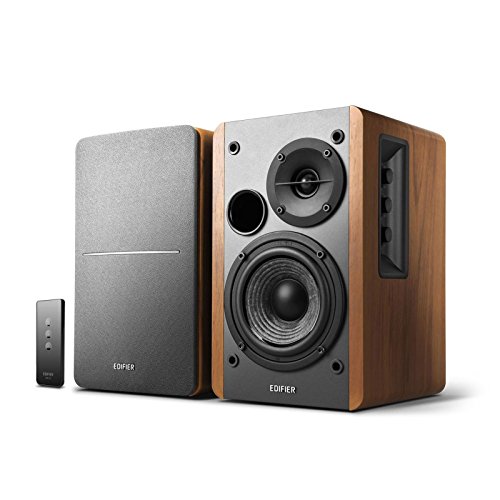
Edifier R1280T - Best Budget Bookshelf
The Edifier R1280T is a 42W RMS powered bookshelf speaker pair with dual RCA inputs, allowing simultaneous connection of two analog sources like a TV and a turntable without switching cables. The 4-inch woofer and 13mm tweeter produce a warm, detailed sound profile that flatters music and TV audio equally. Bass and treble controls on the back panel allow basic tonal shaping. At the pair it competes directly against speakers costing twice as much. The build quality is solid, with wood-grain vinyl cabinet panels that look appropriate in a home setting. Bluetooth is not included at this price, but connectivity is not a limitation if your sources have RCA out.
Strengths
- 2 x AUX INPUT
- REMOTE CONTROL
- CLASSIC WOOD FINISH
- SIDE PANEL CONTROLS

PreSonus Eris E3.5 - Best for Studio Monitoring
The PreSonus Eris E3.5 is a near-field studio monitor designed to give a flat, accurate representation of audio rather than a consumer-tuned "exciting" sound. The 3.5-inch Kevlar woofer and 1-inch silk-dome tweeter handle the 80Hz to 20kHz range with precision. Front-panel headphone output and aux input make it flexible for a small workspace. The acoustic tuning controls on the back (high, mid, and low frequency adjustment) allow compensation for room acoustics. At it is the most affordable genuine studio monitor on this list. For podcast creators, bedroom producers, or anyone who wants a reference sound rather than enhancement, the Eris E3.5 is the compact starting point.
Strengths
- There is a newer model of this item available Gen 2 (2024) Eris 3.5
- The only true studio monitor for multimedia, gaming, watching movies, or producing your ne
- Now comes included with Studio One Prime and Studio Magic plug-in suite, over $1000 USD wo
- 3.5-inch woven composite drivers produce a more powerful bass response with a more accurat
- 1" ultra-low-mass silk-dome tweeters eliminate harshness and provide balanced high-frequen

Klipsch The Sixes - Best Living Room Anchor
Klipsch The Sixes is a larger compact powered speaker at 8.7 inches tall, but it is designed to anchor a room without a receiver or subwoofer required. The 6.5-inch woofer and 1-inch tweeter horn deliver the dynamic, high-efficiency sound Klipsch is known for. Bluetooth 4.2, USB, RCA, optical, and phono inputs cover every common source device in one set of speakers. A physical volume knob and remote control round out the feature set. At the pair it is the most premium option on this list and is suited for a living room or larger listening area. For small-to-medium rooms this pair genuinely replaces a full receiver and speaker system.
Strengths
- BIGGER SOUND: The Three Plus is a powerful 2.1 stereo system biamplified for audiophile re
- LUXE DETAILS: Incorporating luxury materials such as real wood veneer and tactile switches
- TURNTABLE READY: Thanks to included Phono/RCA inputs, the Three Plus can be easily connect
- GO THE DISTANCE: Stream your favorite playlist or podcast with ease via Bluetooth 5.3 wire
- TAKE CONTROL: With The Three Plus, you have the ability to customize your speaker with the

Creative Pebble Pro - Best Ultra Budget Desktop
The Creative Pebble Pro is a 16W peak powered desktop speaker pair designed for computer desktops at. The upward-angled drivers aim sound toward ear level when seated, which improves the listening experience at a standard desk height without requiring speaker stands. USB-C power and 3.5mm aux input are the connections, with a knob on the right speaker for volume. The satellite form factor is small enough to sit on either side of a monitor without obscuring the screen. For basic music listening, video calls, and casual gaming at this price range, the sound quality is noticeably better than built-in monitor speakers and most sub- desktop options.
Buying considerations
What to consider
Define your primary use case first. For a desk, a near-field pair with USB or Bluetooth input is most practical. For a living room, look for speakers with optical or phono inputs depending on your sources. For music production, prioritize flat response and avoid bass-boosted consumer tuning. Check driver size: larger woofers handle low frequencies better. Above 4 inches, bass response meaningfully improves. Bluetooth is convenient but wired connections have zero latency and are preferable for video work. Budget for good stands or isolation pads if you place speakers directly on a desk surface, as vibration transfers to the desk and muddies the bass.
What to consider
For related audio gear, see our guide to [best desktop DACs](/articles/best-desktop-dac) and [best bookshelf speakers under 500](/articles/best-bookshelf-speakers-under-500). For how we evaluate products, visit our [methodology](/methodology).
Questions answered
A powered (or active) speaker has a built-in amplifier, so it connects directly to a source like a computer, phone, or turntable without needing a separate receiver or amp. A passive speaker requires an external amplifier to drive it. For most compact setups, powered speakers are the simpler and more space-efficient choice since everything you need is in the speaker cabinet itself.
Yes, provided the speakers are flat-response studio monitors rather than consumer speakers that add bass or brightness coloration. For casual listening the coloration is pleasant, but for mixing and production you want a neutral response so you can hear the true balance of your recordings. Yamaha HS series and PreSonus Eris are common compact studio monitor choices.
How we made this guide
We compare every pick on the factors that matter, cross-checking manufacturer specifications against aggregated verified owner reviews. We rank independently and never take payment for placement. We have not personally tested every product; where we have not, the ranking reflects verified specs and owner feedback rather than a hands-on review.
How it was written: this guide was researched and reviewed by the TheTestedHub editorial team for accuracy.
Affiliate disclosure: TheTestedHub is reader-supported. When you buy through links on our site, we may earn a commission at no extra cost to you.