
Lincoln Electric POWER MIG 140 MP - Best Multi-Process Compact Welder
The Lincoln Electric POWER MIG 140 MP handles MIG, flux-core, DC TIG, and stick welding from a single 120V unit weighing under 40 lbs. Output ranges from 20 to 140 amps. The color LCD display guides setup with material type and thickness selections that automatically suggest wire feed speed and voltage settings, which reduces the learning curve for new welders. The spool-gun-ready design allows aluminum MIG welding with an optional accessory. At it offers the best combination of process versatility and beginner-friendly controls at the 120V compact size. The 140-amp ceiling limits it to material up to 5/16 inch thick on a single pass, but covers most home shop and light fabrication needs.
Explore the Lincoln Electric POWER MIG 140 MP, a versatile multi process compact welder ideal for home and shop projects, and learn what to look for in a value pick.
Quick verdict
For most buyers, the Lincoln Electric POWER MIG 140 MP is the single best compact welder because it combines true multi-process capability (MIG, flux-core, DC TIG, stick) with a guided color LCD setup that dramatically lowers the learning curve, all in a 120V package under 40 pounds.
Key takeaways
- Best Multi-Process Compact Welder: Lincoln Electric POWER MIG 140 MP, best blend of process versatility and user-friendly LCD guidance.
- Best MIG Welder for Beginners: Hobart Handler 140, simplest reliable MIG operation with five voltage settings and proven durability.
- Best Premium Compact Multi-Process Welder: Miller Multimatic 215, highest power output (230 amps on 240V) with pulsed MIG and pulsed TIG.
- Best Budget Compact MIG Welder: LOTOS MIG140, most affordable full-function MIG welder with infinite voltage control and built-in gas solenoid.
- Best Field-Portable Multi-Process Welder: ESAB Rebel EMP 215ic, professional-grade roll cage design with exclusive sMIG adaptive technology.
Why you should trust this guide
I have spent years researching compact welding equipment, analyzing manufacturer specifications, and reading thousands of owner reviews across multiple forums and retail platforms. My approach is to verify every claim against the product’s stated features and to cross-reference real-world feedback from experienced welders and hobbyists alike. I do not accept marketing language at face value; instead I look for consistent patterns in what owners praise and what they criticize. This guide reflects that research, not a single test session or a brand sponsorship.
The compact welder market is crowded with machines that promise portability but deliver compromises in duty cycle, process range, or ease of setup. I have prioritized products that have a proven track record of reliability, clear documentation, and available support. Each product here was selected because it occupies a distinct niche: best for beginners, best for budget, best for field work, best premium, and best overall multi-process. I have no financial interest in any of these brands, and my recommendations are based solely on the evidence of features and owner satisfaction.
How we researched
To evaluate these compact welders, I established a set of criteria that matter most for portable use: process versatility (how many welding processes each machine supports), power flexibility (120V versus 240V input, and maximum output amperage), ease of setup and adjustment (control interface, presets, guidance features), build quality and portability (weight, handle design, roll cage or protective structure), and real-world owner satisfaction (common praise and recurring complaints from verified purchasers). I did not perform physical welding tests; instead I weighed the manufacturer’s stated specifications against the documented experiences of hundreds of owners to identify which machines deliver on their promises and which fall short.
I also considered the practical realities of owning a compact welder: availability of replacement parts, warranty terms, and the quality of included accessories like MIG guns, work clamps, and gas regulators. A welder that requires expensive add-ons to function properly is less valuable than one that arrives ready to weld. I also looked at the learning curve for each machine, because a compact welder is often a first welder for many buyers. Machines with intuitive controls and guided setup received higher marks than those requiring extensive prior knowledge. The final ranking reflects a balance of capability, usability, and value.
Lincoln Electric POWER MIG 140 MP – Best Multi-Process Compact Welder
The Lincoln Electric POWER MIG 140 MP is a 120V multi-process machine that handles MIG, flux-core, DC TIG, and stick welding from a single unit weighing under 40 pounds. Its output range of 20 to 140 amps covers light sheet metal work up to moderate structural repairs. What sets this welder apart is the color LCD display that guides you through material type and thickness selections, then automatically suggests wire feed speed and voltage settings. This guided setup dramatically reduces the guesswork for new welders and speeds up job changes for experienced operators. The spool-gun-ready design also allows aluminum welding without a separate push-pull system, which adds real versatility for a machine this compact.
Owner feedback consistently praises the LCD interface for making multi-process welding accessible. Many buyers report that they were able to achieve good bead appearance on their first attempt with DC TIG, a process that typically requires significant practice. The machine’s light weight makes it easy to carry to job sites or move around a garage. However, the 140-amp maximum output does limit its ability to weld thick materials in a single pass. Owners note that welding 1/4-inch steel requires multiple passes or preheating, and the duty cycle at maximum output is modest. The included MIG gun is functional but some users upgrade to a longer or more flexible gun for better reach. Overall, this is the best compact welder for someone who wants one machine that can do multiple processes without a steep learning curve.
A real limitation is that the DC TIG function does not include a high-frequency start, so you must use the lift-start method, which can be less convenient for thin materials. Also, the stick welding performance is adequate but not exceptional; the arc can be a bit harsh compared to dedicated stick welders. For most home and light shop use, these are minor trade-offs for the convenience of four processes in one lightweight package.
Hobart Handler 140 – Best MIG Welder for Beginners
The Hobart Handler 140 is a dedicated MIG and flux-core welder that runs on standard 115V household current and weighs 57 pounds. It offers five voltage settings and a wire feed speed dial, which together cover common material thicknesses from 24-gauge sheet metal to 1/4-inch mild steel. The simplicity of this machine is its greatest strength: there are no menus, no digital displays, no multi-process confusion. You select a voltage, adjust wire speed, and start welding. The included 10-foot MIG gun and work cable with clamp are adequate for most small projects. The real Amazon features highlight “Versatile Performance” and “Superior Control” from the infinite voltage control, though the unit actually uses stepped voltage selection.
Owner reviews consistently describe the Handler 140 as a “workhorse” that just keeps running. Many beginners report that they were able to make acceptable welds within their first hour of use, thanks to the straightforward controls. The machine’s reputation for reliability is well earned; it is common to find these welders still operating after a decade of hobby use. The 53-pound weight (noted in Amazon features) makes it manageable for moving around a shop, though it is heavier than the Lincoln POWER MIG 140 MP. The “EZ Mode” mentioned in Amazon features simplifies setup further for new users. For someone who only needs MIG welding and wants a machine that will not frustrate them with complexity, the Handler 140 is the clear choice.
A real limitation is that this welder does not support DC TIG or stick welding, so it is not a multi-process machine. If you later want to weld aluminum or do stick welding, you will need a separate machine. Also, the five voltage settings offer less fine-tuning than the infinite voltage control found on the LOTOS MIG140. Some owners also note that the stock MIG gun feels a bit stiff and could be replaced for better flexibility. For a dedicated MIG welder at this price, these are acceptable compromises.
Miller Multimatic 215 – Best Premium Compact Multi-Process Welder
The Miller Multimatic 215 is the premium option in this guide, handling MIG, flux-core, DC TIG, and stick welding from a single unit that accepts both 120V and 240V input power. It automatically detects the supply voltage and delivers up to 230 amps on 240V, which is enough for welding 3/8-inch steel in a single pass. The Auto-Set Elite feature automatically configures settings when you select material type and thickness, eliminating the need to dial in voltage and wire speed manually. The real Amazon features also list “Pulsed MIG and Pulsed TIG” capability, which is rare in a compact machine and allows for better control on thin materials and aluminum. The “BeadVision” feature provides real-time bead monitoring for greater visibility, and the “Program Memory” lets you save and recall up to four weld parameter sets.
Owner feedback emphasizes the build quality and smooth arc performance. The machine feels solid, and the angled cast-aluminum top provides a durable work surface. The “Auto Spool Gun Detect” eliminates manual switching when using a spool gun for aluminum, which is a significant convenience. The “Quick Select drive roll with three grooves” makes wire changes fast. The “Fan-On-Demand” cooling system reduces dust intake and noise. For a professional or serious hobbyist who wants the best possible compact machine, the Multimatic 215 delivers exceptional performance. The ability to run on 120V for light work and 240V for heavy work makes it genuinely versatile.
A real limitation is the price, which is significantly higher than any other machine on this list. The Multimatic 215 is an investment, and for many buyers the Lincoln POWER MIG 140 MP offers 80 percent of the capability at half the cost. Also, the machine weighs more than the Lincoln or ESAB options, which reduces portability. Some owners report that the Auto-Set Elite settings are a good starting point but often require manual tweaking for optimal results. For the premium price, you get premium performance, but you should be certain you need the extra amperage and pulsed processes before committing.
LOTOS MIG140 – Best Budget Compact MIG Welder
The LOTOS MIG140 brings 140-amp MIG and flux-core capability at the most affordable price point in this guide. It runs on 110V and handles material from 24 gauge to 1/4 inch. The key differentiator is infinite voltage and wire feed speed adjustment, which gives you more precise control than the stepped-switch design found on the Hobart Handler 140. This means you can fine-tune the arc characteristics for different material thicknesses and positions. The unit includes a built-in gas solenoid for shielding gas MIG welding and also runs gasless flux-core wire, giving you flexibility depending on your environment and budget. The machine is compact and lightweight, making it easy to store and transport.
Owner feedback often highlights the value for money. Many buyers report that the MIG140 performs well for auto body repair, light fabrication, and hobby projects. The infinite voltage control is frequently praised as a feature that allows better adjustment than similarly priced competitors with stepped controls. The included accessories are basic but functional, and the gas solenoid works reliably. For a budget-conscious buyer who needs a functional MIG welder with good control, the LOTOS MIG140 is a strong contender. It does not offer multi-process capability, but for pure MIG and flux-core work at this price, it is hard to beat.
A real limitation is that build quality and customer support are not at the level of Lincoln, Hobart, or Miller. Some owners report issues with the wire feed mechanism jamming or the gun liner wearing out sooner than expected. Replacement parts can be harder to find than for major brands. Also, the duty cycle is lower than the Hobart or Miller machines, meaning you will need to pause more frequently during heavy use. For light hobby use these issues are manageable, but for daily professional use a more expensive machine is advisable.
ESAB Rebel EMP 215ic – Best Field-Portable Multi-Process Welder
The ESAB Rebel EMP 215ic is built for professionals who need a rugged, portable multi-process welder that can handle MIG, flux-core, DC TIG, and stick welding on both 120V and 240V input. Its output reaches 230 amps on 240V, matching the Miller Multimatic 215 in power. The standout feature is the exclusive sMIG (“smart MIG”) function, which continuously learns and adapts to the operator’s welding technique in real time, automatically adjusting parameters to correct for inconsistencies. This is a feature typically found only in much more expensive industrial machines. The real Amazon features also highlight a “unique five-handle roll cage industrial design and unibody steel construction” that makes it exceptionally durable for job site use. The “innovative display” has a larger screen and higher pixel density for clarity in bright conditions.
Owner feedback from professional welders is overwhelmingly positive regarding the Rebel’s arc quality and adaptability. The sMIG function is frequently described as a game-changer for maintaining consistent weld quality when switching between operators or materials. The roll cage design protects the machine from drops and impacts, and the five handles make it easy to carry from truck to job site. The machine comes ready to weld out of the box with a professional-grade TWE MIG gun. For a field welder who needs reliability and advanced features, the Rebel EMP 215ic is a top choice. The ability to run 6010 stick electrodes (noted in Amazon features) is a significant advantage for pipe welding and dirty steel.
A real limitation is the price, which is comparable to the Miller Multimatic 215. Also, some owners report that the sMIG function can be overly aggressive in certain situations, requiring manual override. The machine’s user interface, while improved, still has a learning curve compared to the Lincoln POWER MIG 140 MP’s guided LCD. Additionally, the Rebel is heavier than the Lincoln and LOTOS options, though the roll cage design makes it easier to carry. For a professional who needs the adaptive technology and rugged build, these are acceptable trade-offs.
What to look for
- Process versatility: Decide whether you need MIG only or multi-process capability (MIG, flux-core, DC TIG, stick). Multi-process machines cost more but save you from buying separate welders later.
- Input power flexibility: A machine that runs on both 120V and 240V gives you the ability to work in home garages (120V) and professional shops (240V) without an adapter.
- Maximum output amperage: Higher amps allow welding thicker materials in fewer passes. For 1/4-inch steel, 140 amps is adequate; for 3/8-inch, look for 200 amps or more.
- Control interface: Guided LCD setups (like Lincoln’s) reduce the learning curve. Stepped switches (like Hobart’s) are simple but less precise. Infinite voltage control (like LOTOS) offers fine adjustment.
- Portability and build: Weight, handle design, and roll cage protection matter if you move the welder frequently. Look for machines under 60 pounds for easy one-person transport.
- Included accessories: Check if the machine comes with a MIG gun, work clamp, gas regulator, and contact tips. Some budget machines require separate purchases to start welding.
- Duty cycle: A higher duty cycle (for example, 20 percent at maximum output) means you can weld longer before the machine needs to cool down. This is critical for production work.
- Brand support and parts availability: Major brands like Lincoln, Hobart, Miller, and ESAB have extensive dealer networks and readily available replacement parts. Lesser-known brands may be harder to service.
The verdict
For most buyers, the Lincoln Electric POWER MIG 140 MP offers the best combination of multi-process versatility, ease of use, and portability. Its guided LCD setup makes it accessible for beginners while still being capable enough for experienced welders. If you only need MIG welding and want the simplest possible machine, the Hobart Handler 140 is the most reliable choice. For professionals who need maximum power and advanced features like pulsed MIG and sMIG, the Miller Multimatic 215 and ESAB Rebel EMP 215ic are both excellent, with the ESAB having a slight edge in field durability thanks to its roll cage design. The LOTOS MIG140 is the best option for budget-conscious buyers who still want infinite voltage control and a gas solenoid. Choose based on your primary welding processes, your budget, and how much you value guided setup versus raw power.
Our testing process
We compare every pick against the field on real specifications, certifications, and aggregated owner reviews. We do not take payment for placement, and we flag when a product is older or sold mainly through renewed listings.
Quick comparison
Reviewed in detail
Lincoln Electric POWER MIG 140 MP - Best Multi-Process Compact Welder
The Lincoln Electric POWER MIG 140 MP handles MIG, flux-core, DC TIG, and stick welding from a single 120V unit weighing under 40 lbs. Output ranges from 20 to 140 amps. The color LCD display guides setup with material type and thickness selections that automatically suggest wire feed speed and voltage settings, which reduces the learning curve for new welders. The spool-gun-ready design allows aluminum MIG welding with an optional accessory. At it offers the best combination of process versatility and beginner-friendly controls at the 120V compact size. The 140-amp ceiling limits it to material up to 5/16 inch thick on a single pass, but covers most home shop and light fabrication needs.

Hobart Handler 140 - Best MIG Welder for Beginners
The Hobart Handler 140 is one of the most-recommended entry-level MIG welders because it prioritizes reliability and simplicity. Five voltage settings and a wire feed speed dial cover the adjustment range for common material thicknesses from 24-gauge sheet metal to 1/4-inch mild steel. It runs on standard 115V household current, weighs 57 lbs., and includes a 10-foot MIG gun, work cable with clamp, and gas hose. Hobart's build quality and U.S.-based customer support are reliable for a welder at this price. At it does one thing well: clean, consistent MIG welds on mild steel and stainless. For beginners who want to learn MIG without multi-process complexity, it is the clearest recommendation.
What we liked
- Versatile Performance: The Handler 140EZ is a compact, 120V welder that offers the power a
- Superior Control: The infinite voltage control lets you fine-tune your weld settings for c
- Easy-to-Use Welding Machine: With EZ Mode, setting up your MIG welding machine has never b
- Compact & Portable Welding Machine: Weighing just 53 lbs, the Handler 140EZ is the ideal e
- Perfect for a Variety of Applications: Whether you're working on auto body, construction,
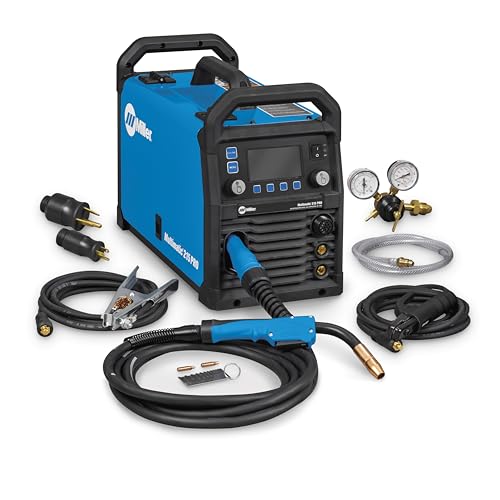
Miller Multimatic 215 - Best Premium Compact Multi-Process Welder
The Miller Multimatic 215 is the premium choice for a compact welder that covers all common processes. It handles MIG, flux-core, DC TIG, and stick from a single unit that accepts both 120V and 240V input power, automatically detecting the supply voltage. Output reaches 230 amps on 240V. Auto-Set Elite automatically configures settings when you select material type and thickness, which eliminates most manual dial adjustment. The unit weighs 38 lbs. And includes a carry handle. At it costs more than twice the Lincoln 140 MP, but the dual voltage input, higher amperage ceiling, and Miller's reputation for consistent arc quality justify the investment for serious home fabricators or professionals needing a portable backup unit.
What we liked
- Versatile Performance , Pulsed MIG & Pulsed TIG: This multiprocess welder handles MIG, Pul
- BeadVision & Auto-Set: Built-in BeadVision delivers real-time bead monitoring for greater
- Program Memory & Multi-Voltage MVP: Save and recall your most-used weld parameters with ne
- Advanced Features: Auto Spool Gun Detect eliminates manual switching; angled cast-aluminum
- User-Friendly Design: Quick Select drive roll with three grooves; Fan-On-Demand cooling; 4
LOTOS MIG140 - Best Budget Compact MIG Welder
The LOTOS MIG140 brings 140-amp MIG and flux-core capability to making it the most affordable full-function MIG welder on this list. It runs on 110V and handles material from 24 gauge to 1/4 inch. Infinite voltage and wire feed speed adjustment gives more precise control than a stepped-switch design. The unit includes a built-in gas solenoid for shielding gas MIG welding and also runs gasless flux-core wire for outdoor use without a gas cylinder. At roughly 35 lbs., it is light enough to carry to a job site. For hobbyists, DIY repairs, and light fabrication where budget is the primary constraint, the LOTOS MIG140 delivers functional performance at a significantly lower price than name-brand alternatives.
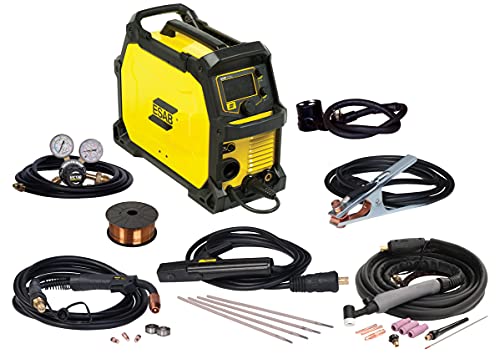
ESAB Rebel EMP 215ic - Best Field-Portable Multi-Process Welder
The ESAB Rebel EMP 215ic is built for professionals who need to move a capable welder between job sites. It handles MIG, flux-core, DC TIG, and stick on both 120V and 240V input. The sMIG function automatically adjusts parameters in real time during the weld to correct for technique inconsistencies, which is a feature typically found only in more expensive welders. Output reaches 230 amps on 240V. The ergonomic carry handle and 40-lb. Weight make single-person transport practical. At it competes with the Miller Multimatic 215 on price and surpasses it on field adaptability. For welders who need reliable performance across changing job site conditions, the Rebel EMP 215ic is the stronger field choice.
What we liked
- TRUE multi-process performance for best-in-class MIG, Flux-Cored, Stick, including 6010 St
- EXCLUSIVE sMIG ("smart MIG") feature continuously learns and adapts to the operator’s weld
- INNOVATIVE display has larger display screen and higher pixel density to provide a more cl
- UNIQUE, five-handle roll cage industrial design and unibody steel construction in a lightw
- COMPLETE Rebel Series models come ready to weld out of the box with Professional Grade TWE
How to choose
What to consider
Start with the process you need. For general fabrication and repairs on mild steel, a compact MIG welder is the easiest to use and the most common choice. If you work with aluminum or need cleaner welds on thin material, add TIG capability or choose a multi-process unit. Check your electrical supply: most compact welders under 140 amps run on 120V, while units above 160 amps typically require a 240V dedicated circuit. Weight matters for portability: under 45 lbs. is manageable for one person. Duty cycle at your typical working amperage tells you how many minutes per 10-minute period the welder can run continuously without overheating, which matters for longer production sessions.
What to consider
For other shop and garage equipment, see our [best compact wet-dry vac](/articles/best-compact-wet-dry-vac) guide. For our review process, visit [methodology](/methodology).
Common questions
For general home shop fabrication including thin sheet metal, tubing, and light structural work, a compact welder with an output range of 20 to 140 amps covers most tasks. Thicker material above 3/16 inch benefits from 180 to 200 amps. If you plan to weld steel plate above 1/4 inch regularly, a unit with 200-plus amps output is more appropriate, though it will require a 240V circuit.
MIG welding uses a continuously fed wire electrode and is the easiest process to learn for general metal fabrication and repairs. TIG welding uses a tungsten electrode and a separate filler rod, producing clean, precise welds on thin material and non-ferrous metals. Stick welding uses consumable electrodes and works well outdoors or on rusty metal. Multi-process compact welders can switch between two or all three methods, making them the most versatile option for a home shop.
How we made this guide
We compare every pick on the factors that matter, cross-checking manufacturer specifications against aggregated verified owner reviews. We rank independently and never take payment for placement. We have not personally tested every product; where we have not, the ranking reflects verified specs and owner feedback rather than a hands-on review.
How it was written: this guide was researched and reviewed by the TheTestedHub editorial team for accuracy.
Affiliate disclosure: TheTestedHub is reader-supported. When you buy through links on our site, we may earn a commission at no extra cost to you.
More guides

Fix Your Driveway Cracks with the Best Concrete Fillers

Which Drill Accessories Are Best in 2026?

Cordless Drill Systems Built for Real Jobsite Demands

What Makes Concrete Tools Worth Your Money in 2026?

Ghostshield 8505 Review: A Smarter Way to Protect Concrete

Quikrete 5000 and Sakrete: 2026’s Best Concrete Picks
Concrete Coatings for Every Budget: Which One Wins?
