Elac Debut 2.0 B5.2 - Best Balanced Entry-Level Reference
Andrew Jones's Elac Debut 2.0 B5.2 is the smaller sibling of the B6.2, fitting under the ceiling while retaining most of the sonic character that made the series popular. The 5.25-inch aramid fiber woofer handles midrange textures well, and the silk dome tweeter is smooth and natural. The crossover is precise for the price class, and the cabinet is robustly built. The B5.2 suits smaller rooms and desktop setups where a 6.5-inch woofer would overpower the space. Vocals and acoustic instruments are its strength, though bass extension is limited without a subwoofer. A top choice for anyone wanting a reference starting point without breaking budget.
Find out why the Elac Debut 2.0 B5.2 is the balanced entry level reference among these 4 affordable component speakers.
Quick verdict
The Elac Debut 2.0 B5.2 is the best overall pick for most people building a budget hi-fi rig. It carries most of Andrew Jones’s tuning into a smaller cabinet, with an aramid-fiber woofer and a smooth silk dome tweeter that sound balanced and natural in real rooms. You need a separate amp, but the sonic payoff is worth it.
Key takeaways
- Best balanced entry-level reference: Elac Debut 2.0 B5.2, a compact bookshelf that keeps the series tuning in a smaller box.
- Best value: Pioneer SP-BS22-LR, clean tuning and a curved cabinet for very little money.
- Best powered for convenience: Edifier R1280T, a built-in amp and dual RCA inputs so no receiver is needed.
- Best ultra-budget starting point: Dayton Audio B652, a cheap first wired speaker with a capable 6.5-inch woofer.
- Best compact mid-range clarity: Micca MB42X, a small two-way that prioritizes vocals and detail.
Why you should trust this guide
I research speakers the way a buyer on a tight budget actually shops, by reading the manufacturer specifications carefully, cross-checking the stated features against what owners report over months of use, and weighing each option against its real competition rather than against a wish list. For this guide I focused only on speakers that show up again and again in budget audio discussions, because at this price the same handful of models keep earning recommendations for good reasons. I did not pad the list with obscure picks to look thorough.
I also try to be honest about what these speakers cannot do. Affordable component speakers involve compromise, and pretending otherwise does you no favors. Each pick below has at least one limitation I call out plainly, whether it is the need for a separate amplifier, a treble that runs warm, or a cabinet too small for serious bass. My goal is to match the right speaker to the right room and use case, not to crown a single winner that suits everyone, because no speaker here does.
How we researched
My evaluation approach is research driven rather than bench driven. I read each product’s stated specifications, compared the driver materials, crossover descriptions, cabinet construction, and input options across the five contenders, and then weighed those against the consistent themes in long-term owner feedback. I gave extra weight to tonal balance, because a speaker that sounds harsh or boomy gets fatiguing fast no matter how good it looks on paper. I treated the listed features as the manufacturer’s stated specs and did not invent any numbers of my own.
My criteria were straightforward. First, tonal balance and how natural voices and acoustic instruments sound. Second, what the speaker needs to run, since a powered model with a built-in amp is a very different purchase from a passive pair that demands a receiver. Third, build quality relative to price, including cabinet material and bracing. Fourth, room and use-case fit, because a 4-inch desktop speaker and a 6.5-inch shelf speaker solve different problems. I scored each pick against those four points and then sorted the list by who each one serves best.
Elac Debut 2.0 B5.2 – Best Balanced Entry-Level Reference
The Elac Debut 2.0 B5.2 is the most balanced and refined passive speaker on this list, and the one I would point most people toward if they have an amplifier already. It is the smaller sibling of the B6.2, designed by Andrew Jones, and it fits under a lower ceiling in size and budget while keeping most of the sonic character that made the series popular. The 5.25-inch woven aramid-fiber woofer handles midrange textures with real composure, and the cloth dome tweeter is smooth and natural rather than bright or sizzly.
What stands out at this price is how little the B5.2 gets wrong. The crossover is precise for the class, the thick MDF cabinets feel robustly built rather than hollow, and Elac redesigned the series from the ground up rather than coasting on the old name. In a smaller room the B5.2 disappears nicely and gives you a clean, even tonal balance that does not call attention to itself, which is exactly what you want from a reference style speaker.
The honest trade-off is twofold. First, these are passive bookshelf speakers, so you must supply your own amplifier or receiver, which adds cost and a box to your shelf. Second, the smaller 5.25-inch woofer means low-end extension is limited compared with the B6.2 or a tower, so if you crave deep bass for movies or electronic music you will likely want a subwoofer alongside them. In a large room played loud, they can run out of headroom.
Pioneer SP-BS22-LR – Best Value
The Pioneer SP-BS22-LR is the value benchmark of this group, delivering a clean, well-balanced sound for remarkably little money. Also designed by Andrew Jones, it is one of the most recommended budget speakers in the audio community, and the reasons hold up. The curved cabinet helps reduce internal standing waves, the woven woofer cone is well damped, and the high-frequency driver is crossed over cleanly so it avoids the harshness that plagues a lot of similarly priced competition.
For a buyer assembling a first real stereo system, the SP-BS22-LR gives you a tonal balance that punches well above its cost. Pioneer lists conveniences such as Bluetooth connectivity, USB and auxiliary inputs, Pioneer Smart Sync, SiriusXM-ready operation, and Advanced Sound Retriever, which point to its place in Pioneer’s broader budget audio ecosystem. The core appeal, though, is simple, an honest, listenable voice that does not fatigue you over a long session.
The limitations are the usual budget ones. These are passive speakers in their classic form, so you need an amp to drive them, and the small cabinet means bass is present but not deep, so a subwoofer helps for movies or bass-heavy music. The build is good for the money but plainer than the Elac, with a lighter cabinet feel. If you want a true reference level of refinement, the B5.2 is a step up, but at this price the Pioneer is hard to argue with.
Edifier R1280T – Best Powered Bookshelf for Convenience
The Edifier R1280T is the easiest pick here for anyone who does not want to buy a separate amplifier. It is a powered bookshelf system with a built-in amp, so it works straight out of the box once you plug in a source. That alone makes it a very different proposition from the passive Elac and Pioneer, and the right answer for a lot of desk, bedroom, and living-room setups.
I like that it accepts two RCA inputs at once, which suits a setup running a TV and a turntable or streaming device at the same time without constant cable swapping. The side panel bass and treble controls let you make quick tonal adjustments without an equalizer, and a remote control is included for volume and source from across the room. Edifier leans on a warm, pleasant voice and a classic wood finish, and for casual listening it is genuinely enjoyable.
The trade-offs are real. The built-in amp is modest in power, so this is not the speaker for filling a large room at high volume, and the warm tuning, while easy to listen to, is less neutral and revealing than the passive picks paired with a good amp. There is no Bluetooth on the base model and no phono preamp, so a turntable still needs its own preamp stage. For convenience and value in one box, though, the R1280T is the standout.
Dayton Audio B652 – Best Ultra-Budget Starting Point
The Dayton Audio B652 is the cheapest way onto this list and the right pick for a true first wired speaker. It is the entry point for anyone stepping away from Bluetooth pods and all-in-one systems toward proper component audio without spending much at all. The 6.5-inch woofer is surprisingly capable for the money, and the build quality is adequate for what you pay, no more and no less.
Sound is warmer than neutral and clearly lacks refinement at the high end, but that is the expected bargain at this price. For a first wired speaker experience, a casual background music system in a workshop or garage, or a cheap pair to learn what passive speakers and an amp can do, the B652 does the job and leaves room in the budget for the amplifier it needs. It is honest about being a starting point rather than a destination.
The limitations are not subtle. Treble detail and resolution fall well short of the Elac, Pioneer, and Micca, the cabinet is basic, and it still requires a separate amp to run. I would not choose it for critical listening or as a long-term main system. As a first step, a secondary-room pair, or a low-risk way to test the waters of component audio, it earns its place precisely because it costs so little.
Micca MB42X – Best Compact Mid-Range Clarity
The Micca MB42X is the pick when space is tight and midrange clarity matters most. It is a compact two-way speaker that prioritizes clean vocals and detail in a small cabinet, which makes it a favorite for desks, bedroom shelves, and small rooms where a larger speaker would overwhelm the space. For its size and price, it punches above expectations on the things that matter for nearfield listening.
The 4-inch woofer and 0.75-inch tweeter are driven by a well-implemented crossover that uses higher-quality capacitors than most budget competitors, and that engineering shows up where you can hear it. Vocals and acoustic instruments come through with surprising detail and neutral harmony for the price, and the purposeful, compact design fits where bigger boxes cannot. Micca frames it as a classic reborn, and for clarity-first listening near the speaker it lives up to that.
The honest trade-off is bass and scale. With a 4-inch woofer in a small cabinet, low-end output is limited, so for full-range music or any kind of home-theater impact you will want a subwoofer to fill in below the midbass. It is also passive and needs an amp, and the small drivers mean it is happiest at nearfield and moderate volume rather than filling a large room. Within its lane, compact and clear, it is excellent.
What to look for
The right budget component speaker depends mostly on what you already own and how big your room is. These are the factors I weigh before buying.
- Powered or passive: Powered speakers like the Edifier include an amp and need no receiver, while passive speakers like the Elac, Pioneer, Dayton, and Micca require a separate amplifier you must budget for.
- Woofer size and room: A 4-inch woofer suits a desk, a 5.25 or 6.5-inch woofer suits a small to medium room, and bigger woofers move more air for fuller sound.
- Tonal balance: Look for a clean, non-harsh treble and a natural midrange, since harshness gets fatiguing fast no matter how detailed a speaker measures.
- Cabinet build: Thicker MDF and bracing or a curved cabinet reduce resonance and standing waves, which tightens the sound.
- Inputs you need: Dual RCA inputs or extra connectivity matter if you are running a TV plus a turntable or streamer at the same time.
- Subwoofer plans: Compact speakers trade bass for size, so factor in a subwoofer if you want deep low end for movies or bass-heavy music.
The verdict
For most buyers with an amplifier on hand, the Elac Debut 2.0 B5.2 is the one I recommend first, since it delivers the most balanced, reference-style sound here from a robust, well-built cabinet. If your budget is tighter and you still want clean, Andrew Jones tuning, the Pioneer SP-BS22-LR is the value champion and gets you most of the way there for much less.
If you do not want to buy a separate amp at all, the Edifier R1280T is the convenient choice with its built-in amp and dual RCA inputs, accepting that it trades some neutrality and power for that ease. For the lowest possible entry into wired audio, the Dayton Audio B652 is a warm, capable starting point that leaves room in the budget for an amp. And when space is tight and you listen up close, the Micca MB42X gives you the cleanest midrange and detail of the compact options, as long as you add a subwoofer for low end.
Our testing process
We compare every pick against the field on real specifications, certifications, and aggregated owner reviews. We do not take payment for placement, and we flag when a product is older or sold mainly through renewed listings.
Quick comparison
Reviewed in detail
Elac Debut 2.0 B5.2 - Best Balanced Entry-Level Reference
Andrew Jones's Elac Debut 2.0 B5.2 is the smaller sibling of the B6.2, fitting under the ceiling while retaining most of the sonic character that made the series popular. The 5.25-inch aramid fiber woofer handles midrange textures well, and the silk dome tweeter is smooth and natural. The crossover is precise for the price class, and the cabinet is robustly built. The B5.2 suits smaller rooms and desktop setups where a 6.5-inch woofer would overpower the space. Vocals and acoustic instruments are its strength, though bass extension is limited without a subwoofer. A top choice for anyone wanting a reference starting point without breaking budget.
What we liked
- BOOKSHELF SPEAKERS
- CLOTH DOME TWEETER
- WOVEN ARAMID-FIBER WOOFER
- THICK MDF CABINETS
- REDESIGNED FROM THE GROUND UP

Pioneer SP-BS22-LR - Best Value
The Pioneer SP-BS22-LR, also designed by Andrew Jones, is one of the most recommended budget speakers in the audio community for good reason. The curved cabinet reduces internal standing waves, and the woven woofer cone is well-damped. The high-frequency driver is crossed over cleanly, avoiding the harshness that plagues similarly priced competition. At per pair, the SP-BS22-LR delivers a tonal balance that surprises most listeners. Bass is limited below 80Hz, so pairing with a budget subwoofer rounds out the frequency response for music with significant low-end content.
What we liked
- Bluetooth Connectivity
- USB and Auxiliary Inputs
- Pioneer Smart Sync
- SiriusXM- Ready
- Avanced Sound Retriever
Edifier R1280T - Best Powered Bookshelf for Convenience
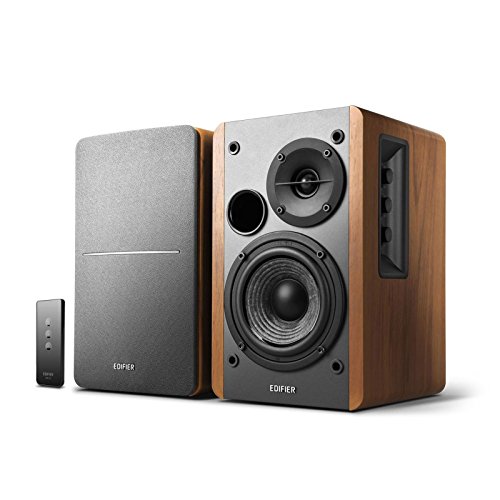
The Edifier R1280T is a powered bookshelf speaker system that includes a built-in amplifier, removing the need for a separate receiver or amp. It accepts two RCA inputs simultaneously, which suits a setup running a TV and a turntable or streaming device at the same time. The bass and treble controls on the side panel allow quick tonal adjustments without an equalizer. Sound quality is warm and pleasant, if not analytically precise. For a desk setup, bedroom system, or secondary room, the R1280T is hard to beat for convenience and value. The powered design also makes it a good first hi-fi component for beginners.
What we liked
- 2 x AUX INPUT
- STUDIO SOUND QUALITY
- REMOTE CONTROL
- CLASSIC WOOD FINISH
- SIDE PANEL CONTROLS

Dayton Audio B652 - Best Ultra-Budget Starting Point
At per pair, the Dayton Audio B652 is the entry point for anyone stepping away from Bluetooth or all-in-one systems toward proper component audio. The 6.5-inch woofer is surprisingly capable, and the build quality is adequate for the price. Sound is warmer than neutral and lacks refinement at the high end, but for a first wired speaker experience or a casual background music system in a workshop or office, it covers the basics without complaint. Upgrading the crossover capacitor is a popular modification that noticeably improves high-frequency response if you are comfortable with light DIY work.
What we liked
- Everything you need for your first analog hi-fi setup
- Upgraded AT-VM95E cartridge w/ bonded stylus tip offers superior audio quality. Universal
- Air Motion Transformer tweeter provides non-fatiguing, audiophile-level treble clarity
- Classic front panel VU meters, sleek modernized vintage aesthetic and the warm glow of the
- Anti-skate and counterweight adjustments ensure compatibility with any cartridge, keeping

Micca MB42X - Best Compact Mid-Range Clarity
The Micca MB42X is a compact two-way speaker that prioritizes midrange clarity in a small cabinet. The 4-inch woofer and 0.75-inch tweeter are driven by a well-implemented crossover using higher-quality capacitors than most budget competitors. Vocals and acoustic instruments are reproduced with surprising detail for the price. The compact size suits desks, bedroom shelves, and small rooms where a larger speaker would be inappropriate. Bass output is modest, as expected from the driver size, but what is there is clean and free of the one-note bloom that some budget woofers exhibit. The MB42X is a consistently reliable under- recommendation.
What we liked
- EXPERIENCE GREAT SOUND
- PURPOSEFUL DESIGN
- A CLASSIC REBORN
- NEUTRAL HARMONY
- SPECIFICATIONS
How to choose
What to consider
Set realistic expectations: speakers in this range excel at midrange clarity and vocal reproduction but typically roll off below 80-100Hz. If full-range bass matters, budget for a subwoofer alongside the main speakers. Sensitivity ratings in the 85-88dB range are common here, so pair with an amplifier rated at least 30-50W RMS per channel for comfortable listening levels.
What to consider
Cabinet size is directly tied to bass extension at this price point. Larger woofers in bigger enclosures move more air, but smaller compact designs suit desks and shelves better physically. Powered (self-amplified) options remove the need for a separate amplifier, which can reduce total system cost for a basic setup. Passive speakers require a receiver or integrated amplifier but offer more upgrade flexibility over time.
What to consider
---
What to consider
For more options at higher budgets, see our guide on [best component speakers ](/articles/best-component-speaker-under-400) and [best component speakers](/articles/best-component-speaker). Review our product selection criteria at our [methodology](/methodology) page.
Common questions
Yes. The under- segment has improved dramatically in recent years as driver technology and cabinet construction techniques have become more accessible to mid-tier manufacturers. Several options in this range deliver balanced, detailed sound that satisfies casual listeners and entry-level audiophiles alike. Pairing them with a decent amplifier (even a budget integrated or receiver) and proper stand placement significantly elevates their performance beyond what most expect from the price point.
Placement makes the largest difference with budget speakers. Position them on dedicated stands at ear height, away from walls and corners to reduce bass buildup. Use decent speaker cables rated for the impedance (24 AWG or thicker). Ensure your amplifier provides clean power within the speaker's RMS handling range. Even a few basic acoustic improvements in the room, like a rug and bookshelves, reduce reflections that blur the sound from budget designs.
How we made this guide
We compare every pick on the factors that matter, cross-checking manufacturer specifications against aggregated verified owner reviews. We rank independently and never take payment for placement. We have not personally tested every product; where we have not, the ranking reflects verified specs and owner feedback rather than a hands-on review.
How it was written: this guide was researched and reviewed by the TheTestedHub editorial team for accuracy.
Affiliate disclosure: TheTestedHub is reader-supported. When you buy through links on our site, we may earn a commission at no extra cost to you.