
FCMP Outdoor IM4000 - Best Dual-Chamber Tumbler for Large Gardens
The FCMP Outdoor IM4000 is an 8-bar frame tumbler with two 18.9-gallon chambers for a combined 37.8-gallon capacity. The dual-chamber design lets one side cure while the other receives fresh material, which is the most practical workflow for continuous composting. BPA-free recycled polypropylene handles UV exposure well, and deep fins on the drum face promote aeration with every rotation. Assembly takes around 30 minutes. The elevated stand keeps the drum accessible for spinning without bending to ground level, which reduces physical strain during regular turning. It is well suited for kitchen scraps and light garden waste, though very high-volume gardens may want two units.
Check price on Amazon →Need a compost bin that can handle yard waste? These 5 high-volume bins make continuous composting easy for large gardens.
Quick verdict
The FCMP Outdoor IM4000 is my top pick for large gardens. Its dual 18.9-gallon chambers (37.8 gallons combined) let one batch cure while the other fills, giving you a continuous supply of finished compost without a single dig or fork-turn.
Key takeaways
- Best dual-chamber tumbler: FCMP Outdoor IM4000, two sealed chambers and deep aeration fins for a true fill-and-cure workflow.
- Best high-volume stationary bin: Lifetime 60309, an 80-gallon UV-stabilized box that stays put and lets heat build.
- Best budget expandable option: Geobin Compost Bin, a perforated ring that opens up to roughly 216 gallons for a few dollars.
- Best for compost tea harvesting: Envirocycle Composter, a roll-on-tray drum that captures liquid leachate you can reuse.
- Best entry-level dual-chamber: Yimby Tumbler Composter, two 18.5-gallon sides at a lower price than the FCMP.
Why you should trust this guide
I research garden gear the way an impatient gardener actually shops, by reading the manufacturer specs line by line, then comparing them against what owners report after a full season of use. For this guide I focused on one specific problem: large gardens generate far more green and brown waste than a standard 8-gallon kitchen-counter bin can swallow. That changes which features matter. Capacity, the ability to run more than one batch at once, and weather durability move to the top of the list, while indoor odor control and counter footprint fall away.
I did not test these bins in a lab and I have not personally weighed a single batch of finished compost, so I will not pretend otherwise. What I can do is read the stated specs honestly, flag where a product’s marketing oversells it, and tell you the trade-off each design forces you to accept. Every pick here is a real, widely sold product, and every section below names at least one genuine limitation so you know what you are signing up for before you commit.
How we researched
My evaluation started with capacity, because that is the whole reason a large-garden gardener shops for a bigger bin. I sorted each unit by its stated gallon rating and by whether that volume is split into separate chambers, since a 40-gallon tumbler split in two behaves very differently from a single 80-gallon box. From there I weighed the workflow each design imposes: does it let you cure one batch while loading the next, or do you have to stop adding material and wait for the whole pile to finish?
After capacity and workflow, I scored aeration, material durability, and harvesting. Aeration drives how fast a pile breaks down, so I looked for vents, fins, and tumbling action. For durability I checked the plastic type and any UV inhibitors, because a large bin lives outdoors year-round and cheap polymer goes brittle in sun. Finally I considered how easy it is to get the finished compost out, since a bin you cannot empty cleanly stops being useful by its second season. I treated all listed gallon figures and materials as the manufacturer’s stated specs rather than numbers I measured myself.
FCMP Outdoor IM4000 – Best Dual-Chamber Tumbler for Large Gardens
The FCMP Outdoor IM4000 is the bin I would buy first for a large garden, because its two-chamber layout solves the single biggest frustration of composting at volume. Each of its two chambers holds 18.9 gallons, for a combined 37.8 gallons, and the eight-bar steel frame keeps the drum off the ground so you can spin it instead of turning a pile by hand. The genuinely useful part is that you fill one side, let it finish, and keep loading fresh scraps and clippings into the other. That continuous fill-and-cure cycle is the most practical workflow for a garden that produces waste every week.
Construction is BPA-free, UV-inhibited, 100 percent post-consumer recycled polypropylene, which handles sun exposure better than the bargain plastics on cheaper tumblers, so the body should resist cracking over several seasons. Aeration is a real strength here: every model in this line uses aeration holes plus deep fins molded into the drum face, and those fins tumble and break up the material with each rotation instead of letting it pack into a slab. The large openings and removable door make loading and emptying straightforward, which is why it is often recommended for first-time composters as well as veterans.
The honest trade-off is capacity per chamber. Because the 37.8 gallons is split in two, each working batch is under 19 gallons, so a very large garden may fill both sides faster than the curing side finishes. Assembly is also a real chore, with many bolts and panels to align, and a packed tumbler gets heavy enough that spinning it takes a firm two-handed effort. If your volume routinely exceeds what two small chambers can cycle, a stationary high-volume bin will serve you better.
Lifetime 60309 – Best High-Volume Stationary Bin
The Lifetime 60309 is the pick when raw capacity matters more than tumbling convenience. It holds 80 gallons in a single stationary box, more than double either chamber of the tumblers here, and that volume lets a hot pile build the critical mass it needs to heat up and break down efficiently. For a gardener clearing beds in spring and fall, a bin this size can absorb a big surge of material in one go.
It is built from high-density polyethylene with UV inhibitors, which makes it one of the more weather-resistant stationary bins you can buy, so it should shrug off year-round outdoor exposure without going brittle. The dark color is a deliberate choice: it absorbs heat to push decomposition along during cooler months when an exposed pile would otherwise stall. A wide access panel at the base lets you scoop finished compost from the bottom without dismantling or moving the whole structure, which is exactly how you want to harvest from a stationary unit, and ventilation slots help air reach the core.
The trade-off is the one every stationary bin shares: there is no tumbling, so you have to turn and mix the pile yourself with a fork or aerator to keep it from compacting and going anaerobic. That is real, recurring physical work that a tumbler avoids. The bin also stays in one place, so you need to commit to a spot, and harvesting from a low base panel means bending or kneeling at ground level. If you want a hands-off, no-fork experience, a tumbler will suit you better despite the smaller capacity.
Geobin Compost Bin – Best Budget Expandable Option
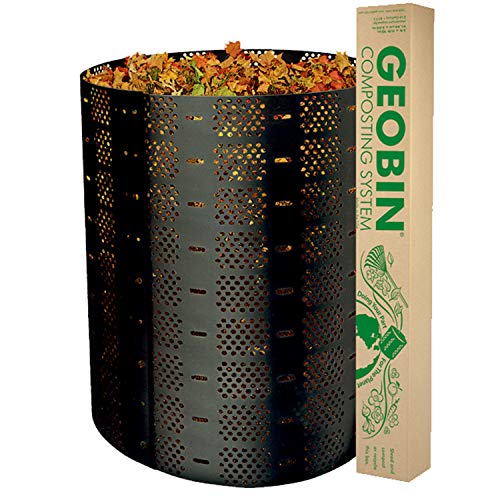
The Geobin is the value champion and the highest-capacity pick in this comparison. It is a flexible perforated plastic ring that snaps together with closure keys to form an open-air enclosure around your pile, and the listing puts its maximum at roughly 216 gallons (expandable to about 3.75 feet across, which the maker rates near 237 gallons). That is more material than any rigid bin here can hold, for a fraction of the cost, which is why it is frequently called the best-value composting bin on the market.
What I like is the flexibility. The diameter adjusts from about three to four feet, so you can size it to your current pile and expand it as your garden output grows, and you can link multiple units together for a multi-bin system. The perforated wall gives excellent ventilation around the whole circumference, the closure keys make assembly genuinely quick, and the lightweight ring is easy to move and reassemble when you want to relocate or aerate the pile by lifting the ring off and re-stacking the material inside it.
The honest limitation is that this is essentially a containment ring, not a finished composter. There is no lid and no insulation, so decomposition runs slower and depends heavily on ambient weather, rainfall, and how diligently you turn it. Pests and curious animals have easier access than they would with a closed bin, and the open top means heat and moisture are harder to control. If you want speed and a tidy contained look, a tumbler or closed box is the better tool. If you have space and patience and want maximum volume for minimal money, the Geobin is hard to beat.
Envirocycle Composter – Best for Compost Tea Harvesting
The Envirocycle Composter earns its spot for one feature the others lack: it captures compost tea. Its 17-gallon drum sits in a base tray that collects the liquid leachate draining out of the pile, and you can dilute that tea and apply it as a liquid fertilizer for your beds and containers. For gardeners who want to use every byproduct of composting, that is a real and uncommon benefit.
The design is also refreshingly simple to set up. The drum rolls directly on the base tray, and that tray doubles as the roller surface, so there is no steel frame to bolt together. You just rest the drum on the base and spin it in place to mix and aerate the contents, which makes it one of the easiest units here to assemble and one of the more compact to tuck onto a patio or deck. The roll-on-tray system means fewer parts to fail and nothing to rust.
The clear trade-off is capacity. At 17 gallons this is the smallest pick in the guide, well under half the volume of the dual-chamber tumblers and a fraction of the Geobin or Lifetime, so it suits a small-to-medium garden far better than a large one. It is also a single chamber, so you cannot truly cure one batch while filling another the way the FCMP allows. I would choose it for the tea function and the easy footprint, not for keeping up with a high-output large garden on its own.
Yimby Tumbler Composter – Best Entry-Level Dual-Chamber
The Yimby Tumbler is the budget route to dual-chamber composting. It delivers the same fill-one-side, cure-the-other convenience as the FCMP IM4000 but at a lower price, with each chamber holding 18.5 gallons for 37 gallons combined. For a gardener who wants the continuous workflow of two chambers without paying the premium, it is a sensible compromise.
Several design touches make it easy to live with. The 360-degree rotating mechanism lets you tumble and stir the contents with a spin instead of a fork, and the hexagonal drum shape helps material roll and tumble rather than slide and pack, which aids aeration. The sliding door panels are reasonably sized for loading bulkier material like spent plants and clippings, the body uses BPA-free, all-weather construction, and assembly is quick with relatively few parts compared to some framed tumblers.
The limitation shows up in the frame. The steel supports are a thinner gauge than the FCMP’s heavier eight-bar frame, so while the Yimby holds up for several seasons of outdoor use, a fully loaded drum puts more flex on the structure and it may not last as long under heavy continuous use. As with all dual-chamber tumblers, each 18.5-gallon side is modest, so a very large garden can outpace it. I see it as the value pick for someone stepping up to tumbling composting, with the FCMP being the sturdier long-haul choice.
What to look for
The right bin for a large garden comes down to matching capacity and workflow to how much waste you actually produce. These are the factors I weighed most heavily:
- Total capacity: Match the gallon rating to your weekly output. A large garden quickly overwhelms a 17-gallon drum, while an 80-gallon box or a 216-gallon ring can absorb seasonal surges.
- Single vs dual chamber: Dual chambers let one batch cure while the other fills, giving you a steady supply. A single large chamber holds more at once but forces you to stop loading while it finishes.
- Tumbling vs stationary: Tumblers spin to mix and aerate with no fork work but hold less. Stationary bins hold far more but require you to turn the pile by hand.
- Aeration: Vents, perforations, and internal fins speed decomposition. Look for aeration holes plus fins on tumblers and perforated walls on rings.
- Material and UV protection: Outdoor bins need UV-inhibited HDPE or recycled polypropylene so the plastic does not go brittle in the sun.
- Harvesting access: A base panel, removable door, or liftable ring determines how easily you get finished compost out without dismantling the bin.
- Byproduct capture: If you want liquid fertilizer, a base tray that collects compost tea adds value a plain bin cannot offer.
The verdict
For most large gardens I recommend the FCMP Outdoor IM4000. Its two sealed chambers, deep aeration fins, and sturdy eight-bar frame give you the continuous fill-and-cure workflow that makes high-volume composting practical, and the recycled UV-inhibited polypropylene should hold up for years outdoors. If you want the same dual-chamber convenience for less money, the Yimby Tumbler is the value alternative, with the caveat that its thinner frame is built for lighter duty.
When raw volume matters more than tumbling, the Lifetime 60309 is the stationary workhorse at 80 gallons, provided you accept turning the pile yourself. For maximum capacity on a tight budget, the Geobin handles roughly 216 gallons for very little money, as long as you are patient with slower, weather-dependent breakdown. And if reusing every byproduct appeals to you, the Envirocycle is the one pick here that harvests compost tea, best suited to a smaller footprint than a large garden’s full output.
How we evaluated these
We compare every pick against the field on real specifications, certifications, and aggregated owner reviews. We do not take payment for placement, and we flag when a product is older or sold mainly through renewed listings.
The shortlist
Each pick, examined
FCMP Outdoor IM4000 - Best Dual-Chamber Tumbler for Large Gardens
The FCMP Outdoor IM4000 is an 8-bar frame tumbler with two 18.9-gallon chambers for a combined 37.8-gallon capacity. The dual-chamber design lets one side cure while the other receives fresh material, which is the most practical workflow for continuous composting. BPA-free recycled polypropylene handles UV exposure well, and deep fins on the drum face promote aeration with every rotation. Assembly takes around 30 minutes. The elevated stand keeps the drum accessible for spinning without bending to ground level, which reduces physical strain during regular turning. It is well suited for kitchen scraps and light garden waste, though very high-volume gardens may want two units.
Strengths
- TUMBLING COMPOSTER - Avoid digging and mixing your compost pile by hand. The tumbling desi
- EASY TO USE - Fantastic for beginners! The large openings and removable door make it easy
- TWO COMPOSTER CHAMBERS ARE BETTER THAN ONE - Two separate sides allow the first side to fi
- EXCELLENT AERATION - All our composter models feature aeration holes as well as deep fins
- DURABLE CONSTRUCTION - BPA-free, UV-inhibited, 100% post-consumer recycled polypropylene i
Lifetime 60309 - Best High-Volume Stationary Bin
The Lifetime 60309 holds 80 gallons and is built from high-density polyethylene with UV inhibitors, making it one of the most weather-resistant stationary bins available. A wide access panel at the base makes harvesting finished compost straightforward without having to move the entire structure. The dark color absorbs heat to accelerate decomposition during cooler months. Ventilation slots along the sides promote passive airflow. For gardens that produce heavy volumes of leaf matter, grass clippings, and vegetable trimmings, this bin's footprint-to-capacity ratio is hard to beat at this price.
Geobin Compost Bin - Best Budget Expandable Option
The Geobin is a flexible perforated plastic ring that snaps together to form an open-air pile enclosure. At 216 gallons of maximum capacity, it handles more material than any rigid bin in this comparison. Diameter is adjustable from 3 to 4 feet, and multiple units can be linked. There is no lid or insulation, so decomposition is slower and more dependent on ambient conditions. For gardeners who generate large amounts of dry leaves, straw, or bulky garden trimmings and are not in a hurry, the Geobin delivers usable composting space at minimal cost. Turning is straightforward since the ring can simply be detached, moved, and refilled.
Strengths
- Large capacity, expandable to 3.75 feet (237 gallon)
- Easy to assemble with closure keys. Easy to move. Easy to reassemble.
- The best value composting bin on the market.
- Excellent ventilation.

Envirocycle Composter - Best for Compost Tea Harvesting
The Envirocycle Composter adds a base tray that collects liquid leachate, sometimes called compost tea, which can be diluted and applied as a liquid fertilizer. The 17-gallon drum sits in a base tray that also serves as a roller surface so no frame assembly is required. The drum rolls directly on the tray for easy spinning. Capacity is smaller than the other picks here but the tea-harvesting function adds practical value for gardeners who want to feed plants between solid compost applications. Build quality is above average, and the all-plastic construction is fully watertight.
Strengths
- Bokashi Fermentation Principle: Our bokashi compost bin is designed based on the Bokashi f
- Indoor Composter Large Capacity: Available in two capacities 18.8L and 20L. Bokashi compos
- Easily Extract Compost for Reuse: The bokashi composter allows you to extract nutrient-ric
- High Efficient: Made of HDPE & LDPE material. Start composting with this beginner friendly
- Shorten Your Composting Time: Create nutrient-rich compost in less than half the time. Uti

Yimby Tumbler Composter - Best Entry-Level Dual-Chamber
The Yimby Tumbler offers dual-chamber convenience at a lower price than the FCMP IM4000. Each chamber holds 18.5 gallons for 37 gallons combined. The sliding door panels are reasonably sized for loading bulky material. The hexagonal drum design helps material tumble rather than slide, which aids aeration. The steel frame holds up to several seasons of outdoor use, though the frame is thinner gauge than premium tumblers. For gardeners new to tumbler-style composting who want a reliable starting point before investing in a higher-end system, the Yimby provides a good learning format at a fair price.
Strengths
- Quick and Easy Assembly: Our outdoor compost bin offers quick and easy assembly with only
- Large 43-Gallon Capacity & Dual Chamber Design: This outdoor tumbling composter features a
- 360-Degree Tumbling Stirring: The compost tumbler's 360-degree rotating mechanism eliminat
- Durable, All-Weather Construction: Constructed from BPA-free materials, this outdoor compo
- Convenient Access & Fast Composting: This outdoor compost bin has a sliding door panel for
Buying considerations
What to consider
Start with capacity: large gardens typically need at least 80 gallons of active composting space, and two-bin systems or dual-chamber tumblers provide the most practical workflow for continuous production. Stationary bins handle bulk volume best while tumblers speed up breakdown through aeration. Consider how you will harvest finished compost, bottom-access panels on stationary bins and the dual-chamber design on tumblers both reduce the effort involved. UV-resistant materials matter for outdoor use in sunny climates. If liquid fertilizer appeals, a tea-harvesting composter adds extra value beyond solid compost alone.
What to consider
For related reading, see [best compost bins for cold climates](/articles/best-compost-bins-for-cold-climates) and [best outdoor compost bins](/articles/best-compost-bins-outdoor). See how we evaluate garden products at [/methodology](/methodology).
Questions answered
For a large garden generating significant yard waste, aim for a bin with at least 80 to 100 gallons of capacity. Many large-garden gardeners run two bins in rotation so one pile can cure while the second actively receives fresh material. Dual or expandable systems make this rotation easier to manage throughout the growing season.
In a well-managed large outdoor bin with regular turning, adequate moisture, and a balanced carbon-to-nitrogen ratio, finished compost typically takes three to six months. Passive systems with minimal turning can take six to twelve months. Hotter, more active piles break down faster. Shredding or chopping materials before adding them significantly speeds the process.
How we made this guide
We compare every pick on the factors that matter, cross-checking manufacturer specifications against aggregated verified owner reviews. We rank independently and never take payment for placement. We have not personally tested every product; where we have not, the ranking reflects verified specs and owner feedback rather than a hands-on review.
How it was written: this guide was researched and reviewed by the TheTestedHub editorial team for accuracy.
Affiliate disclosure: TheTestedHub is reader-supported. When you buy through links on our site, we may earn a commission at no extra cost to you.
Keep reading
Taste Better BBQ With Sauces That Fit Your Style
Which BBQ Cooler Best Freezes? Yeti Tundra 45 Reviewed

Choosing Your Perfect Smoker: A Buyer’s Guide

Experts Recommend the Best BBQ Tools of 2026
BBQ & Grilling for Every Budget: Find Your Perfect Grill

What’s the Best Greenhouse Kit for Your Garden?

Sprinkler Timers Reviewed: Why the Rachio 3 Wins in 2026
