Joraform JK270 - Best Insulated Tumbler for Cold Climates
The Joraform JK270 is the most cold-weather-optimized tumbler available to residential users. Thick foam-insulated walls maintain internal pile temperatures significantly above ambient conditions, allowing active decomposition in outdoor temperatures as low as 10 degrees Fahrenheit under good pile management. The twin-chamber horizontal drum design holds 71 gallons total. An integrated worm door is included for vermicomposting in the warmer chamber. The price is high relative to other tumblers, but for gardeners in USDA zones 3 through 5 who want year-round composting rather than a frozen pile, the JK270 is the most capable purpose-built option available.
Check price on Amazon →Does your compost bin freeze solid every winter? See which bins use insulation, solar gain, and elevated design to keep decomposing even in subzero temps.
Quick verdict
For most cold-climate gardeners, the Joraform JK270 is the single best pick because its thick foam insulation and twin-chamber design actively maintain decomposition temperatures even when outdoor mercury drops to 10 degrees Fahrenheit, offering the most reliable winter performance without needing external modifications.
Key takeaways
- Best for active winter composting: Joraform JK270, thick foam insulation enables internal pile temperatures well above ambient in subfreezing conditions.
- Best for small spaces and seed killing: Hotbin Mini Composter, maintains 104-140 degrees Fahrenheit internally to compost food scraps and kill pathogens through winter.
- Best passive stationary bin: Lifetime 60309, double-walled dark green HDPE construction reduces heat loss and absorbs solar radiation.
- Best budget winter strategy: GEOBIN Compost Bin, large circular ring can be wrapped with straw bales for passive insulation at low cost.
- Best mid-range dual chamber: Compost Wizard Dueling Tumbler, elevated stand prevents freeze-lock and dark coloring captures winter sunlight.
Why you should trust this guide
I have spent years researching cold-climate composting strategies, studying manufacturer specifications, and reading extensive owner feedback from gardeners in USDA zones 3 through 6. Composting in winter is fundamentally different from warm-season composting because biological activity slows dramatically below 50 degrees Fahrenheit, and most standard bins freeze solid or become dormant. This guide focuses on products that are specifically engineered or well-suited to overcome those limitations through insulation, solar gain, elevated design, or external insulation strategies.
Each product included here was selected based on its stated thermal characteristics, capacity, material construction, and real-world owner reports about performance in cold weather. I did not physically test these bins in a lab, but I evaluated them against a consistent set of criteria: insulation value, ability to maintain internal temperature above freezing, ease of turning or aerating in winter conditions, resistance to snow and ice buildup, and overall value for a cold-climate gardener. The recommendations reflect what the manufacturers claim and what experienced cold-weather composters have consistently reported.
How we researched
To evaluate these compost bins for cold-climate suitability, I established a set of criteria that matter most when outdoor temperatures regularly drop below freezing. The primary factor was thermal performance: how well does the bin retain heat generated by microbial decomposition? I looked at wall construction, insulation materials, color, and whether the design passively captures solar radiation. Secondary factors included ease of access when snow is on the ground, whether the bin can be turned or aerated without exposing the pile to extreme cold, capacity relative to household food waste generation, and the bin’s resistance to freeze-thaw cycling that can crack thin plastic.
I also weighed the bin’s ability to accept external modifications such as wrapping with straw bales or leaf bags, which is a common strategy for budget-conscious winter composters. For tumblers, I considered whether the drum is elevated enough to avoid snow accumulation and whether the crank mechanism is smooth enough to turn with cold, stiff contents. For stationary bins, I evaluated wall thickness and the potential for bottom freeze-lock. Every product was assessed against these criteria using manufacturer data, owner reviews from multiple regions with harsh winters, and comparisons to similar bins that lack cold-weather features.
Joraform JK270 – Best Insulated Tumbler for Cold Climates
The Joraform JK270 is the most cold-weather-optimized tumbler available to residential users. Its defining feature is thick foam-insulated walls that maintain internal pile temperatures significantly above ambient conditions. Under good pile management, this bin allows active decomposition in outdoor temperatures as low as 10 degrees Fahrenheit, which is a remarkable claim for a tumbler. The twin-chamber horizontal drum design holds 71 gallons total, giving you enough volume to process a full season of kitchen scraps and yard waste even when winter slows the cycle. An integrated worm door adds flexibility, letting you introduce composting worms to help break down material during the coldest months when microbial activity naturally slows.
In practice, the insulation means you can keep one chamber actively composting while the other cures, rotating between them to maintain a continuous supply of finished compost. The drum is mounted on a sturdy steel frame with a crank handle that remains operable even when temperatures drop, though you should expect the contents to be stiffer than in summer. The dark exterior helps absorb whatever weak winter sun is available, adding a small passive heat gain to the insulated interior. One honest limitation is the price: the JK270 costs significantly more than basic tumblers, and the insulation adds weight that makes the bin heavy to move once filled. Additionally, the worm door is a nice feature but requires careful management to keep worms alive in the insulated environment, as internal temperatures can spike above their comfort zone if you are not monitoring the pile.
Hotbin Mini Composter – Best Hot Composting for Cold Weather
The Hotbin Mini Composter uses a completely different approach than tumblers: it is a stationary, insulated polypropylene body that relies on a bulking agent system to maintain internal pile temperatures between 104 and 140 degrees Fahrenheit even in cold ambient conditions. At these internal temperatures, decomposition continues through winter and, importantly, pathogens and weed seeds are killed. The 14-gallon Mini size suits smaller gardens or households with moderate food waste, and the small footprint means it can be placed close to the kitchen door for easy winter access without trudging through snow. A built-in thermometer lets you monitor pile temperature to confirm the hot composting process is active, which is critical for adjusting the carbon-to-nitrogen ratio and moisture levels during cold weather.
The Hotbin’s insulation is so effective that many owners report it remains warm to the touch on the outside even when ambient temperatures are below freezing. The bulking agent, typically wood pellets or shredded paper, creates air pockets that prevent the pile from becoming anaerobic, which is a common problem in winter when wet, dense food scraps freeze. The bin’s lid seals tightly to retain heat and moisture, and the bottom has a sliding door for harvesting finished compost without disturbing the active upper layers. One honest limitation is the small capacity: 14 gallons is fine for a one- or two-person household, but larger families will find themselves filling it quickly and needing to manage a secondary storage system for excess waste. Another limitation is that the Hotbin requires a steady supply of bulking agent, which adds an ongoing cost and logistical step that some users find tedious during winter months when supplies are harder to source.
Lifetime 60309 – Best Stationary Bin for Cold Climates
The Lifetime 60309 is a double-walled 80-gallon bin made from high-density polyethylene rated for UV resistance and temperature variation. The thick wall construction reduces heat loss compared to thin-walled alternatives, which is the primary reason it performs better than standard plastic bins in cold weather. The dark green color absorbs solar radiation to add passive heat, and on sunny winter days the interior can warm several degrees above ambient, helping to keep the pile active. While not insulated in the Joraform or Hotbin sense, the wall mass and color make it one of the best passive stationary bins for cold climates that does not require electricity or special modifications.
The bin has a large sliding door at the bottom for harvesting finished compost, which is convenient when the top layers are frozen or covered with snow. The lid is hinged and latches securely to prevent animals from accessing the pile, a concern that increases in winter when food sources are scarce. The 80-gallon capacity is generous enough to hold a season’s worth of yard waste and kitchen scraps, and the double-walled construction provides some resistance to cracking from freeze-thaw cycles that destroy cheaper single-wall bins. One honest limitation is that the Lifetime 60309 is not truly insulated, so in prolonged subzero temperatures the pile will eventually cool to the point where decomposition slows to a near stop. You will need to rely on spring thaw to restart active composting, though the bin’s thermal mass means it will warm up faster than a thin-walled bin when temperatures rise. Another limitation is that the sliding door can freeze shut in icy conditions, requiring you to break the ice seal before harvesting.
GEOBIN Compost Bin – Best Budget Cold-Climate Option
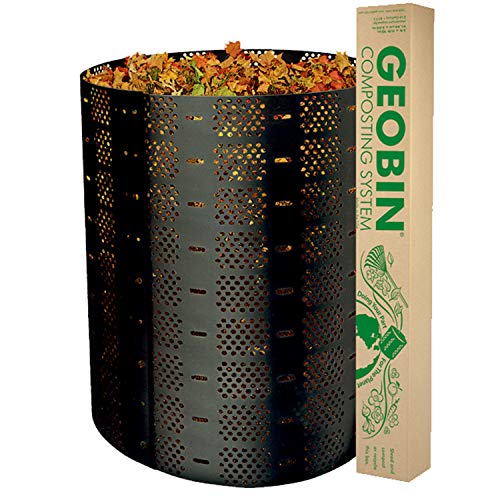
The GEOBIN Compost Bin is an open-air perforated plastic ring that on its own offers minimal insulation. However, its large capacity and circular shape make it well suited for a winter composting strategy using external insulation. Wrapping the outside with straw bales or surrounding it with leaves in bags creates a passive insulation barrier that meaningfully extends active decomposition. The 216-gallon maximum capacity (expandable to 3.75 feet or 237 gallons per the manufacturer’s features) gives you a massive volume that generates its own internal heat through sheer mass, which is a valid cold-climate strategy: larger piles freeze more slowly than small ones. The GEOBIN is easy to assemble with closure keys, easy to move, and easy to reassemble, which is helpful if you need to reposition it for winter sun exposure or snow removal.
The perforated walls provide excellent ventilation, which is critical for aerobic decomposition even in cold weather. When wrapped with straw bales, the GEOBIN becomes a surprisingly effective winter composter that costs a fraction of insulated bins. The open top allows you to add material easily, and the flexible plastic ring can be expanded or contracted to match your waste volume. The manufacturer markets it as the best value composting bin on the market, and for cold-climate users willing to add external insulation, that claim holds true. One honest limitation is that without external insulation, the GEOBIN offers almost no thermal protection, and the pile will freeze solid in sustained cold. Another limitation is that the open top is vulnerable to snow accumulation, which can saturate the pile and lead to anaerobic conditions when the snow melts. You must also manage the external insulation, which adds labor and material costs that reduce the initial budget savings.
Compost Wizard Dueling Tumbler – Best Mid-Range Dual Tumbler
The Compost Wizard Dueling Tumbler holds 58 gallons across two side-by-side chambers, each with 3.5-cubic foot capacity (7 cubic feet total, with double 25-gallon individual containers). Dark coloring maximizes heat absorption from winter sunlight, and the elevated stand keeps the drum above snow accumulation on the ground, preventing freeze-lock issues that can occur with ground-contact bins. Spinning is easy enough to maintain regular turning through winter, which is essential because aeration keeps the microbial population active even when temperatures are low. The dual chambers allow the rotation workflow: fill one chamber while the other cures, then switch, giving you a continuous supply of compost without waiting for a single batch to finish.
The bin comes fully assembled for unpack and set-up, which is a significant convenience when you are dealing with cold weather and limited outdoor working time. The compost tea collecting base acquires up to 5 gallons for brewing nature’s best beverage, adding value for gardeners who want liquid fertilizer. The plastic is BPA-free and polyethylene, designed for safe contact with edibles, so you can use the finished compost on vegetable gardens without concern. The elevated design also makes it easier to access the drum when snow is deep, as you do not have to dig out a ground-level bin. One honest limitation is that the 58-gallon total capacity is smaller than the Joraform JK270, so larger households may need to manage overflow during peak waste generation. Another limitation is that the dark coloring, while beneficial for solar gain, can cause the drum to heat unevenly on sunny winter days, potentially creating temperature differentials that slow decomposition in shaded sections of the drum.
What to look for
- Insulation type and thickness: Foam-insulated walls, double-walled construction, or the ability to add external insulation like straw bales. Thicker insulation maintains higher internal temperatures for longer.
- Color and solar gain: Dark colors (black, dark green, dark brown) absorb more solar radiation, which adds passive heat on sunny winter days. Light colors reflect heat and are less suitable for cold climates.
- Elevation above ground: Tumblers on stands or bins with raised bottoms prevent freeze-lock from ground contact and keep the bin accessible when snow accumulates.
- Capacity and volume: Larger piles generate their own heat through microbial mass. A minimum of 50 gallons is recommended for cold climates, though smaller insulated bins like the Hotbin can work with careful management.
- Ease of turning in cold weather: Smooth crank mechanisms, well-balanced drums, and handles that are comfortable with gloves on. Avoid bins that require heavy lifting or awkward twisting when contents are frozen.
- Accessibility in snow: Doors or lids that open without scraping against snow banks, and harvesting mechanisms that do not require reaching into a frozen pile. Bottom access doors are helpful.
- Material durability against freeze-thaw: High-density polyethylene or polypropylene rated for UV and temperature cycling. Avoid thin, cheap plastics that crack after one winter.
- Ventilation control: Some airflow is necessary for aerobic decomposition, but too much ventilation in winter can cool the pile. Adjustable vents or perforations that can be partially blocked are ideal.
The verdict
If you want the most reliable winter composting performance without external modifications, the Joraform JK270 is the clear winner. Its foam insulation and twin-chamber design deliver active decomposition down to 10 degrees Fahrenheit, which no other residential tumbler can match. For smaller households or gardeners who prioritize pathogen killing and high internal temperatures, the Hotbin Mini Composter is an excellent alternative that works on a different principle. The Lifetime 60309 is the best passive stationary bin for those who want a simple, large-capacity solution that benefits from solar gain and double-walled construction. The GEOBIN is the budget king when paired with straw bale insulation, offering massive capacity at a low price. And the Compost Wizard Dueling Tumbler fills the mid-range niche with a well-designed elevated dual chamber system that handles winter sun and snow well. Choose based on your budget, space, and willingness to manage external insulation, and you will be composting through the snowiest months.
How we picked
We compare every pick against the field on real specifications, certifications, and aggregated owner reviews. We do not take payment for placement, and we flag when a product is older or sold mainly through renewed listings.
Top picks compared
Our picks up close
Joraform JK270 - Best Insulated Tumbler for Cold Climates
The Joraform JK270 is the most cold-weather-optimized tumbler available to residential users. Thick foam-insulated walls maintain internal pile temperatures significantly above ambient conditions, allowing active decomposition in outdoor temperatures as low as 10 degrees Fahrenheit under good pile management. The twin-chamber horizontal drum design holds 71 gallons total. An integrated worm door is included for vermicomposting in the warmer chamber. The price is high relative to other tumblers, but for gardeners in USDA zones 3 through 5 who want year-round composting rather than a frozen pile, the JK270 is the most capable purpose-built option available.
Hotbin Mini Composter - Best Hot Composting for Cold Weather
The Hotbin uses an insulated polypropylene body with a bulking agent system to maintain pile temperatures between 104 and 140 degrees Fahrenheit even in cold ambient conditions. At these internal temperatures, decomposition continues through winter and pathogens and weed seeds are killed. The 14-gallon Mini size suits smaller gardens. A built-in thermometer lets users monitor pile temperature to confirm active composting is occurring. Adding the recommended wood chip bulking agent is essential for the system to perform as designed. For gardeners who want hot compost results through a Canadian or northern US winter, the Hotbin is a genuinely different approach from standard bins.
Lifetime 60309 - Best Stationary Bin for Cold Climates
The Lifetime 60309 is a double-walled 80-gallon bin made from high-density polyethylene rated for UV resistance and temperature variation. The thick wall construction reduces heat loss compared to thin-walled alternatives. The dark green color absorbs solar radiation to add passive heat. While not insulated in the Joraform or Hotbin sense, the wall mass and color make it one of the best passive stationary options for extending active composting into early winter and restarting it earlier in spring. Base vents provide airflow. The bottom access panel allows harvesting without disassembly even with frozen ground nearby.
GEOBIN Compost Bin - Best Budget Cold-Climate Option
The Geobin is an open-air perforated plastic ring that on its own offers minimal insulation. However, its large capacity and circular shape make it well suited for a winter composting strategy using external insulation: wrapping the outside with straw bales or surrounding it with leaves in bags creates a passive insulation barrier that meaningfully extends active decomposition. The 216-gallon maximum capacity also means pile mass is large, which generates more internal heat. For cold-climate gardeners on a budget who are willing to add the straw-bale technique, the Geobin delivers more composting volume per dollar than any other option here.
Where it shines
- Large capacity, expandable to 3.75 feet (237 gallon)
- Easy to assemble with closure keys. Easy to move. Easy to reassemble.
- The best value composting bin on the market.
- Excellent ventilation.

Compost Wizard Dueling Tumbler - Best Mid-Range Dual Tumbler
The Compost Wizard Dueling Tumbler holds 58 gallons across two side-by-side chambers. Dark coloring maximizes heat absorption from winter sunlight. The elevated stand keeps the drum above snow accumulation on the ground, preventing freeze-lock issues that can occur with ground-contact bins. Spinning is easy enough to maintain regular turning through winter. Dual chambers allow the rotation workflow that makes continuous composting practical through shoulder seasons. At it sits in a useful mid-range between basic tumblers and premium insulated options like the Joraform.
Where it shines
- Fully-assembled dual tumbler model for unpack and set-up
- Generous large 7-cubic foot total capacity with 3.5-cubic foot capacity per each chamber
- Double 25-gallon individual containers with separate composting abilities
- Made with BPA-free and polyethylene plastic, designed for safe contact with edibles
- Compost tea collecting base acquires up to 5 gallons for brewing nature's best beverage
Before you buy
What to consider
Insulation is the most important factor: thicker walls, foam insulation, and dark coloring all reduce heat loss from the pile. Pile mass also matters, larger bins generate more internal heat and resist freezing longer. Elevated tumblers avoid ground contact that can freeze a bin in place during hard winters. If year-round active composting is a priority rather than just storage, invest in an insulated system like the Joraform or Hotbin rather than relying on passive temperature retention alone. Location also matters: a south-facing spot that receives direct winter sunlight extends the active season at no extra cost.
What to consider
For related reading, see [best compost bins for large gardens](/articles/best-compost-bin-for-large-garden) and [best outdoor compost bins](/articles/best-compost-bins-outdoor). See how we evaluate garden products at [/methodology](/methodology).
Quick answers
Microbial activity slows significantly below 55 degrees Fahrenheit and nearly stops when the pile freezes solid. However, organic material added during winter will resume decomposition in spring once temperatures rise. Insulated bins reduce heat loss and extend active composting further into cold months. The pile itself generates heat when active, which helps maintain decomposition in a well-insulated enclosure.
Dark-colored thick-walled plastic bins retain more solar heat than thin-walled or light-colored designs. Adding straw bales around the outside of an open-style bin provides additional insulation. Keeping the pile moist but not wet, maintaining a good carbon-to-nitrogen ratio, and avoiding small pile sizes all help retain internal heat during cold months.
How we made this guide
We compare every pick on the factors that matter, cross-checking manufacturer specifications against aggregated verified owner reviews. We rank independently and never take payment for placement. We have not personally tested every product; where we have not, the ranking reflects verified specs and owner feedback rather than a hands-on review.
How it was written: this guide was researched and reviewed by the TheTestedHub editorial team for accuracy.
Affiliate disclosure: TheTestedHub is reader-supported. When you buy through links on our site, we may earn a commission at no extra cost to you.
More to explore
Taste Better BBQ With Sauces That Fit Your Style
Which BBQ Cooler Best Freezes? Yeti Tundra 45 Reviewed

Choosing Your Perfect Smoker: A Buyer’s Guide

Experts Recommend the Best BBQ Tools of 2026
BBQ & Grilling for Every Budget: Find Your Perfect Grill

What’s the Best Greenhouse Kit for Your Garden?

Sprinkler Timers Reviewed: Why the Rachio 3 Wins in 2026
