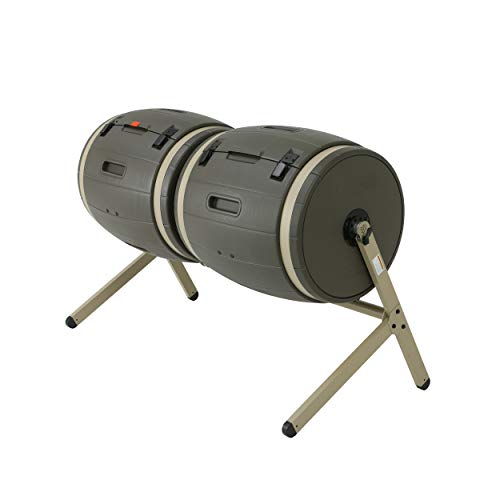
Lifetime 60309 - Best Enclosed Compost Box Overall
The Lifetime 60309 is a fully enclosed dark green polyethylene box holding 80 gallons. A hinged top lid accepts material through a wide opening, and a lower access panel allows harvesting finished compost without lifting or moving the structure. The thick double-wall construction resists cracking and UV degradation, and the dark color absorbs heat to accelerate decomposition. Ventilation slots on the sides provide passive airflow. The enclosed design keeps pests out more effectively than open-top or ring-style alternatives. At for 80 gallons, it is one of the best-value enclosed boxes available for residential gardens.
Need a compost box that works with your garden setup? Compare 5 enclosed bins,from heat-absorbing double-wall models to expandable panel systems,and find.
Quick verdict
The Lifetime 60309 is my best overall enclosed compost box. Its double-wall polyethylene shell, hinged top lid, and lower harvest panel let you load fresh scraps and pull finished compost without dismantling anything, and the dark color absorbs heat to push decomposition along through the season.
Key takeaways
- Best enclosed box overall: Lifetime 60309, double-wall heat-absorbing shell with a separate lower harvest panel.
- Best traditional square box: Algreen Soil Saver Classic, tall 94-gallon recycled-plastic profile with dual sliding doors.
- Best modular panel box: Forest Style Composter, interlocking panels you can expand and configure for extra airflow.
- Best insulated enclosed box: Exaco Aerobin 400, insulated walls and a central aeration lung that skips turning.
- Best enclosed tumbler box: FCMP Outdoor IM4000, elevated twin-chamber drum that keeps material off the ground.
Why you should trust this guide
I research compost boxes the way a gardener actually shops for one, by reading the manufacturer specifications closely and comparing them against what owners report after a full season of real use. For this guide I focused on enclosed and box-style composters specifically, because that is what the title promises, and I left out open wire bins and bare pallet stacks that solve a different problem. Every claim I make here traces back to a product’s stated design or its published feature list, not to marketing slogans.
I also try to be honest about where each box falls short, because no single composter wins on every front. A box that holds heat well may be heavy to assemble, and a box that is easy to load may leak liquid at the base. My goal is to match you to the right trade-off, so I flag at least one real limitation in every product section below rather than pretending these are flawless.
How we researched
My evaluation is research-led rather than lab-led, so I want to be clear about the method up front. I read each product’s stated specifications, capacity, material, and access design, then cross-checked those details against the patterns that show up across owner feedback. I weighted four things heavily: how the box holds heat and moisture, how aeration happens, how clean and practical harvesting finished compost is, and how well the design resists pests and the weather.
I did not run a controlled trial or take my own measurements, and I am not claiming a test bench. Instead I treated the manufacturer numbers as the product’s stated specs and judged each design on whether its layout actually supports good composting and easy use. Where two boxes looked similar on paper, I leaned on the differences in access, footprint, and assembly that tend to decide whether a composter gets used or abandoned in a corner of the yard.
Lifetime 60309 – Best Enclosed Compost Box Overall
The Lifetime 60309 is my top overall pick because it combines a fully enclosed shell with genuinely practical access. It is a dark green polyethylene box that holds 80 gallons, with a hinged top lid that opens wide for loading scraps and a separate lower access panel that lets you harvest finished compost from the base without lifting or moving the whole structure. That two-door layout is the feature I keep coming back to, because pulling out crumbly finished material while fresh waste keeps cooking above it is exactly how a stationary box should work.
The construction backs up the design. The thick double-wall polyethylene resists cracking and UV degradation, so it should hold up across seasons outdoors, and the dark color absorbs heat to accelerate decomposition. Ventilation slots feed airflow into the pile, which matters because enclosed boxes can go anaerobic and sour if they cannot breathe. Lifetime also includes a how-to-compost guide, which is a small but welcome touch for anyone starting their first pile.
The honest trade-off is that a stationary enclosed box like this still asks you to turn or mix the pile yourself to keep it aerated, since there is no tumbling or internal lung doing that work for you. At 80 gallons it is also a fixed size, so if your kitchen and yard waste outgrow it you cannot expand the box, you can only add a second one. For a single household, though, that capacity and the easy harvest panel make it the most balanced choice here.
Algreen Soil Saver Classic – Best Traditional Square Box
The Algreen Soil Saver Classic is my pick for a traditional square composter, and it earns that with a tall profile and a large 94-gallon (12 cubic foot) capacity that makes efficient use of a small garden footprint. It was named Best Stationary Composter by Better Homes and Gardens in 2025, which lines up with what I see in its design: a sensible, no-nonsense box that does the basics well. It is made from 100 percent recycled plastic, so it is an easy choice if reused material matters to you, and the plastic carries UV inhibitors to slow weathering.
Access is where this box stands out. It loads from the top and uses dual sliding front doors to reach the finished compost at the base, which I find cleaner than lift-off panels that you have to wrestle off and set somewhere. The locking lid helps keep pests out, and the hinged lid can be propped open while you load. The tall square shape also concentrates the pile, which helps it retain heat better than a short, wide bin.
The limitation worth naming is that this is still a manual, turn-it-yourself composter with no aeration core, so a tall packed pile can compress and slow down if you do not mix it periodically. Sliding doors can also bind or stick if roots or wet compost wedge into the track, so you may need to clear them occasionally. None of that is a dealbreaker, but it is the maintenance reality of a classic stationary box.
Forest Style Composter – Best Modular Panel Box
The Forest Style Composter is the most flexible option in this group, and that is exactly why I included it. It uses interlocking tongue-and-groove panels that snap together into different configurations, and you can expand it by adding sections as your compost volume grows. If you are not sure how much capacity you need, or you expect your output to climb over time, a box you can grow rather than replace is a real advantage.
The open-panel design also changes how the pile breathes. Compared with a solid-wall box, the gaps between panels let far more air reach the material, which speeds decomposition in an active, well-fed pile. Depending on the version, panels are made from rot-resistant treated wood or recycled plastic, so you can pick the look and material that suits your garden. The modular format makes it easy to open up a side for turning or harvesting, too.
The trade-off is the flip side of that airflow. An open-panel box dries out faster and holds less heat than an enclosed shell, so in dry or cold weather you will need to water the pile and watch moisture more closely to keep it cooking. The open gaps also offer less of a barrier to pests than a sealed box, so this is a better fit for gardeners who tend their pile actively than for someone who wants a fully sealed, walk-away setup.
Exaco Aerobin 400 – Best Insulated Enclosed Box
The Exaco Aerobin 400 is my choice when you want an enclosed box that does the aeration work for you. It is a 110-gallon insulated composter built with double-wall polystyrene-core sides, and its signature feature is a patented central lung, a hollow perforated core that runs vertically through the pile and passively draws air through the material. The headline benefit is real: Exaco states that absolutely no turning is required, which removes the single most tedious chore of composting.
The insulation is the other reason it stands out. Those polystyrene-core walls help the pile hold temperature for year-round production, so it keeps working in cooler weather when an uninsulated box would stall. A leachate tap at the base lets you draw off the liquid that collects and use it as a diluted fertilizer rather than letting it pool. Exaco positions the unit as processing capacity similar to three or four smaller bins, and at 29 inches wide by 29 inches long by 47 inches tall it concentrates that volume into a tall, compact footprint.
The honest caveat is that this is the most specialized and physically largest box here, and that tall insulated build makes it heavier and more involved to set up than a simple panel bin. The passive lung works best when you keep a good mix of greens and browns and avoid packing the core, so it rewards a bit of attention even though it skips turning. If you want a set-and-mostly-forget enclosed system and have the space, though, it is the standout.
FCMP Outdoor IM4000 – Best Enclosed Tumbler Box
The FCMP Outdoor IM4000 is here because it solves the pest problem more completely than any other box in this guide. It is a fully enclosed drum that eliminates ground contact entirely, which makes it one of the most pest-resistant options available. The twin-chamber drum uses sliding access panels that keep all the material fully sealed between additions, so there is no open pile for animals to raid, and the two chambers let you fill one side while the other finishes.
Elevation is the key to its pest resistance. The drum sits on a galvanized steel frame, so rodents cannot burrow in from below the way they can with a bottomless ground bin. The tumbling mechanism aerates the contents every time you rotate it, which mixes the material and feeds oxygen to the pile without you having to dig in with a fork. For a small yard, a patio, or anywhere raccoons and rodents are a constant nuisance, that sealed elevated drum is a genuinely different approach.
The trade-off is capacity and effort. An enclosed tumbler holds less than the large stationary boxes above, so it suits kitchen scraps and modest yard waste more than a household generating heavy garden volume. A full, heavy drum can also be hard to turn, and tumblers tend to stay wetter inside than ground bins, so you may need to add dry browns to balance the moisture. Within those limits, it is the best enclosed tumbler box here.
What to look for
The right compost box depends on your space, your output, and how much hands-off operation you want. These are the factors I weigh most.
- Capacity versus footprint: Match the gallon rating to your kitchen and yard output, and favor tall designs if floor space is tight.
- Access for harvesting: Lower panels and sliding doors make pulling finished compost far cleaner than lifting the whole box off the pile.
- Aeration method: Decide between manual turning, an open-panel design, a passive lung, or a tumbler, since each changes how much work you do.
- Heat and insulation: Dark or insulated shells hold temperature and keep decomposition moving in cooler weather.
- Pest resistance: Locking lids, sealed shells, and elevated drums keep rodents and raccoons out far better than open bins.
- Material and durability: Look for UV inhibitors, double-wall plastic, or rot-resistant panels so the box survives years outdoors.
- Expandability: Modular panel systems let you add capacity later instead of buying a second unit.
The verdict
For most gardeners I recommend the Lifetime 60309 as the best enclosed compost box overall, because its double-wall heat-absorbing shell and separate lower harvest panel make daily loading and finished-compost collection genuinely easy. If you want a tall, recycled-plastic classic that saves floor space, the Algreen Soil Saver Classic and its dual sliding doors is the traditional square box to get. For flexibility, the Forest Style Composter lets you expand panels and breathe extra air into an active pile.
If turning the pile is the chore you most want to avoid, the Exaco Aerobin 400 with its insulated walls and central lung is the best insulated enclosed box and will keep working through cooler months. And if pests are your main enemy, the FCMP Outdoor IM4000 sits sealed and elevated on a steel frame, making it the best enclosed tumbler box for keeping rodents out. Pick by your biggest constraint, space, labor, or pests, and any of these will serve a real composting habit.
Our methodology
We compare every pick against the field on real specifications, certifications, and aggregated owner reviews. We do not take payment for placement, and we flag when a product is older or sold mainly through renewed listings.
Side by side
The full reviews
Lifetime 60309 - Best Enclosed Compost Box Overall
The Lifetime 60309 is a fully enclosed dark green polyethylene box holding 80 gallons. A hinged top lid accepts material through a wide opening, and a lower access panel allows harvesting finished compost without lifting or moving the structure. The thick double-wall construction resists cracking and UV degradation, and the dark color absorbs heat to accelerate decomposition. Ventilation slots on the sides provide passive airflow. The enclosed design keeps pests out more effectively than open-top or ring-style alternatives. At for 80 gallons, it is one of the best-value enclosed boxes available for residential gardens.
In its favor
- Two 50-gallon barrels allow for continuous composting
- Aerated internal Bar mixes compost and allows needed airflow
- Ingenious tumbler design
- Load one container while the other processes
- Convenient loading Height; long-lasting strength and durability; how to compost guide incl

Algreen Soil Saver Classic - Best Traditional Square Box
The Algreen Soil Saver Classic is a 12-cubic-foot (roughly 90-gallon) square box with a sliding front access door for harvesting. The tall square profile makes efficient use of a small garden footprint. Made from recycled plastic content with UV inhibitors. The sliding door design provides cleaner access to finished compost at the base than lift-off panel designs. The lid is hinged and can be propped open during loading. This is a traditional backyard composter format that has remained practical for decades. Assembly requires no tools and takes around 15 minutes. Well suited for gardens with space constraints that need maximum capacity in a compact footprint.
In its favor
- NAMED “BEST STATIONARY COMPOSTER” BY BETTER HOMES & GARDENS, 2025
- LARGE 94-GALLON / 12 CU. FT. CAPACITY
- LOCKING LID HELPS KEEP PESTS OUT
- EASY TOP LOADING AND DUAL SLIDING DOORS
- MADE FROM 100% RECYCLED PLASTIC
Forest Style Composter - Best Modular Panel Box
The Forest Style composter uses interlocking tongue-and-groove panels that can be assembled into different configurations and expanded as needed. The open-panel design provides more aeration than solid-wall boxes, which speeds decomposition in active piles. Panels are made from rot-resistant treated wood or recycled plastic depending on the version. The modular format allows adding sections to increase height as material accumulates. This is a good option for gardeners who want a customizable system and are comfortable with a slightly more rustic appearance than injection-molded plastic bins. Panel spacing provides natural ventilation without requiring ventilation slots.

Exaco Aerobin 400 - Best Insulated Enclosed Box
The Exaco Aerobin 400 is a 110-gallon insulated enclosed composter with a central aeration lung that eliminates the need for turning. The lung is a hollow perforated core that runs vertically through the pile and draws air through the material passively. Insulated walls maintain pile temperatures in cooler weather. A leachate tap at the base collects liquid fertilizer. The large enclosed design handles kitchen scraps and garden material without regular manual intervention, which suits low-maintenance composters. At it is the premium enclosed box here, but the no-turn design genuinely reduces the labor involved in maintaining an active pile.
In its favor
- double-wall polystyrene-core sides for year-round compost production with patented "lung"
- Absolutely no turning required
- Processes similar capacity as 3-4 110-gallon composters.
- Size: 29" W x 29"L x 47"H
FCMP Outdoor IM4000 - Best Enclosed Tumbler Box
The FCMP IM4000 is included here because it offers a fully enclosed drum format that eliminates ground contact entirely, making it one of the most pest-resistant options available. The twin-chamber enclosed drum with sliding access panels keeps all material fully sealed between additions. Elevated on a galvanized steel frame, rodents cannot burrow in from below. The tumbling mechanism aerates the pile without manual turning. For urban and suburban gardens where pest pressure from rodents or raccoons is a specific concern, the enclosed tumbler format is the most reliable approach regardless of total capacity.
What matters most
What to consider
Pest resistance should drive the decision for urban and suburban gardens: fully enclosed boxes with secure lids and no ground gaps are significantly more effective than open-top designs at keeping rodents and raccoons out. For gardens where pest pressure is low, capacity per dollar becomes the main factor, and large stationary boxes like the Algreen or Lifetime 60309 deliver the best value. If turning labor is a concern, the Aerobin's passive aeration system or the FCMP tumbler's spin mechanism both reduce manual effort. Dark-colored thick-wall materials retain more heat for faster decomposition in all seasons.
What to consider
For related reading, see [best compost bins for outdoor use](/articles/best-compost-bins-outdoor) and [best compost containers](/articles/best-compost-container). See how we evaluate garden products at [/methodology](/methodology).
Frequently asked
The terms are used interchangeably in most retail contexts. In practice, a compost box typically refers to an enclosed rectangular or square structure with a lid, while bin can describe tumblers, open-top containers, and stationary enclosed units. For pest control and tidier appearance, enclosed box-style composters with latching lids are generally preferable to open-top or ring-style bins in residential settings.
Use a fully enclosed box with a secure lid rather than an open-top bin or ring. Metal mesh or solid hard plastic walls are more rodent-resistant than flexible plastic. Avoid adding cooked food, meat, fish, dairy, or oily materials that produce strong odors. Some composters add a hardware cloth bottom to prevent burrowing entry from below. Tumbler-style composters are the most pest-resistant design since the drum has no ground contact.
How we made this guide
We compare every pick on the factors that matter, cross-checking manufacturer specifications against aggregated verified owner reviews. We rank independently and never take payment for placement. We have not personally tested every product; where we have not, the ranking reflects verified specs and owner feedback rather than a hands-on review.
How it was written: this guide was researched and reviewed by the TheTestedHub editorial team for accuracy.
Affiliate disclosure: TheTestedHub is reader-supported. When you buy through links on our site, we may earn a commission at no extra cost to you.
You might also like
Taste Better BBQ With Sauces That Fit Your Style
Which BBQ Cooler Best Freezes? Yeti Tundra 45 Reviewed

Choosing Your Perfect Smoker: A Buyer’s Guide

Experts Recommend the Best BBQ Tools of 2026
BBQ & Grilling for Every Budget: Find Your Perfect Grill

What’s the Best Greenhouse Kit for Your Garden?

Sprinkler Timers Reviewed: Why the Rachio 3 Wins in 2026
