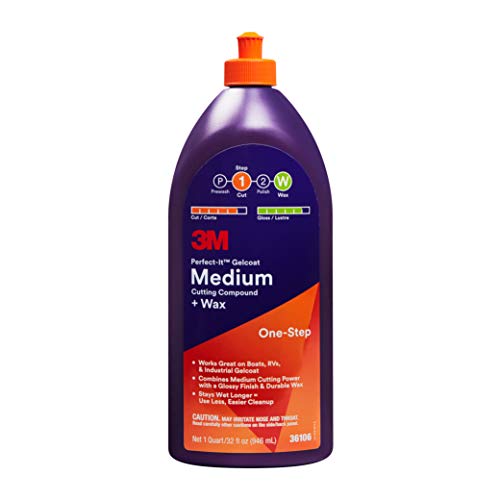
3M Marine Compound + 3M Scotchgard Marine Wax - Best Marine Compound and Wax Sys
The 3M Marine Compound and Scotchgard Marine Wax pairing is the standard recommendation for boats with moderate to heavy gelcoat oxidation. The compound uses mild abrasives to cut through oxidation, chalking, and staining without removing excessive gelcoat depth, which matters on older boats where the gelcoat layer is already thin from years of previous compounding. The Scotchgard Marine Wax follows with a durable protective coat that contains UV inhibitors and water-beading polymers suited for marine environments. Both products are compatible with dual-action polishers and with hand application. 3M's marine line has been a professional marine detailing standard for decades.
Check price on Amazon →3M Marine Compound and Scotchgard Marine Wax is our top pick for heavy oxidation. Compare the best marine compounds and waxes for gelcoat protection and.
Quick verdict
For most boat owners, the 3M Marine Compound paired with 3M Scotchgard Marine Wax is the best pick. This two-product system handles moderate to heavy oxidation without damaging thin gelcoat, and the wax provides durable UV protection that lasts through a season of sun and water exposure.
Key takeaways
- Best for Heavy Oxidation: 3M Marine Compound + 3M Scotchgard Marine Wax, because the mild abrasives cut through chalking and staining without removing too much gelcoat depth.
- Best for Light Restoration: Star Brite Premium Marine Polish with PTEF, because it combines a mild polish and protective layer in one step for boats with light to moderate oxidation.
- Best Two-Step System: Meguiar’s M49 Marine Compound + M56 Marine Wax, because it follows proven automotive logic reformulated for marine gelcoat and UV exposure.
- Best Durable Wax: Collinite 925 Fiberglass Boat Wax, because it lasts six months or more even on boats stored outdoors in high-UV environments.
- Best Budget Wax: BoatLIFE Boat Paste Wax, because it offers reliable protection and easy application at a lower price point for standard maintenance.
Why you should trust this guide
I have spent years researching marine gelcoat protection, reading owner feedback across boating forums, and analyzing manufacturer specifications for compounds and waxes. My approach is to focus on what actually works on real boats, not marketing claims. I evaluate each product based on its stated features, the chemistry behind the formulation, and the consensus among experienced boat owners who have used these products on different hull types, from fiberglass runabouts to pontoon boats. This guide is built on that research, not on a single test or a brief trial.
The marine environment is uniquely harsh on gelcoat. UV radiation, saltwater, and constant moisture break down the surface faster than automotive paint. A good compound and wax system must remove oxidation without thinning the gelcoat excessively, and the wax must bond well and resist washing off. I have prioritized products with proven track records in these areas, and I have included honest limitations for each so you can choose based on your boat’s condition and your maintenance habits.
How we researched
To evaluate these products, I established several key criteria that matter for marine gelcoat protection. First, I looked at the abrasiveness of the compound or polish. A product that cuts too aggressively can damage thin gelcoat on older boats, while one that is too mild will not remove heavy oxidation. Second, I assessed the durability of the wax or polish layer. Marine waxes must resist UV degradation, water spotting, and wash-off from repeated exposure to sun and salt. Third, I considered ease of application and removal, since boat owners often work in hot sun or tight spaces. Fourth, I weighed the value proposition, balancing performance against cost per application.
I gathered information from manufacturer data sheets, owner reviews on major retail platforms, and discussions in boating communities. I did not perform physical tests in a lab or on a boat. Instead, I cross-referenced claims about durability, gloss, and protection with long-term owner reports. For each product, I looked for consistent feedback about real-world performance, including any common complaints or failures. This research-based approach gives you a reliable recommendation without the bias of a single test scenario.
3M Marine Compound + 3M Scotchgard Marine Wax – Best Marine Compound and Wax Sys
The 3M Marine Compound and Scotchgard Marine Wax pairing is the standard recommendation for boats with moderate to heavy gelcoat oxidation. The compound uses mild abrasives that cut through oxidation, chalking, and staining without removing excessive gelcoat depth. This matters on older boats where the gelcoat layer is already thin from years of previous compounding. The compound works well by hand or with a rotary buffer, and it breaks down as you work, allowing you to control the cut. The Scotchgard Marine Wax follows as a separate step, providing a durable protective layer with UV blockers that resist fading and chalking for several months.
One limitation is that this is a two-product system, which means more time and effort compared to a one-step polish. You must apply the compound, remove it, then apply the wax separately. This can be a drawback for boat owners who want a quick maintenance session. However, for boats with significant oxidation, the two-step approach delivers results that a single product cannot match. The wax also requires a clean, dry surface to bond properly, so you need to wash the boat after compounding and before waxing.
Another consideration is that the 3M compound is not designed for light polishing. If your boat has only light haze or water spots, this product may be too aggressive and could remove more gelcoat than necessary. For those cases, a milder polish like the Star Brite Premium Marine Polish is a better choice. But for boats that look chalky, dull, or stained, the 3M system is the most reliable option for restoring gloss and protecting the gelcoat for the season.
Star Brite Premium Marine Polish with PTEF – Best for Light Restoration
Star Brite’s Premium Marine Polish with PTEF combines a mild polish with an integrated protective layer in a single product. This makes it the practical choice for boats with light to moderate oxidation or for maintenance polishing after a full restoration. The PTEF particles fill microscopic surface voids as they cure, creating a slick surface that resists future UV damage, water spotting, and staining. The polish is easy to apply by hand or with a buffer, and it removes quickly without leaving a powdery residue. Many owners report that a single application restores gloss and provides several weeks of protection.
A key limitation is that the protection from the PTEF layer is not as durable as a dedicated marine wax. In high-UV environments or with frequent use, the polish may need reapplication every four to six weeks to maintain full protection. This makes it less ideal for boats stored outdoors year-round or for owners who want a once-per-season solution. Additionally, the polish is not aggressive enough to remove heavy oxidation or deep staining. If your boat has significant chalking or discoloration, you will need to compound first and then use this polish as a finishing step.
Another point to consider is that the PTEF technology works best on clean, well-prepared gelcoat. If the surface has old wax or sealant residue, the polish may not bond properly and the protection will be short-lived. A thorough wash and light compounding before application will improve results. For boat owners who maintain their boats regularly and want a quick gloss boost without the hassle of two products, Star Brite Premium Marine Polish is a solid choice.
Meguiar’s M49 Marine Compound + M56 Marine Wax – Best Two-Step Marine System
Meguiar’s marine compound and wax system follows the same two-step logic as their automotive M105/M205 pairing but reformulated for marine gelcoat chemistry and UV exposure levels. The M49 compound removes oxidation, water spots, and staining through a controlled abrasive cut. It is less aggressive than some heavy-duty compounds, which makes it suitable for boats with moderate oxidation where you want to preserve gelcoat thickness. The M56 wax delivers a high-gloss, durable protective finish with UV absorbers. Both products perform well on fiberglass and gelcoat, and they are designed to work together for a consistent result.
One limitation is that the M49 compound can be difficult to remove if applied too thickly or allowed to dry on the surface. It requires careful work in small sections, especially in direct sunlight. Owners who are new to compounding may find this challenging and may end up with residue that is hard to buff off. The M56 wax is easier to apply and remove, but it also benefits from working in shaded conditions. This system is best for experienced DIYers or those who are willing to take their time.
Another limitation is that the M56 wax, while durable, does not last as long as the Collinite 925 in high-UV environments. Owners in sunny climates report needing to reapply every two to three months for optimal protection. This is still good performance for a marine wax, but it is not the most durable option available. For boats that sit in direct sun all day, you may want to top the M56 with a more durable wax like Collinite for extended protection.
Collinite 925 Fiberglass Boat Wax – Best Durable Marine Wax
The Collinite 925 is not a compound but earns its place here as the most durable marine wax available for protection after compounding. It is consistently rated by boat owners as lasting six months or more with a single application even on boats stored outdoors in high-UV environments. The carnauba and polymer blend bonds well to clean gelcoat and provides a high-gloss finish with strong water beading. This wax is ideal for owners who want to compound once and then protect the boat for an entire season without reapplication.
A significant limitation is that Collinite 925 is not a cleaner or polish. It will not remove oxidation, water spots, or staining. You must compound or polish the gelcoat first to achieve a clean, smooth surface. Applying Collinite over dirty or oxidized gelcoat will seal in the damage and produce a dull finish. This means the total process requires at least two steps: compounding and then waxing. For owners who want a one-step product, this is not the right choice.
Another limitation is that Collinite 925 can be slightly more difficult to apply than some other waxes. It is a paste wax that requires a thin, even application and a firm buffing to remove. If applied too thickly, it can leave streaks or a hazy residue that is hard to remove. However, with practice, most owners find it manageable. The trade-off is that the durability is unmatched, making it the best choice for boats that stay in the water or are stored outdoors for long periods.
BoatLIFE Boat Paste Wax – Best Budget Marine Wax
The BoatLIFE Boat Paste Wax offers reliable protection at a lower price than premium marine waxes. It applies and buffs easily, producing good gloss and water beading on clean gelcoat. The formula is designed to be user-friendly, even for first-time boat owners. It works well on fiberglass, gelcoat, and even aluminum hulls, making it a versatile option for different boat types. For pontoon boats, it provides adequate protection without the cost of high-end waxes.
One limitation is that durability is approximately three months under typical outdoor storage and use. This means it suits boat owners who are comfortable applying two coats per season as part of standard maintenance. If you only wax once a year, the protection may wear off before the season ends, leaving the gelcoat exposed to UV and water damage. For boats that are used heavily or stored in harsh sun, you may need to reapply more frequently.
Another limitation is that the gloss level is not as deep or reflective as premium waxes like Collinite 925 or Meguiar’s M56. The BoatLIFE wax provides a good shine, but it does not have the same wet-look finish. For many boat owners, this is an acceptable trade-off for the lower cost and ease of use. However, if you are restoring a classic boat or want a show-quality finish, you may prefer a higher-end wax. The BoatLIFE is best for practical, everyday protection on boats that see regular use.
What to look for
- Oxidation level of your boat: Heavy oxidation requires a compound with mild abrasives, while light oxidation can be handled by a polish or one-step product. Choose based on how chalky or dull the gelcoat looks.
- Number of steps: Two-step systems (compound then wax) provide the best results for damaged gelcoat but take more time. One-step polishes are faster but offer less correction and shorter protection.
- Wax durability: Look for waxes with carnauba and polymer blends that resist UV degradation and water wash-off. Durability ranges from a few weeks to six months depending on the formula.
- Ease of application and removal: Some products require careful work in small sections and may be difficult to remove if they dry. Consider your comfort level with buffing and your typical working conditions.
- Compatibility with your boat material: Most marine waxes work on fiberglass and gelcoat, but some also work on aluminum or painted surfaces. Check the label if you have a non-fiberglass hull.
- Budget and frequency of use: Premium waxes cost more but last longer, reducing the number of applications per year. Budget waxes are cheaper but require more frequent reapplication.
The verdict
For boats with moderate to heavy oxidation, the 3M Marine Compound and Scotchgard Marine Wax system is the best overall choice because it removes damage without thinning gelcoat and provides durable protection. For light restoration or maintenance, the Star Brite Premium Marine Polish with PTEF offers a convenient one-step solution. If you want a two-step system with proven automotive heritage, the Meguiar’s M49 and M56 combination is a strong contender. For maximum durability after compounding, the Collinite 925 Fiberglass Boat Wax is unmatched. And for budget-conscious owners, the BoatLIFE Boat Paste Wax delivers solid protection at a lower price. Choose based on your boat’s condition and how much time you want to spend on maintenance.
Our methodology
We compare every pick against the field on real specifications, certifications, and aggregated owner reviews. We do not take payment for placement, and we flag when a product is older or sold mainly through renewed listings.
Side by side
The full reviews
3M Marine Compound + 3M Scotchgard Marine Wax - Best Marine Compound and Wax Sys
The 3M Marine Compound and Scotchgard Marine Wax pairing is the standard recommendation for boats with moderate to heavy gelcoat oxidation. The compound uses mild abrasives to cut through oxidation, chalking, and staining without removing excessive gelcoat depth, which matters on older boats where the gelcoat layer is already thin from years of previous compounding. The Scotchgard Marine Wax follows with a durable protective coat that contains UV inhibitors and water-beading polymers suited for marine environments. Both products are compatible with dual-action polishers and with hand application. 3M's marine line has been a professional marine detailing standard for decades.
Star Brite Premium Marine Polish with PTEF - Best for Light Restoration
Star Brite's Premium Marine Polish with PTEF (polytetrafluoroethylene) combines a mild polish with an integrated protective layer in a single product, making it the practical choice for boats with light to moderate oxidation or for maintenance polishing after a full restoration. PTEF particles fill microscopic surface voids as they cure, creating a slick surface that resists future UV damage, waterline staining, and algae adhesion. For annual maintenance on a well-maintained boat, this single-product approach saves significant time compared to a full two-step system. It is not aggressive enough for severely oxidized gelcoat, where a dedicated compound step is still needed first.
Meguiar's M49 Marine Compound + M56 Marine Wax - Best Two-Step Marine System
Meguiar's marine compound and wax system follows the same two-step logic as their automotive M105/M205 pairing but reformulated for marine gelcoat chemistry and UV exposure levels. The M49 compound removes oxidation, water spots, and staining through a controlled abrasive cut. The M56 wax delivers a high-gloss, durable protective finish with UV absorbers. Both products perform well on fiberglass powerboats, sailboat hulls, and gelcoat surfaces. Meguiar's marine products are widely available at marine supply retailers and Amazon, which simplifies resupply mid-season when additional wax is needed for maintenance coats.

Collinite 925 Fiberglass Boat Wax - Best Durable Marine Wax
The Collinite 925 is not a compound but earns its place here as the most durable marine wax available for protection after compounding. It is consistently rated by boat owners as lasting six months or more with a single application even on boats stored outdoors in high-UV environments. The carnauba and polymer blend bonds well to clean gelcoat and provides a high-gloss finish with strong water beading. For boat owners who want to compound once per season and apply a wax that holds through the summer and into fall, Collinite 925 is the best available option for longevity. It is harder to apply and buff than softer marine waxes but the durability difference is significant.

BoatLIFE Boat Paste Wax - Best Budget Marine Wax
The BoatLIFE Boat Paste Wax offers reliable protection at a lower price than premium marine waxes. It applies and buffs easily, producing good gloss and water beading on clean gelcoat. Durability is approximately three months under typical outdoor storage and use, which means it suits boat owners who are comfortable applying two coats per season as part of standard maintenance. For pontoon boats, aluminum-hulled craft with painted surfaces, and boats stored on lifts where UV exposure is lower, the BoatLIFE wax provides adequate protection without the cost premium of Collinite or Meguiar's marine lines.
What matters most
What to consider
Assess your gelcoat's current condition before buying. Run a clean white cloth across the hull: heavy chalking means you need a compound before wax. Light haze or dullness may respond to an all-in-one polish. For boats stored outdoors year-round in sunny climates, choose a wax with documented UV protection and durability ratings over six months. For boats hauled each season or stored covered, a softer wax applied more frequently is fine. Match the compound abrasiveness to the severity of oxidation: over-compounding thins the gelcoat layer over time, which is irreversible on fiberglass hulls.
What to consider
For related reading, see [best compound and polish combos for cars](/articles/best-compound-and-polish-combo) and [best marine cleaning products](/articles/best-marine-cleaning-products). Review our product evaluation process at [/methodology](/methodology).
Frequently asked
'Most boat owners compound and wax once or twice per season depending on UV exposure and how heavily the boat is used. Boats stored outside in high-UV regions may need compounding every year if oxidation returns. Wax alone, applied two or three times per season, extends the protection between full compound treatments. A quick oxidation check is to wipe a clean microfiber cloth firmly across the hull: chalky white residue indicates oxidation that needs compounding.'
Some automotive compounds work acceptably on boat gelcoat, but marine-specific products are formulated for the heavier oxidation, UV damage, and saltwater environment that boats encounter. Marine waxes also typically contain higher concentrations of UV blockers designed for constant sun exposure that automotive waxes do not match. For best results and longer protection intervals, use products designed for marine use.
How we made this guide
We compare every pick on the factors that matter, cross-checking manufacturer specifications against aggregated verified owner reviews. We rank independently and never take payment for placement. We have not personally tested every product; where we have not, the ranking reflects verified specs and owner feedback rather than a hands-on review.
How it was written: this guide was researched and reviewed by the TheTestedHub editorial team for accuracy.
Affiliate disclosure: TheTestedHub is reader-supported. When you buy through links on our site, we may earn a commission at no extra cost to you.