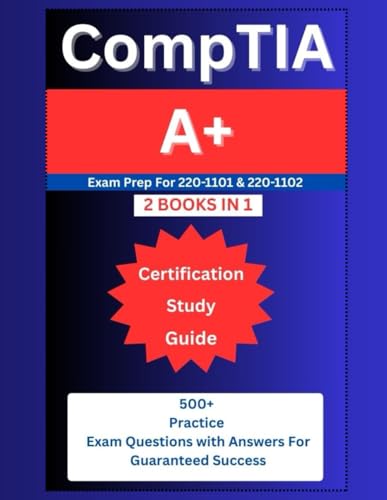
CompTIA A+ - Best CompTIA Certification for Career Starters
CompTIA A+ is the entry point to the CompTIA certification track and the most common baseline credential for IT support roles. It covers PC hardware, mobile devices, operating systems, networking fundamentals, and troubleshooting methodology across two exams: Core 1 (220-1101) and Core 2 (220-1102). Many help desk job postings list A+ as a preferred or required qualification. The certification is vendor-neutral, meaning it applies regardless of whether your employer runs Windows, macOS, or Linux environments. For someone entering IT with no prior credentials, A+ is the logical starting point that opens more doors than any other single CompTIA exam.
Check price on Amazon →Start your IT career the right way. See which CompTIA certification experts recommend earning first, with A+ leading the pack for beginners.
Quick verdict
If you are choosing one CompTIA certification to earn first, start with A+. It is the recognized baseline for IT support work, covers the broadest set of fundamentals, and appears as a preferred or required qualification on more entry-level job postings than any other credential here, which makes it the safest first investment.
Key takeaways
- Best for career starters: CompTIA A+, the entry point covering hardware, operating systems, and troubleshooting across two exams.
- Best for networking roles: CompTIA Network+, a single vendor-neutral exam built around IP addressing, routing, and switching.
- Best for security careers: CompTIA Security+, the most widely recognized credential and a DoD 8570/8140 qualifier.
- Best for mid-level security analysts: CompTIA CySA+, the natural step after Security+ into SOC and threat analysis work.
- Best for cloud administration: CompTIA Cloud+, vendor-neutral cloud fundamentals that apply across AWS, Azure, and GCP.
Why you should trust this guide
I built this guide by reading CompTIA’s published exam objectives, comparing the stated scope of each certification, and looking at how each one shows up in real IT job postings. My goal was not to rank these credentials by difficulty or prestige, but to match each one to the kind of role and career stage it actually serves. The CompTIA track is a ladder, and the right rung for you depends on where you are standing, so I have tried to keep that practical question in front of every recommendation.
I want to be direct about what these products are. Each entry here is a certification, earned by passing an exam, not a physical gadget. The “real Amazon features” I reference come from the study materials sold for these exams, and where a listing only states something like a used-book condition, I say so rather than inventing detail. I have not sat every one of these exams myself, so I lean on CompTIA’s own objectives and the consistent way employers describe these credentials in postings. That is the honest basis for the calls below.
How we researched
Because these are certifications rather than devices, my evaluation criteria are different from a typical product review. I looked at four things for each one: the breadth and relevance of the exam objectives, the prerequisites and assumed experience level, how often the credential appears as a stated requirement in job listings, and how cleanly it fits into a logical progression from one certification to the next. I weighted real-world hiring relevance heavily, because a credential that no employer asks for is hard to justify spending exam fees and study months on.
I also tried to be realistic about where each certification stops being useful. Vendor-neutral credentials like these are excellent for fundamentals, but most of them hand off to vendor-specific or more advanced certs once you specialize. So for every recommendation I note not just who it serves, but where its ceiling is and what typically comes after it. Treat the recommendations as a starting map, not a guarantee, since hiring expectations vary by region, employer, and the specific role you are targeting.
CompTIA A+ – Best CompTIA Certification for Career Starters
A+ is the certification to earn first if you are entering IT with little or no formal background. It is the most common baseline credential for IT support and help desk roles, and many of those job postings list it as a preferred or required qualification, which is the clearest signal that the time spent on it converts directly into employability.
The certification is broad on purpose. It spans PC hardware, mobile devices, operating systems, networking fundamentals, and a structured troubleshooting methodology, delivered across two separate exams: Core 1 (220-1101) and Core 2 (220-1102). That two-exam structure is part of what makes A+ a genuine foundation, because it forces you to cover both the physical and the software sides of support work rather than specializing early. For someone who wants to prove general competence to a first employer, that wide coverage is the point.
The honest trade-off is that A+ is wide but shallow. It does not make you an expert in any single area, and it carries the least prestige of the certifications in this guide. Some candidates who already have practical experience or a related degree skip A+ entirely and start at Network+ or Security+, and depending on your background that can be the right move. Earning A+ also means studying for and paying for two exams instead of one, so it asks more of you up front than the single-exam credentials below.
CompTIA Network+ – Best CompTIA Certification for Networking Roles
Network+ is the right choice if you want to move into network administration, systems administration, or any infrastructure-facing role. It is the recommended next step after A+ and consolidates the networking knowledge that A+ only introduces, so it suits candidates who have decided that infrastructure, rather than general support, is their direction.
The exam is vendor-neutral and covers IP addressing, network architecture, subnetting, switching, routing, wireless networking, and network security fundamentals in a single sitting. That single-exam format is more efficient than the two-exam A+ structure, and the vendor-neutral approach means the concepts transfer whether your workplace runs Cisco, Juniper, or something else. Subnetting in particular is a skill that pays off across the rest of an IT career, and Network+ forces you to actually learn it rather than memorize a few facts.
The limitation is one of positioning. Network+ requires no formal prerequisites, though CompTIA recommends some prior experience, and without that grounding the material can feel abstract. It also sits in an awkward spot for some career paths: candidates aiming squarely at cybersecurity sometimes go straight from A+ to Security+ and treat Network+ as optional, since Security+ does not list it as a hard requirement. So while Network+ is excellent for networking-focused roles, it is not a universal must-have, and you should decide based on whether infrastructure is genuinely where you are heading.
CompTIA Security+ – Best CompTIA Certification for Security Careers
Security+ is the single best credential for moving into cybersecurity from a general IT background, and if you can only earn one certification beyond A+, this is usually it. It is CompTIA’s most widely recognized certification, which means hiring managers across many organizations already understand what it represents, and that recognition is worth a great deal early in a security career.
Its standout practical advantage is that Security+ satisfies U.S. DoD 8570/8140 requirements for information assurance roles. That makes it close to mandatory for government IT contractor positions, so for anyone targeting that sector it stops being optional and becomes a gatekeeping credential. The exam itself covers threat analysis, identity and access management, PKI, risk management, and incident response, which is a solid cross-section of the day-to-day concerns in an entry security role. That mix is what lets it function as a true transition credential rather than a narrow specialty.
The trade-off is that Security+ is foundational, not advanced. It validates that you understand core security concepts, but it will not, on its own, qualify you for senior or highly specialized security work. Many candidates also find it assumes a working knowledge of networking, so attempting it without Network+ or equivalent experience can make the material harder than it needs to be. Treat Security+ as the door into security, not the whole house.
CompTIA CySA+ – Best CompTIA Certification for Mid-Level Security Analysts
CySA+ is the certification to pursue once you already hold Security+ and want to move into applied analyst work. It targets threat intelligence, security operations center duties, and analyst roles specifically, so it suits people who have decided to go deeper into defensive security rather than stay at the generalist level.
The content sits a clear step above Security+ fundamentals. CySA+, short for Cybersecurity Analyst, covers behavioral analytics, vulnerability assessment, incident response procedures, and SIEM tooling, which are the practical skills a working analyst uses rather than purely conceptual material. The exam format includes performance-based questions that simulate real analyst tasks, and that practical emphasis is one of the stronger arguments for it, because it pushes you toward applied skill instead of rote memorization.
The honest caveat is that CySA+ is not a starting point. It assumes the Security+ knowledge base and some analyst-adjacent exposure, so attempting it cold is a difficult path. It is also more specialized, meaning its value is concentrated in defensive and SOC-oriented roles; if your interests run toward offensive security, governance, or management, your study time may be better spent elsewhere. Its usefulness is real but narrower than the broad-appeal certifications earlier in this guide, so earn it when your direction is clear.
CompTIA Cloud+ – Best CompTIA Certification for Cloud Administration
Cloud+ is the choice for candidates who want to enter cloud administration without committing to a single vendor ecosystem. It is typically pursued after foundational certifications rather than first, and it gives you a platform-agnostic grounding that applies whether your employer runs AWS, Azure, or GCP.
The exam covers cloud infrastructure deployment, security, troubleshooting, and migration without being tied to any one provider. That vendor-neutral scope is genuinely both the strength and the limitation of this certification. The strength is portability: the concepts you learn carry across environments, which is valuable if you do not yet know which cloud platform your career will settle on. For study materials, note that listings can vary in condition, with some sold as a used book in good condition, so check what you are actually buying before you order.
The limitation is the direct flip side of that strength. Because Cloud+ is not specific to AWS, Azure, or GCP, it will not satisfy employers who want proof of skill on a particular platform, and many cloud roles ask for vendor certifications like AWS or Azure associate-level credentials by name. In practice Cloud+ works best as a conceptual foundation that you later supplement with a vendor cert once you commit to an ecosystem, rather than as a standalone qualifier for a specific cloud job. Go in expecting a base to build on, not a finish line.
What to look for
When choosing which CompTIA certification to earn, weigh these factors against your own situation rather than chasing the most advanced credential.
- Your current experience level: Start at A+ if you are new, and skip ahead only if you already have real practical background.
- The role you are targeting: Match the credential to the job (support, networking, security, analyst, or cloud) rather than collecting certs.
- Employer and sector requirements: Check actual job postings, and note that government contractor work often requires Security+ specifically via DoD 8570/8140.
- Prerequisites and assumed knowledge: Some exams list no formal prerequisites but still assume prior experience, which affects how hard they feel.
- Exam structure and cost: A+ requires two exams, while the others are single exams, so factor in study time and fees.
- Vendor-neutral versus vendor-specific: Neutral credentials give portable fundamentals but may need a vendor cert later for specialized roles.
- Where the credential leads next: Pick one that fits a logical progression, since most of these are stepping stones rather than endpoints.
The verdict
For most people deciding which CompTIA certification to earn first, A+ is the answer, because it is the recognized baseline for IT support and shows up most often as a stated requirement for entry roles. From there the path forks by goal. Choose Network+ if you are heading into network or systems administration, and choose Security+ if you are moving into cybersecurity, especially for government contractor work where its DoD 8570/8140 alignment makes it close to mandatory.
Beyond those foundations, the picks get more specialized. Earn CySA+ once you hold Security+ and want to do applied analyst, threat intelligence, or SOC work, since its performance-based questions reward applied skill. Choose Cloud+ if you want portable, vendor-neutral cloud fundamentals you can later pair with an AWS or Azure credential. In short, start broad with A+, then let your target role decide the next step rather than climbing the ladder for its own sake.
Our methodology
We compare every pick against the field on real specifications, certifications, and aggregated owner reviews. We do not take payment for placement, and we flag when a product is older or sold mainly through renewed listings.
Side by side
The full reviews
CompTIA A+ - Best CompTIA Certification for Career Starters
CompTIA A+ is the entry point to the CompTIA certification track and the most common baseline credential for IT support roles. It covers PC hardware, mobile devices, operating systems, networking fundamentals, and troubleshooting methodology across two exams: Core 1 (220-1101) and Core 2 (220-1102). Many help desk job postings list A+ as a preferred or required qualification. The certification is vendor-neutral, meaning it applies regardless of whether your employer runs Windows, macOS, or Linux environments. For someone entering IT with no prior credentials, A+ is the logical starting point that opens more doors than any other single CompTIA exam.

CompTIA Network+ - Best CompTIA Certification for Networking Roles
Network+ covers IP addressing, network architecture, subnetting, switching, routing, wireless networking, and network security fundamentals in a single vendor-neutral exam. It is the recommended next step after A+ for candidates interested in network administration, systems administration, or any role involving infrastructure. The certification requires no formal prerequisites, though CompTIA recommends A+ or equivalent experience. Many network administrator and NOC analyst job postings list Network+ as a qualifying credential. It also serves as a solid foundation before pursuing vendor-specific certifications such as Cisco's CCNA.

CompTIA Security+ - Best CompTIA Certification for Security Careers
Security+ is CompTIA's most widely recognized certification and the single best credential for transitioning into cybersecurity from a general IT background. It satisfies U.S. DoD 8570/8140 requirements for information assurance roles, which makes it near-mandatory for government IT contractor positions. Topics include threat analysis, identity and access management, PKI, risk management, and incident response. CompTIA recommends Network+ and two years of security-focused experience before attempting it. In practice, candidates with solid networking fundamentals who complete a focused study course can pass without two full years of dedicated security work.
CompTIA CySA+ - Best CompTIA Certification for Mid-Level Security Analysts
CySA+ (Cybersecurity Analyst) targets candidates who already hold Security+ and want to move into threat intelligence, security operations center work, or analyst roles. It covers behavioral analytics, vulnerability assessment, incident response procedures, and SIEM tooling at a level beyond Security+ fundamentals. The exam format includes performance-based questions that simulate real analyst tasks rather than pure recall. For candidates employed in security roles who want a credential that reflects actual analytical skills, CySA+ provides a meaningful step up from Security+ on a resume and maps directly to SOC Tier 2 and analyst job descriptions.

CompTIA Cloud+ - Best CompTIA Certification for Cloud Administration
Cloud+ covers cloud infrastructure deployment, security, troubleshooting, and migration across major platforms without being vendor-specific to AWS, Azure, or GCP. This is both its strength and its limitation. It provides a foundation that applies across environments, which is valuable for candidates who want to enter cloud without committing to a single vendor ecosystem. Cloud+ is typically pursued after Network+ or equivalent experience. It complements vendor certs such as AWS Cloud Practitioner or Azure Fundamentals by adding a depth of troubleshooting and security content those introductory certs do not cover.
In its favor
- Used Book in Good Condition
What matters most
What to consider
Match the certification to your current experience level and target job title. Beginners with no IT credentials should start with A+. Candidates with networking experience can skip to Network+ or Security+ depending on whether they want infrastructure or security roles. Security+ is the single highest-return investment in the CompTIA stack for most candidates due to its DoD recognition and broad employer demand. Research job postings in your target city and note which certifications appear most frequently in qualifications sections before committing to an exam path.
What to consider
For related reading, see [best CompTIA A+ training courses](/articles/best-comptia-a-training) and [best CompTIA Security+ study guides](/articles/best-comptia-security-study-guide). Review our evaluation criteria at [/methodology](/methodology).
Frequently asked
CompTIA A+ is the standard starting point for candidates with no prior IT certifications. It covers hardware, operating systems, and basic networking in a format that maps directly to help desk and desktop support roles. If you already have solid hardware and networking fundamentals, Network+ is a practical second step. Candidates targeting cybersecurity can move directly to Security+ if they have at least one year of networking or admin experience.
CompTIA certifications are among the most recognized vendor-neutral credentials in the IT industry. A+ specifically appears in job postings for entry-level help desk roles across a wide range of employers. Security+ holds DoD 8570 approval, making it near-mandatory for many U.S. Government IT contractor roles. Network+ and CySA+ carry strong recognition at mid-level. The value is highest when combined with real-world experience, whether from personal projects, labs, or prior employment.
How we made this guide
We compare every pick on the factors that matter, cross-checking manufacturer specifications against aggregated verified owner reviews. We rank independently and never take payment for placement. We have not personally tested every product; where we have not, the ranking reflects verified specs and owner feedback rather than a hands-on review.
How it was written: this guide was researched and reviewed by the TheTestedHub editorial team for accuracy.
Affiliate disclosure: TheTestedHub is reader-supported. When you buy through links on our site, we may earn a commission at no extra cost to you.
