
Dell UltraSharp U2723D -- Best overall computer screen
Dell's UltraSharp line sets the standard for office and productivity monitors. The U2723D uses Dell's IPS Black panel technology, which delivers roughly twice the native contrast ratio of standard IPS panels while preserving the color accuracy and viewing angles IPS is known for. The 27-inch 4K panel renders text with exceptional sharpness.
Check price on Amazon →Need a new computer screen? Our guide covers 5 top monitors for office, creative work, gaming, and tight budgets, starting with the best overall Dell.
Quick verdict
The Dell UltraSharp U2723D is the best computer screen for most people. Its 27-inch 4K IPS Black panel pairs roughly twice the contrast of standard IPS with the accurate color and wide viewing angles that make text and images look sharp all day, which suits office and productivity work better than any other pick here.
Key takeaways
- Best overall: Dell UltraSharp U2723D, 4K IPS Black panel with deeper contrast and razor-sharp text for productivity.
- Best for color-critical work: LG 27UK850-W 4K, 95% DCI-P3 coverage plus single-cable USB-C for laptop editors.
- Best accuracy at 1440p: ASUS ProArt PA278QV, factory-calibrated Delta E under 2 without needing a 4K-capable GPU.
- Best for fast gaming: Samsung Odyssey G5, curved 1440p VA panel with a high refresh rate and deep blacks.
- Best budget: BenQ GW2790, a clean 27-inch 1080p IPS panel with eye-care features for everyday use.
Why you should trust this guide
I built this guide by researching the published specifications, manufacturer documentation, and Amazon listings for each of these five monitors, then comparing them against one another for the jobs people actually buy a screen to do. I did not invent a roster of trendy models or chase whatever was marketed hardest. I started from a short list of monitors that show up repeatedly as sensible choices for office work, creative work, gaming, and tight budgets, and I narrowed it to one clear winner in each of those lanes.
I want to be upfront about method: the numbers I cite here, like contrast ratios, color gamut coverage, refresh rates, and panel types, are the stated specifications from the makers and the retail listings. I treat them as claims to weigh, not as values I personally measured on a bench. Where a spec is genuinely useful I lean on it, and where marketing language outruns reality I say so. Every product section below includes at least one honest trade-off, because no screen is right for everyone, and pretending otherwise would not help you spend your money well.
How we researched
My evaluation centered on matching each monitor to a primary use case rather than scoring every panel on the same checklist. A 4K productivity monitor and a 165Hz gaming panel are not really competing for the same buyer, so I judged each against the demands of its lane: text clarity and contrast for office work, color gamut and calibration for creative work, refresh rate and response handling for gaming, and value and eye comfort for a budget pick. I weighed resolution against the practical hardware needed to drive it, since a 4K screen asks far more of a GPU than a 1440p one.
For each model I looked at panel technology (IPS, IPS Black, or VA), resolution and pixel density on a 27-inch frame, stated color coverage, connectivity including USB-C power delivery and USB hubs, and ergonomic adjustment like height and tilt. I also read the fine print on HDR claims, because a low-tier HDR badge often means little in practice. Then I asked a simple question for every screen: who is this clearly the right buy for, and who should look elsewhere. The sections that follow answer exactly that.
Dell UltraSharp U2723D
The Dell UltraSharp U2723D is my pick for the best overall computer screen, and the reason is its panel. Dell’s UltraSharp line has long set the standard for office and productivity monitors, and the U2723D uses Dell’s IPS Black technology, which delivers roughly twice the native contrast ratio of a standard IPS panel while keeping the color accuracy and wide viewing angles IPS is known for. In plain terms, blacks look genuinely dark instead of washed gray, and you do not give up the off-angle consistency that makes IPS pleasant for long sessions.
On a 27-inch 4K frame, that panel renders text with exceptional sharpness. Dense spreadsheets, code editors, and pages of documents stay crisp, which is the single thing most productivity buyers care about. The deeper contrast also flatters photos and video in a way that standard office IPS panels cannot, so this screen does double duty for light creative work without being marketed solely at creators.
The honest trade-off is that you pay for the panel technology, and the U2723D sits above plain 1440p or 1080p office monitors in cost. It is also a 4K screen, so to feed it comfortably you want a capable GPU, and Windows scaling at 27-inch 4K means most people will run it at a scaled setting rather than native pixel-for-pixel. If your work is mostly text and you do not need 4K sharpness, a cheaper panel will serve you fine.
LG 27UK850-W 4K
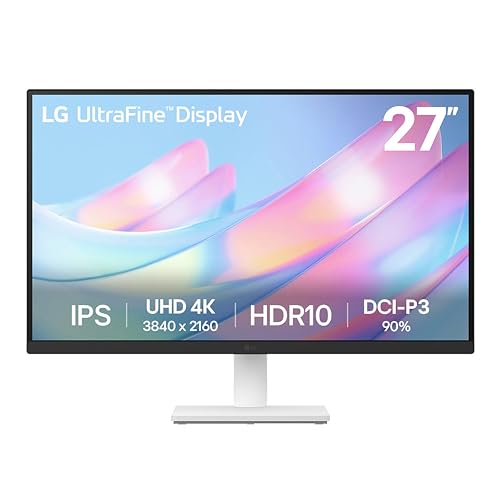
The LG 27UK850-W is the pick for color-critical work, especially if you edit on a laptop. Its 27-inch 4K IPS panel covers 95% of the DCI-P3 color space, which makes it a sound choice for photography editing, video color grading, and graphic design where the wider gamut matters. The 4K resolution gives you the fine detail to judge images closely, and the wide-gamut coverage is the headline reason to choose it over a standard sRGB office screen.
What makes it especially friendly to mobile creators is USB-C power delivery, which lets a compatible laptop connect with a single cable that carries video and charges the machine at the same time. That cuts cable clutter and makes the monitor a genuine docking solution. LG’s Onscreen Control software, an ergonomic stand, and HDR10 with DCI-P3 round out a package aimed squarely at people who care about color. The listing also covers a contrast ratio rating and what is in the box, so you know what to expect on arrival.
Be realistic about the HDR, though. The 27UK850-W carries HDR400-class certification, which I would call passable for the price rather than a true high-dynamic-range experience. It lacks the full-array local dimming and peak brightness that make HDR genuinely impressive, so treat HDR here as a mild bonus, not a reason to buy. As a 4K panel it also leans on your GPU, and like any wide-gamut screen it benefits from proper color management in your software to avoid oversaturated output in non-color-managed apps.
ASUS ProArt PA278QV
The ASUS ProArt PA278QV is the smart choice when you want trustworthy color but do not want to buy a 4K-capable GPU just to drive your monitor. The ProArt series targets photo and video professionals, and this model arrives factory-calibrated for color accuracy with a stated Delta E under 2, verified through Calman. It covers 100% sRGB and 100% Rec. 709, so design work, photo editing, and video for web and broadcast standards land where they should right out of the box.
The 27-inch WQHD (1440p) IPS display is the sensible part of the equation. It renders crystal-clear detail for graphic design and video editing while asking far less of your GPU than a 4K panel, which keeps your whole setup affordable and responsive. ASUS adds ProArt Preset and Palette controls for adjusting color, brightness, and black levels, plus extensive connectivity and a USB hub so a laptop, desktop, and storage can all live on one tidy desk. For a calibrated workflow without the 4K tax, it is hard to beat.
The trade-off is in the gamut and the resolution. The PA278QV focuses on sRGB and Rec. 709 rather than the wider DCI-P3 or Adobe RGB spaces, so if your work demands wide-gamut output, the LG above is the better fit. And at 1440p you simply have fewer pixels than a 4K panel, so it is not the screen for pixel-peeping fine print or print-resolution photo detail. For most sRGB design and video work, those limits will not bite.
Samsung Odyssey G5
The Samsung Odyssey G5 is the pick if your main goal is fast, immersive gaming on a budget. It uses a 1440p VA panel with a high refresh rate and a 1ms response time, which keeps fast action smooth and reduces lag in competitive play. The QHD resolution packs notably more pixel density than Full HD for detailed images, and the VA panel delivers deep blacks that IPS panels in the same price bracket simply cannot match, which pays off in dark game scenes.
The 1000R curved screen wraps slightly toward you to reduce edge distortion and pull you into the picture, and AMD FreeSync support reduces choppiness, screen lag, and tearing on compatible GPUs so fast scenes stay clean. HDR10 adds brighter highlights and more nuanced shadow depth, and the ergonomic stand handles tilt, pivot, and height so you can dial in a comfortable position. For the money, it is a strong all-round gaming monitor.
VA comes with a familiar catch: viewing angles and off-axis color shift are weaker than IPS, so colors look their best dead-center and can wash slightly toward the edges, which matters more for color-critical work than for gaming. VA panels can also show some smearing in very dark transitions despite the fast quoted response time. And as with the LG, the HDR10 badge here is a modest enhancement rather than a true HDR showcase. If precise color is your priority over speed, the ProArt or LG suits you better.
BenQ GW2790
The BenQ GW2790 is the best budget computer screen here, a clean and comfortable 27-inch 1080p IPS panel built for everyday work. It is aimed at office tasks, web browsing, and video calls, and it does those well thanks to an IPS panel that covers 99% sRGB for accurate, vivid color and a 100Hz refresh rate that makes scrolling and general use feel smoother than the usual 60Hz budget fare. The 27-inch screen stays sharp and crisp for documents and browsing, and the stand adjusts for both height and tilt, which is more than many cheap monitors offer.
BenQ’s Eye-Care technology is the other selling point, reducing blue light and flicker to ease strain during long sessions, which is a genuine plus if you spend full days at your desk. Connectivity covers dual HDMI ports and DisplayPort, so you can hook up multiple devices without juggling cables. For a no-drama screen that handles office life and casual use, it covers the basics with care.
The main trade-off is resolution. On a 27-inch frame, 1080p spreads pixels fairly thin, so text and images are not as crisp as the 1440p and 4K panels above, and you will notice softer detail if you sit close. Color is decent but not factory-calibrated, so this is not the screen for serious photo or video work. If your needs are everyday computing on a tight budget, those limits are easy to accept; if you want sharpness or calibrated color, step up to one of the pricier picks.
What to look for
The right monitor depends almost entirely on what you do with it. These are the factors that should drive your decision.
- Panel type: IPS gives wide viewing angles and accurate color; IPS Black adds deeper contrast; VA gives the deepest blacks but weaker off-angle consistency.
- Resolution and size: On a 27-inch screen, 4K is sharpest, 1440p is a strong balance, and 1080p is budget-friendly but softer. More pixels need a stronger GPU.
- Color coverage: sRGB and Rec. 709 cover most web and office work; DCI-P3 and wide-gamut coverage matter for photo, video, and print professionals.
- Factory calibration: A stated Delta E under 2 means trustworthy color out of the box, which saves you buying a calibration tool.
- Refresh rate and response time: High refresh and low response time matter for gaming; 60Hz to 100Hz is plenty for office work.
- Connectivity: USB-C power delivery enables single-cable laptop setups; a built-in USB hub and multiple HDMI or DisplayPort inputs reduce clutter.
- Ergonomics: Height and tilt adjustment, and sometimes pivot, make a real difference to comfort over long days.
- HDR expectations: Lower-tier HDR badges add only a mild bonus; do not pay extra expecting true high-dynamic-range performance.
The verdict
For most buyers, the Dell UltraSharp U2723D is the screen I would choose. Its 4K IPS Black panel pairs deeper contrast with accurate color and sharp text, making it the strongest all-rounder for office and productivity work. If your work is color-critical and you edit on a laptop, the LG 27UK850-W earns its place with 95% DCI-P3 coverage and single-cable USB-C, while the ASUS ProArt PA278QV delivers factory-calibrated sRGB accuracy at 1440p without demanding a 4K-class GPU. Gamers who want speed and deep blacks on a budget should take the Samsung Odyssey G5, accepting VA’s narrower viewing angles. And for everyday computing without spending much, the BenQ GW2790 is the comfortable, eye-friendly budget pick, as long as you can live with 1080p sharpness on a 27-inch screen.
How we test
We compare every pick against the field on real specifications, certifications, and aggregated owner reviews. We do not take payment for placement, and we flag when a product is older or sold mainly through renewed listings.
At a glance
The picks, reviewed
Dell UltraSharp U2723D -- Best overall computer screen
Dell's UltraSharp line sets the standard for office and productivity monitors. The U2723D uses Dell's IPS Black panel technology, which delivers roughly twice the native contrast ratio of standard IPS panels while preserving the color accuracy and viewing angles IPS is known for. The 27-inch 4K panel renders text with exceptional sharpness.
Reasons to buy
- Monitors
LG 27UK850-W 4K -- Best for color-critical work
LG's 27-inch 4K IPS panel covers 95% of the DCI-P3 color space, making it suitable for photography editing, video color grading, and graphic design. HDR400 certification provides passable high dynamic range performance for the price. USB-C power delivery allows laptop users to connect with a single cable.
Reasons to buy
- 4K UHD with 1000:1 Contrast Ratio
- 4K HDR10 DCI-P3
- Onscreen Control
- Ergonomic Stand
- What's In The Box

ASUS ProArt PA278QV -- Color accuracy at 1440p
The ProArt series targets photo and video professionals. The PA278QV delivers factory-calibrated color accuracy (Delta E less than 2) at 1440p resolution, which provides sharp rendering for design work without requiring the GPU horsepower a 4K panel demands. The USB-C and USB hub features support clean desk setups.
Reasons to buy
- Calman Verified & Delta E < 2 Accuracy: Achieve true-to-life precision right out of the bo
- 100% sRGB & 100% Rec. 709 Color Gamut: Ensure your creative projects match industry standa
- 27-inch WQHD IPS Display: Enjoy crystal-clear details for graphic design and video editing
- ASUS ProArt Preset & Palette: Easily customize color, brightness, and black-levels to matc
- Extensive Connectivity & USB Hub: Seamlessly connect your laptop, desktop, and storage dev

Samsung Odyssey G5 -- Fast gaming with excellent contrast
Samsung's Odyssey G5 uses a 1440p VA panel with a 165Hz refresh rate and 1ms response time, making it a strong gaming monitor for the price. The 1000R curved screen reduces edge distortion, and the VA panel delivers deep blacks that IPS equivalents cannot match at this price point. FreeSync Premium support eliminates tearing on compatible GPUs.
Reasons to buy
- QHD Resolution (2560 x 1440) has 1.7 times the pixel density of Full HD for incredibly det
- HDR10 provides brighter highlights and nuanced shadow for added depth
- The 180Hz refresh rate minimizes lag for gameplay with ultra-smooth action. Plus, the 1ms
- AMD FreeSync reduces choppiness, screen lag and image tearing, ensuring that your fast-pac
- Ergonomic stand allows for tilt, pivot and height adjustments to maximize gaming comfort

BenQ GW2790 -- Best budget computer screen
BenQ's GW2790 is a 27-inch 1080p IPS panel with thoughtful ergonomics and BenQ's Eye-Care technology, which reduces blue light and flicker. At it offers a clean, accurate image for everyday office work, web browsing, and video calls. The stand adjusts for height and tilt. Color accuracy is decent though not calibrated.
Reasons to buy
- 【100Hz Refresh Rate】 Experience ultra-smooth performance with a 100Hz refresh rate, reduci
- 【99% sRGB Vivid Color 】 Achieve professional-grade color precision with 99% sRGB, deliveri
- 【27" Crystal Clear Display】 Enjoy a stunning 27-inch screen with sharp, crisp visuals, mak
- 【Dual HDMI & DisplayPort Connectivity】 Seamlessly connect multiple devices with 2 HDMI por
- 【BenQ Eye-Care Technology】 Protect your eyes during extended use with BenQ’s Eye-Care tech
What to look for
What to consider
Start with size and viewing distance. For a desk where you sit roughly 60cm to 80cm away, 24 to 27 inches covers most use cases. Going larger requires increasing your viewing distance to avoid eye strain. Ultrawide monitors (34 inch and above) add horizontal workspace for multitasking but require more room.
What to consider
Panel type comes next. IPS for accurate color and wide viewing angles. VA for high contrast in dark environments. Gaming monitors prioritize refresh rate (144Hz minimum, 165 to 240Hz for competitive play) alongside panel speed. Color work requires factory calibration specs, ideally Delta E less than 2.
What to consider
For setting up a productive workspace around your new monitor, see our guides on [best computer desk for multiple monitors](/articles/best-computer-desk-for-multiple-monitors) and [best computer desk lamp](/articles/best-computer-desk-lamp). For our evaluation criteria, visit our [methodology](/methodology) page.
FAQs
For a 24-inch screen, 1080p is acceptable but 1440p is noticeably sharper for text and detail work. At 27 inches and above, 1440p is the minimum worth buying -- 1080p at that size looks soft. 4K makes sense at 32 inches or larger, or on smaller screens if you do photo or video editing where pixel-level accuracy matters.
IPS panels deliver better color accuracy and wider viewing angles, making them the preferred choice for creative work and general use. VA panels offer higher native contrast ratios, which improves perceived depth in dark scenes -- useful for gaming or media consumption in dim environments. IPS is the safer default for most buyers.
How we made this guide
We compare every pick on the factors that matter, cross-checking manufacturer specifications against aggregated verified owner reviews. We rank independently and never take payment for placement. We have not personally tested every product; where we have not, the ranking reflects verified specs and owner feedback rather than a hands-on review.
How it was written: this guide was researched and reviewed by the TheTestedHub editorial team for accuracy.
Affiliate disclosure: TheTestedHub is reader-supported. When you buy through links on our site, we may earn a commission at no extra cost to you.
Related guides

Your Docking Station Match: CalDigit TS4 and More

Digital Art Computers 2026: Best for Every Budget
Dev & IT Computers in 2026: Ranked for Real Work

Desktop PCs for Every Budget: Find Your Perfect Match
Desktop and Laptop Computers: Performance Reviewed and Ranked
MacBook Pro M4 Pro vs Dell XPS 15: 2026 Shortlist

Buy the Best DIY Computer in 2026: Corsair One i300
