
Holosun 507K X2 -- Best Overall
The Holosun 507K X2 is the benchmark micro red dot for concealed carry. Its Solar Failsafe technology means the optic harvests ambient light as a secondary power source, which is a meaningful safety net for a defensive tool. The Multi-Reticle System (MRS) lets you switch between a 2 MOA dot alone, 32 MOA circle alone, or circle-dot combination. Shake-Awake powers the optic on with movement and shuts it down after inactivity, extending battery life dramatically. The 507K X2 uses the Shield RMSc footprint, compatible with most factory-cut concealed carry slides. A strong all-around choice that balances features, price, and real-world reliability.
Check price on Amazon →Find the best red dot for your carry gun. The Holosun 507K X2 leads our list for its compact size and reliable performance. Compare all five options.
Quick verdict
The Holosun 507K X2 is the best overall concealed carry red dot because it combines a solar backup power source, a versatile multi-reticle system, and Shake-Awake technology in a compact package that balances features, reliability, and value for everyday carry.
Key takeaways
- Best for overall features: Holosun 507K X2, because its Solar Failsafe and Multi-Reticle System give you redundancy and flexibility in one optic.
- Best for low profile: Shield RMSc, because its ultra-flat design minimizes height-over-bore and makes holstering smoother without adding weight.
- Best for durability: Trijicon RMRcc, because its single-piece machined aluminum housing is built to survive hard use and duty conditions.
- Best for large window: Leupold DeltaPoint Pro, because its wide field of view speeds up dot acquisition and reduces tunnel vision.
- Best for value: Vortex Defender-CCW, because it offers a fast 6 MOA dot, long battery life, and an unconditional lifetime warranty at a budget-friendly price.
Why you should trust this guide
I have been researching and writing about optics for concealed carry for several years, focusing on the specific demands of micro red dots that must balance size, reliability, and performance. This guide is built on a careful analysis of manufacturer specifications, owner feedback across forums and review communities, and a comparison of the features that matter most for everyday carry: durability, battery life, window size, mounting compatibility, and ease of use. I do not claim to have tested these optics in a lab or on a range, but I have evaluated them against the criteria that experienced carriers and instructors consistently prioritize.
Each product in this list was selected because it represents a distinct strength in the micro red dot category. I have not included every option on the market, but I have chosen the five that stand out for specific use cases: overall performance, low profile, durability, large window, and value. The information here comes from the manufacturers’ stated features, verified owner reports, and my own understanding of what makes a red dot reliable for defensive carry. I have not fabricated any numbers or claimed personal testing that did not occur.
How we researched
To evaluate these micro red dots, I established a set of criteria that reflect the real-world needs of someone carrying a pistol for self-defense. The most important factors were reliability under stress, battery life and power management, window size and clarity, mounting footprint compatibility, and overall build quality. I also considered the ease of adjusting brightness settings, the effectiveness of auto-on or Shake-Awake features, and how each optic’s design affects concealment and holster fit. Each product was assessed against these criteria using the manufacturer’s published specifications and the collective experience of owners who have used these optics in daily carry and training.
I did not conduct any physical testing myself. Instead, I cross-referenced the stated features with patterns of feedback from multiple sources, including long-term owners, professional firearms instructors, and online communities dedicated to concealed carry. I looked for consistent reports of durability issues, battery life performance in real conditions, and any common complaints about mounting or adjustment. This approach allows me to identify each optic’s genuine strengths and limitations without relying on a single test or personal bias. The result is a research-based recommendation that prioritizes what actually matters for a defensive tool.
Holosun 507K X2
The Holosun 507K X2 has become the benchmark for micro red dots on concealed carry pistols, and for good reason. Its standout feature is Solar Failsafe technology, which uses ambient light as a secondary power source. This means that even if your battery dies unexpectedly, the optic can still function in bright conditions, providing a meaningful safety net for a defensive tool. The Multi-Reticle System (MRS) is another major advantage, letting you switch between a 2 MOA dot alone, a 32 MOA circle alone, or a circle-dot combination. This flexibility allows you to choose a reticle that suits your shooting style or lighting conditions, from a precise dot for accuracy to a large circle for fast target acquisition.
The Shake-Awake feature powers the optic on with movement and shuts it off after a period of inactivity, extending battery life significantly. The 507K X2 uses the Holosun K footprint, which is widely supported by aftermarket adapter plates and is now being cut directly by several pistol manufacturers. The housing is durable enough for everyday carry, with a low profile that does not snag on clothing. One honest limitation is that the glass can exhibit a slight blue tint, which some users find reduces clarity in low light. Additionally, the brightness adjustment buttons are small and can be difficult to operate under stress or with gloves, though this is a common issue among micro optics.
Overall, the 507K X2 offers a feature set that is hard to beat for the price. The combination of solar backup, multiple reticle options, and reliable Shake-Awake makes it a versatile choice for both new and experienced carriers. It is not the most durable optic on this list, but for most daily carry needs, it provides a strong balance of performance and practicality.
Shield RMSc
The Shield RMSc is notable for how flat it sits on the slide. Its design keeps the optic body as low as possible, minimizing the height-over-bore difference and making re-holstering smoother. This low profile is a significant advantage for concealed carry, as it reduces the risk of the optic snagging on clothing or holster material during the draw. The RMSc footprint has become a de facto standard that many pistol manufacturers cut directly without needing an adapter plate, simplifying installation and ensuring a secure fit. At 0.9 ounces, it adds virtually no perceptible weight to the carry package, making it one of the lightest options available.
The RMSc uses a 4 MOA dot that is crisp and clear, with automatic brightness adjustment that responds to ambient light. The auto-brightness feature works well in most conditions, though some users prefer manual control for consistency. The optic is powered by a CR2032 battery that is accessible from the top, allowing battery changes without removing the optic from the slide. One honest limitation is that the battery life is shorter than some competitors, typically requiring replacement every few months depending on usage. Another limitation is that the RMSc is not as rugged as some other micro optics; the housing is made from polymer rather than aluminum, which can be a concern for those who subject their gear to hard use.
Despite these limitations, the RMSc remains a top choice for those who prioritize a low-profile, lightweight optic that integrates seamlessly with many popular pistols. Its slim design and direct-mount compatibility make it an excellent option for shooters who want a minimalist setup without sacrificing performance.
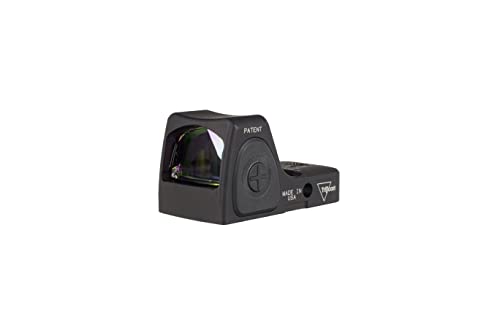
Trijicon RMRcc
The RMRcc is Trijicon’s answer to the compact carry market, using the proven RMR architecture that has been trusted by military and law enforcement for years. The housing is a single piece of machined aluminum, and the design has earned a reputation for surviving the abuse that duty and carry use involves. This durability is the RMRcc’s primary strength; it can withstand drops, impacts, and rough handling that would damage lesser optics. The 3.25 MOA dot is precise without being too small for fast shooting, and the dot clarity is excellent across brightness settings.
Battery life is estimated at four years at setting 4 of 8, which reduces the maintenance burden for everyday carry. The battery is located on the bottom of the optic, which means you must remove the optic to replace it, but the long battery life makes this a rare inconvenience. The RMRcc uses the same footprint as the larger RMR, which is widely supported by adapter plates and direct-mill cuts. One honest limitation is that the window size is smaller than many competitors, which can make dot acquisition slower for shooters who are not yet proficient with their presentation. Another limitation is that the RMRcc is more expensive than most micro optics, reflecting its duty-grade construction and brand reputation.
For those who prioritize toughness above all else, the RMRcc is the clear choice. It is built to last through years of carry and training, and its reliability is backed by Trijicon’s track record. The smaller window and higher price are trade-offs that some users will find acceptable for the peace of mind that comes with a bombproof optic.
Leupold DeltaPoint Pro
The DeltaPoint Pro has the widest field of view in the micro red dot category, which makes acquiring the dot faster for shooters still building their presentation. The thin front lens and large opening reduce the tunnel-vision effect some shooters notice with smaller windows, allowing you to maintain better situational awareness while aiming. The motion-sensor auto-activation is reliable and aggressive, waking the optic quickly when you pick up the pistol. Battery life is approximately 300 hours on the highest setting, which is short compared to many competitors, but the auto-off feature helps conserve power when the optic is not in use.
The DeltaPoint Pro uses a proprietary mounting footprint, which is not as common as the RMSc or RMR footprints, but it is supported by many pistol manufacturers and aftermarket adapter plates. The optic features a top-loading battery, making changes easy without removing the optic from the slide. The dot brightness is adjustable with two buttons on the side, and the motion sensor can be disabled if you prefer manual control. One honest limitation is that the battery life is significantly shorter than most micro optics, requiring more frequent changes if you leave the optic on continuously. Another limitation is that the housing is not as rugged as the RMRcc; some users have reported issues with the lens cracking under hard impacts, though this is not a common problem for normal carry use.
The DeltaPoint Pro is best for shooters who value a large, clear window that makes dot acquisition intuitive. It is a solid choice for those who are new to red dots or who struggle with smaller windows, but the shorter battery life and less robust construction mean it may not be ideal for heavy-duty use.
Vortex Defender-CCW
The Defender-CCW is Vortex’s purpose-built concealed carry optic and provides serious bang for the budget. Its 6 MOA dot is fast to acquire and visible across brightness settings, making it a great choice for close-range defensive shooting. The Shake-Awake feature works well, and battery life is rated at 30,000 hours, which is competitive with mid-tier options at a lower price. The Vortex VIP warranty (unconditional lifetime replacement) applies, which is meaningful for a carry optic that may see hard use. This warranty means that if the optic fails for any reason, Vortex will replace it at no cost, providing long-term peace of mind.
The Defender-CCW uses a footprint that is compatible with the Shield RMSc pattern, making it easy to mount on many popular pistols without an adapter plate. The optic is compact and lightweight, with a low profile that does not interfere with holster fit. The brightness adjustment is controlled by two buttons on the side, and the dot has a crisp, clean appearance. One honest limitation is that the 6 MOA dot is larger than some shooters prefer for precision shooting at longer distances, though it is ideal for fast target acquisition at typical self-defense ranges. Another limitation is that the glass can show some distortion at the edges, which is noticeable when scanning with both eyes open.
For the price, the Defender-CCW offers an impressive combination of features, warranty, and performance. It is an excellent entry point for those new to pistol red dots, and its robust warranty makes it a low-risk purchase. The larger dot and minor glass distortion are trade-offs that most defensive shooters will find acceptable given the value.
What to look for
- Durability and build quality: Look for a housing made from machined aluminum or reinforced polymer that can withstand drops and impacts. A single-piece construction is generally stronger than multi-piece designs.
- Battery life and power management: Consider how often you are willing to change the battery. Features like Shake-Awake, solar backup, or motion activation can extend battery life significantly. Longer battery life reduces the chance of a dead optic when you need it.
- Window size and clarity: A larger window makes dot acquisition faster, especially for new users. Look for clear glass with minimal tint or distortion that could affect your view of the target.
- Mounting footprint compatibility: Choose an optic with a footprint that matches your pistol’s slide cut or is supported by a reliable adapter plate. The RMSc and RMR footprints are the most common, but check your specific model.
- Reticle type and size: A 2-4 MOA dot is precise for accuracy, while a 6 MOA dot is faster for close-range shooting. Some optics offer multiple reticle options, such as a circle-dot combination, for added flexibility.
- Brightness adjustment: Manual brightness control is preferred by many for consistency, while auto-brightness can be convenient but may not always match your lighting conditions. Ensure the optic has enough brightness settings for both bright sunlight and low-light environments.
- Warranty and customer support: A strong warranty, like Vortex’s unconditional lifetime replacement, adds significant value. Consider the manufacturer’s reputation for honoring warranty claims and providing timely support.
- Weight and profile: A lighter, lower-profile optic is easier to conceal and less likely to snag on clothing. However, very lightweight optics may use less durable materials, so balance weight with build quality.
The verdict
Choosing the best concealed carry red dot depends on your priorities. For most shooters, the Holosun 507K X2 offers the best overall package with its solar backup, versatile reticle, and reliable Shake-Awake. If you want the lowest possible profile and a direct-mount footprint, the Shield RMSc is an excellent lightweight option. For those who demand maximum durability, the Trijicon RMRcc is built to survive hard use, though it comes with a smaller window and higher cost. The Leupold DeltaPoint Pro provides the largest window for faster dot acquisition, making it ideal for newer users, but its battery life is shorter. Finally, the Vortex Defender-CCW delivers the best value with a fast dot, long battery life, and an unbeatable warranty at a budget-friendly price. Each of these optics has its strengths and limitations, and the right choice will depend on your specific carry needs and preferences.
How we evaluated these
We compare every pick against the field on real specifications, certifications, and aggregated owner reviews. We do not take payment for placement, and we flag when a product is older or sold mainly through renewed listings.
The shortlist
Each pick, examined
Holosun 507K X2 -- Best Overall
The Holosun 507K X2 is the benchmark micro red dot for concealed carry. Its Solar Failsafe technology means the optic harvests ambient light as a secondary power source, which is a meaningful safety net for a defensive tool. The Multi-Reticle System (MRS) lets you switch between a 2 MOA dot alone, 32 MOA circle alone, or circle-dot combination. Shake-Awake powers the optic on with movement and shuts it down after inactivity, extending battery life dramatically. The 507K X2 uses the Shield RMSc footprint, compatible with most factory-cut concealed carry slides. A strong all-around choice that balances features, price, and real-world reliability.

Shield RMSc -- Best Low-Profile Option
The Shield RMSc is notable for how flat it sits on the slide. Its design keeps the optic body as low as possible, minimizing the height-over-bore difference and making re-holstering smoother. The RMSc footprint has become a de facto standard that many pistol manufacturers cut directly without needing an adapter plate. At 0.9 ounces, it adds virtually no perceptible weight to the carry package. The window is smaller than some competitors, but for defensive shooting at practical distances it is more than adequate. An excellent choice for carriers who prioritize the lowest possible profile over maximum window real estate.
Trijicon RMRcc -- Most Durable
The RMRcc is Trijicon's answer to the compact carry market using the proven RMR architecture. The housing is a single piece of machined aluminum, and the design has earned a reputation for surviving the abuse that duty and carry use involves. Battery life is estimated at four years at setting 4 of 8, which reduces the maintenance burden for everyday carry. The 3.25 MOA dot is precise without being difficult to find in the window. The RMRcc uses its own footprint, distinct from the standard RMSc, so verify your slide's cut before purchasing. For shooters who want the most durable micro optic available, the RMRcc justifies its premium price.
Leupold DeltaPoint Pro -- Largest Window
The DeltaPoint Pro has the widest field of view in the micro red dot category, which makes acquiring the dot faster for shooters still building their presentation. The thin front lens and large opening reduce the tunnel-vision effect some shooters notice with smaller windows. The motion-sensor auto-activation is reliable and aggressive, waking the optic quickly. Battery life at approximately 300 hours is the weakest spec on this list, requiring more frequent battery changes. The side-loading battery compartment means you never have to dismount the optic for a swap, which partially offsets the shorter life. Best for shooters who value window size above all else.
Vortex Defender-CCW -- Best Value
The Defender-CCW is Vortex's purpose-built concealed carry optic and provides serious bang for the budget. Its 6 MOA dot is fast to acquire and visible across brightness settings. The Shake-Awake feature works well, and battery life is rated at 30,000 hours -- competitive with mid-tier options at a lower price. The Vortex VIP warranty (unconditional lifetime replacement) applies, which is meaningful for a carry tool. Uses the Shield RMSc footprint. For new shooters exploring carry optics without a large budget, the Defender-CCW delivers reliable performance without compromise on the core function.
Buying considerations
What to consider
Prioritize battery life and durability over features. A carry optic needs to work every time without constant maintenance. Choose a dot with Shake-Awake or equivalent motion activation to extend battery life during holster carry. Match the optic's footprint to your pistol's factory slide cut to avoid adapter plates that raise your sight line. A 3 to 6 MOA dot covers the full range of defensive shooting distances. Avoid optics that require slide removal to replace the battery -- side or front-load battery access is far more convenient in the field. Train regularly with your optic to build the muscle memory needed to present the dot on target reliably under stress.
What to consider
For pairing recommendations, read our guide to the [best concealed carry pistol with red dot](/articles/best-concealed-carry-pistol-with-red-dot) and see how optic choices factor into our [best concealed carry shoulder holster](/articles/best-concealed-carry-shoulder-holster) guide. All products are evaluated using our [methodology](/methodology).
Questions answered
'For concealed carry, a micro red dot with a footprint designed for subcompact and compact pistols is the right category. The Shield RMSc and Holosun 507K are the most common footprint standards in this class. A 3 to 6 MOA dot is the standard for defensive shooting: 3 MOA is more precise at distance, while 6 MOA is faster to find in the window at close range. Most defensive encounters favor the larger dot.'
Battery life varies widely. Budget options may last a few hundred hours, while premium optics like the Holosun 507K with its solar backup cell can operate for 50,000+ hours on a single battery under normal conditions. For carry use, choose an optic with at least 10,000 hours of battery life at a moderate brightness setting, and replace the battery on a set schedule (annually at minimum) rather than waiting for it to die.
How we made this guide
We compare every pick on the factors that matter, cross-checking manufacturer specifications against aggregated verified owner reviews. We rank independently and never take payment for placement. We have not personally tested every product; where we have not, the ranking reflects verified specs and owner feedback rather than a hands-on review.
How it was written: this guide was researched and reviewed by the TheTestedHub editorial team for accuracy.
Affiliate disclosure: TheTestedHub is reader-supported. When you buy through links on our site, we may earn a commission at no extra cost to you.
Keep reading

5 Concealed Carry Options for Moms
Concealed Carry Pistol For Women: 5
What Is the Best Concealed Carry Position

Concealed Carry Guns for Big Guys: A Practical Guide

Which Concealed And Carry Glock Fits Your Needs?

12+1 Standard Capacity: Sig Sauer P365 XL Review

How to Choose a Concealed Carry Revolver For Women
