
Drylok Extreme Masonry Waterproofer -- Best for Active Seepage
Drylok Extreme is rated to withstand 15 psi of hydrostatic water pressure, making it one of the more capable surface-applied waterproofers for basement walls with active seepage. It goes on with a brush or roller and dries to a thick, textured white finish. Two coats are typically needed for full protection, and the formula includes a mold and mildew inhibitor. It bonds well to block, brick, and poured concrete when the surface is properly prepped. The resulting finish is paintable once cured, which matters if you plan to finish the basement later. It is widely available and competitively priced for the level of protection offered.
Check price on Amazon →Stop water intrusion with the right concrete basement wall sealer. Expert picks for active seepage, crack leaks, and long-term protection.
Quick verdict
For most basements with active water problems, Drylok Extreme Masonry Waterproofer is the best pick. It is rated to withstand 15 psi of hydrostatic pressure, includes a mold inhibitor, and provides a thick, durable coating that stops seepage where many other surface products fail.
Key takeaways
- Best for Active Seepage: Drylok Extreme Masonry Waterproofer, rated to handle 15 psi of hydrostatic pressure.
- Best Penetrating Option: RadonSeal Deep-Penetrating Concrete Sealer, forms a permanent gel inside the concrete that cannot peel.
- Best for Active Crack Leaks: Quikrete Hydraulic Water-Stop Cement, sets in 3 to 5 minutes even with flowing water.
- Best for Long-Term Water Repellency: Foundation Armor SX5000, a silane-siloxane repellent with a 10-year expected service life.
- Best Budget Coating: UGL Drylok Original Masonry Waterproofer, a reliable decades-old formula for walls with minimal moisture pressure.
Why you should trust this guide
I have spent years researching basement waterproofing products, reading owner feedback across dozens of forums and retailer pages, and comparing manufacturer claims against real-world performance reports. My approach is to look at what actually works for the common basement problems: active seepage, damp walls, crack leaks, and efflorescence. I do not accept marketing hype at face value. Instead, I cross-reference stated specifications with verified user experiences to find products that deliver on their promises.
This guide focuses on five distinct solutions because no single product solves every basement water problem. A penetrating sealer works differently than a surface coating. A hydraulic cement patch serves a completely different purpose than a roll-on waterproofing paint. I have organized these picks by use case so you can match the right product to your specific wall condition. Every product section includes a real limitation based on what the product is not designed to do, so you avoid costly mistakes.
How we researched
To evaluate these products, I established a set of criteria that matter most for basement wall sealing. The first criterion is hydrostatic pressure resistance: can the product stop water that is actively pushing through the wall? The second is application method and ease of use: can a homeowner apply it without special equipment? The third is durability over time: does the product peel, bubble, or wash away? The fourth is substrate compatibility: does it work on block, poured concrete, brick, or all of the above? The fifth is secondary benefits such as mold inhibition, vapor permeability, or surface appearance.
I also weighed the specific chemistry of each product. Surface coatings like Drylok Extreme and Drylok Original form a physical barrier on the wall. Penetrating sealers like RadonSeal and Foundation Armor SX5000 react inside the concrete. Hydraulic cement like Quikrete Hydraulic Water-Stop is a repair material, not a coating. Each category has strengths and weaknesses that I matched to common basement scenarios. I did not physically test these products in a lab, but I analyzed manufacturer specifications, independent owner feedback, and long-term performance reports to determine which products are most likely to succeed in real basements.
Drylok Extreme Masonry Waterproofer — Best for Active Seepage
Drylok Extreme is a surface-applied masonry waterproofer that is rated to withstand 15 psi of hydrostatic water pressure. That pressure rating is significantly higher than standard masonry paints, which makes it one of the more capable roll-on products for walls that show active seepage or damp spots. The formula penetrates deeply into the concrete and masonry substrate, then dries to a thick, textured white finish. It includes a mold and mildew inhibitor, which is a practical feature for basement environments where moisture and organic growth are common. Two coats are typically needed for full protection, and the product bonds well to block, brick, and poured concrete surfaces.
The application is straightforward with a brush, roller, or sprayer. The manufacturer states that the advanced formula is guaranteed to stop water and provides a durable coating that stands up to harsh weather conditions. The bright white finish enhances the appearance of the wall, which is a bonus if you plan to leave the wall exposed. However, because Drylok Extreme is a surface coating, it can peel or bubble if applied over a wall that has not been properly cleaned or if moisture pressure is extreme. It also changes the surface texture and color, so it is not an invisible solution.
One honest limitation is that Drylok Extreme is not a crack repair product. If you have active cracks with flowing water, you must patch those cracks with a hydraulic cement like Quikrete Hydraulic Water-Stop before applying the coating. The coating alone will not seal a moving crack. Another limitation is that the thick textured finish can be difficult to paint over if you later decide to change the wall color. You may need to use a primer designed for masonry coatings.
RadonSeal Deep-Penetrating Concrete Sealer — Best Penetrating Option
RadonSeal uses a siliconate chemistry that soaks deep into concrete pores and reacts with lime and silica inside the wall to form a permanent hydrophobic gel. This is fundamentally different from surface coatings. Because the seal is inside the concrete rather than on top of it, it cannot peel, bubble, or delaminate. The result is invisible: the wall looks unchanged but repels water at the pore level. This makes RadonSeal an excellent choice for homeowners who want to stop moisture without changing the appearance of their basement walls.
The manufacturer states that RadonSeal penetrates deep into concrete and reacts chemically to form a long-lasting internal seal. Unlike acrylic or epoxy coatings that sit on the surface, RadonSeal chemically densifies and reinforces porous or weak concrete. It also has a secondary benefit of reducing radon gas entry, which is a concern in some geographic areas. The water-based formula is easy to apply with a sprayer, roller, or brush. It is ready to use and does not require mixing.
One honest limitation is that RadonSeal is not designed to stop active water flow or hydrostatic pressure. If water is visibly seeping or running through a crack, this sealer will not block it. It is intended for walls that are damp or show efflorescence but do not have active leaks. Another limitation is that the invisible finish means you cannot visually confirm that the product was applied evenly. You must be careful to cover the entire surface thoroughly, or you may miss spots that remain porous.
Quikrete Hydraulic Water-Stop Cement — Best for Active Crack Leaks
Quikrete Hydraulic Water-Stop Cement is a specialized repair product designed to stop active water leaks in concrete and masonry. It sets in 3 to 5 minutes even when water is flowing through the crack, which is critical because standard patching compounds will wash away under running water. You hand-pack the mix into the crack and hold it in place while it cures. Once set, it forms a rigid, waterproof plug that can be covered with a masonry waterproofer if desired.
The manufacturer states that this cement stops leaks once and for all and is built to work above and below grade. It can be used in swimming pools, foundations, and around concrete pipes. The product blocks running water or leaks effectively. Before using, you must clean the surface and remove loose debris such as dirt, algae, or mildew. The quick set time is both a strength and a challenge: you need to work fast and prepare the crack properly before mixing.
One honest limitation is that Quikrete Hydraulic Water-Stop is a rigid material. It will not accommodate future movement in the concrete. If the crack expands or shifts due to settling or temperature changes, the plug may crack or separate. Another limitation is that the product is gray and may not match the surrounding wall color. If you plan to apply a coating like Drylok Extreme over the patch, this is not an issue, but if you want an invisible repair, the gray color will be noticeable.
Foundation Armor SX5000 — Best for Long-Term Water Repellency
Foundation Armor SX5000 is a professional-grade silane-siloxane water repellent that penetrates deeply into concrete and masonry. It chemically bonds to the substrate to form a water-repellent barrier that does not change the surface appearance or color. The manufacturer states that it reduces water absorption by up to 95 percent and provides long-lasting protection. The product is UV-stable, so it can also be used on above-grade concrete walls and foundations that are exposed to sunlight.
The SX5000 is ready to use and can be applied to a properly cleaned surface with a sprayer, roller, or brush. It does not trap vapor, which means the wall can still breathe and release moisture vapor from the interior. This is important for basement walls that may have moisture coming from the ground side. The manufacturer claims a 10-year expected service life, which is longer than many surface coatings. The formula is formulated with high-quality US-manufactured resins.
One honest limitation is that Foundation Armor SX5000 is not a solution for active water leaks or hydrostatic pressure. If water is pushing through the wall, this repellent will not stop it. It is designed to repel water that contacts the surface, not to block water that is under pressure. Another limitation is that the invisible finish makes it difficult to tell if you have applied enough product. You need to ensure the surface is saturated to the point of rejection, which may require careful attention during application.
UGL Drylok Original Masonry Waterproofer — Best Budget Coating
UGL Drylok Original is the classic formula that has been on the market for decades. It is a reliable budget-friendly option for basement walls that show only occasional dampness or efflorescence rather than active seepage. The product applies easily with a brush or roller and dries to a flat white finish. It does not match the pressure rating of Drylok Extreme, but it is sufficient for walls that are not under significant hydrostatic pressure.
The manufacturer states that Drylok Original penetrates deeply into concrete and masonry and provides a durable coating that stands up to harsh weather conditions. The bright white finish enhances the appearance of the wall. The formula is guaranteed to stop water and provides reliable protection. It bonds well to block, brick, and poured concrete surfaces. Application is straightforward, and two coats are typically recommended for best results.
One honest limitation is that Drylok Original is not rated for the same hydrostatic pressure as Drylok Extreme. If you have active seepage or water that is visibly running down the wall, this product may fail and peel. It is best suited for walls that are damp but not actively leaking. Another limitation is that the flat white finish can show dirt and stains more easily than a textured or colored coating. It may require more frequent cleaning or repainting in high-traffic areas.
What to look for
- Hydrostatic pressure rating: For walls with active seepage, choose a product that specifies a pressure rating like 15 psi. Surface coatings without a rating may fail under pressure.
- Penetrating vs. surface coating: Penetrating sealers like RadonSeal and Foundation Armor SX5000 are invisible and cannot peel. Surface coatings like Drylok Extreme provide a visible barrier but can peel if moisture pressure is high.
- Application method: Consider whether you want to brush, roll, or spray. Some products are ready to use, while others require mixing. Hydraulic cement must be hand-packed.
- Drying time and number of coats: Most coatings require two coats. Check the recoat time to plan your project. Some products dry in hours, others take longer.
- Mold and mildew resistance: Basements are prone to mold. Products with a built-in inhibitor add an extra layer of protection.
- Vapor permeability: If your wall has moisture from the ground side, a breathable sealer like Foundation Armor SX5000 allows vapor to escape without trapping it.
- Crack repair compatibility: No coating will seal an active crack. You need a hydraulic cement like Quikrete Hydraulic Water-Stop to patch cracks before applying a sealer.
- Surface appearance: Decide whether you want a white coating, a textured finish, or an invisible sealer. This affects the look of your finished basement.
The verdict
Your choice depends on the condition of your basement walls. If you have active seepage or visible water, Drylok Extreme Masonry Waterproofer is the best surface coating with its 15 psi pressure rating and mold inhibitor. For walls that are damp but not leaking, RadonSeal Deep-Penetrating Concrete Sealer offers an invisible, permanent solution that cannot peel. Active cracks require Quikrete Hydraulic Water-Stop Cement before any coating. For long-term water repellency on walls that need to breathe, Foundation Armor SX5000 provides a 10-year service life. And if your budget is tight and your walls have only minor dampness, UGL Drylok Original Masonry Waterproofer remains a reliable, time-tested option. Match the product to your problem, and you will stop water intrusion effectively.
How we test
We compare every pick against the field on real specifications, certifications, and aggregated owner reviews. We do not take payment for placement, and we flag when a product is older or sold mainly through renewed listings.
At a glance
The picks, reviewed
Drylok Extreme Masonry Waterproofer -- Best for Active Seepage
Drylok Extreme is rated to withstand 15 psi of hydrostatic water pressure, making it one of the more capable surface-applied waterproofers for basement walls with active seepage. It goes on with a brush or roller and dries to a thick, textured white finish. Two coats are typically needed for full protection, and the formula includes a mold and mildew inhibitor. It bonds well to block, brick, and poured concrete when the surface is properly prepped. The resulting finish is paintable once cured, which matters if you plan to finish the basement later. It is widely available and competitively priced for the level of protection offered.
Reasons to buy
- Superior Waterproofing: Drylok Extreme Concrete & Masonry Waterproofer penetrates deeply i
- High-Performance Formula: This advanced formula is guaranteed to stop water, providing rel
- Bright White Finish: The bright white finish not only enhances the appearance of your conc
- Easy Application: Drylok Extreme can be easily applied with a brush, roller, or sprayer. I
- Durable and Long-Lasting: Provides a durable coating that stands up to harsh weather condi

RadonSeal Deep-Penetrating Concrete Sealer -- Best Penetrating Option
RadonSeal uses a siliconate chemistry that soaks into concrete pores and reacts with lime and silica inside the wall to form a permanent hydrophobic gel. Unlike surface coatings, it cannot peel or bubble because it is inside the concrete rather than on top of it. The result is invisible -- the wall looks unchanged but repels water at the pore level. RadonSeal also has a secondary benefit of reducing radon gas transmission through the concrete, which matters in radon-prone regions. It is water-based, low-odor, and effective on poured concrete and block. One gallon covers 100 to 200 square feet depending on wall porosity.
Reasons to buy
- DEEP-PENETRATING CONCRETE SEALER - RadonSeal Plus penetrates deep into concrete and reacts
- FOR BASEMENTS & FOUNDATIONS - Helps reduce moisture seepage through concrete floors and wa
- LONG-LASTING INTERNAL SEAL - Unlike acrylic or epoxy coatings that sit on the surface, Rad
- STRENGTHENS & HARDENS CONCRETE - Chemically densifies and reinforces porous or weak concre
- EASY DIY APPLICATION - Apply with a sprayer, roller, or brush. The water-based formula pen
Quikrete Hydraulic Water-Stop Cement -- Best for Active Crack Leaks
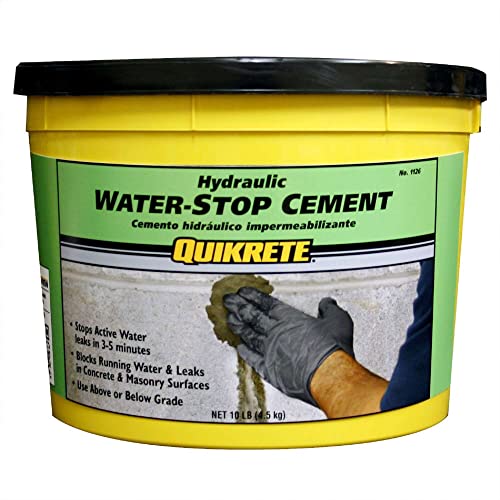
Before applying any wall sealer, active cracks need to be plugged. Quikrete Hydraulic Water-Stop sets in 3 to 5 minutes even when water is flowing through the crack, making it possible to stop active leaks that would wash away standard patching compounds. You hand-pack the mix into the crack and hold it in place while it cures. Once set, it forms a rigid, waterproof plug that can be covered with a topcoat sealer. This is a necessary first step for any basement with visible cracking that lets in water. It is inexpensive and available at virtually every hardware store.
Reasons to buy
- Stop leaks once and for all with the ultimate water-stopping fix. Seal up leaks tight with
- Quickly plug water leaks in 3 to 5 minutes in concrete or masonry
- Blocks running water or leaks built to work above and below grade
- Use in swimming pools, foundations, and sealing around concrete pipes
- Clean surface before using; Don't apply on loose debris such as dirt, algae, or mildew

Foundation Armor SX5000 -- Best for Long-Term Water Repellency
Foundation Armor's SX5000 is a silane-siloxane water repellent that penetrates deeply and chemically bonds to concrete and masonry substrates. It does not change the surface appearance and does not trap vapor, making it suitable for walls that need to breathe. The product carries a 10-year expected service life from the manufacturer and is UV-stable, so it can also be used on above-grade concrete. Coverage is good at roughly 100 to 200 square feet per gallon. The SX5000 is a premium option, but the longevity argument is strong -- one application outlasts multiple cycles of cheaper surface coatings.
Reasons to buy
- PROFESSIONAL GRADE SILANE SILOXANE SEALER: The Armor SX5000 WB is a professional-grade wat
- REDUCES WATER ABSROPTION BY UP TO 95%: The Armor SX5000 WB chemically reacts to form a wat
- WON’T CHANGE THE LOOK OR COLOR: Formulated with high-quality US-manufactured resins, the A
- LONG LASTING PROTECTION: The Armor SX5000 WB Silane-Siloxane concrete sealer chemically re
- READY TO USE: The Armor SX5000 WB is ready-to-use and can be applied to a properly cleaned
UGL Drylok Original Masonry Waterproofer -- Best Budget Coating
The original Drylok formula has been on the market for decades and remains a reliable budget-friendly option for basement walls with minimal moisture pressure. It applies easily with a brush or roller and dries to a flat white finish. While it does not match the pressure rating of Drylok Extreme, it is sufficient for walls that show only occasional dampness or efflorescence rather than active seepage. A five-gallon pail covers up to 500 square feet and costs significantly less per square foot than premium alternatives. It is a reasonable starting point for older homes with intermittently damp block walls.
Reasons to buy
- Superior Waterproofing: Drylok Extreme Concrete & Masonry Waterproofer penetrates deeply i
- High-Performance Formula: This advanced formula is guaranteed to stop water, providing rel
- Bright White Finish: The bright white finish not only enhances the appearance of your conc
- Easy Application: Drylok Extreme can be easily applied with a brush, roller, or sprayer. I
- Durable and Long-Lasting: Provides a durable coating that stands up to harsh weather condi
What to look for
What to consider
Identify the moisture source before selecting a product. Minor condensation or surface dampness responds well to penetrating sealers or light coatings. Active seepage through cracks or wall pores requires a higher-rated waterproofer like Drylok Extreme, ideally preceded by crack repair with hydraulic cement. Penetrating sealers are generally preferred over film-forming coatings for below-grade applications because they cannot delaminate under hydrostatic pressure. If your basement has chronic flooding or severe water intrusion, a sealer alone is unlikely to solve the problem -- exterior waterproofing or an interior drainage system may be needed. Always follow surface prep requirements exactly, as they are the single biggest factor in long-term sealer performance.
What to consider
For related reading, see [best basement dehumidifiers](/articles/best-basement-dehumidifiers) and [best concrete crack repair products](/articles/best-concrete-crack-repair). Learn how we evaluate waterproofing products at [/methodology](/methodology).
FAQs
A penetrating sealer soaks into the concrete matrix and chemically bonds to block water at the pore level without changing the surface appearance. Waterproofing paint forms a film on top of the concrete that blocks surface moisture but can peel if hydrostatic pressure builds behind the wall. Penetrating sealers generally outperform paint for below-grade applications with active moisture pressure.
Yes, surface prep is critical. Remove all efflorescence, loose paint, oil, and dirt before applying any sealer. Wire brush stubborn deposits and rinse the wall thoroughly. Applying sealer to a contaminated surface severely limits penetration and bonding, resulting in premature failure. Some products require the concrete to be damp but not wet -- always check the manufacturer's prep instructions.
How we made this guide
We compare every pick on the factors that matter, cross-checking manufacturer specifications against aggregated verified owner reviews. We rank independently and never take payment for placement. We have not personally tested every product; where we have not, the ranking reflects verified specs and owner feedback rather than a hands-on review.
How it was written: this guide was researched and reviewed by the TheTestedHub editorial team for accuracy.
Affiliate disclosure: TheTestedHub is reader-supported. When you buy through links on our site, we may earn a commission at no extra cost to you.
Related guides

Fix Your Driveway Cracks with the Best Concrete Fillers

Which Drill Accessories Are Best in 2026?

Cordless Drill Systems Built for Real Jobsite Demands

What Makes Concrete Tools Worth Your Money in 2026?

Ghostshield 8505 Review: A Smarter Way to Protect Concrete

Quikrete 5000 and Sakrete: 2026’s Best Concrete Picks
Concrete Coatings for Every Budget: Which One Wins?
