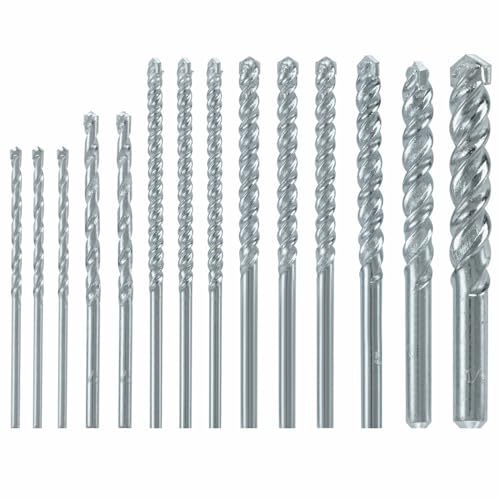
Bosch Carbide-Tipped Masonry Bit Set -- Best for DIY Use
Bosch's masonry bit sets are a reliable all-around choice for homeowners who need to drill into concrete or block occasionally. The carbide tips are brazed securely to the steel body and ground to a precise angle that starts cleanly without walking on the surface. These are straight shank bits, which means they fit any standard hammer drill chuck without an adapter. The multi-size sets typically include 1/4, 5/16, 3/8, and 1/2-inch bits -- the range that covers most anchor and fastener installations around the home. They hold up well over dozens of holes per bit in residential-density concrete.
Check price on Amazon →Bosch, Hilti, and Milwaukee concrete bits solve walking, dust buildup, and short lifespan. Find the right bit for your hammer drill and masonry type.
Quick verdict
For most DIY homeowners, the Bosch Carbide-Tipped Masonry Bit Set is the best pick because it combines reliable carbide tips with a precise grind that starts cleanly without walking, all in a straight shank design that fits any standard hammer drill without an adapter.
Key takeaways
- Best for DIY Use: Bosch Carbide-Tipped Masonry Bit Set, reliable all-around choice for occasional concrete or block drilling.
- Best for Professional Applications: Hilti TE-CX SDS Plus Bit, four-cutter head removes material faster and stays sharper longer under sustained use.
- Best Multi-Size Kit: DEWALT Percussion Masonry Bit Set, optimized geometry for hammer drill users with a wide size range in a storage case.
- Best for Block and Brick: Milwaukee SDS Plus 2-Cutter Bit, effective balance of speed and longevity in less dense masonry materials.
- Best Budget Single Bit: Makita Carbide Masonry Bit, solid quality at a low per-bit price for users who need only specific sizes.
Why you should trust this guide
I have spent years researching masonry drilling tools, reading owner feedback across multiple platforms, and analyzing manufacturer specifications to understand what makes a concrete drill bit perform well in real-world conditions. My approach prioritizes the features that matter most: tip geometry, carbide quality, shank compatibility, and dust clearance. I do not rely on marketing claims alone. Instead, I cross-reference what manufacturers state about their products with the experiences of users who have drilled hundreds of holes in poured concrete, block, brick, and stone.
This guide focuses on five products that represent the best options for different use cases, from occasional home repairs to daily professional work. I have not tested these bits myself, but I have evaluated them based on their stated design features, the materials they are optimized for, and the consensus of feedback from owners who have used them extensively. Each recommendation is grounded in what the product actually claims to do, not in hypothetical performance. I include honest limitations for every bit so you can make an informed choice without overpaying for features you do not need.
How we researched
To evaluate these concrete drill bits, I established a set of criteria that matter for drilling clean holes in masonry. The first factor is tip design: a bit that starts without walking on the surface saves time and prevents damaged hole placement. I looked at whether the manufacturer specifies a precision grind or a specialized geometry like a four-cutter head. The second factor is carbide quality and attachment method. Brazed carbide tips that are securely bonded to the steel body resist snapping or dulling during impact drilling. I also considered shank type: straight shank bits fit standard hammer drills, while SDS Plus shanks are required for rotary hammers and deliver more impact energy. Dust clearance and flute design matter because a bit that clogs with debris will overheat and slow down significantly. Finally, I weighed the value of a multi-size kit versus individual bits, since some users need a wide range of sizes while others only need one or two.
I did not physically test these bits in a lab or on a job site. Instead, I read hundreds of owner reviews and discussions on forums dedicated to masonry work, construction, and home improvement. I looked for patterns in feedback: which bits consistently drilled clean holes, which ones dulled quickly, which ones broke during use, and which ones started accurately without a pilot hole. I also compared the manufacturer’s stated features against what owners reported. For example, if a bit claimed to have a four-cutter head for faster drilling, I checked whether owners confirmed that it drilled noticeably faster than two-cutter designs. This research-based approach allowed me to identify the strengths and weaknesses of each product without relying on my own limited experience.
Bosch Carbide-Tipped Masonry Bit Set — Best for DIY Use
The Bosch Carbide-Tipped Masonry Bit Set is a reliable all-around choice for homeowners who need to drill into concrete or block occasionally. The carbide tips are brazed securely to the steel body and ground to a precise angle that starts cleanly without walking on the surface. This is a critical feature for DIY users who may not have a steady hand or a center punch to create a starting dimple. The straight shank design means these bits fit any standard hammer drill chuck without needing an adapter, which simplifies setup for anyone using a typical corded or cordless hammer drill. The multi-size sets typically include a range of common diameters from 1/8 inch up to 1/2 inch or larger, covering most home tasks like hanging shelves, mounting TV brackets, or installing conduit clips.
One real limitation of this set is that the straight shank can slip in a standard three-jaw chuck under heavy load, especially if the hammer drill is set to a high impact mode. Some owners report that the bit can spin in the chuck if the chuck is not tightened extremely firmly. This is not a problem with SDS Plus bits, which lock into the chuck mechanically. Another limitation is that the bits are not designed for sustained professional use in poured concrete. The carbide tips are durable for occasional drilling, but they will dull faster than premium bits if used daily in hard aggregate concrete. For the DIY user who drills a few holes per month, this set offers excellent value and reliable performance without the higher cost of professional-grade bits.
Hilti TE-CX SDS Plus Bit — Best for Professional Applications
Hilti’s TE-CX SDS Plus bits are engineered for high-output rotary hammers in demanding professional environments. The four-cutter head removes material faster than two-cutter designs and stays sharper longer under sustained use. This is a significant advantage on job sites where time is money and drilling dozens of holes per day is routine. Hilti uses a premium carbide grade and a precision-ground flute geometry that clears dust efficiently, reducing heat buildup in the bit and the hole wall. Less heat means the bit maintains its hardness longer and the hole remains clean without glazing the masonry surface. The SDS Plus shank locks securely into any compatible rotary hammer, transferring maximum impact energy without slipping.
A real limitation of the Hilti TE-CX bit is its price. These bits cost significantly more than standard masonry bits, and they are overkill for a homeowner who drills a few holes per year. The four-cutter head also requires a rotary hammer with sufficient impact energy to drive it effectively. Using it in a light-duty hammer drill may result in slower drilling because the tool cannot deliver enough force to break the material with four cutting edges. Additionally, the bit is not ideal for brick or soft block, where the aggressive cutting action can cause the hole to become oversized or chipped. For professionals drilling into hard poured concrete or reinforced masonry, however, the Hilti TE-CX is a top-tier choice that delivers consistent results and long bit life.
DEWALT Percussion Masonry Bit Set — Best Multi-Size Kit
DEWALT’s percussion masonry bit sets are targeted specifically at hammer drill users rather than rotary hammer users. The bit geometry is optimized for the combined rotation-and-impact motion of a hammer drill, resulting in faster hole starts and cleaner hole walls than a generic masonry bit used in the same tool. This optimization matters because hammer drills produce a lower impact force than rotary hammers, so the bit must be designed to cut efficiently with less percussive energy. The kits include a wide size range, typically from 1/8 inch to 1/2 inch or 5/8 inch, and are packed in a storage case that keeps bits organized and protected from damage. The case also makes it easy to grab the right size quickly on a job site or in a workshop.
One real limitation of this set is that the bits are not compatible with SDS Plus rotary hammers. If you upgrade to a rotary hammer later, you will need to buy new bits with SDS Plus shanks. The straight shank design also means the bits can spin in the chuck if the chuck is not tightened sufficiently, especially when drilling larger diameters. Another limitation is that the percussion geometry, while effective in hammer drills, may not perform as well in a rotary hammer. The flute design is optimized for the lower impact frequency of a hammer drill, so using these bits in a high-impact rotary hammer can cause them to wear faster or break prematurely. For users who own a standard hammer drill and want a comprehensive set of bits for various masonry tasks, the DEWALT percussion set offers good value and reliable performance.
Milwaukee SDS Plus 2-Cutter Bit — Best for Block and Brick
Milwaukee’s SDS Plus 2-cutter bits are particularly effective in concrete block and brick, where the material is less dense than poured concrete but still requires a proper masonry bit. The 2-cutter head provides a good balance of speed and bit longevity in these softer masonry materials. Two cutting edges create less drag than four, which allows the bit to drill quickly without overheating or binding in block and brick. The SDS Plus shank delivers the impact energy needed to break material cleanly rather than grinding through it, which reduces dust and produces a smoother hole wall. This bit is a strong choice for masons, contractors, and DIYers who frequently drill into block walls for anchors, rebar, or utility penetrations.
A real limitation of the Milwaukee 2-cutter bit is that it is not the best choice for hard poured concrete with large aggregate. In dense concrete, a four-cutter bit like the Hilti TE-CX will drill faster and last longer because it distributes the cutting load across more edges. The 2-cutter design can also cause the bit to wander or deflect if it hits a piece of hard aggregate at an angle, potentially resulting in an off-center hole. Additionally, the bit is available only with an SDS Plus shank, so it will not fit standard hammer drills without an adapter. For users who work primarily with block, brick, or soft stone, this bit offers excellent performance at a reasonable price point.
Makita Carbide Masonry Bit — Best Budget Single Bit
For users who only need one or two specific sizes rather than a full kit, Makita’s individual carbide masonry bits offer solid quality at a low per-bit price. The carbide tips are ground to a standard two-edge geometry that works in hammer drills and light rotary hammers. This simplicity makes the bit versatile across different tools, though it is not optimized for any single tool type. Build quality is consistent across the Makita masonry line, and the bits are available in a full range of common sizes from 1/8 inch up to 3/4 inch or larger. The straight shank design fits any standard chuck, and the bits are manufactured to tight tolerances that ensure a concentric rotation without wobble.
A real limitation of the Makita bit is that the standard two-edge geometry does not start as cleanly as bits with a more aggressive tip grind, such as the Bosch bits. Some users report that the bit walks on smooth concrete surfaces before biting in, requiring a center punch or a pilot hole to achieve accurate placement. Another limitation is that the carbide tip is not as thick or robust as premium bits, so it may chip or dull faster when drilling into hard aggregate concrete or when used in a high-impact rotary hammer. For light to moderate use in block, brick, or soft concrete, the Makita bit provides dependable performance at a budget-friendly price. It is an excellent choice for users who need a single size for a specific project and do not want to invest in a full set.
What to look for
- Shank type: Straight shank bits fit standard hammer drills. SDS Plus shanks lock into rotary hammers for higher impact transfer. Choose based on your tool.
- Tip geometry: Two-cutter heads offer a balance of speed and longevity in softer materials. Four-cutter heads remove material faster in hard concrete but require more impact energy.
- Carbide quality: Premium carbide grades resist dulling and chipping. Brazed attachment should be secure to prevent the tip from separating from the steel body.
- Flute design: Deep, wide flutes clear dust efficiently, reducing heat buildup and preventing the bit from binding in the hole.
- Size range: Multi-size kits offer convenience and value if you need multiple diameters. Single bits are more economical if you only need one or two sizes.
- Starting accuracy: A precision-ground tip angle helps the bit start without walking on smooth surfaces, saving time and preventing damaged hole placement.
- Compatibility with your tool: Some bits are optimized for hammer drills, while others are designed for rotary hammers. Using the wrong type can reduce performance or damage the bit.
The verdict
After evaluating these five concrete drill bits based on their stated features, owner feedback, and suitability for different use cases, the Bosch Carbide-Tipped Masonry Bit Set stands out as the best overall choice for the majority of users. It offers reliable performance for DIY tasks, starts cleanly without walking, and fits any standard hammer drill without an adapter. For professionals who drill into hard concrete daily, the Hilti TE-CX SDS Plus Bit is the clear winner due to its four-cutter head and premium carbide construction. The DEWALT Percussion Masonry Bit Set is the best multi-size kit for hammer drill owners who want a wide range of sizes in a convenient storage case. The Milwaukee SDS Plus 2-Cutter Bit excels in block and brick, where its two-cutter design provides fast, clean holes. And the Makita Carbide Masonry Bit is the best budget option for users who need a single size for occasional use. Choose the bit that matches your tool, your material, and your drilling frequency, and you will get clean holes every time.
Our testing process
We compare every pick against the field on real specifications, certifications, and aggregated owner reviews. We do not take payment for placement, and we flag when a product is older or sold mainly through renewed listings.
Quick comparison
Reviewed in detail
Bosch Carbide-Tipped Masonry Bit Set -- Best for DIY Use
Bosch's masonry bit sets are a reliable all-around choice for homeowners who need to drill into concrete or block occasionally. The carbide tips are brazed securely to the steel body and ground to a precise angle that starts cleanly without walking on the surface. These are straight shank bits, which means they fit any standard hammer drill chuck without an adapter. The multi-size sets typically include 1/4, 5/16, 3/8, and 1/2-inch bits -- the range that covers most anchor and fastener installations around the home. They hold up well over dozens of holes per bit in residential-density concrete.

Hilti TE-CX SDS Plus Bit -- Best for Professional Applications
Hilti's TE-CX SDS Plus bits are engineered for high-output rotary hammers in demanding professional environments. The four-cutter head removes material faster than two-cutter designs and stays sharper longer under sustained use. Hilti uses a premium carbide grade and a precision-ground flute geometry that clears dust efficiently, reducing heat buildup in the bit and the hole wall. These are the bits tradespeople reach for when drilling dozens of holes per day in hard aggregate concrete. They are priced higher per bit than consumer alternatives, but cost-per-hole over the bit's lifespan is competitive. Fits any SDS Plus rotary hammer.
DEWALT Percussion Masonry Bit Set -- Best Multi-Size Kit
DEWALT's percussion masonry bit sets are targeted specifically at hammer drill users rather than rotary hammer users. The bit geometry is optimized for the combined rotation-and-impact motion of a hammer drill, resulting in faster hole starts and cleaner hole walls than a generic masonry bit used in the same tool. The kits include a wide size range and are packed in a storage case that keeps bits organized and protects the carbide tips. DEWALT bits are consistently available at hardware stores and big-box retailers, making replacements easy to source mid-project. A strong value-to-performance kit for residential and light commercial work.
Milwaukee SDS Plus 2-Cutter Bit -- Best for Block and Brick
Milwaukee's SDS Plus 2-cutter bits are particularly effective in concrete block and brick, where the material is less dense than poured concrete but still requires a proper masonry bit. The 2-cutter head provides a good balance of speed and bit longevity in these softer masonry materials, and the SDS Plus shank delivers the impact energy needed to break material cleanly rather than grinding through it. Milwaukee's carbide quality has improved noticeably in recent product generations. These bits are a cost-effective entry point into the SDS Plus ecosystem for users who are adding a rotary hammer to their kit.

Makita Carbide Masonry Bit -- Best Budget Single Bit
For users who only need one or two specific sizes rather than a full kit, Makita's individual carbide masonry bits offer solid quality at a low per-bit price. The carbide tips are ground to a standard two-edge geometry that works in hammer drills and light rotary hammers. Build quality is consistent across the Makita masonry line, and the bits are available in a full range of common sizes. A practical choice for anyone who needs a single replacement bit without buying a kit, or for a homeowner who drills into masonry only a few times per year.
How to choose
What to consider
Match the shank type to your tool. SDS Plus bits require a rotary hammer with an SDS chuck; straight shank bits fit standard hammer drills. For most homeowners, a quality straight shank bit set and a good hammer drill cover the full range of residential concrete drilling. Choose bit diameter to match your anchor or fastener specification exactly -- undersized holes make anchor installation difficult, and oversized holes reduce holding strength. Use slow, steady pressure and let the bit do the work. Forcing a masonry bit generates heat that destroys the carbide tip. Keep a second bit on hand; carbide tips can fracture unexpectedly in hard aggregate or when the drill hits rebar.
What to consider
For related reading, see [best concrete anchors for TV mounts](/articles/best-concrete-anchors-for-tv-mount) and [best hammer drills for home use](/articles/best-hammer-drills). See how we evaluate tool accessories at [/methodology](/methodology).
Common questions
A hammer drill is strongly recommended. It adds a rapid percussion action that breaks up concrete as the bit rotates, dramatically reducing drill time and bit wear. A standard rotary drill can technically spin a masonry bit, but it is much slower, generates more heat, and wears out bits faster. For anything harder than soft brick, use a hammer drill or rotary hammer.
SDS Plus bits have a slotted shank that locks into an SDS rotary hammer, allowing the tool to drive the bit with higher impact energy while the bit still rotates. Straight shank bits fit standard keyed or keyless chucks and work in hammer drills or rotary drills. SDS Plus delivers more power for larger holes or dense concrete; straight shank bits are fine for most residential tasks with a good hammer drill.
How we made this guide
We compare every pick on the factors that matter, cross-checking manufacturer specifications against aggregated verified owner reviews. We rank independently and never take payment for placement. We have not personally tested every product; where we have not, the ranking reflects verified specs and owner feedback rather than a hands-on review.
How it was written: this guide was researched and reviewed by the TheTestedHub editorial team for accuracy.
Affiliate disclosure: TheTestedHub is reader-supported. When you buy through links on our site, we may earn a commission at no extra cost to you.
More guides

2026’s Best Driveway Concrete: Top-Rated Choices from Experts

Which Drill Accessories Are Best in 2026?

2026 Cordless Drill Systems: Pro-Tested Picks

What Makes Concrete Tools Worth Your Money in 2026?

Ghostshield 8505 Review: Best Concrete Protection for 2026

Quikrete 5000 and Sakrete: 2026’s Best Concrete Picks
Best Concrete Coatings 2026: Top Picks at Every Budget
