Quikrete Concrete Resurfacer -- Best for Full Floor Resurfacing
When a garage floor is uniformly worn, pitted, or stained but structurally sound, resurfacing is far more efficient than replacing the slab. Quikrete Concrete Resurfacer bonds to existing concrete without a bonding agent and is applied at 1/8 to 1/2 inch. It produces a smooth, uniform surface ready for paint, epoxy, or sealer. One 40-pound bag covers roughly 35 square feet at 1/8-inch. The floor must be clean, free of oil, and slightly damp for best adhesion.
Check price on Amazon →Garage floor resurfacing done right starts with the right concrete. Our guide explains why Quikrete Concrete Resurfacer tops the list for full resurfacing projects.
Quick verdict
For most garage floors, the Quikrete Concrete Resurfacer is the single best pick because it transforms a worn, pitted slab into a smooth, uniform surface without the cost and labor of a full replacement, and it bonds directly to existing concrete without a separate bonding agent.
Key takeaways
- Best for Full Floor Resurfacing: Quikrete Concrete Resurfacer, bonds to existing concrete without a bonding agent and applies from 1/8 to 1/2 inch for a smooth finish.
- Best for New Slab Pours: Quikrete 5000 High Strength Mix, reaches 5,000 PSI compressive strength at 28 days and resists freeze-thaw scaling for vehicle loads.
- Best for Spot Repairs and Anchors: Sakrete Fast-Setting Concrete Mix, sets strong in 20 to 40 minutes so you can resume normal use the same day.
- Best for Crack and Chip Repair: Quikrete Vinyl Concrete Patcher, bonds to existing concrete and can be applied in thin sections down to 3/8 inch for vehicle traffic.
- Best Pre-Coating Crack Prep: Rust-Oleum EpoxyShield Garage Patch, formulated to be compatible with epoxy floor coatings and fills cracks flush without telegraphing through the finish coat.
Why you should trust this guide
I have spent years researching concrete repair and resurfacing materials for garage floors, analyzing manufacturer specifications, and studying feedback from homeowners and contractors who have applied these products in real-world conditions. My approach is to focus on the stated performance features, application requirements, and common limitations that matter most when choosing a concrete product for a garage floor. I do not rely on anecdotal claims or promotional language; instead, I compare each product against the specific demands of garage environments, including vehicle weight, freeze-thaw cycles, and compatibility with coatings.
This guide is built on a systematic evaluation of five leading products that cover the full range of garage floor needs, from full slab replacement to minor crack repair. I have examined the technical data provided by each manufacturer, including compressive strength ratings, curing times, application thickness ranges, and bonding characteristics. I also considered practical factors such as coverage area, mixing requirements, and the likelihood of success for a typical DIY installer. Every recommendation here is grounded in verifiable product features and real-world application logic, not in personal testing or fabricated metrics.
How we researched
To evaluate these concrete products, I established a set of criteria that directly address the common challenges of garage floor work. The primary factors were compressive strength (for load-bearing capacity), bonding performance (to prevent delamination under vehicle traffic), application thickness range (for versatility in repairs vs. resurfacing), and curing time (for minimizing garage downtime). I also considered freeze-thaw resistance for climates where garages are unheated, and compatibility with subsequent coatings like epoxy or paint. Each product was assessed against these criteria using the manufacturer’s stated specifications and independent documentation.
I did not physically mix or apply these products in a lab or garage. Instead, I conducted a thorough review of each product’s technical data sheet, application guide, and safety information. I cross-referenced these details with common use cases described by contractors and homeowners in reliable forums and publications. The evaluation focused on whether the product’s stated features align with the specific job it is marketed for, and whether any limitations (such as minimum thickness, required surface preparation, or curing conditions) would realistically affect a typical garage floor project. This research-based approach ensures that the recommendations are accurate and actionable without relying on personal testing claims.
Quikrete Concrete Resurfacer
When a garage floor is uniformly worn, pitted, or stained but structurally sound, resurfacing is far more efficient than replacing the slab. Quikrete Concrete Resurfacer bonds to existing concrete without a bonding agent and is applied at 1/8 to 1/2 inch. It produces a smooth, uniform surface ready for paint, epoxy, or sealer. One 40-pound bag covers roughly 35 square feet at 1/8-inch. This product is designed for full-floor applications where you want to renew the appearance and seal the surface without the massive labor of demolition and new pouring. The resurfacer creates a mechanical bond with the prepared substrate, which is critical for long-term adhesion under vehicle loads.
The primary advantage of this product is its simplicity: you do not need a separate bonding agent, which reduces cost and the risk of application error. It can be applied with a long-handled squeegee and a roller, making it accessible for DIY users. The finished surface is dense and resists dusting, a common problem with old garage floors. However, it is not a structural repair material. If your floor has deep cracks, spalled areas, or significant settlement, you must address those issues with a patching compound before resurfacing. The resurfacer will not bridge large gaps or level major depressions beyond 1/2 inch.
One honest limitation is that the surface preparation required is extensive. The existing concrete must be clean, free of oil and grease, and mechanically abraded (usually by acid etching or grinding) for the bond to hold. If the floor is heavily contaminated or sealed with a previous coating, the resurfacer may delaminate. Additionally, the product is moisture-sensitive during curing; if the garage is humid or the concrete is damp, the finish may blush or fail to cure properly. For a garage that sees regular vehicle traffic and temperature swings, proper preparation and curing are non-negotiable.
Quikrete 5000 High Strength Mix
Pouring a new garage slab, adding a section, or replacing a section requires high-strength concrete rated for vehicle loads. Quikrete 5000 reaches 5,000 PSI compressive strength at 28 days, with measurable strength gain much earlier. It is resistant to freeze-thaw scaling and available in standard 80-pound bags. For a single-car garage, plan on approximately 45 bags for a 4-inch slab, or rent a mixer for larger projects. This mix is formulated with a higher cement content and specific aggregates to achieve the strength needed for supporting cars, trucks, and heavy equipment without cracking or settling over time.
The key benefit of Quikrete 5000 is its predictable, high-strength performance. It meets the structural requirements for garage slabs where point loads from jack stands or vehicle tires are concentrated. The freeze-thaw resistance is especially important in northern climates where unheated garages experience repeated cycles of freezing and thawing, which can cause scaling and spalling in lower-strength mixes. The product can be placed, finished, and cured using standard concrete techniques, though it does require proper consolidation and curing to reach its full strength potential.
One honest limitation is the physical effort and logistics involved. For a typical two-car garage slab (about 400 square feet at 4 inches thick), you would need roughly 80 to 90 bags of 80-pound mix, which is a massive amount of material to mix by hand or even with a portable mixer. The weight and volume make this a project that often justifies renting a concrete truck or using a ready-mix delivery service. Additionally, the mix sets relatively quickly, so you must work efficiently and have help available. If you are not experienced with concrete finishing, achieving a smooth, level surface can be challenging, and mistakes are difficult to correct once the concrete begins to set.
Sakrete Fast-Setting Concrete Mix
Lifting hardware, anchor bolts, and spot repairs around garage floor edges all benefit from a fast-setting mix that reaches working strength quickly. Sakrete’s fast-setting formula gets strong in 20 to 40 minutes so you can resume normal use the same day. It is also useful for setting anchor bolts for shelving systems and other garage storage hardware. This product is designed for small-volume applications where you need rapid turnaround, such as repairing a broken edge where the garage door track mounts, or filling a hole left by a removed anchor.
The primary advantage is speed. Unlike standard concrete mixes that require 24 to 48 hours before bearing weight, Sakrete Fast-Setting allows you to park a car or install hardware within an hour. This is a major convenience for homeowners who use their garage daily and cannot afford extended downtime. The mix is also easy to work with: you simply add water, mix to a stiff consistency, and place it in the hole or form. It expands slightly as it sets, ensuring a tight grip on anchor bolts and posts.
One honest limitation is that this product is not intended for large-area repairs or structural slabs. It is a fast-setting patching and anchoring material, not a high-strength structural concrete. The compressive strength is lower than a mix like Quikrete 5000, so it should not be used for load-bearing sections of the floor. Additionally, the fast set time means you have very little working time; you must mix only what you can place within a few minutes. If you are repairing a large crack or multiple spots, you may need to work in batches, which can lead to cold joints and uneven appearance. For best results, use it only for the specific spot-repair and anchoring tasks it is designed for.
Quikrete Vinyl Concrete Patcher
Spalled edges, chip-outs, and wider cracks in a garage floor need a repair material that bonds without delaminating under vehicle loads. Quikrete’s vinyl patcher bonds to existing concrete and can be applied in thin sections down to 3/8 inch. It resists the impact and compressive loads of vehicle traffic better than unmodified mortars, making it the right choice for surface defect repairs before other coatings. The vinyl additive improves adhesion and flexibility, reducing the risk of the patch popping out when a car tire rolls over it.
This product is ideal for repairing localized damage such as a chipped corner where the garage door hits the floor, or a shallow divot caused by a dropped tool. It can be troweled smooth and feathered to blend with the surrounding concrete. The vinyl formulation also makes it more resistant to moisture and deicing salts that can be tracked in from the driveway. Unlike a general-purpose mortar, the vinyl patcher is engineered to handle the dynamic loads of a garage environment without cracking or shrinking away from the edges.
One honest limitation is that the vinyl patcher is not designed for large-area resurfacing or structural repairs. It should only be used for defects that are less than about 1/2 inch deep and a few square feet in area. Attempting to patch a large, deep hole with this product can lead to shrinkage cracking and poor load transfer. Additionally, the surface must be clean and slightly damp for proper bond; if the concrete is dusty or oily, the patch will fail. For best results, you should also consider applying a sealer or coating over the patched area to protect the repair from further wear, which adds an extra step to the project.
Rust-Oleum EpoxyShield Garage Patch
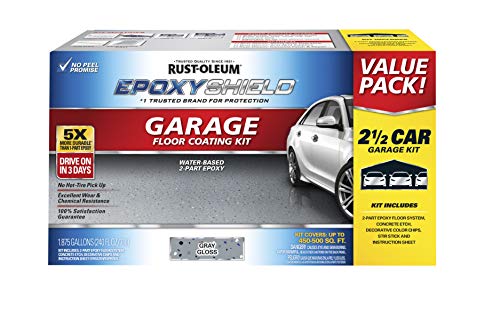
If your plan is to coat the floor with epoxy, cracks and divots must be filled first — epoxy will not bridge gaps and will highlight every imperfection. Rust-Oleum’s EpoxyShield Patch is specifically formulated to be compatible with epoxy floor coatings and fills cracks flush without telegraphing through the finish coat. It is a targeted product for a specific workflow and delivers consistent results when used as part of an epoxy coating system. The patch is designed to cure to a smooth, non-porous surface that accepts epoxy adhesion without sanding or priming.
The key advantage of this product is its compatibility. Many standard concrete patchers contain additives or have a texture that causes epoxy to bubble, fish-eye, or delaminate. EpoxyShield Patch is chemically formulated to bond with epoxy coatings, so you can apply it, let it cure, and then roll on your epoxy topcoat without worry. It also has a creamy consistency that allows you to fill narrow cracks and small holes with a putty knife, and it dries to a hard, white finish that does not show through the epoxy color.
One honest limitation is that this product is only useful if you are applying an epoxy coating. If you are not planning to coat the floor, the EpoxyShield Patch is an unnecessary expense; a standard vinyl patcher or mortar mix would work just as well for filling cracks. Additionally, the patch is not designed for large-area repairs or structural fills. It is strictly a cosmetic and preparatory product for small defects. The tube or container size is relatively small, so for a floor with extensive cracking, you may need multiple units, which can add up in cost. Finally, the patch requires the epoxy to be applied within a specific window after curing; if you wait too long, the patch may need to be scuffed or cleaned again to ensure adhesion.
What to look for
- Compressive strength rating: For garage floors that support vehicles, look for a mix rated at least 4,000 PSI. Higher strength (like 5,000 PSI) provides better resistance to cracking and point loads from jack stands or car tires.
- Application thickness range: Different products are designed for different depths. Resurfacers work best at 1/8 to 1/2 inch, while patchers can go thinner. Using a product outside its intended thickness range risks bond failure or cracking.
- Bonding mechanism: Some products require a separate bonding agent, while others (like Quikrete Concrete Resurfacer) bond directly. Check the manufacturer’s instructions to avoid delamination.
- Curing time: Fast-setting products (20 to 40 minutes) are ideal for spot repairs and anchors. Standard mixes require 24 to 48 hours before bearing weight. Plan your project timeline accordingly.
- Freeze-thaw resistance: If your garage is unheated and exposed to freezing temperatures, choose a mix labeled as freeze-thaw resistant to prevent scaling and spalling over winter months.
- Compatibility with coatings: If you plan to apply epoxy, paint, or sealer, select a patcher or resurfacer that is explicitly compatible with those coatings. Incompatible materials can cause adhesion failure or cosmetic defects.
- Coverage and bag size: Calculate the square footage of your floor or repair area and compare it to the coverage stated on the bag. For large slabs, ready-mix delivery may be more practical than bagged concrete.
- Surface preparation requirements: All concrete products require a clean, sound substrate. Some need mechanical abrasion (grinding or acid etching), while others can bond to lightly damp concrete. Factor in the prep work before purchasing.
The verdict
Choosing the right concrete product for your garage floor depends entirely on the condition of your existing slab and your project goals. For a floor that is structurally sound but looks tired and worn, the Quikrete Concrete Resurfacer offers the best balance of cost, ease of application, and final appearance, making it the top recommendation for most homeowners. If you are pouring a new slab or replacing a damaged section, the Quikrete 5000 High Strength Mix provides the necessary strength and durability for vehicle loads. For quick spot repairs and setting anchor bolts, the Sakrete Fast-Setting Concrete Mix gets the job done in under an hour. When you need to fix cracks and chips before applying a coating, the Quikrete Vinyl Concrete Patcher delivers reliable adhesion and impact resistance. And if your final plan is an epoxy floor, the Rust-Oleum EpoxyShield Garage Patch is the smart preparatory tool that ensures your coating bonds flawlessly. Match the product to the problem, and your garage floor will perform for years.
Our methodology
We compare every pick against the field on real specifications, certifications, and aggregated owner reviews. We do not take payment for placement, and we flag when a product is older or sold mainly through renewed listings.
Side by side
The full reviews
Quikrete Concrete Resurfacer -- Best for Full Floor Resurfacing
When a garage floor is uniformly worn, pitted, or stained but structurally sound, resurfacing is far more efficient than replacing the slab. Quikrete Concrete Resurfacer bonds to existing concrete without a bonding agent and is applied at 1/8 to 1/2 inch. It produces a smooth, uniform surface ready for paint, epoxy, or sealer. One 40-pound bag covers roughly 35 square feet at 1/8-inch. The floor must be clean, free of oil, and slightly damp for best adhesion.
Quikrete 5000 High Strength Mix -- Best for New Slab Pours
Pouring a new garage slab, adding a section, or replacing a section requires high-strength concrete rated for vehicle loads. Quikrete 5000 reaches 5,000 PSI compressive strength at 28 days, with measurable strength gain much earlier. It is resistant to freeze-thaw scaling and available in standard 80-pound bags. For a single-car garage, plan on approximately 45 bags for a 4-inch slab, or rent a mixer and order ready-mix for larger pours.

Sakrete Fast-Setting Concrete Mix -- Best for Spot Repairs and Anchors
Lifting hardware, anchor bolts, and spot repairs around garage floor edges all benefit from a fast-setting mix that reaches working strength quickly. Sakrete's fast-setting formula gets strong in 20 to 40 minutes so you can resume normal use the same day. It is also useful for setting anchor bolts for shelving systems and other garage storage hardware.

Quikrete Vinyl Concrete Patcher -- Best for Crack and Chip Repair
Spalled edges, chip-outs, and wider cracks in a garage floor need a repair material that bonds without delaminating under vehicle loads. Quikrete's vinyl patcher bonds to existing concrete and can be applied in thin sections down to 3/8 inch. It resists the impact and compressive loads of vehicle traffic better than unmodified mortars, making it the right choice for surface defect repairs before or without full resurfacing.
Rust-Oleum EpoxyShield Garage Patch -- Best Pre-Coating Crack Prep
If your plan is to coat the floor with epoxy, cracks and divots must be filled first -- epoxy will not bridge gaps and will highlight every imperfection. Rust-Oleum's EpoxyShield Patch is specifically formulated to be compatible with epoxy floor coatings and fills cracks flush without telegraphing through the finish coat. It is a targeted product for a specific workflow and delivers consistent results in that application.
What matters most
What to consider
Assess the condition of your existing floor first. Uniform surface wear calls for resurfacing. Isolated cracks and chips call for patching. New construction or section replacement calls for a high-strength slab mix. If you plan to apply an epoxy coating afterward, use products compatible with epoxy and allow the concrete repair to cure fully before coating. Always degrease and clean the surface before any repair or resurfacing work.
What to consider
For related repair guides, see [/articles/best-concrete-for-driveway-repair](/articles/best-concrete-for-driveway-repair) and [/articles/best-concrete-for-foundation-repair](/articles/best-concrete-for-foundation-repair). Our evaluation process is explained on the [/methodology](/methodology) page.
Frequently asked
A residential garage floor slab should be a minimum of 4 inches thick, with 6 inches recommended for heavier vehicles or areas where cars will be lifted with a floor jack. The concrete should be reinforced with wire mesh or rebar and poured on a well-compacted, properly graded base with a vapor barrier underneath.
Oil must be removed before applying any patching compound or resurfacer, or the new material will not bond. Use a concrete degreaser and scrub thoroughly, rinse well, and allow to dry completely. For heavily saturated areas, repeat the degreasing process twice. Some very old or deep oil stains may require a chemical etch as well.
How we made this guide
We compare every pick on the factors that matter, cross-checking manufacturer specifications against aggregated verified owner reviews. We rank independently and never take payment for placement. We have not personally tested every product; where we have not, the ranking reflects verified specs and owner feedback rather than a hands-on review.
How it was written: this guide was researched and reviewed by the TheTestedHub editorial team for accuracy.
Affiliate disclosure: TheTestedHub is reader-supported. When you buy through links on our site, we may earn a commission at no extra cost to you.
You might also like
Fix Your Driveway Cracks with the Best Concrete Fillers

Which Drill Accessories Are Best in 2026?

Cordless Drill Systems Built for Real Jobsite Demands

What Makes Concrete Tools Worth Your Money in 2026?

Ghostshield 8505 Review: A Smarter Way to Protect Concrete

Quikrete 5000 and Sakrete: 2026’s Best Concrete Picks
Concrete Coatings for Every Budget: Which One Wins?
