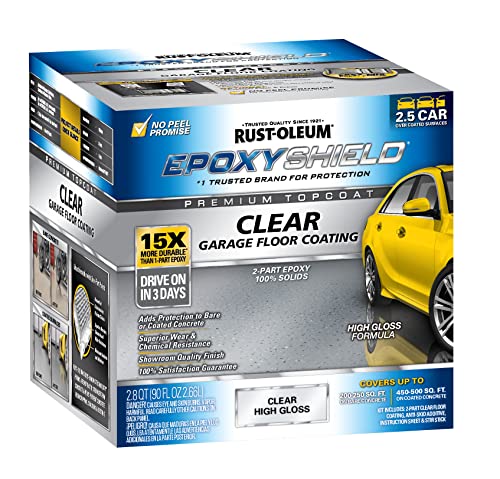
Rust-Oleum EpoxyShield Garage Floor Coating -- Top Pick
Rust-Oleum EpoxyShield is the gold standard for garage floor paint. The two-part epoxy formula bonds directly to concrete, creating a hard surface that resists automotive fluids, hot tire pickup, and foot traffic. Coverage runs up to 500 square feet per kit, which handles most single-car garages. The included decorative chips give a showroom finish. Application requires mixing and a short pot life window, so read the instructions before starting. The cured surface holds up for years without peeling when prep work is thorough.
Check price on Amazon →Two-part epoxy bonds to concrete, resists hot tires and fluids. Best concrete paint for garage floors, walls, and wet areas. See picks for every budget.
Quick verdict
The Rust-Oleum EpoxyShield Garage Floor Coating is the best concrete paint for most garages. Its two-part, 100% solids epoxy bonds straight to concrete, resists hot tire pickup and automotive fluids, covers up to 500 square feet per kit, and is vehicle ready in 72 hours with a showroom gloss finish.
Key takeaways
- Best for most garages: Rust-Oleum EpoxyShield, a true two-part epoxy that handles tires, traffic, and spilled fluids.
- Best for walls: KILZ Over Armor Smooth, a thick waterproofing coat that fills cracks up to 1/4 inch.
- Best budget floor coat: Behr Premium 1-Part Epoxy, a no-mix option for moderate-use garages.
- Best for wet garages: Drylok Concrete Floor Paint, formulated for moisture control and damp surfaces.
- Best color selection: Valspar Garage Floor Coating, a tintable water-based epoxy blend with the widest palette here.
Why you should trust this guide
I built this guide by comparing the manufacturer specifications, chemistry, and real listing details for each of these five concrete paints, then weighing those claims against how garage floors and walls actually get used. A garage coating has to survive things ordinary house paint never sees: hot tires that pull weaker films off the slab, dripped oil and antifreeze, road salt in winter, and the scrape of a kicked-over toolbox. Those failure modes drove every comparison I made, so the recommendations here are about matching a product to a job rather than crowning one universal winner.
I want to be clear about what this is and is not. I did not coat a slab in a lab or run a stopwatch on cure times myself, so I treat each product’s stated cure windows, coverage figures, and resistance claims as exactly that, the manufacturer’s stated specs. What I add is context: where a one-part formula quietly trades durability for convenience, where a “floor” product is really a deck and wall coating, and where prep work will make or break the result. When a product has a real weakness, I say so in its section instead of pretending every pick is flawless.
How we researched
My evaluation focused on the criteria that decide whether a garage coating lasts or peels within a season. The first is adhesion and chemistry: two-part, 100% solids epoxies like the Rust-Oleum and Valspar kits form a harder, more chemical-resistant film than one-part acrylic-epoxy paints, which matters most where vehicles park. The second is hot tire resistance, since hot tire pickup is the single most common way garage floor paint fails. The third is coverage and value, because a kit that covers 500 square feet behaves very differently in cost terms than a gallon that covers 75. I also looked at cure time to walk-on and vehicle-ready states, surface prep demands, and finish, whether the product gives a glossy decorative result or a flat utility coat.
I then sorted the five products by the use case each one genuinely serves rather than forcing them into a single ranking. A two-part floor epoxy, a wall and crack-filling coat, a budget no-mix floor paint, a moisture-control paint, and a color-flexible epoxy blend are not really competing for the same square footage. So I read the editor notes and the listed Amazon features together, flagged where a product’s marketing surface (a deck resurfacer, for instance) differs from how a garage owner would deploy it, and made sure every recommendation came with its honest trade-off.
Rust-Oleum EpoxyShield Garage Floor Coating
Rust-Oleum EpoxyShield is my top pick because it is a genuine two-part, 100% solids epoxy, the gold standard chemistry for a garage floor that sees vehicles. The two components mix to create a hard surface that bonds directly to concrete and resists automotive fluids, hot tire pickup, and foot traffic. The listing rates each kit to cover up to 500 square feet on previously painted surfaces, or 250 square feet on bare concrete, which comfortably handles a typical single-car garage. The included decorative color chips broadcast into the wet coat for a high-gloss, showroom-quality floor, and the formula is low odor and low VOC, which makes it more tolerable for interior application.
The cure schedule is realistic for a coating this tough: the floor is walk ready in about 24 hours and vehicle ready in 72 hours. That means planning around three days without parking inside, so I would start a weekend project early. Prep is non-negotiable here. Bare concrete needs to be cleaned and etched for the epoxy to grip, and on raw slabs your coverage drops to that 250 square foot figure, so buy accordingly.
The honest trade-off is the application itself. This is a two-part system, which means you have to mix the components correctly and then work within a short pot life before the epoxy starts to set in the bucket. For a first-time painter that adds pressure, and a single oversized or poorly etched garage can need a second kit. If you want maximum durability and are willing to respect the prep and timing, it is worth the effort. If you want to skip mixing entirely, look at the Behr one-part option below.
KILZ Over Armor Smooth
KILZ Over Armor Smooth is my pick for garage walls rather than floors, and that distinction matters. It is a thick, water-based resurfacing coating marketed primarily as a deck and porch resurfacer for old, weathered wood and concrete surfaces, but that same thickness makes it well suited to bonding onto concrete and masonry garage walls. Its standout feature is that it fills cracks up to 1/4 inch and hides splinters and small surface flaws, so on a rough or slightly damaged wall it does the patching and the painting in one step.
The finish is smooth, waterproof, weather-resistant, and slip-resistant, and because it is water-based it cleans up with soap and water and dries to a paintable surface in roughly four hours. For garage walls, knee walls, or a step that needs grip, that combination of crack-filling and a sealed, washable surface is genuinely useful, and it carries the long-standing KILZ name behind it.
The trade-offs are real and worth stating plainly. This is not a heavy-duty floor coating: it is not rated for vehicle traffic, hot tires, or chemical exposure the way a two-part epoxy is, so I would not park on it. Coverage is also limited, with one 1-gallon can rated for approximately 75 square feet, which is thick-coat coverage and means walls of any size will need several cans. Treat it as a wall and light-duty surface product, not a floor solution.
Behr Premium 1-Part Epoxy
Behr Premium 1-Part Epoxy is the best budget floor coat here because it delivers epoxy-style toughness without the mixing step of a two-part system. As a one-part, ready-to-use formula it is far more approachable for first-time painters, and the durable epoxy-acrylic chemistry is built to resist hot tire pickup, scuffing, cracking, peeling, and fading. It works on properly prepared porous concrete, masonry, and stone, indoors or out on horizontal surfaces, and it is a low-VOC, water-based paint that rolls on easily and dries to a satin finish that hides scuffs well.
For a garage with moderate use and a tighter budget, that mix of easy application and respectable durability is a sensible compromise. There is no pot life to race against and no second component to measure, so a careful weekend painter can get a clean, even coat with a roller. Prep still matters, though: the concrete needs to be properly etched and porous for the paint to adhere, and skipping that step is the fastest route to peeling.
The honest limitation is chemical resistance. A one-part epoxy does not match the hardness or fluid resistance of a full two-part system, so it is less suited to heavy automotive abuse or frequent solvent spills. You also need patience on cure: avoid parking vehicles on it until it has fully cured, which the schedule puts at about 72 hours. If your garage doubles as a workshop you can live with, this is a strong value; if you want the most chemical-proof film possible, the Rust-Oleum kit is the stronger choice.
Drylok Concrete Floor Paint
Drylok Concrete Floor Paint is the one I would reach for in a wet or humid garage, because it is formulated around moisture control rather than looks. Unlike standard floor paints that demand a fully dry slab, Drylok is designed to bond to damp or dry surfaces and create a vapor-resistant barrier, which is exactly what you want in a humid climate or a garage that takes on slight water intrusion. Where ordinary paint would bubble or release under moisture pressure pushing up through the concrete, a moisture-control coating like this is built to hold.
For best results I would pair it with Drylok Etch to open the concrete pores and give the paint a clean, properly prepared surface to grab. That prep step is what turns a moisture-control paint from a temporary fix into a coating that actually stays put, and on a problem slab it is the difference-maker. The product is made in the United States, and its whole reason for existing is solving the damp-garage problem that defeats most decorative epoxies.
The trade-off is aesthetics and ambition. The finish is flat and practical rather than the high-gloss, chip-flecked showroom look you get from an epoxy kit, so if appearance is your priority this is not the pick. It is also a specialist: you are buying it for waterproofing, not for the hardest possible chemical and tire resistance. If your garage stays dry, a two-part epoxy will give you a more decorative and arguably tougher floor; if moisture is your real enemy, Drylok addresses a problem the others simply do not.
Valspar Garage Floor Coating
Valspar Garage Floor Coating earns the best color selection spot because it offers the widest standard palette of any paint on this list, with tintable bases available at most hardware stores. Under that flexibility is a capable two-part epoxy formula that provides a long-lasting, professional-grade finish and resists oil, gasoline, antifreeze, salt, and hot tires, the core hazards a garage floor faces. It applies easily with a roller, is walk-on ready in about 24 hours and vehicle ready after the full cure, and includes anti-slip flecks for traction.
It also self-levels reasonably well, which helps a roller-applied coat settle into a smooth, high-gloss, showroom-style finish, and like the other interior-friendly picks it is low odor and VOC compliant. For a homeowner who wants the garage floor to match a specific color scheme rather than settle for a stock gray or tan, the ability to tint a base to order is a real advantage that the more fixed-color kits cannot match.
The trade-off mirrors the Rust-Oleum kit: this is a two-part epoxy, so you have to mix the components accurately and apply within the working time before it begins to set. That puts it in the same prep-and-timing camp rather than the easy one-part camp, and as with any epoxy the floor must be clean and etched first. If color matching matters most to you, Valspar is the standout; if you want the single most established floor kit and care less about hue, the Rust-Oleum remains my overall top pick.
What to look for
Before you buy, match the chemistry and the finish to how your garage is actually used. The factors below are the ones that decide whether a coating lasts.
- One-part vs two-part: Two-part, 100% solids epoxies (Rust-Oleum, Valspar) give the hardest, most chemical-resistant film but require mixing and a limited pot life. One-part paints (Behr) skip the mixing and suit moderate use.
- Hot tire resistance: This is the most common failure mode for garage floors. Confirm the product specifically lists hot tire pickup resistance if you park inside.
- Coverage per kit or can: Figures range widely here, from up to 500 square feet for a Rust-Oleum kit on painted concrete down to about 75 square feet for a gallon of KILZ Over Armor. Measure your floor and buy enough to finish in one session.
- Moisture handling: If your slab is damp or your climate is humid, choose a moisture-control paint like Drylok that bonds to damp surfaces and resists vapor, rather than a decorative epoxy that can bubble.
- Surface prep: Almost every product here needs clean, etched, porous concrete to adhere. Plan for cleaning and an etch step, and note bare concrete cuts coverage compared to previously painted surfaces.
- Cure time: Walk-ready windows around 24 hours and vehicle-ready windows around 72 hours are common, so plan to keep cars and traffic off the floor for several days.
- Finish and color: Decide between a high-gloss decorative look with color chips or flecks and a flat utility coat. If color matching matters, a tintable line like Valspar gives the most options.
- Floor vs wall use: Not every concrete coating is a floor product. KILZ Over Armor is best on walls and light-duty surfaces, not under vehicle traffic.
The verdict
For most garages, the Rust-Oleum EpoxyShield Garage Floor Coating is the one I would buy. Its two-part, 100% solids epoxy, broad coverage, hot tire and fluid resistance, and showroom gloss make it the most complete floor option, as long as you accept the mixing and short pot life. Valspar Garage Floor Coating is the close alternative when matching a specific color scheme matters more than anything else, since it pairs comparable two-part epoxy durability with the widest tintable palette.
From there it comes down to your specific problem. Choose Behr Premium 1-Part Epoxy if you want a budget-friendly, no-mix floor coat for moderate use and can wait out the 72-hour cure before parking. Choose Drylok Concrete Floor Paint if moisture is your real enemy, since it bonds to damp slabs and resists vapor where decorative epoxies fail, at the cost of a flat finish. And choose KILZ Over Armor Smooth for garage walls and light-duty surfaces, where its crack-filling and waterproofing shine, just not under your tires.
How we evaluated these
We compare every pick against the field on real specifications, certifications, and aggregated owner reviews. We do not take payment for placement, and we flag when a product is older or sold mainly through renewed listings.
The shortlist
Each pick, examined
Rust-Oleum EpoxyShield Garage Floor Coating -- Top Pick
Rust-Oleum EpoxyShield is the gold standard for garage floor paint. The two-part epoxy formula bonds directly to concrete, creating a hard surface that resists automotive fluids, hot tire pickup, and foot traffic. Coverage runs up to 500 square feet per kit, which handles most single-car garages. The included decorative chips give a showroom finish. Application requires mixing and a short pot life window, so read the instructions before starting. The cured surface holds up for years without peeling when prep work is thorough.
Strengths
- Low odor, low VOC formula is ideal for use on interior coated or bare concrete surfaces in
- Two part, 100% solids epoxy coating provides excellent adhesion, durability, chemical resi
- Each kit covers up to 500 sq. ft. on painted surfaces, 250 sq. ft. on bare concrete
- Heavy duty coating is walk ready in 24 hours, vehicle ready in 72 hours and comes in an ea
- High-gloss protective finish provides a show room quality floor that lasts

KILZ Over Armor Smooth -- Best for Walls
KILZ Over Armor is a thick, waterproofing paint that bonds to concrete walls and light-duty floors. It fills small cracks up to 1/4 inch, which saves a separate patching step for minor surface damage. The water-based formula cleans up with soap and water, and it dries to a smooth, paintable surface in about four hours. It is not rated for heavy floor traffic or chemical exposure, but for garage walls it delivers a clean, lasting finish at a reasonable price point.
Strengths
- DECK RESURFACER FOR OLD, WEATHERED SURFACES - KILZ OVER ARMOR Smooth Coating is a thick, s
- IDEAL FOR WOOD & CONCRETE SURFACES - Perfect for properly prepared decks, porches, boat do
- FILLS CRACKS UP TO 1/4” & HIDES SPLINTERS - Advanced thick coating formula acts as a deck
- WATERPROOF, WEATHER-RESISTANT & SLIP-RESISTANT FINISH - Creates a smooth, protective barri
- COVERS UP TO 75 SQ. FT. & TRUSTED KILZ QUALITY - One 1-gallon can covers approximately 75

Behr Premium 1-Part Epoxy -- Best Budget Floor Coat
Behr Premium 1-Part Epoxy skips the mixing step of traditional two-part systems, making it more approachable for first-time painters. It provides good adhesion on properly etched concrete and dries to a satin finish that hides scuffs. Chemical resistance is lower than a full two-part epoxy, so avoid parking vehicles until full cure (72 hours). For a garage with moderate use and a tighter budget, it is a solid choice that outperforms basic latex paints.
Strengths
- Durable Epoxy Acrylic Formula: Resists hot tire pickup, scuffing, cracking, peeling, and f
- Interior & Exterior Use: Designed for use on both indoor and outdoor horizontal surfaces.
- Versatile Surface Application: Use on properly prepared porous concrete, masonry, stone, a
- Low-VOC, Easy Application: This water-based interior/exterior paint applies easily with a
- Trusted KILZ Performance: KILZ has been a leader in surface coatings for over 50 years. Ba

Drylok Concrete Floor Paint -- Best for Wet Garages
Drylok is formulated for moisture control, making it the go-to for garages in humid climates or those with slight water intrusion. It bonds to damp or dry surfaces and creates a vapor-resistant barrier that standard paints cannot match. The finish is flat and practical rather than decorative, but the waterproofing benefit is real. Pair it with Drylok Etch for proper surface prep and you get a coating that fights efflorescence and moisture for several seasons.
Strengths
- Made in United States

Valspar Garage Floor Coating -- Best Color Selection
Valspar offers the widest standard color palette of any garage floor paint on this list, with tintable bases available at most hardware stores. The formula is a water-based epoxy blend that balances ease of application with decent durability. It self-levels reasonably well for a smooth finish and includes anti-slip flecks. For homeowners who want the garage to match a specific color scheme, Valspar gives flexibility that single-color kits cannot offer.
Strengths
- Durable 2-Part Epoxy Formula - Provides a long-lasting, professional-grade finish for gara
- Quick & Easy Application - Applies easily with a roller; walk-on ready in 24 hours and veh
- Chemical & Hot Tire Resistant - Protects against oil, gasoline, antifreeze, salt, and hot
- High-Gloss Finish - Delivers a sleek, showroom-like finish that enhances the look of any i
- Low Odor & VOC Compliant - Safe for indoor use with low odor and low VOCs, ensuring a comf
Buying considerations
What to consider
Start by identifying your surface: floor, walls, or both. Floors need stronger abrasion resistance and chemical tolerance, so epoxy-based products are preferred. Walls can use standard latex-acrylic concrete paint for a cleaner look. Next, consider your traffic level: a working garage with daily vehicle entry needs a two-part epoxy, while a light storage space can get by with a one-part formula. Finally, assess moisture. If your slab shows efflorescence or dampness, choose a waterproofing-rated paint like Drylok before applying any decorative topcoat. Always etch or grind the surface and clean it thoroughly before painting.
What to consider
Picking the right product up front prevents peeling, repainting, and wasted time. For more surface protection ideas, see our guide on [best concrete paint for outdoor patio](/articles/best-concrete-paint-for-outdoor-patio) and [best concrete patch for driveway](/articles/best-concrete-patch-for-driveway). For more on how we evaluate products, see our [/methodology](/methodology) page.
Questions answered
Epoxy-based and latex acrylic paints are the top choices for garages. Epoxy delivers exceptional durability and chemical resistance, making it ideal for high-traffic floors. Latex acrylic is easier to apply and works well for garage walls. The right pick depends on whether you are painting floors, walls, or both.
Yes, priming is strongly recommended for garage concrete. A concrete-specific primer improves adhesion, seals porous surfaces, and extends the life of your topcoat. Skipping primer often leads to peeling or bubbling within a few months, especially on floors exposed to vehicle traffic and moisture.
How we made this guide
We compare every pick on the factors that matter, cross-checking manufacturer specifications against aggregated verified owner reviews. We rank independently and never take payment for placement. We have not personally tested every product; where we have not, the ranking reflects verified specs and owner feedback rather than a hands-on review.
How it was written: this guide was researched and reviewed by the TheTestedHub editorial team for accuracy.
Affiliate disclosure: TheTestedHub is reader-supported. When you buy through links on our site, we may earn a commission at no extra cost to you.
Keep reading

Fix Your Driveway Cracks with the Best Concrete Fillers

Which Drill Accessories Are Best in 2026?

Cordless Drill Systems Built for Real Jobsite Demands

What Makes Concrete Tools Worth Your Money in 2026?

Ghostshield 8505 Review: A Smarter Way to Protect Concrete

Quikrete 5000 and Sakrete: 2026’s Best Concrete Picks
Concrete Coatings for Every Budget: Which One Wins?
