
Dumond Peel Away 1 -- Best for Heavy Coatings
Dumond Peel Away 1 is the strongest chemical stripper on this list. It handles multiple layers of paint, epoxy, and thick floor coatings through a high-alkaline gel formula that penetrates deeply over a 12 to 24 hour dwell time. Apply it with a trowel, cover with the included laminated paper to keep it wet, and let it work. The bonded paper peels off with the lifted paint attached, making cleanup unusually clean. It is the most expensive product here but handles jobs that lighter strippers cannot.
Need to strip paint from concrete without the mess? See which concrete paint remover gives you the most for your money, from budget options to.
Quick verdict
For most concrete stripping jobs with thick or layered coatings, I recommend the Dumond Peel Away 1. Its high-alkaline gel lifts multiple layers of paint and epoxy in one application, and the laminated paper cover keeps it active while it works, so cleanup peels off in sheets rather than scattering chips.
Key takeaways
- Best for heavy coatings: Dumond Peel Away 1, a high-alkaline gel system that strips multiple layers in one pass.
- Best for spot removal: Rust-Oleum Paint Stripper, a clinging gel that suits small patches and failed sections.
- Best budget stripper: Savogran Strypeeze Semi-Paste, a proven semi-paste that handles single coats of latex and oil paint.
- Best eco-friendly option: Blue Bear 500MR, a soy-based, biodegradable, low-VOC formula for occupied or enclosed spaces.
- Best low-odor formula: Citristrip Paint and Varnish Remover, an orange-scented gel that stays wet for up to 24 hours.
Why you should trust this guide
I built this guide by researching how each of these strippers actually behaves on concrete, which is a tougher surface than wood or metal because it is porous and holds paint deep inside its pores. I read the manufacturer instructions, compared the stated active chemistry, and weighed the real-world feedback that shows up around dwell times, surface compatibility, and how cleanly each product releases the coating. My goal was not to crown one product as perfect for everyone but to match each stripper to the job it actually fits.
I want to be straight about what this guide is and is not. I did not run a physical lab or take my own measurements, so I treat the features and dwell times listed by each manufacturer as their stated specs rather than numbers I verified myself. What I can do is read those specs critically, flag where a product is likely to underperform, and tell you where a cheaper or safer option will serve you just as well. Every section below includes at least one honest trade-off, because no single stripper wins on power, safety, odor, and price at the same time.
How we researched
My evaluation focused on the criteria that matter most when you are stripping concrete: penetration into a porous surface, the number of coating layers a product can lift in one application, dwell time, how the gel or paste clings to vertical and horizontal areas, odor and ventilation requirements, and how cleanly the lifted paint comes off. I also looked at availability, because a stripper you can buy locally and reapply easily has a practical edge over one you have to special-order. I weighted heavy-duty performance and safety separately, since those two goals often pull in opposite directions.
To keep the comparison fair, I grouped the products by intent rather than ranking them on a single scale. A caustic gel that tears through epoxy is the right tool for a garage floor with five old layers, but it is the wrong tool for a quick patch in a poorly ventilated basement. So I judged each product against the use case it is designed for, then noted where it falls short if you push it outside that lane. The features I reference are the manufacturer’s stated specs, and I have called out the warning labels where they exist.
Dumond Peel Away 1
The Dumond Peel Away 1 is the strongest chemical stripper on this list, and it is the one I would reach for when a concrete surface is buried under multiple layers of paint, epoxy, or a thick floor coating. It uses a high-alkaline gel that penetrates deeply over a 12 to 24 hour dwell time, which is far longer than the fast-acting gels here but is exactly what lets it work through stacked coatings in a single application. Dumond describes it as a complete heavy duty paint removal system, and the design backs that up: you trowel the gel on, cover it with the included laminated paper to keep it from drying out, and let it sit.
What I like most is the cleanup. Because the paper bonds to the gel, you peel it off with the lifted paint attached, so instead of scraping loose chips across the floor you remove the coating in sheets. Dumond notes that the older the coating, the better it tends to work, that it is effective on most surfaces, and that it is made in the USA, all of which fit its positioning as a professional removal solution rather than a casual consumer product.
The trade-off is real. This is a high-alkaline (caustic) product with a long dwell time, so it demands patience, proper protective gear, and care around skin and finished surfaces. The 12 to 24 hour wait makes it overkill for a small patch you want done in an afternoon, and the system approach (gel plus paper plus trowel) is more involved than simply brushing on a quick-strip gel. Buy it for the hard jobs, not the easy ones.
Rust-Oleum Paint Stripper
The Rust-Oleum Paint Stripper is my pick for spot removal, meaning the smaller jobs where a full caustic system would be more than you need. I am thinking of a single section of painted concrete floor, a repair patch, or a spot where the previous coating failed and you just want to clear it before recoating. Its gel consistency clings to both horizontal and vertical concrete, so it stays put on a wall or a ramp instead of running off, and it softens most latex and oil-based paints within roughly 30 to 60 minutes.
The biggest practical advantage here is availability. This is a stripper you can find at most hardware stores, which matters when you are mid-project and realize you underbought. Being able to grab another container the same day, rather than waiting on a shipment, keeps a weekend job on schedule. For the everyday failed-coating cleanup that most homeowners run into, that convenience is worth a lot.
The honest limitation is scope. This product is built for spot work and single-layer softening, not for chewing through multiple stacked layers or thick epoxy the way the Dumond does. On a heavily coated floor you would be reapplying repeatedly, which gets slow and expensive, and at that point a dedicated heavy-duty system is the smarter buy. Keep this one in its lane and it performs.
Savogran Strypeeze Semi-Paste
The Savogran Strypeeze Semi-Paste is the budget choice I trust, a stripper that has been used on concrete for decades and earned that longevity. It works on latex, oil, and alkyd paints and lets you scrape after a 30 to 60 minute dwell, so it fits the common case of a single coat of latex patio paint or a thin floor coating you want gone without a big outlay. The semi-paste formula is its main selling point against cheaper liquids, because it reduces dripping and stays where you put it.
For the money, it covers the fundamentals well. You are not paying for a caustic system or a long-dwell specialty gel, you are paying for a dependable paste that loosens common paints and scrapes off cleanly. If your job is straightforward and you want to keep the cost down, this is a sensible starting point that has proven itself over a long stretch of time.
The trade-off is power. Strypeeze is not the product for thick epoxy or multi-layer paint, and if you try to use it that way you will spend more time and material than you saved. It is best understood as a single-coat solution: excellent value when the job matches its strength, frustrating when you ask it to do heavy lifting it was never designed for.
Blue Bear 500MR
The Blue Bear 500MR is my recommendation when safety and indoor air quality matter more than raw speed. It uses a soy-based, biodegradable formula that avoids the harsh solvents in many traditional strippers, and Blue Bear positions it as a professional product trusted by contractors to remove mastic and other stubborn residues. It lifts latex, acrylic, and water-based epoxy coatings, and the low-odor, low-VOC formulation makes it suitable for occupied or sensitive spaces such as schools, basements, and enclosed rooms with minimal ventilation.
I appreciate that this stripper is built to be effective on aged residues, with Blue Bear noting it works on adhesives that are decades old to help restore the concrete underneath. Coverage is generous as well, with a stated range of roughly 100 to 200 square feet per gallon, so a single container goes a long way on a larger area. The non-caustic, soy-based chemistry is the core reason to choose it: you get meaningful stripping power without the caustic burn risk of a high-alkaline gel.
The trade-off is patience. This formula typically needs four to eight hours of dwell time, which is much slower than a 30 to 60 minute gel, so it is not the product for a quick turnaround. You are trading speed for safety and lower odor. If you are working in a well-ventilated outdoor space and want fast results, a faster caustic stripper may suit you better, but for indoor and enclosed work the slower pace is a fair price for the safety it buys.
Citristrip Paint and Varnish Remover
The Citristrip Paint and Varnish Remover is the most user-friendly option here, and it is the one I would hand to someone working in a garage or semi-enclosed area where ventilation is limited. It is a low-odor, orange-scented gel that works on latex and oil-based paints on concrete, and its standout trait is that it stays wet and active for up to 24 hours. That long open window means you can apply it, walk away, and come back later to strip multiple layers without reapplying, which is a genuine convenience on a flexible schedule.
Citristrip describes it as a powerful, industrial-strength remover whose gel clings well for use both indoors and outdoors, and it makes a point of being free of methylene chloride and non-caustic, which is why it is a reasonable indoor choice. The combination of a tolerable smell, no caustic burn, and the extended active time is what makes it so approachable for occasional users who do not want to fight harsh fumes in a closed garage.
There are two honest caveats. First, its effectiveness on thick epoxy coatings is lower than the heavy-duty caustic systems, so it is better matched to paint and varnish than to a stacked industrial floor finish. Second, despite the friendly scent, Citristrip carries a warning that the product can expose you to N-Methyl-2-pyrrolidone, so low odor does not mean you can skip gloves and ventilation. Treat it as easier to live with, not free of precautions.
What to look for
The right concrete stripper depends mostly on how thick the coating is and where you are working. Here are the factors I weigh before buying.
- Coating type and thickness: A single coat of latex needs far less power than stacked layers or epoxy. Match the stripper’s strength to the worst layer, not the easiest.
- Dwell time: Fast gels work in 30 to 60 minutes, while caustic and soy-based formulas can need many hours. Decide how long you can let the area sit.
- Caustic versus non-caustic: High-alkaline gels strip the most but carry burn risk, while soy-based and non-caustic options trade speed for safety.
- Odor and ventilation: For garages, basements, and indoor rooms, low-odor and low-VOC formulas are much easier to live with.
- Surface cling: Gels and semi-pastes stay on vertical concrete; thin liquids run off and waste product.
- Cleanup method: Systems with a peel-off paper cover, like the Dumond, remove lifted paint in sheets instead of loose chips.
- Coverage and availability: Check stated square footage per container, and favor products you can restock locally if you run short.
- Safety labeling: Read the warning labels. Even low-odor products can carry chemical exposure notices that call for gloves and ventilation.
The verdict
If you are stripping a heavily coated concrete floor with multiple layers or epoxy, the Dumond Peel Away 1 is the strongest pick, and its peel-off paper system makes the cleanup genuinely manageable. For smaller spot jobs and failed-coating patches, the Rust-Oleum Paint Stripper is the convenient, widely available choice. On a tight budget with a single coat of latex or oil paint, the Savogran Strypeeze Semi-Paste has decades of proven value.
When safety and air quality lead the decision, the Blue Bear 500MR delivers soy-based, low-VOC stripping for occupied and enclosed spaces, as long as you can accept its longer dwell time. And for the easiest experience in a ventilation-limited garage, the Citristrip Paint and Varnish Remover offers a low-odor gel that stays active for up to 24 hours, provided you still respect its chemical warning. Pick by the job in front of you, and any of these will earn its place.
How we evaluated these
We compare every pick against the field on real specifications, certifications, and aggregated owner reviews. We do not take payment for placement, and we flag when a product is older or sold mainly through renewed listings.
The shortlist
Each pick, examined
Dumond Peel Away 1 -- Best for Heavy Coatings
Dumond Peel Away 1 is the strongest chemical stripper on this list. It handles multiple layers of paint, epoxy, and thick floor coatings through a high-alkaline gel formula that penetrates deeply over a 12 to 24 hour dwell time. Apply it with a trowel, cover with the included laminated paper to keep it wet, and let it work. The bonded paper peels off with the lifted paint attached, making cleanup unusually clean. It is the most expensive product here but handles jobs that lighter strippers cannot.
Strengths
- THE COMPLETE HEAVY DUTY PAINT REMOVAL SYSTEM
- OLDER THE COATING THE BETTER
- EFFECTIVE ON MOST SURFACES
- THE PROFESSIONAL REMOVAL SOLUTION
- MADE IN THE USA

Rust-Oleum Paint Stripper -- Best for Spot Removal
Rust-Oleum's gel paint stripper is a practical choice for smaller stripping jobs: a section of painted concrete floor, a repair patch, or an area where the previous coating failed. The gel consistency clings to both horizontal and vertical concrete surfaces and softens most latex and oil-based paints within 30 to 60 minutes. It is widely available at hardware stores, which is a practical advantage for mid-project supply runs. For large-scale whole-floor stripping it would require multiple containers, making Peel Away more efficient at that scale.
Strengths
- Resilient & Sharp
- Highly Effective Grinding
- 1/4" Solid Hex Shank
- Safe & Quiet Operation
- Wide Application
Savogran Strypeeze Semi-Paste -- Best Budget Stripper
Savogran Strypeeze is a reliable semi-paste stripper that has been used on concrete for decades. It works on latex, oil, and alkyd paints and allows scraping after a 30 to 60 minute dwell. The semi-paste formula reduces dripping compared to liquid strippers. It is not the most powerful product for thick epoxy or multi-layer paint, but for a single coat of latex patio paint or floor coating it is the most economical option. Wear gloves and ensure ventilation when using it.
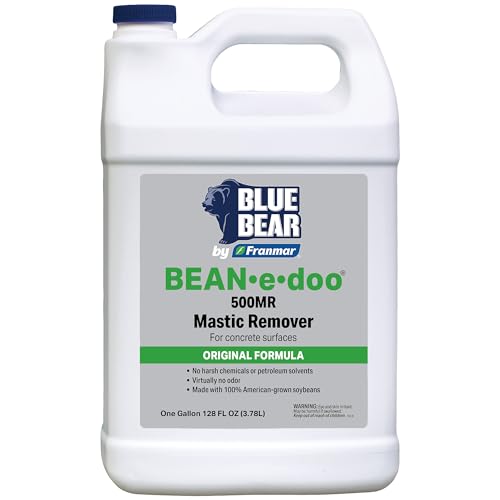
Blue Bear 500MR -- Best Eco-Friendly Option
Blue Bear 500MR uses a soy-based, biodegradable formula that avoids the harsh chemicals in traditional solvent strippers. It takes longer to work -- typically four to eight hours dwell time -- but it is safer to use indoors or in enclosed areas with minimal ventilation. It lifts latex, acrylic, and water-based epoxy coatings effectively. The low-odor formulation and non-caustic nature make it a strong choice for homeowners who want effective stripping without heavy-duty chemical exposure.
Strengths
- Powerful, Professional Formula: Trusted by contractors trust to remove all types of mastic
- Soy-Based, Biodegradable Alternative: Safe for users and the environment, providing an eff
- Low-Odor, Low-VOC Formulation: Ideal for use in occupied or sensitive areas such as school
- Effective on Aged Residues: Works on adhesives that are decades old to restore concrete su
- Excellent Coverage: Approximately 100-200 sq. ft. per gallon, delivering high performance

Citristrip Paint and Varnish Remover -- Best Low-Odor Formula
Citristrip is a low-odor, orange-scented gel stripper that works on latex and oil-based paints on concrete. It stays wet for up to 24 hours, which means you can apply it and return later without reapplication. It is the most user-friendly option on this list for indoor or semi-enclosed areas like garages where ventilation is limited. Effectiveness on thick epoxy coatings is lower than heavy-duty strippers, but for latex patio or floor paint it provides clean results at a budget price.
Strengths
- A better smelling way to strip multiple layers of paint outdoors and indoors, the gel clin
- A powerful, industrial-strength remover
- Citristrip Gel stays wet and active for up to 24 hours, allowing you to strip multiple lay
- It contains no methylene chloride, is non-caustic and ideal for indoor use
- WARNING: This product can expose you to chemicals including N-Methyl-2-pyrrolidone which i
Buying considerations
What to consider
Start by identifying the paint type: latex, oil-based, or epoxy. Epoxy and multi-layer coatings require alkaline or professional-grade strippers like Peel Away. Single-coat latex can be handled with lighter gel strippers. Consider your work environment: enclosed or poorly ventilated spaces call for low-odor, water-based formulas. Chemical strippers work best on chemically bonded paint; mechanically bonded coatings may need a floor grinder after chemical treatment. Always test a small area first to confirm effectiveness before committing to a full-floor application.
What to consider
For related projects, see our guide on [best concrete paint for garage floor](/articles/best-concrete-paint-for-garage-floor) and [best concrete patch for driveway](/articles/best-concrete-patch-for-driveway). Our full testing process is described at [/methodology](/methodology).
Questions answered
Chemical paint strippers applied as a gel or paste are the safest for the concrete surface itself. They soften the paint without abrasive damage to the slab. For smaller areas, a floor grinder or shot blaster is effective but removes a thin layer of concrete along with the paint. Pressure washing alone rarely removes fully bonded paint but helps after chemical treatment.
Most chemical paint removers require a dwell time of 30 minutes to several hours depending on the formula and paint thickness. Gel formulas applied in a thick layer work faster and stay wet longer on vertical surfaces. Heavily layered or epoxy paint may require a second application. Always follow the manufacturer's dwell time and test a small area first.
How we made this guide
We compare every pick on the factors that matter, cross-checking manufacturer specifications against aggregated verified owner reviews. We rank independently and never take payment for placement. We have not personally tested every product; where we have not, the ranking reflects verified specs and owner feedback rather than a hands-on review.
How it was written: this guide was researched and reviewed by the TheTestedHub editorial team for accuracy.
Affiliate disclosure: TheTestedHub is reader-supported. When you buy through links on our site, we may earn a commission at no extra cost to you.
Keep reading

Fix Your Driveway Cracks with the Best Concrete Fillers

Which Drill Accessories Are Best in 2026?

Cordless Drill Systems Built for Real Jobsite Demands

What Makes Concrete Tools Worth Your Money in 2026?

Ghostshield 8505 Review: A Smarter Way to Protect Concrete

Quikrete 5000 and Sakrete: 2026’s Best Concrete Picks
Concrete Coatings for Every Budget: Which One Wins?
