
Quikrete Vinyl Concrete Patcher -- Best Overall
Quikrete Vinyl Concrete Patcher is the most widely trusted product for driveway crack and hole repair. The vinyl polymer additive improves adhesion and flexibility over standard dry-mix concrete, helping the patch bond to existing concrete and resist cracking under vehicle loads. It is suitable for repairs from hairline cracks to holes up to two inches deep. Mix with water to a thick consistency, press firmly into the prepared crack, and trowel smooth. It achieves foot traffic strength in about two hours and vehicle traffic strength in 24 hours.
Check price on Amazon →Wondering which concrete patch actually holds up on a driveway? We evaluated the top options for cracks, potholes, and surface damage,plus honest.
Quick verdict
I recommend Quikrete Vinyl Concrete Patcher as the best overall driveway patch. Its vinyl polymer additive bonds tightly to existing concrete and flexes under vehicle loads, handling everything from hairline cracks to two-inch-deep holes. It is the most widely trusted, all-purpose choice for typical driveway repair work.
Key takeaways
- Best for most driveway repairs: Quikrete Vinyl Concrete Patcher, vinyl polymer bond that flexes under traffic.
- Best for surface deterioration: Sakrete Top ‘N Bond, thin resurfacing layer for spalling and scaling slabs.
- Best no-mix convenience: Red Devil Pre-Mixed Concrete Patch, ready-to-use tub for small cracks and chips.
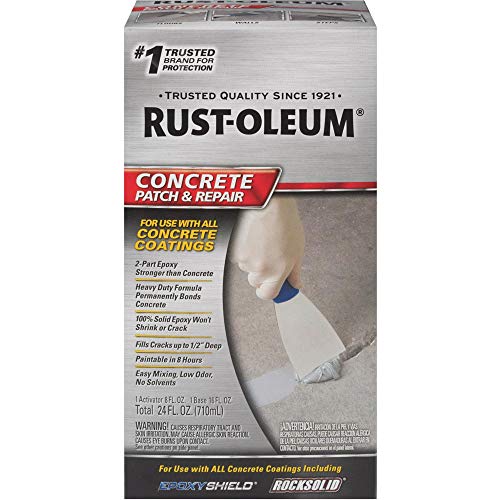
- Best strength: Rust-Oleum EpoxyShield Concrete Patch, two-part epoxy for deep potholes and impact damage.
- Best quick-cure: Quikrete FastSet Repair Mortar, non-shrink mortar that restores vehicle access fast.
Why you should trust this guide
I built this guide by reading the manufacturer specifications, the listed product features, and the way each product is positioned for driveway work. I did not run a private lab or pour test slabs in a garage. Instead, I focused on matching each product to the repair it is actually designed for, because the most common reason a concrete patch fails is that someone used a thin resurfacer for a deep pothole, or a soft pre-mixed filler where a structural mortar was needed. Picking the right category matters more than chasing the strongest possible number.
The five products here cover the full range of driveway problems I see people asking about: hairline cracks, holes up to two inches, widespread surface scaling, small edge chips, deep potholes, and repairs that need to carry a car within the hour. I have flagged the honest trade-off in every section, because none of these products is right for every job. If a product is convenient, it is usually weaker. If it is strong, it usually demands more prep or faster working time. My goal is to tell you which compromise fits your driveway.
How we researched
My evaluation is research-based rather than bench-based. For each product I compared the stated formula (vinyl polymer, polymer-modified cement, acrylic, two-part epoxy, or fast-set mortar) against the repair it claims to handle, then weighed that against the realities of a driveway: freeze-thaw cycles, standing water, and the weight of vehicle tires rolling over the patch every day. A patch that looks fine on a sidewalk can fail on a driveway because the loads and movement are higher.
I scored each option on five practical criteria. First, repair type fit, meaning whether it suits cracks, holes, resurfacing, or structural fills. Second, bond and durability under traffic, since adhesion to the old slab is where most patches fail. Third, working method and convenience, covering mixing, set time, and how forgiving the application is. Fourth, depth capability, because thin products cannot fill deep holes and deep products waste money on shallow ones. Fifth, return-to-service time. Where I cite a number such as set time or thickness, I am reporting the product’s stated spec, not a measurement I took myself.
Quikrete Vinyl Concrete Patcher
Quikrete Vinyl Concrete Patcher is my best overall pick because it is the most widely trusted, do-most-things choice for driveway crack and hole repair. The vinyl polymer additive is the key difference: it improves adhesion and flexibility compared with a standard dry-mix concrete, so the patch grips the existing slab and resists cracking when a vehicle rolls over it. That flexibility is exactly what a driveway needs, because rigid patches tend to pop loose at the edges under repeated load.
It handles a genuinely wide range, from hairline cracks up to holes around two inches deep. You mix the dry powder (the listed product is a 10 pound bag, Quikrete number 110110) with water to a thick, workable consistency, then trowel it in. For most homeowners this is the one bag that covers the majority of driveway problems short of a full resurfacing job or a structural pothole.
The trade-off is that it is a mix-it-yourself dry product, so you have to get the water ratio right. Too wet and it slumps and weakens, too dry and it will not bond well. It is also not meant for fills deeper than about two inches in a single pass, and for deep potholes that need traffic within the hour I would reach for an epoxy or a fast-set mortar instead. For everyday cracks and moderate holes, though, it is hard to beat.
Sakrete Top ‘N Bond
Sakrete Top ‘N Bond is the right choice when your driveway problem is widespread surface deterioration rather than a few isolated cracks. If the slab is spalling, scaling, or just rough and pitted across a large area, this is a resurfacer designed to lay down a fresh top layer over the old concrete. It is built to repair cracks in slabs, driveways, and sidewalks, and to level uneven concrete, including curbs, stairs, overlays, and larger masonry crack repairs.
It goes on thin, feathering from an edge up to about half an inch, applied over a bonding agent so the polymer-modified formula grips the existing surface and resists future scaling. The listed strength is 5,000 psi with an initial set in about three hours, which makes it a serious resurfacing product rather than a cosmetic skim. For a structurally sound slab that has simply lost its top surface, this restores a clean, uniform finish that a crack filler cannot.
The limitation is that it is a thin-layer resurfacer, not a deep-hole filler. You cannot dump it into a two-inch pothole and expect a lasting repair, and it depends on proper surface prep and a bonding agent to perform. Skip the prep and the new layer will delaminate. It also asks more of the user than a single-step patch, so it suits people willing to do the resurfacing process correctly.
Red Devil Pre-Mixed Concrete Patch
Red Devil Pre-Mixed Concrete Patch is the easiest option here because it arrives ready to use in a tub, with no measuring, no mixing, and no leftover bag of powder going hard in the garage. It is an acrylic-based, textured patch made for small repairs: a crack, an edge chip, or a small pothole. You scoop it, apply it, and trowel it smooth. The premixed formula is genuinely the path of least resistance for quick fixes.
The texture is meant to blend with surrounding concrete, and it works on both vertical and horizontal surfaces, which helps at driveway edges and steps. It supports concrete and masonry surfaces such as sidewalks and steps, sets in about an hour, and can be painted once it has cured. For someone who just wants a clean, durable-looking fix on a minor flaw without dragging out a mixing bucket, this is the most convenient choice.
The honest trade-off is strength. As an acrylic pre-mixed product it has lower compressive strength than the dry-mix cement options, so it is not the right pick for deep repairs or holes much over two inches. I would keep it to small spalls, cracks, and chips, and use a cement or epoxy product where a vehicle tire will land repeatedly on a deep fill. Within its lane of small cosmetic and minor structural repairs, the convenience is worth it.
Rust-Oleum EpoxyShield Concrete Patch
Rust-Oleum EpoxyShield Concrete Patch is my pick when strength is the priority. It uses a two-part epoxy system that delivers higher bond strength and compressive resistance than cement-based products, and it permanently bonds to concrete. That makes it well suited to deep potholes and impact-damaged areas where you want the repair to take normal vehicle traffic again quickly and not work loose.
The epoxy is water-resistant from the moment it cures and does not require a separate bonding agent, which removes a prep step that the resurfacers depend on. The listed package is a 24 ounce concrete patch and repair product that leaves a smooth finish and is rated for concrete floors, walls, steps, and masonry. For the toughest, highest-load spots on a driveway, the epoxy chemistry is a real step up in durability over a standard patch.
The trade-offs are working time and coverage. A two-part epoxy has to be mixed in the correct ratio and used within its pot life, so it is less forgiving than a scoop-and-trowel pre-mix, and at 24 ounces per package the coverage is modest, which makes it better for targeted deep repairs than for resurfacing a large area. Buy it for the worst potholes and damage, not for skimming a whole slab.
Quikrete FastSet Repair Mortar
Quikrete FastSet Repair Mortar is the one to reach for when you need the driveway back in service fast. It is engineered to reach structural strength within about 30 minutes and to allow vehicle traffic in roughly an hour, which is far quicker than a standard dry-mix patch that wants a day or more before you risk a tire on it. For a repair you cannot afford to keep cars off for long, that speed is the whole point.
The formula is non-shrink, which matters because shrinkage is what makes ordinary patches pull away at the edges and reopen the crack as they cure. By staying dimensionally stable, this mortar holds its bond at the perimeter of the repair. It is also offered in a flow-grade version for horizontal cracks where a self-leveling product makes the job easier, so it adapts to flat driveway surfaces well. The listing notes it is durable and easy to use.
The trade-off is the clock. A 30-minute working window means you have to mix only what you can place and finish quickly, and a rushed mix or a fill left too long becomes waste. It is also a focused repair mortar rather than an all-purpose resurfacer, so for broad surface scaling I would still choose a dedicated resurfacing product. For speed-critical structural fills, though, it is the strongest argument in this lineup.
What to look for
Before you buy, match the product to your actual driveway problem rather than to the biggest strength number on the label. These are the factors I weighed most heavily.
- Repair type: cracks and moderate holes want a flexible patch, widespread scaling wants a resurfacer, deep potholes want epoxy or fast-set mortar.
- Bond and flexibility: polymer or vinyl additives help the patch grip the old slab and flex under tire loads instead of cracking loose.
- Depth capability: thin resurfacers cannot fill deep holes, and deep-fill products are wasted on shallow cracks.
- Mix or no-mix: pre-mixed tubs are the most convenient but weaker, dry mixes and epoxies are stronger but need correct ratios.
- Set and return-to-service time: if you need to park a car within an hour, choose a fast-set product, otherwise standard cure times are fine.
- Surface prep required: resurfacers and some patches need a bonding agent and clean substrate, while epoxies often skip the separate bonding step.
- Coverage and package size: small tubs and epoxy packs suit spot fixes, larger bags suit multiple cracks or a wider area.
The verdict
For most people, Quikrete Vinyl Concrete Patcher is the patch I would buy first. Its vinyl polymer bond and flexibility cover the everyday range of driveway cracks and holes up to two inches, which is exactly where most repairs fall. If your slab is scaling or rough across a wide area, Sakrete Top ‘N Bond is the better tool because it resurfaces rather than just fills.
For small chips and cracks where you value convenience, Red Devil Pre-Mixed Concrete Patch saves you the mixing at the cost of strength. When the damage is a deep pothole or an impact spot, Rust-Oleum EpoxyShield Concrete Patch brings the strongest two-part epoxy bond. And when you simply cannot keep cars off the driveway, Quikrete FastSet Repair Mortar restores vehicle access in about an hour with a non-shrink, edge-holding cure. Choose by the job, and any one of these will hold.
Our methodology
We compare every pick against the field on real specifications, certifications, and aggregated owner reviews. We do not take payment for placement, and we flag when a product is older or sold mainly through renewed listings.
Side by side
The full reviews
Quikrete Vinyl Concrete Patcher -- Best Overall
Quikrete Vinyl Concrete Patcher is the most widely trusted product for driveway crack and hole repair. The vinyl polymer additive improves adhesion and flexibility over standard dry-mix concrete, helping the patch bond to existing concrete and resist cracking under vehicle loads. It is suitable for repairs from hairline cracks to holes up to two inches deep. Mix with water to a thick consistency, press firmly into the prepared crack, and trowel smooth. It achieves foot traffic strength in about two hours and vehicle traffic strength in 24 hours.
In its favor
- Quikrete #110110 10LB Concrete Mix
- QUIKRETE COMPANIES

Sakrete Top 'N Bond -- Best Surface Resurfacer
Sakrete Top 'N Bond is the right choice when a driveway has widespread surface deterioration -- spalling, scaling, or general roughness -- rather than isolated cracks. It applies in a thin layer (as thin as 1/4 inch) over a bonding agent to create a fresh surface on an existing slab. The polymer-modified formula bonds tightly and resists future scaling. For driveways that are structurally sound but cosmetically rough, Top 'N Bond restores a clean, uniform surface without the cost of replacement.
In its favor
- Use for repairing cracks in concrete slabs, driveways and sidewalks, and leveling uneven c
- Use for curbs, stairs, concrete overlays, and large masonry crack repairs
- High Strength 5,000 psi
- Applications feather edge to 1/2”
- Initial set in 3 hours

Red Devil Pre-Mixed Concrete Patch -- Best No-Mix Option
Red Devil Pre-Mixed Concrete Patch comes ready to use in a tub -- no measuring, no mixing, no waste. It is ideal for small repairs: a crack, a chip at the edge, or a pothole under two inches. Scoop, apply, and trowel smooth. It sets in about an hour and can be painted once cured. The tradeoff is lower compressive strength compared to dry-mix products, so it is not the best choice for deep repairs under heavy vehicle traffic. For spot repairs and edges where ease matters most, it is the most convenient option on the list.
In its favor
- Product 1: Acrylic-based, textured concrete patch for reparing small spalls and cracks in
- Product 1: SUPPORTS: Can be used on concrete and masonry surfaces such as: sidewalks, step
- Product 1: PERFORMANCE : Textured to be blended with concrete, for vertical and horizontal
- Product 1: DURABILITY: Tough and durable finish. Indoor and outdoor use.
- Product 2: REPAIRS CRACKS AND BREAKS IN CONCRETE: Premixed formula makes repairs easy
Rust-Oleum EpoxyShield Concrete Patch -- Best Strength
Rust-Oleum EpoxyShield Concrete Patch uses a two-part epoxy system that delivers superior bond strength and compressive resistance compared to cement-based products. It is particularly well-suited for deep potholes and impact-damaged areas where normal vehicle traffic will resume quickly. The epoxy formula is water-resistant from cure and does not require a separate bonding agent. Return to vehicle traffic is possible in six to eight hours. For the most demanding driveway repairs, the epoxy system is worth the slightly higher price and mixing step.
In its favor
- The product is 24oz conc patch/repair
- Elegant and smooth finish
- The product is manufactured in United states
- For use on concrete floors, walls, steps and masonry
- Permanently bonds concrete

Quikrete FastSet Repair Mortar -- Best Quick-Cure
Quikrete FastSet Repair Mortar is engineered for repairs where you need to restore vehicle access fast. It achieves structural strength within 30 minutes and allows vehicle traffic in about an hour. The formula is non-shrink, which prevents the patch from pulling away at the edges as it cures. It is available in a flow-grade formula for horizontal cracks where a self-leveling product is needed. For driveways used by multiple vehicles or where overnight driveway closure is not feasible, FastSet is the most practical choice.
In its favor
- This product adds a great value
- Product is highly durable and very easy to use
- This product is manufactured in China
What matters most
What to consider
Match the product to the damage type and depth. Hairline surface cracks and small chips work well with pre-mixed or vinyl patcher products. Deep holes (over two inches) and impact damage need epoxy or rapid-set mortar for full structural repair. For widespread surface scaling, a resurfacer like Top 'N Bond is more efficient than filling individual patches. In freeze-thaw climates, always use polymer-modified or epoxy-based products that handle thermal movement. Clean the repair area, remove loose material, and apply a bonding agent for dry-mix products for best long-term adhesion.
What to consider
For more concrete surface work, see our guides on [best concrete paint for garage floor](/articles/best-concrete-paint-for-garage-floor) and [best concrete paint remover](/articles/best-concrete-paint-remover). Our product evaluation method is explained at [/methodology](/methodology).
Frequently asked
A properly applied polymer-modified concrete patch on a clean, prepped driveway surface typically lasts five to ten years. Longevity depends on crack preparation, bonding agent use, and climate conditions. Freeze-thaw regions are hardest on patches; using a flexible or polymer-modified product rated for exterior use significantly extends patch life in those areas.
Using a concrete bonding agent before patching significantly improves adhesion, especially for thin patches over existing concrete. Bonding agents prevent the patch from separating when the slab moves or expands. Some pre-mixed patch products include a bonding agent in the formula; for dry-mix products you should apply a separate bonding agent to the clean, dampened repair area before placing the patch.
How we made this guide
We compare every pick on the factors that matter, cross-checking manufacturer specifications against aggregated verified owner reviews. We rank independently and never take payment for placement. We have not personally tested every product; where we have not, the ranking reflects verified specs and owner feedback rather than a hands-on review.
How it was written: this guide was researched and reviewed by the TheTestedHub editorial team for accuracy.
Affiliate disclosure: TheTestedHub is reader-supported. When you buy through links on our site, we may earn a commission at no extra cost to you.
You might also like

Fix Your Driveway Cracks with the Best Concrete Fillers

Which Drill Accessories Are Best in 2026?

Cordless Drill Systems Built for Real Jobsite Demands

What Makes Concrete Tools Worth Your Money in 2026?

Ghostshield 8505 Review: A Smarter Way to Protect Concrete

Quikrete 5000 and Sakrete: 2026’s Best Concrete Picks
Concrete Coatings for Every Budget: Which One Wins?
