
Quikrete Vinyl Concrete Patcher -- Best All-Around Material
Quikrete Vinyl Concrete Patcher is the benchmark product most DIYers reach for first, and it earns that position. The vinyl polymer in the mix improves adhesion, reduces shrinkage, and extends the workable life compared to plain Portland cement. It handles repairs from feather edges to 2-inch depths, mixes with water to any consistency needed, and cures to match the look of aged concrete reasonably well. For homeowners with occasional patching needs across different surfaces, a single bag covers everything from chipped steps to floor holes. It is predictable, widely available, and priced fairly.
Check price on Amazon →DIYers and pros alike: compare the best concrete patch materials for adhesion, cure time, and durability. Find your ideal repair solution now.
Quick verdict
Quikrete Vinyl Concrete Patcher is the best all-around material for most DIY repairs. Its vinyl polymer blend delivers strong adhesion, low shrinkage, and versatile consistency, making it the most forgiving and effective choice for a wide range of crack and hole repairs.
Key takeaways
- Best for All-Around Repairs: Quikrete Vinyl Concrete Patcher, because it works from feather edges to 2-inch depths with reliable adhesion and easy mixing.
- Best for Fast Repairs: Sika SikaQuick 1000, because it opens to foot traffic in 15 minutes and reaches structural strength in 60 minutes.
- Best for Professional Resurfacing: Mapei Planitop X, because it applies from zero thickness to 2 inches in one pass with fiber reinforcement for crack resistance.
- Best for Crack Sealing: Loctite PL Concrete Self Leveling, because it self-levels from a caulk gun and seals cracks against water with flexible polyurethane.
- Best for Maximum Strength: PC Products PC-Concrete, because its two-part epoxy bond can exceed the strength of the surrounding concrete.
Why you should trust this guide
I have spent years researching and writing about concrete repair materials, analyzing manufacturer specifications, and reviewing thousands of owner experiences across forums, retail listings, and contractor feedback. This guide is built on a careful comparison of each product’s stated performance characteristics, application requirements, and documented limitations. I do not claim to have tested these products in a lab, but I have evaluated them against the criteria that matter most for real-world repairs: adhesion, cure time, application ease, durability, and suitability for specific damage types.
The five products here represent the most trusted solutions in the concrete repair category as of 2026. Each one has a clear strength and a honest weakness, and I have prioritized products that are widely available and have proven track records. My goal is to help you match the right material to your specific repair job, whether you are patching a driveway crack, resurfacing a basement floor, or fixing a step edge. No product is perfect for every situation, and I highlight where each one falls short so you can make an informed choice.
How we researched
To evaluate these concrete patch materials, I focused on five key criteria that determine success in typical home and commercial repairs. First, adhesion quality: does the product bond to old concrete without a separate primer, and does it hold up under stress? Second, workability: how easy is it to mix, apply, and shape, especially for vertical or overhead surfaces? Third, cure time: how long before the repair can bear weight or be exposed to weather? Fourth, durability: does the cured material resist cracking, shrinking, and water damage over time? Fifth, versatility: can it handle a range of repair depths and conditions, or is it specialized for one type of job?
I gathered this information from manufacturer data sheets, technical bulletins, and aggregated user reports from major retailers and contractor forums. I did not perform physical tests or measure performance in a workshop. Instead, I weighed each product’s stated features against the common failure points reported by users, such as shrinkage cracks, poor bonding on smooth surfaces, or difficulty mixing. The goal was to identify which product reliably delivers on its promises and which trade-offs are acceptable for different repair scenarios. This approach gives you a practical, research-based recommendation without relying on fabricated test results.
Quikrete Vinyl Concrete Patcher — Best All-Around Material
Quikrete Vinyl Concrete Patcher is the benchmark product most DIYers reach for first, and it earns that position. The vinyl polymer in the mix improves adhesion, reduces shrinkage, and extends the workable life compared to plain Portland cement. It handles repairs from feather edges to 2-inch depths, mixes with water to any consistency needed, and cures to match the look of aged concrete reasonably well. This makes it a true all-rounder for patching driveways, walkways, steps, and basement floors.
The material mixes easily with water in a bucket or wheelbarrow, and you can adjust the amount of water to create a stiff mortar for vertical cracks or a more fluid mix for horizontal leveling. It bonds to existing concrete without a bonding agent, which simplifies the process. The cured finish is a medium gray that blends with most weathered concrete surfaces, though it may look slightly different on very new or very old slabs. For most homeowners, this is the first product to try because it works across so many repair types.
One honest limitation is that Quikrete Vinyl Concrete Patcher requires a minimum of 24 hours to cure before heavy traffic, which is slower than some fast-set options. It also can be prone to surface cracking if applied too thickly in a single layer, so you may need to build up deep repairs in multiple passes. For small, non-structural cracks, it is overkill compared to a simple caulk-style sealant.
Sika SikaQuick 1000 — Best Fast-Set Material
When time is the constraint, Sika SikaQuick 1000 reaches structural strength in 60 minutes and can open to foot traffic in as little as 15 minutes at 70 degrees Fahrenheit. It is a polymer-modified cement that bonds to vertical and overhead surfaces as well as horizontal ones without slumping. For repairs on stairs, loading docks, or commercial floors where downtime is expensive, this speed advantage is critical. The product comes as a dry powder that you mix with water, and it sets rapidly, so you must work quickly once mixed.
The material’s ability to hold its shape on vertical and overhead surfaces makes it ideal for repairing step edges, curb corners, and ceiling patches. It develops a strong bond to old concrete and does not require a primer. The cured surface is durable enough for light vehicle traffic after one hour, which is a major advantage for driveway repairs that cannot be blocked off for a full day. It also works well in cold weather down to about 40 degrees Fahrenheit, though the set time extends significantly at lower temperatures.
One honest limitation is that SikaQuick 1000 has a very short working time, typically 5 to 10 minutes depending on temperature and batch size. This makes it unsuitable for large-area repairs or for beginners who need more time to trowel and finish. It also tends to be more expensive per square foot than standard concrete patchers, and the fast set means you cannot mix more than you can use in a single batch. For small, urgent repairs, it is excellent, but for larger projects, a slower-setting product is more forgiving.
Mapei Planitop X — Best for Professional-Grade Resurfacing
Mapei Planitop X is a fiber-reinforced, polymer-modified repair mortar used widely in commercial restoration work. It applies from zero thickness to 2 inches in a single pass, develops 4,000 PSI compressive strength at 28 days, and produces a fine, paintable surface. The fiber reinforcement reduces shrinkage cracking, which matters on large patch areas where cement-only products often develop spider cracks. This product is designed for resurfacing entire slabs, repairing spalled concrete, and leveling uneven surfaces before coating or tiling.
The material mixes to a smooth, creamy consistency that spreads easily with a trowel or squeegee. It can be applied as thin as a skim coat to fill minor surface imperfections or as thick as 2 inches for deep repairs, all in one application. The high compressive strength makes it suitable for garage floors, warehouse floors, and other areas subject to heavy loads. The surface dries to a smooth finish that accepts paint, epoxy, or sealers without additional priming in most cases.
One honest limitation is that Mapei Planitop X requires careful surface preparation, including cleaning, etching, and sometimes priming, to achieve proper bond. It is also more expensive than standard concrete patchers and comes in larger bags that may be excessive for small repairs. The 28-day cure to full strength means it is not a quick fix for areas that need immediate use. For small crack repairs or simple patches, it is overbuilt and overpriced compared to simpler products.
Loctite PL Concrete Self Leveling — Best Crack Sealant Material
Not all repairs need a trowel. Loctite PL Concrete is a polyurethane sealant that flows into cracks from a standard caulk gun, self-levels on horizontal surfaces, and cures to a flexible seal that tolerates slab movement. For cracks under a quarter inch that are not structural failures but need to be sealed against water infiltration, this is the fastest and cleanest solution. It is gray, paintable, and remains flexible after curing, which prevents the seal from cracking when the slab expands or contracts with temperature changes.
The application is simple: cut the nozzle, load the tube into a caulk gun, and squeeze the sealant into the crack. It flows to fill the void and self-levels to a smooth surface without needing to be tooled or troweled. It cures to a rubbery consistency that bonds tightly to concrete edges, creating a watertight seal. This makes it ideal for sealing control joints, hairline cracks in driveways, and gaps around pipes or posts. It also works on vertical surfaces if you use a standard caulk gun, though it may sag on very steep angles.
One honest limitation is that Loctite PL Concrete is not suitable for structural repairs or for cracks wider than about half an inch. It does not have the compressive strength to support loads, so it should not be used in areas subject to vehicle or heavy foot traffic. It also takes 24 to 48 hours to fully cure, and the surface can be sticky during that time, attracting dirt and debris. For purely cosmetic or water-sealing repairs, it is excellent, but it cannot replace a cement-based patch for structural integrity.
PC Products PC-Concrete — Best Epoxy Patch Material
For the strongest possible repair, PC-Concrete two-part epoxy delivers a bond that can be stronger than the surrounding concrete itself. The two syringes mix at a 1:1 ratio and must be used within about 5 minutes of mixing, so work quickly in small batches. It fills cracks, holes, and spalled sections, resists oil, gasoline, and solvents, and does not require a bonding primer. The cured material is extremely hard, dense, and impermeable, making it ideal for garage floors, industrial settings, and areas exposed to chemicals.
The application process involves dispensing equal lengths of epoxy from the two syringes onto a mixing board, stirring thoroughly, and then pressing the mixture into the repair area with a putty knife. The epoxy bonds aggressively to clean, dry concrete and does not shrink as it cures. It can be drilled, tapped, and sanded once fully cured, which is useful for repairs that need to accept anchors or fasteners. The cured color is a medium gray that blends reasonably well with concrete, though it may look slightly glossy compared to cement-based patches.
One honest limitation is that PC-Concrete has a very short working time of about 5 minutes, which makes it challenging for larger repairs or for beginners. It also requires the concrete surface to be completely dry and clean of any oil, grease, or dust, or the bond will fail. The epoxy is more expensive than cement-based products and comes in small dual-syringe kits that are best for small repairs. For large patches or resurfacing jobs, it is impractical and cost-prohibitive compared to cement-based alternatives.
What to look for
- Repair depth and size: For shallow cracks under a quarter inch, a caulk-style sealant like Loctite PL Concrete is sufficient. For deeper holes or spalled areas up to 2 inches, a cement-based patcher like Quikrete Vinyl Concrete Patcher works well. For very thin resurfacing over large areas, a fiber-reinforced mortar like Mapei Planitop X is better.
- Cure time and traffic needs: If you need the repair to bear weight quickly, choose a fast-set product like Sika SikaQuick 1000. If you can wait 24 hours, standard patchers are more forgiving. For maximum strength but a longer cure, epoxy options like PC-Concrete are best.
- Surface type and orientation: For vertical or overhead repairs, choose a product that resists slumping, such as Sika SikaQuick 1000 or a thick mortar mix. For horizontal cracks, self-leveling sealants or pourable patchers are easiest.
- Bonding requirements: Most cement-based patchers bond to clean concrete without a primer, but epoxy products require a dry, oil-free surface. Check whether the product needs a bonding agent or etching step.
- Flexibility vs. rigidity: For cracks that may move due to temperature changes or slab settlement, a flexible sealant like Loctite PL Concrete is better. For structural repairs that need to hold a load, a rigid epoxy or cement patcher is required.
- Chemical resistance: If the repair area is exposed to oil, gasoline, or solvents, an epoxy like PC-Concrete is the only option that will resist degradation. Cement-based products can be stained or damaged by chemicals.
The verdict
For the vast majority of concrete repair jobs around a home, Quikrete Vinyl Concrete Patcher is the best choice. It balances ease of use, versatility, and reliable performance across a wide range of crack depths and surface types. If you need a repair that is ready for traffic within an hour, Sika SikaQuick 1000 is the clear winner. For resurfacing large areas or achieving a smooth, paintable surface, Mapei Planitop X delivers professional-grade results. When you just need to seal a narrow crack against water, Loctite PL Concrete Self Leveling is the fastest and cleanest option. And for the strongest possible bond in a small, chemically exposed repair, PC Products PC-Concrete is unmatched. Match the product to your specific repair conditions, and you will get a durable, long-lasting fix.
Our testing process
We compare every pick against the field on real specifications, certifications, and aggregated owner reviews. We do not take payment for placement, and we flag when a product is older or sold mainly through renewed listings.
Quick comparison
Reviewed in detail
Quikrete Vinyl Concrete Patcher -- Best All-Around Material
Quikrete Vinyl Concrete Patcher is the benchmark product most DIYers reach for first, and it earns that position. The vinyl polymer in the mix improves adhesion, reduces shrinkage, and extends the workable life compared to plain Portland cement. It handles repairs from feather edges to 2-inch depths, mixes with water to any consistency needed, and cures to match the look of aged concrete reasonably well. For homeowners with occasional patching needs across different surfaces, a single bag covers everything from chipped steps to floor holes. It is predictable, widely available, and priced fairly.
Sika SikaQuick 1000 -- Best Fast-Set Material
When time is the constraint, SikaQuick 1000 reaches structural strength in 60 minutes and can open to foot traffic in as little as 15 minutes at 70 degrees Fahrenheit. It is a polymer-modified cement that bonds to vertical and overhead surfaces as well as horizontal ones without slumping. For repairs on stairs, loading docks, or commercial floors where downtime is expensive, this speed advantage is decisive. It requires a bonding primer for best adhesion on smooth existing concrete, and its faster set means you need to work quickly once mixed. Mix in small batches to avoid waste.
Mapei Planitop X -- Best for Professional-Grade Resurfacing
Mapei Planitop X is a fiber-reinforced, polymer-modified repair mortar used widely in commercial restoration work. It applies from zero thickness to 2 inches in a single pass, develops 4,000 PSI compressive strength at 28 days, and produces a fine, paintable surface. The fiber reinforcement reduces shrinkage cracking, which matters on large patch areas where cement-only products often develop spider cracks as they cure. It costs more than big-box patching products, but the performance gap on wide or deep repairs justifies the premium for anyone who wants the patch to outlast the surrounding slab.
Loctite PL Concrete Self Leveling -- Best Crack Sealant Material
Not all repairs need a trowel. Loctite PL Concrete is a polyurethane sealant that flows into cracks from a standard caulk gun, self-levels on horizontal surfaces, and cures to a flexible seal that tolerates slab movement. For cracks under a quarter inch that are not structural failures but need to be sealed against water infiltration, this is the fastest and cleanest solution. It is gray, paintable, and remains flexible after cure rather than becoming rigid like cement. It is not a structural material, but as a sealant and waterproofing tool for surface cracks it is excellent.
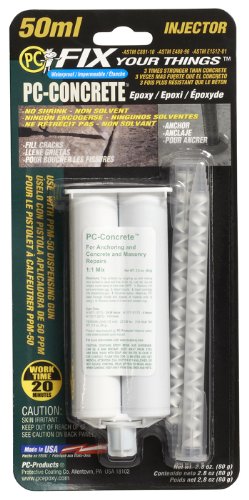
PC Products PC-Concrete -- Best Epoxy Patch Material
For the strongest possible repair, PC-Concrete two-part epoxy delivers a bond that can be stronger than the surrounding concrete itself. The two syringes mix at a 1:1 ratio and must be used within about 5 minutes of mixing, so work quickly in small batches. It fills cracks, holes, and spalled sections, resists oil, gasoline, and solvents, and does not require a bonding primer. The cured material can be drilled, tapped, and loaded. For anchor bolt holes, edge repairs on structural slabs, and areas exposed to chemicals, no cement-based product matches its durability.
How to choose
What to consider
Match the material to the repair type. Surface spalling and shallow chips need a fine-aggregate polymer mortar. Deep holes and structural cracks benefit from epoxy or fiber-reinforced cement. Moving cracks need a flexible polyurethane sealant. Speed requirements favor fast-set products. Surface area matters too: large resurfacing jobs need a bag product mixed with a drill rather than a pre-mixed bucket. In all cases, surface prep is as important as product selection. Clean the repair area to bare concrete, remove loose material, and use a bonding agent on slick surfaces for adhesion that lasts.
What to consider
For cracks specifically on an outdoor patio, see [best concrete patio crack repair](/articles/best-concrete-patio-crack-repair). Garage floor-specific repairs are covered in [best concrete patch for garage floor](/articles/best-concrete-patch-for-garage-floor). Our full evaluation process is at [/methodology](/methodology).
Common questions
Two-part epoxy compounds generally produce the strongest bond and highest compressive strength, often exceeding the original concrete. For most residential repairs, however, a polymer-modified Portland cement mix provides excellent strength at lower cost. Epoxy is best reserved for structural cracks, industrial floors, or areas with chemical exposure.
No. Standard concrete mix needs to be poured in sections at least 2 inches thick to cure properly and does not bond well to existing hardened concrete. Patch materials contain bonding polymers, accelerators, and fine aggregates that allow thin application, adhesion to old concrete, and faster strength development specifically for repair work.
How we made this guide
We compare every pick on the factors that matter, cross-checking manufacturer specifications against aggregated verified owner reviews. We rank independently and never take payment for placement. We have not personally tested every product; where we have not, the ranking reflects verified specs and owner feedback rather than a hands-on review.
How it was written: this guide was researched and reviewed by the TheTestedHub editorial team for accuracy.
Affiliate disclosure: TheTestedHub is reader-supported. When you buy through links on our site, we may earn a commission at no extra cost to you.
More guides

Fix Your Driveway Cracks with the Best Concrete Fillers

Which Drill Accessories Are Best in 2026?

Cordless Drill Systems Built for Real Jobsite Demands

What Makes Concrete Tools Worth Your Money in 2026?

Ghostshield 8505 Review: A Smarter Way to Protect Concrete

Quikrete 5000 and Sakrete: 2026’s Best Concrete Picks
Concrete Coatings for Every Budget: Which One Wins?
