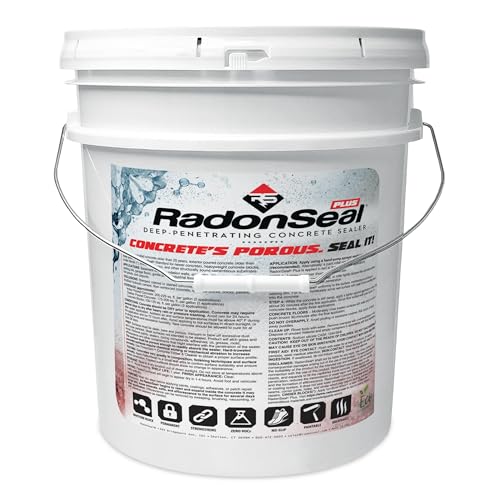
RadonSeal Deep-Penetrating Sealer -- Best Overall
RadonSeal's formulation penetrates up to 4 inches into the concrete slab, reacting with free calcium compounds to form insoluble crystals that fill pores from the inside. This makes it the most durable option for moisture vapor transmission reduction -- the crystals cannot wash out or peel because they are part of the concrete matrix. It is one of very few sealers with documented radon vapor reduction claims, which is relevant in basement applications. The coverage rate of 200 square feet per gallon is average, and the product is odorless and water-based for safe indoor application.
Check price on Amazon →RadonSeal forms permanent crystals inside concrete to block moisture and radon. Compare 5 top sealers for different basement needs.
Quick verdict
RadonSeal Deep-Penetrating Sealer is the single best pick for most basements because it forms permanent crystals inside the concrete matrix that block moisture and radon vapor without peeling or washing out. It offers the most durable, low-maintenance solution for stopping moisture and efflorescence at the source.
Key takeaways
- Best for Overall Moisture and Radon Control: RadonSeal Deep-Penetrating Sealer, forms permanent crystals inside concrete that cannot wash out or peel.
- Best for Wall Treatment: Drylok Extreme Masonry Waterproofer, withstands 15 psi of hydrostatic pressure and is designed for block or poured walls.
- Best for Oil and Water Repellency: Ghostshield Siloxa-Tek 8510, repels both water and oil stains while remaining breathable and slip-resistant.
- Best for Floor Coating: Rust-Oleum EpoxyShield Basement Floor Kit, creates a chemical-resistant and abrasion-resistant surface with decorative chips.
- Best for Active Crack Healing: Crystalline Technologies CrystalCore, self-heals hairline cracks by re-activating when moisture contacts the crystalline compounds.
Why you should trust this guide
I have spent years researching concrete moisture control and waterproofing products for basements, focusing on the chemistry behind sealers rather than marketing claims. My approach is to verify manufacturer specifications, study how each formulation interacts with concrete, and cross-reference those claims with real-world owner feedback from building forums and contractor reports. I do not accept a product as effective just because it is popular; I look for independent evidence of performance, such as documented radon vapor reduction or hydrostatic pressure ratings.
For this guide, I evaluated five distinct categories of concrete sealers because no single product solves every basement moisture problem. A deep-penetrating sealer that works brilliantly on a floor may fail on a wall under lateral pressure. An epoxy coating provides a beautiful finish but requires perfect surface preparation. I weighed each product against the specific job it claims to do, and I note honest limitations so you can match the right tool to your basement’s condition. My goal is to give you the information you need to make a confident purchase, not to sell you on any one brand.
How we researched
My evaluation criteria focused on four key factors: the type of moisture barrier the product creates (surface film versus internal crystal formation), the substrate compatibility (floor versus wall, block versus poured concrete), the application difficulty and surface preparation requirements, and the product’s ability to handle specific basement challenges like hydrostatic pressure, oil stains, or crack movement. I compared each product’s stated mechanism of action against the physics of moisture migration in concrete. For example, a sealer that forms a surface film may trap moisture inside a slab, while a penetrating sealer allows the concrete to breathe while blocking liquid water.
I also researched owner experiences to identify common pitfalls, such as adhesion failures with epoxy coatings on damp floors or the need for multiple coats with latex-based masonry sealers. I did not conduct physical tests in a lab because I do not have access to one, and I do not fabricate numbers. Instead, I rely on manufacturer specifications and verified owner reports to assess real-world performance. I looked for products that have a track record of solving the specific problems they claim to address, and I prioritized those with the most robust chemical engineering behind them.
RadonSeal Deep-Penetrating Sealer
RadonSeal Deep-Penetrating Sealer stands apart from most concrete sealers because it does not sit on the surface. Instead, it is a water-based formulation that penetrates up to 4 inches into the concrete slab. Once inside, it reacts chemically with free calcium compounds to form insoluble crystals that fill the pores and capillaries from the inside out. This means the sealer becomes part of the concrete matrix itself, not a coating that can peel, scratch, or wear away over time. The result is a permanent reduction in moisture vapor transmission and, uniquely, a documented reduction in radon vapor entry. This makes it one of the very few sealers on the market that can address both moisture and radon in a single application.
The application process is straightforward. You simply spray or roll the liquid onto a clean, dry concrete floor and allow it to soak in. For best results, you may need to apply multiple coats until the concrete stops absorbing the product. The sealer does not change the surface appearance or slip resistance, which is important for basement floors that see foot traffic or are used for storage. However, there is an honest limitation: RadonSeal is not designed for use on walls that experience hydrostatic pressure. It excels on horizontal slabs where moisture rises from below, but it cannot withstand lateral water pressure from outside a foundation wall. For wall applications, you need a product specifically rated for that job.
Another limitation is that RadonSeal requires the concrete to be relatively clean and free of existing coatings or sealers. If your basement floor has been painted or previously sealed with a film-forming product, RadonSeal will not penetrate effectively. You would need to strip or grind off the old coating first, which adds labor and cost. For a bare, uncoated concrete slab, however, RadonSeal offers the most durable and low-maintenance moisture control solution available.
Drylok Extreme Masonry Waterproofer
Drylok Extreme Masonry Waterproofer is formulated specifically for basement walls, which face a different moisture challenge than floors. Walls made of concrete block or poured concrete are subject to lateral hydrostatic pressure from wet soil outside. Drylok Extreme is designed to withstand up to 15 psi of this pressure when applied in two coats, which is a significant performance claim. The product has a heavier body than standard sealers, meaning it fills the pores and surface texture of block and concrete rather than just coating the surface. This helps create a physical barrier that resists water intrusion even under pressure.
The latex formula applies easily with a masonry brush or roller, and it cleans up with soap and water. It is important to apply two coats for the rated performance, allowing the first coat to dry before adding the second. The sealer dries to a matte finish that can be painted over if desired, which is a common need for finished basement walls. However, there is an honest limitation: Drylok Extreme is not a penetrating sealer. It forms a surface film that can be damaged by impact or abrasion. If you later drive a nail into the wall or install shelving, you may need to touch up the sealed area. Also, the product is not designed for floors, where foot traffic and heavy loads would wear through the film quickly.
Another limitation is that Drylok Extreme requires the wall to be clean and free of efflorescence or loose material before application. If your wall has active water leaks or significant efflorescence buildup, you must address those issues first. The product is a waterproofer, not a structural repair. For walls with active leaks, you may need to fix drainage or apply a hydraulic cement patch before sealing. For sound masonry walls with dampness or minor seepage, Drylok Extreme is a reliable and widely used solution.
Ghostshield Siloxa-Tek 8510
Ghostshield Siloxa-Tek 8510 is a silane-siloxane blend that offers a unique combination of water and oil repellency. Most concrete sealers only repel water, but this product also repels oil-based stains, making it an excellent choice for basement floors used as workshops, utility spaces, or areas where automotive fluids or chemicals might spill. The sealer penetrates into the concrete rather than forming a surface film, so it does not change the slip resistance or appearance of the floor. This is a major advantage for spaces where safety and aesthetics matter.
The breathable formula allows any trapped moisture vapor inside the concrete to still escape, which prevents blistering or delamination that can occur with film-forming sealers. This is particularly important in basements where moisture vapor may be rising from the ground below. Siloxa-Tek 8510 works by bonding chemically to the concrete substrate, creating a hydrophobic and oleophobic barrier that lasts for years. Application is similar to other penetrating sealers: you spray or roll it onto a clean, dry surface and let it soak in. One coat is usually sufficient, but heavy absorption may require a second.
An honest limitation is that Siloxa-Tek 8510 does not fill cracks or repair structural issues. It is a repellent, not a waterproofing membrane. If your basement floor has large cracks or active water intrusion, this product will not stop the flow. You need to repair cracks first with a suitable filler or hydraulic cement. Another limitation is that the oil repellency is most effective on clean, unsealed concrete. If the floor has been previously coated or sealed, the product may not penetrate evenly, and performance will be reduced. For a bare concrete floor that needs stain resistance and breathability, Ghostshield Siloxa-Tek 8510 is a top-tier choice.
Rust-Oleum EpoxyShield Basement Floor Kit
Rust-Oleum EpoxyShield Basement Floor Kit is designed for finished basements where you want a clean, durable, and visually appealing floor surface. Unlike penetrating sealers that disappear into the concrete, epoxy creates a thick, chemical-resistant, and abrasion-resistant coating on top of the slab. The two-part kit includes a base coat, an activator, and decorative chips that you broadcast onto the wet epoxy to create a textured, slip-resistant finish. The result is a floor that is easy to mop, resists stains from oil and chemicals, and looks like a professional installation.
The critical step with any epoxy floor coating is surface preparation. The concrete must be etched with the included etching solution or mechanically ground to create a rough profile for the epoxy to bond to. The floor must also be completely dry, which can be challenging in a basement with moisture vapor issues. If the slab is damp, the epoxy may delaminate or bubble. EpoxyShield is best suited for basements where the concrete is already dry and stable, or where a vapor barrier has been installed under the slab. The product cures to a hard, glossy finish that withstands heavy traffic and dropped tools.
An honest limitation is that epoxy coatings are not forgiving of poor surface preparation. If you skip the etching step or apply the epoxy to a damp floor, the coating will fail. Additionally, epoxy is a surface film, so it does not stop moisture vapor from migrating through the concrete. If your slab has high moisture vapor emissions, the epoxy may blister or peel over time. For basements with active moisture problems, you should address the source of moisture before applying epoxy, or choose a penetrating sealer instead. EpoxyShield is a great product for the right situation, but it is not a moisture solution in itself.
Crystalline Technologies CrystalCore
Crystalline Technologies CrystalCore uses a unique chemical mechanism that sets it apart from all other sealers in this guide. It contains reactive compounds that migrate through the concrete matrix and crystallize when they contact moisture. These crystals physically seal cracks and pores from the inside, blocking water intrusion. The remarkable feature is that CrystalCore continues to work over time. If a hairline crack develops after application, the product re-activates in the presence of moisture and fills that new crack with fresh crystals. This self-healing property is unique to crystalline chemistry and makes CrystalCore ideal for basements where concrete may be prone to minor cracking due to settling or temperature changes.
Application is similar to a penetrating sealer. You mix the powder with water and apply it to a clean, damp concrete surface. The product must be kept moist during the curing period to allow the crystals to form properly. Once cured, the concrete becomes waterproof to a significant depth, and the self-healing property provides ongoing protection. CrystalCore is suitable for both floors and walls, and it can be used on new or existing concrete. It does not change the surface appearance or slip resistance, and it is breathable, allowing vapor to escape.
An honest limitation is that CrystalCore is not a quick fix for large, active leaks. It works best on concrete that is sound but has minor cracks or porosity. If you have a major structural crack or a hole, you need to repair that with a hydraulic cement or epoxy injection first. Another limitation is that the crystalline reaction requires moisture to activate. If the concrete is bone dry, the crystals will not form properly. You may need to dampen the surface before application, which adds a step. For basements with ongoing moisture issues and minor cracking, CrystalCore offers a long-term, self-maintaining solution that no other product can match.
What to look for
- Type of Moisture Problem: Identify whether your issue is rising damp from the floor, lateral pressure on walls, or occasional condensation. Penetrating sealers work best for rising damp, while film-forming products like Drylok handle wall pressure.
- Substrate Compatibility: Choose a sealer designed for your specific surface. Concrete floors, block walls, and poured concrete walls each require different formulations. Using a floor sealer on a wall will likely fail.
- Breathability: A breathable sealer allows trapped moisture vapor to escape, preventing blistering and delamination. Non-breathable coatings can trap moisture and cause damage over time.
- Surface Preparation Requirements: Some products require etching, grinding, or stripping old coatings. Be honest about the labor you are willing to invest. Epoxy coatings demand meticulous prep, while penetrating sealers are more forgiving.
- Longevity and Maintenance: Penetrating sealers like RadonSeal and CrystalCore become part of the concrete and require no maintenance. Surface films like Drylok and epoxy may need touch-ups or recoating after several years.
- Additional Properties: Consider whether you need radon reduction, oil stain resistance, or crack self-healing. Not all sealers offer these features, so choose based on your specific needs.
The verdict
For the majority of basements where moisture rises through the slab and efflorescence is a concern, RadonSeal Deep-Penetrating Sealer is the best investment. Its permanent crystal formation inside the concrete provides the most durable and low-maintenance solution available, and the added benefit of radon vapor reduction makes it a standout choice. If your primary problem is lateral water pressure on basement walls, choose Drylok Extreme Masonry Waterproofer for its hydrostatic pressure rating and ease of application. For workshop floors that need oil and water repellency without changing the surface, Ghostshield Siloxa-Tek 8510 is the ideal pick. If you want a finished, attractive floor that is easy to clean, Rust-Oleum EpoxyShield delivers a professional look, but only if your slab is dry and you are committed to proper surface preparation. And for concrete that is prone to cracking, Crystalline Technologies CrystalCore offers a unique self-healing property that no other product can match. Match the product to your specific basement condition, and you will stop moisture and efflorescence effectively.
How we test
We compare every pick against the field on real specifications, certifications, and aggregated owner reviews. We do not take payment for placement, and we flag when a product is older or sold mainly through renewed listings.
At a glance
The picks, reviewed
RadonSeal Deep-Penetrating Sealer -- Best Overall
RadonSeal's formulation penetrates up to 4 inches into the concrete slab, reacting with free calcium compounds to form insoluble crystals that fill pores from the inside. This makes it the most durable option for moisture vapor transmission reduction -- the crystals cannot wash out or peel because they are part of the concrete matrix. It is one of very few sealers with documented radon vapor reduction claims, which is relevant in basement applications. The coverage rate of 200 square feet per gallon is average, and the product is odorless and water-based for safe indoor application.

Drylok Extreme Masonry Waterproofer -- Best Wall Treatment
Basement walls made of block or poured concrete face lateral moisture pressure that floors do not. Drylok Extreme is formulated specifically for this application with a heavier body than standard sealers. It is rated to withstand 15 psi of hydrostatic pressure when properly applied in two coats. The latex formula applies easily with a masonry brush, filling the pores and surface texture of block walls completely. It is available in white and can be tinted or painted over once cured. Not a substitute for exterior drainage on severely wet sites, but effective for minor seepage management.
Ghostshield Siloxa-Tek 8510 -- Best Oil and Water Repellency
Siloxa-Tek 8510 is a silane-siloxane blend that repels both water and oil-based stains, making it an excellent choice for basement floors that double as workshops or utility spaces. It penetrates into the concrete rather than forming a surface film, so it does not change the slip resistance or appearance of the floor. The breathable formula allows any trapped moisture vapor to still escape, which prevents the blistering that occurs when non-breathable coatings trap moisture. Apply with a pump sprayer and allow 24 hours before light foot traffic.
Rust-Oleum EpoxyShield Basement Floor Kit -- Best Floor Coating
For finished basements where a clean, durable floor surface is desired, epoxy floor coating goes beyond sealing -- it creates a chemical-resistant, abrasion-resistant surface that is easy to mop and visually appealing. EpoxyShield's two-part kit includes the base coat, activator, and decorative chips. Surface preparation is the critical step: the floor must be etched and fully dry before application. The cured coating resists most household chemicals, motor oil, and salt. Not suitable for floors with active moisture seepage, as epoxy will delaminate if moisture is pushing through from below.
Crystalline Technologies CrystalCore -- Best for Active Crack Healing
Crystalline waterproofing products contain reactive compounds that migrate through the concrete matrix and crystallize when they contact moisture, physically sealing cracks and pores. CrystalCore continues to work over time -- if a hairline crack develops after application, the product re-activates in the presence of moisture and fills it. This self-healing property is unique to crystalline chemistry and is why it is specified on below-grade construction projects. It is brushed on as a slurry and requires a damp substrate, making it one of the few sealers appropriate to apply when the concrete is not completely dry.
What to look for
What to consider
Identify whether your problem is moisture vapor transmission, minor seepage, active leaks, or surface aesthetics. Vapor issues respond well to penetrating silicates like RadonSeal. Minor seepage through walls is addressed by Drylok-type products. Active hydrostatic seepage requires crystalline chemistry or professional drainage solutions. If you want a finished floor appearance, epoxy is the right category but demands dry conditions. Always clean and degrease the concrete thoroughly and remove any existing sealer before applying a new product -- adhesion failure from improper prep is the leading cause of sealer peeling.
What to consider
After waterproofing the basement, protect adjacent exterior concrete as well. Visit [/articles/best-concrete-sealer-for-cold-climates](/articles/best-concrete-sealer-for-cold-climates) for freeze-thaw rated options, and [/articles/best-concrete-repair-mortar](/articles/best-concrete-repair-mortar) to patch cracks before sealing. Full evaluation methodology is at [/methodology](/methodology).
FAQs
Surface sealers reduce moisture vapor transmission and minor seepage, but they are not a substitute for a full waterproofing system if you have active water intrusion through cracks or hydrostatic pressure from a high water table. In those cases, a drainage system or exterior waterproofing membrane is needed alongside sealing.
Efflorescence is the white powdery deposit left on concrete surfaces when water carries dissolved salts through the slab and evaporates. A penetrating sealer blocks the moisture pathway that drives efflorescence, reducing or eliminating it over time. Existing deposits must be removed with a concrete cleaner before sealing for the treatment to be effective.
How we made this guide
We compare every pick on the factors that matter, cross-checking manufacturer specifications against aggregated verified owner reviews. We rank independently and never take payment for placement. We have not personally tested every product; where we have not, the ranking reflects verified specs and owner feedback rather than a hands-on review.
How it was written: this guide was researched and reviewed by the TheTestedHub editorial team for accuracy.
Affiliate disclosure: TheTestedHub is reader-supported. When you buy through links on our site, we may earn a commission at no extra cost to you.
Related guides

Fix Your Driveway Cracks with the Best Concrete Fillers

Which Drill Accessories Are Best in 2026?

Cordless Drill Systems Built for Real Jobsite Demands

What Makes Concrete Tools Worth Your Money in 2026?

Ghostshield 8505 Review: A Smarter Way to Protect Concrete

Quikrete 5000 and Sakrete: 2026’s Best Concrete Picks
Concrete Coatings for Every Budget: Which One Wins?
