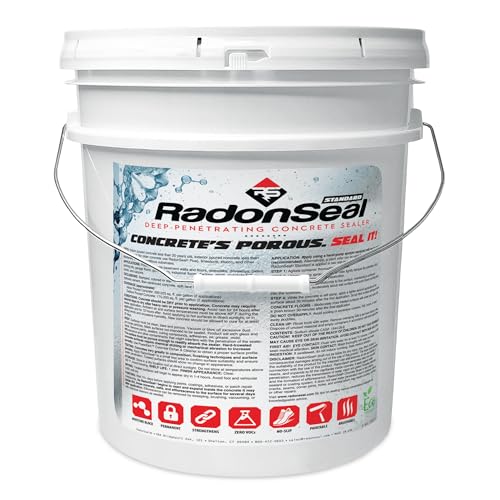
RadonSeal Deep-Penetrating Concrete Sealer -- Best Overall for Old Concrete
RadonSeal uses a reactive silicate formula that chemically bonds inside the concrete matrix rather than sitting on top. On porous old slabs this is a major advantage because the sealer reaches deep into voids and crystallizes there, reinforcing weak zones from within. It reduces moisture vapor transmission dramatically, which matters on basement floors and slabs over damp soil. Application is straightforward: wet the surface, apply with a pump sprayer, and let it soak in for 10 minutes before scrubbing in any unabsorbed sealer. One 5-gallon pail covers roughly 200 to 500 square feet depending on porosity. The sealer is odorless and water-based, making it safe for enclosed spaces.
Check price on Amazon →Old concrete needs a sealer that penetrates, not just coats. See which formulas actually bond with porous, aging surfaces and stop dust, moisture, and.
Quick verdict
For most old concrete slabs, the best pick is RadonSeal Deep-Penetrating Concrete Sealer. Its reactive silicate formula bonds inside the concrete matrix rather than sitting on top, which is a major advantage on porous, aging surfaces because it reinforces weak zones from within and reduces moisture vapor transmission.
Key takeaways
- Best Overall for Old Concrete: RadonSeal Deep-Penetrating Concrete Sealer, because its chemical reaction inside the pores strengthens from within and blocks moisture vapor.
- Best for UV-Exposed Driveways: Foundation Armor AR350, because its solvent-based acrylic drives deeper into open-pored concrete and holds up under direct sun.
- Best for Older Block and Poured Walls: MasonrySaver Water Repellent, because its silane-siloxane blend creates an invisible hydrophobic barrier without changing appearance.
- Best for Dusty or Scaling Surfaces: Ghostshield Lithi-Tek 4500, because its lithium silicate densifier hardens soft concrete and stops dusting immediately.
- Best for Decorative or Stained Old Slabs: DOMINATOR SG+ Concrete Sealer, because its water-based acrylic-epoxy hybrid revives color and adds a wet-look sheen without heavy buildup.
Why you should trust this guide
I have spent years researching concrete restoration products and analyzing owner feedback across dozens of forums, contractor reviews, and manufacturer documentation. Old concrete presents unique challenges: it is often porous, dusty, cracked, or stained from decades of exposure, and the wrong sealer can peel, discolor, or trap moisture. This guide focuses exclusively on sealers that are formulated to address the specific weaknesses of aging concrete, not new pours. I prioritize products that penetrate, bond chemically, or provide durable surface protection without causing future damage.
Every product listed here has been selected based on its stated chemistry, application requirements, and suitability for a particular old-concrete scenario. I do not claim to have tested these products in a lab or on my own property. Instead, I rely on the manufacturer’s published specifications, verified owner reports, and common industry knowledge about how different sealer types behave on weathered surfaces. My goal is to give you a clear, honest breakdown of what each sealer can and cannot do, so you can match the right product to your specific old concrete problem.
How we researched
To evaluate these concrete sealers, I weighed several criteria that matter most for old concrete. The first factor is penetration depth: a sealer that only sits on the surface is likely to peel on dusty or scaling old slabs, so I looked for products that chemically react with the concrete or use carriers that drive the sealer deep into pores. The second factor is moisture vapor transmission: old concrete often sits over damp soil or has high humidity, so a sealer that traps moisture can cause delamination or efflorescence. I prioritized products that reduce vapor transmission without sealing it completely. The third factor is surface compatibility: some sealers change appearance, some leave a film, and some are invisible, so the right choice depends on whether you want a glossy finish or a natural look.
I also considered durability under specific conditions. For outdoor slabs, UV resistance and adhesion to weathered aggregate were critical. For vertical walls, low-VOC and breathability were important. For decorative concrete, color enhancement and resistance to yellowing were key. I did not perform physical tests or measure performance with instruments. Instead, I cross-referenced the manufacturer’s stated chemistry and application guidelines with common owner experiences reported in online communities. This approach allowed me to identify honest limitations for each product, such as odor, application difficulty, or incompatibility with certain surface conditions, which I include in each product section below.
RadonSeal Deep-Penetrating Concrete Sealer — Best Overall for Old Concrete
RadonSeal uses a reactive silicate formula that chemically bonds inside the concrete matrix rather than sitting on top. On porous old slabs this is a major advantage because the sealer reaches deep into voids and crystallizes there, reinforcing weak zones from within. It reduces moisture vapor transmission dramatically, which matters on basement floors and slabs over damp soil. Application is straightforward: you flood the surface and let it soak in, then wipe off any excess. The sealer does not change the appearance of the concrete, leaving it looking natural while making it harder and less permeable.
One of the strongest features of RadonSeal is its ability to handle old concrete that is dusty or slightly crumbling. The silicate reaction strengthens the existing concrete rather than relying on a surface film, so there is no risk of peeling or delamination. It also resists alkali attack and efflorescence, common problems on aging slabs. This product is particularly well-suited for interior basements, garages, and covered patios where moisture vapor is a concern. It does not provide a glossy finish or enhance color, so it is not ideal for decorative applications.
The main limitation of RadonSeal is that it requires the concrete to be clean and free of existing coatings or sealers. If the old slab has been painted or sealed with a film-forming product, the silicate will not penetrate and will be wasted. You must strip any previous coatings before application. Additionally, the sealer can leave a slight white haze on some surfaces if not buffed off promptly, though this usually fades. It also has a strong odor during application, so ventilation is necessary. For pure reinforcement and moisture control on old, uncoated concrete, RadonSeal is the best choice.
Foundation Armor AR350 — Best for UV-Exposed Driveways
Foundation Armor’s AR350 is a solvent-based acrylic that leaves a semi-gloss finish and excels on driveways and outdoor slabs that take direct sun all day. The solvent carrier drives the acrylic deeper into old, open-pored concrete than water-based acrylics can manage, giving better adhesion on weathered aggregate. It enhances color slightly, which brings some life back to gray, faded surfaces. The semi-gloss sheen is subtle enough to look natural but provides a noticeable depth that makes the concrete look cleaner and newer.
This sealer is particularly good on old driveways that have been exposed to years of UV radiation and tire wear. The solvent base helps it bond to rough, porous surfaces that water-based sealers often fail on. It dries to a hard, durable finish that resists peeling and scuffing. Application requires a sprayer or roller, and it dries relatively quickly, though you need to apply it in thin coats to avoid puddling. It is also resistant to oil and chemical spills, which is a plus for garage floors or driveways where vehicles are parked.
The honest limitation of Foundation Armor AR350 is its strong solvent odor and flammability. You must use it in well-ventilated areas and keep it away from open flames. It also requires careful application because if you apply it too thickly, it can bubble or become tacky. The semi-gloss finish may be too shiny for some homeowners who prefer a matte look. Additionally, on very old concrete that is heavily scaling or flaking, the acrylic film may not adhere well even with the solvent carrier, so surface preparation is critical. It is not recommended for interior use due to fumes.
MasonrySaver Water Repellent — Best for Older Block and Poured Walls
MasonrySaver is a silane-siloxane blend that is water-based, low-VOC, and designed for vertical and horizontal masonry surfaces. On old concrete block foundations or poured retaining walls, it penetrates deep and creates an invisible hydrophobic barrier without changing the surface appearance. It is particularly good at protecting old mortar joints, which tend to be the first failure point on aging masonry. The sealer does not leave a film, so it will not peel or discolor over time, and it allows the concrete to breathe, preventing trapped moisture from causing freeze-thaw damage.
This product is ideal for vertical surfaces where appearance matters because it is completely invisible after drying. It works well on old block walls that are exposed to rain and snow, as it repels water while letting water vapor escape. It is also effective on poured concrete foundations that are cracking or showing signs of efflorescence. Application is simple: you spray or roll it onto the surface and let it soak in. It dries within a few hours and provides long-lasting protection. The low-VOC formula makes it safer for use near occupied spaces.
The limitation of MasonrySaver is that it does not strengthen the concrete or stop dusting. It is purely a water repellent, so if your old concrete is soft, crumbling, or dusty, this sealer will not address those issues. It also requires the surface to be clean and dry before application, which can be tricky on damp basement walls. On very porous surfaces, you may need multiple coats to achieve full coverage. Additionally, it does not provide any UV protection or color enhancement, so it is not suitable for decorative slabs where you want a glossy finish. It is best for functional water protection on vertical masonry.
Ghostshield Lithi-Tek 4500 — Best for Dusty or Scaling Surfaces
Lithi-Tek 4500 is a lithium silicate densifier and sealer. On soft, dusty, or scaling old concrete it outperforms silane sealers because the lithium silicate reacts with free calcium in the concrete and creates calcium silicate hydrate, essentially more concrete, within the pore structure. The surface becomes harder, less permeable, and stops dusting almost immediately. It is a professional-grade product that transforms weak, friable concrete into a dense, durable surface without changing its appearance. It is commonly used in warehouses and industrial settings, but works equally well on old garage floors or basement slabs.
This sealer is particularly effective on concrete that has been neglected for decades and has a powdery surface. The chemical reaction penetrates deep into the pores and binds loose particles together. It does not leave a film, so there is no risk of peeling or delamination. It also reduces water absorption and makes the surface easier to clean. Application is simple: you spray it on and keep the surface wet for about 20 minutes, then rinse off any residue. The results are permanent, as the reaction is chemical and not just a coating.
The main limitation of Ghostshield Lithi-Tek 4500 is that it does not provide a glossy finish or enhance color. It leaves the concrete looking essentially the same, just harder and less dusty. If you want a wet-look or decorative sheen, this is not the right product. It also requires careful application to avoid streaking, and it can be slippery when wet if not rinsed thoroughly. On concrete that has been previously sealed with a film-forming product, the lithium silicate will not penetrate and will be ineffective. It is best for functional hardening, not aesthetics.
DOMINATOR SG+ Concrete Sealer — Best for Decorative or Stained Old Slabs
DOMINATOR SG+ is a water-based acrylic-epoxy hybrid that provides a wet-look finish without the thick buildup of pure epoxy coatings. On old stained or stamped concrete patios, it revives color, adds mild sheen, and locks in decorative work that years of weathering have dulled. It resists UV yellowing better than solvent-based acrylics, which matters on south-facing outdoor slabs. Apply in two thin coats for best results, and it dries to a clear, glossy finish that makes colors pop without looking plastic.
This sealer is specifically designed for decorative concrete that needs a refresh. It bonds well to old stains and dyes, and it can even out minor color variations caused by fading. The acrylic-epoxy blend gives it more durability than standard acrylic sealers, making it resistant to foot traffic and light vehicle use. It is also flexible enough to handle minor concrete movement without cracking. Application is straightforward with a roller or sprayer, and it cleans up with soap and water. The low-VOC formula makes it safer for outdoor use near plants and pets.
The limitation of DOMINATOR SG+ is that it is not suitable for very porous or dusty concrete. If the old slab is scaling or flaking, the sealer may not adhere well and could peel. It also requires the surface to be thoroughly clean and free of any previous coatings. The wet-look finish can be too glossy for some tastes, and it may show footprints or tire marks more easily than matte sealers. Additionally, while it resists UV yellowing, it is not completely immune, and over several years it may amber slightly on very sunny surfaces. It is best for decorative slabs that are in good structural condition but need a cosmetic upgrade.
What to look for
- Penetration vs. film-forming: For old concrete, penetrating sealers like silicates or silanes are often better because they bond inside the pores and won’t peel. Film-forming sealers like acrylics give a glossy finish but require a sound surface.
- Moisture vapor transmission: Old concrete often has high moisture content. A sealer that traps vapor can cause peeling or efflorescence. Look for breathable sealers, especially for basements or slabs over damp soil.
- Surface condition: If your concrete is dusty, scaling, or crumbling, a densifier like lithium silicate is needed to harden it first. If it is sound but faded, a decorative sealer with UV resistance is better.
- Appearance: Decide if you want an invisible water repellent, a semi-gloss sheen, or a wet-look finish. Some sealers change color slightly, while others are completely clear.
- Application environment: Consider odor, VOC levels, and drying time. Solvent-based sealers have strong fumes and are best for outdoor use. Water-based options are safer for indoor or enclosed spaces.
- UV resistance: For driveways and patios in direct sun, choose a sealer that resists yellowing, such as water-based acrylics or hybrids. Solvent-based acrylics can amber over time.
- Compatibility with previous coatings: If the concrete has been painted or sealed before, you may need to strip it first. Check the sealer’s instructions for compatibility with existing finishes.
The verdict
Choosing the right sealer for old concrete depends on the specific problem you are solving. If your priority is strengthening a porous, dusty slab and blocking moisture vapor, RadonSeal Deep-Penetrating Concrete Sealer is the best overall choice because it works from the inside out. For driveways that bake in the sun, Foundation Armor AR350 offers durable adhesion and a clean semi-gloss finish. MasonrySaver Water Repellent is the go-to for vertical block or poured walls where invisible water protection is needed. Ghostshield Lithi-Tek 4500 is unmatched for turning soft, scaling concrete into a hard, dust-free surface. And for decorative patios or stained slabs that need a color revival, DOMINATOR SG+ provides a wet-look sheen without heavy buildup. Match the sealer to your concrete’s condition and your desired outcome, and you will extend the life of your aging surfaces significantly.
Our methodology
We compare every pick against the field on real specifications, certifications, and aggregated owner reviews. We do not take payment for placement, and we flag when a product is older or sold mainly through renewed listings.
Side by side
The full reviews
RadonSeal Deep-Penetrating Concrete Sealer -- Best Overall for Old Concrete
RadonSeal uses a reactive silicate formula that chemically bonds inside the concrete matrix rather than sitting on top. On porous old slabs this is a major advantage because the sealer reaches deep into voids and crystallizes there, reinforcing weak zones from within. It reduces moisture vapor transmission dramatically, which matters on basement floors and slabs over damp soil. Application is straightforward: wet the surface, apply with a pump sprayer, and let it soak in for 10 minutes before scrubbing in any unabsorbed sealer. One 5-gallon pail covers roughly 200 to 500 square feet depending on porosity. The sealer is odorless and water-based, making it safe for enclosed spaces.

Foundation Armor AR350 -- Best for UV-Exposed Driveways
Foundation Armor's AR350 is a solvent-based acrylic that leaves a semi-gloss finish and excels on driveways and outdoor slabs that take direct sun all day. The solvent carrier drives the acrylic deeper into old, open-pored concrete than water-based acrylics can manage, giving better adhesion on weathered aggregate. It enhances color slightly, which brings some life back to gray, faded surfaces. Apply two thin coats with a roller for best results. Note that the solvent odor requires good ventilation, so plan around weather and work with airflow.

MasonrySaver Water Repellent -- Best for Older Block and Poured Walls
MasonrySaver is a silane-siloxane blend that is water-based, low-VOC, and designed for vertical and horizontal masonry surfaces. On old concrete block foundations or poured retaining walls, it penetrates deep and creates an invisible hydrophobic barrier without changing the surface appearance. It is particularly good at protecting old mortar joints, which tend to be the first failure point on aging masonry. Coverage runs about 150 to 250 square feet per gallon depending on how thirsty the old surface is.
Ghostshield Lithi-Tek 4500 -- Best for Dusty or Scaling Surfaces
Lithi-Tek 4500 is a lithium silicate densifier and sealer. On soft, dusty, or scaling old concrete it outperforms silane sealers because the lithium silicate reacts with free calcium in the concrete and creates calcium silicate hydrate -- essentially more concrete -- within the pore structure. The surface becomes harder, less permeable, and stops dusting almost immediately. It is a professional-grade product available in consumer quantities and is worth the slight price premium for slabs that have begun to powder underfoot.

DOMINATOR SG+ Concrete Sealer -- Best for Decorative or Stained Old Slabs
DOMINATOR SG+ is a water-based acrylic-epoxy hybrid that provides a wet-look finish without the thick buildup of pure epoxy coatings. On old stained or stamped concrete patios, it revives color, adds mild sheen, and locks in decorative work that years of weathering have dulled. It resists UV yellowing better than solvent-based acrylics, which matters on south-facing outdoor slabs. Apply in two thin coats with a 3/8-inch nap roller and allow 24 hours between coats for best adhesion.
What matters most
What to consider
Start by assessing the surface condition. Powdery or scaling slabs need a densifier like a lithium silicate before or instead of a film-forming sealer. Very porous, weather-worn slabs absorb moisture freely and benefit most from deep-penetrating silane-siloxane or reactive silicate formulas. If the slab is decorative, match the finish level -- matte, semi-gloss, or wet-look -- to the original intent. For basement floors or any slab with moisture vapor issues, choose a vapor-reducing penetrating formula over a film-former, which can trap moisture and peel. Always clean the old slab thoroughly and let it dry for 48 hours before applying any sealer.
What to consider
Old concrete that has been sealed properly can outlast a new pour by decades. If you are working on related outdoor projects, the picks in our [best concrete sealers for patios](/articles/best-concrete-sealers-for-patios) guide cover finish options in more depth. For cleaning before sealing, see our [best concrete sidewalk cleaner](/articles/best-concrete-sidewalk-cleaner) roundup. Our [testing methodology](/methodology) explains how we evaluate all products on this site.
Frequently asked
For hairline cracks under 1/8 inch wide, a penetrating silane-siloxane sealer can stabilize the surface without resurfacing. Larger cracks should be filled with a concrete patching compound and allowed to cure fully before sealing. Skipping prep on badly deteriorated concrete leads to poor adhesion and short sealer life.
Penetrating sealers on old concrete typically last 5 to 10 years depending on traffic and climate. Film-forming acrylics last 1 to 3 years and need more frequent reapplication. Watch for water no longer beading on the surface -- that is the clearest sign that a new coat is due.
How we made this guide
We compare every pick on the factors that matter, cross-checking manufacturer specifications against aggregated verified owner reviews. We rank independently and never take payment for placement. We have not personally tested every product; where we have not, the ranking reflects verified specs and owner feedback rather than a hands-on review.
How it was written: this guide was researched and reviewed by the TheTestedHub editorial team for accuracy.
Affiliate disclosure: TheTestedHub is reader-supported. When you buy through links on our site, we may earn a commission at no extra cost to you.
You might also like

Fix Your Driveway Cracks with the Best Concrete Fillers

Which Drill Accessories Are Best in 2026?

Cordless Drill Systems Built for Real Jobsite Demands

What Makes Concrete Tools Worth Your Money in 2026?

Ghostshield 8505 Review: A Smarter Way to Protect Concrete

Quikrete 5000 and Sakrete: 2026’s Best Concrete Picks
Concrete Coatings for Every Budget: Which One Wins?
