
Quikrete Polyurethane Concrete Crack Sealant -- Best Overall
Quikrete's polyurethane formula is the go-to for most homeowners because it works on cracks up to half an inch wide, self-levels on horizontal surfaces, and stays flexible after curing. That flexibility is critical outdoors where slabs shift seasonally. The product comes in a standard caulk tube, so any caulk gun works. Application takes under ten minutes per linear foot, and it accepts paint once cured. The gray color blends reasonably well with aged concrete.
Check price on Amazon →Not all crack fillers are the same. Compare Quikrete, Sika, RadonSeal, Red Devil, and Rust-Oleum to find the right match for your slab.
Quick verdict
The Quikrete Polyurethane Concrete Crack Sealant is the best pick for most homeowners. It handles cracks up to half an inch, self-levels on horizontal slabs, and stays flexible after curing, so it copes with the seasonal slab movement that causes outdoor repairs to fail. It loads into any standard caulk gun.
Key takeaways
- Best Overall: Quikrete Polyurethane Concrete Crack Sealant, flexible polyurethane that self-levels and seals cracks up to half an inch.
- Best for Patios: Sika Sikaflex Self-Leveling Sealant, flows into irregular edges and shrugs off UV on open horizontal surfaces.
- Best for Basements: RadonSeal Concrete Crack Filler, penetrates the concrete to fight moisture and hydrostatic pressure from inside.
- Best Budget Pick: Red Devil Pre-Mixed Concrete Patch, no mixing and no special tools for shallow cosmetic cracks.
- Best for Garage Floors: Rust-Oleum EpoxyShield Crack Filler, industrial epoxy bond that resists oil, fuel, and road salt.
Why you should trust this guide
I approached this guide the way a homeowner stares at a cracked slab on a Saturday morning: with a specific problem and no patience for marketing language. Crack fillers are not interchangeable. A product that is perfect for a flexing patio joint will fail on a basement wall fighting groundwater, and an epoxy built for a garage floor will crack apart on an outdoor slab that expands and contracts every season. So instead of asking which filler is best, I asked which filler is best for which job, and I built the picks around that.
For each product I worked from the manufacturer’s stated specifications, the documented chemistry (polyurethane, self-leveling sealant, penetrating two-part, pre-mixed vinyl patch, and 100 percent solids epoxy), and the listed Amazon features, then matched those traits to the real conditions each repair has to survive. I treat the stated specs as claims, not lab results, and where a product has a clear weakness I say so plainly. Nothing here is all upside, because no single filler does everything.
How we researched
My evaluation is research-based rather than a physical bench test, so I want to be upfront about that. I compared each product on the criteria that actually decide whether a concrete repair lasts: crack width capability, flexibility versus rigidity after cure, suitability for horizontal versus vertical surfaces, moisture and water resistance, indoor versus outdoor durability (especially freeze-thaw exposure), application difficulty, and the tools required. Those are the variables that separate a repair that holds for years from one that reopens by the next winter.
I weighted the criteria by use-case rather than scoring everything on one scale, because the right answer changes with the project. For an active outdoor crack, flexibility and UV resistance matter most. For a basement, moisture penetration and low-VOC safety in an enclosed space lead. For a garage floor, raw bond strength and chemical resistance win. I read each formula’s chemistry against the failure mode it is most likely to face, and I flag the cure time, mixing requirement, and any honest limitation for each pick so you can choose with the trade-offs in view.
Quikrete Polyurethane Concrete Crack Sealant
This is the filler I would reach for first on the widest range of jobs, which is why it is the best overall pick. Quikrete’s gray polyurethane formula seals cracks up to half an inch wide, self-levels on horizontal surfaces, and stays flexible once it cures. That flexibility is the whole point outdoors: a slab that shifts with seasonal temperature swings will tear a rigid filler apart, but a polyurethane bead moves with the concrete instead of fighting it. It is a single-component product, so there is no mixing, and it comes in a standard 10.1 oz caulk tube that fits any caulk gun you already own.
Quikrete positions this as a commercial-grade sealant that permanently seals and waterproofs cracks, and it is designed to meet or exceed the performance of traditional polyurethane or silicone sealants while being a more environmentally friendly, single-component alternative. In practice that means fast, low-fuss application (roughly under ten minutes per linear foot once you have a rhythm) and a finished bead that accepts paint, so you can blend the repair into a coated or stained slab. It ships as a pack of two, which is convenient if you have more than a few feet of cracking to chase down.
The honest trade-off is width. Half an inch is the ceiling, so a wide, spalling crack or a broken slab edge is beyond what a single bead of this product should handle without backer rod and patience, and polyurethane self-levels best on flat ground rather than vertical faces. Packaging can also vary between orders. For typical driveway, walkway, and patio cracks within its width range, though, it is the most broadly capable choice here.
Sika Sikaflex Self-Leveling Sealant
For open horizontal surfaces like patios and pool decks, the Sika Sikaflex Self-Leveling Sealant is the stronger choice, which is why it earns the patio pick. Its self-leveling formula flows into the irregular edges of a crack or expansion joint and settles itself, then cures to a tough, rubberized finish that holds up well under direct UV exposure. That weather resistance is what you want on a surface that bakes in the sun all summer, and Sika calls out excellent resistance to weathering and the ability to withstand harsh conditions without losing integrity.
Working time is a real advantage here. The compound stays workable for roughly half an hour, which gives you time to smooth and tool the joint before it sets, and it tempers to a tack-free consistency within a couple of hours. Once cured it is waterproof and immersible, so it blocks water infiltration and even tolerates standing water, which is exactly why it suits pool decks and low spots that pond after rain. It is also versatile beyond concrete, bonding to asphalt and masonry, so a single tube can cross between a driveway joint and a paved edge.
The limitation to keep in mind is that self-leveling sealant is built for horizontal joints, not vertical cracks, because it relies on gravity to flow and settle. It also needs an expansion joint or crack with some depth to pool into rather than a paper-thin hairline on a flat face. Used where it belongs, on flat exterior surfaces that move and take sun and water, it is hard to beat.
RadonSeal Concrete Crack Filler
RadonSeal is the right answer for basement floors and walls, where the enemy is not slab movement but moisture wicking through the concrete, which is why it takes the basement pick. Rather than just coating the surface, it penetrates the concrete matrix and forms a crystalline barrier that resists hydrostatic pressure, the steady push of groundwater from the outside. That penetrating action is what lets it stop water at a level a surface coating cannot match, and it is engineered to seal even hairline cracks permanently.
It is built for interior repair, and that has practical payoffs. You inject it from inside the basement using a standard caulking gun, with a drill-free injection approach that avoids the cost and mess of exterior excavation. The low-viscosity, two-component urethane flows into tight cracks, and beyond blocking water it also helps guard against radon and gas intrusion through those same pathways. It is low-VOC, which genuinely matters in an enclosed, poorly ventilated space where you will be breathing the air while you work.
The trade-off is that this is a two-part product, so you have to mix it correctly, and there is less margin for sloppiness than with a squeeze-and-go tube. The instructions are clear, but it asks more of you than a pre-mixed patch, and its strength is sealing against moisture rather than rebuilding broken or load-bearing concrete. For a damp basement crack, that focus is exactly what you want.
Red Devil Pre-Mixed Concrete Patch
For shallow, purely cosmetic surface cracks, the Red Devil Pre-Mixed Concrete Patch is the most accessible option and the budget pick. There is no mixing and no special equipment: the premixed formula goes on with a putty knife, dries hard, and can be sanded smooth or painted afterward. It dries to a light to medium gray that blends into lighter shades of concrete, and cleanup is simple soap and water rather than solvents. It is made in the USA and rated for both interior and exterior use.
The appeal here is purely simplicity and cost. If you have a hairline or shallow crack in a basement floor or an interior wall and you just want it filled and out of sight, this gets you there with the least effort and the lowest barrier to entry of anything in this guide. Red Devil states the formula will not shrink or crack, which helps the repair stay put once it has dried.
The honest limitation is rigidity. This patch dries hard and does not flex, so it is not the right tool for an active crack that opens and closes, or for an outdoor slab exposed to freeze-thaw cycles that will work a stiff filler loose over a winter. Despite the listed exterior rating, I would keep it indoors on static, cosmetic cracks and reach for a flexible polyurethane or self-leveling sealant for anything that moves or lives outside.
Rust-Oleum EpoxyShield Crack Filler
For garage floors that take vehicle weight, dropped tools, and chemical spills, the Rust-Oleum EpoxyShield Crack Filler is the pick, because it delivers industrial-grade bond strength. It is a two-component, 100 percent solids, high-strength, high-modulus epoxy that bridges cracks up to three-quarters of an inch and cures to a rigid finish. That rigidity is a feature in this setting: a garage floor does not flex much, and you want a repair hard enough to shrug off a car tire rolling over it and tough enough to resist oil, gasoline, and road salt tracked in off the street.
The formula is moisture-insensitive, so it performs reliably on damp surfaces and in environments where you cannot get the concrete bone dry. It is a non-sag formula with strong bonding capability, and it cures fast, reaching a tack-free state in about three hours at room temperature with roughly an eight-minute working window. The two-part kit includes what you need to mix and apply, and it is compatible with Rust-Oleum, EpoxyShield, and RockSolid coating systems, so a crack repair can sit under a later floor coating without a compatibility problem.
There are two honest catches. First, the working time is short, around eight minutes, so you mix small batches and move quickly or the epoxy starts to set in the container. Second, it cures rigid and does not flex, which makes it the wrong choice for outdoor slabs that expand and contract with the seasons. Keep it where it shines, indoors on garage and shop floors, and it is the toughest option here.
What to look for
The right filler is the one matched to your crack’s location, movement, and width. Before you buy, work through these factors.
- Flexible or rigid: Active cracks and outdoor slabs that move with the seasons need a flexible polyurethane or self-leveling sealant. Static interior cracks can take a rigid patch or epoxy.
- Crack width: Check the rated maximum. Polyurethane handles up to about half an inch, epoxy up to about three-quarters, and pre-mixed patch suits only shallow, narrow cracks.
- Horizontal or vertical: Self-leveling products rely on gravity and belong on floors, patios, and joints. Vertical wall cracks call for a non-sag or injectable product.
- Moisture and water: For basements and anything fighting groundwater, choose a penetrating, waterproof formula that resists hydrostatic pressure rather than a surface coating.
- Indoor versus outdoor: Outdoor repairs must survive UV and freeze-thaw cycles. A stiff indoor patch will loosen outside over a winter.
- Mixing and tools: Single-component tubes load into a standard caulk gun for fast jobs. Two-part epoxies and penetrating sealants need accurate mixing and a little more care.
- Finish and overcoating: If you plan to paint, stain, or coat the slab later, confirm the filler accepts paint or is compatible with your coating system.
The verdict
For most homeowners chasing typical driveway, walkway, and patio cracks, the Quikrete Polyurethane Concrete Crack Sealant is the best overall choice, flexible enough for outdoor movement and simple enough to apply from a standard caulk gun. For open patios and pool decks that take sun and standing water, the Sika Sikaflex Self-Leveling Sealant flows into the joint and holds up to weather. For a damp basement, the RadonSeal Concrete Crack Filler penetrates and seals against moisture from the inside. On a tight budget for shallow cosmetic cracks indoors, the Red Devil Pre-Mixed Concrete Patch gets the job done with no mixing. And for garage and shop floors that face traffic and chemicals, the Rust-Oleum EpoxyShield Crack Filler brings the industrial bond strength those surfaces demand. Match the filler to the job and the repair will outlast the crack.
Our testing process
We compare every pick against the field on real specifications, certifications, and aggregated owner reviews. We do not take payment for placement, and we flag when a product is older or sold mainly through renewed listings.
Quick comparison
Reviewed in detail
Quikrete Polyurethane Concrete Crack Sealant -- Best Overall
Quikrete's polyurethane formula is the go-to for most homeowners because it works on cracks up to half an inch wide, self-levels on horizontal surfaces, and stays flexible after curing. That flexibility is critical outdoors where slabs shift seasonally. The product comes in a standard caulk tube, so any caulk gun works. Application takes under ten minutes per linear foot, and it accepts paint once cured. The gray color blends reasonably well with aged concrete.
What we liked
- Quikrete Gray Polyurethane Concrete Advanced Polymer 10.1 oz
- commercial-grade material that permanently seals and waterproofs cracks in concrete with t
- Designed to deliver or exceed the performance of traditional polyurethane or silicone seal
- the single-component Quikrete Concrete Crack Sealant is an environmentally-friendly altern
- Pack of 2, Packaging may vary.

Sika Sikaflex Self-Leveling Sealant -- Best for Patios
Sikaflex's self-leveling formula is a step above for horizontal applications like patios and pool decks. It flows into irregular crack edges and cures to a tough, rubberized finish that handles UV exposure well. The formula remains workable for about 30 minutes, giving you time to smooth and tool the surface before it sets. It also bonds to asphalt and masonry, making it versatile if your project has mixed surfaces. Available in limestone and gray tones.
What we liked
- EASY VERSATILE APPLICATION , Apply self-leveling concrete sealant to expansion joints with
- QUICK CURING , Once applied, compound tempers to a tack-free consistency within a couple h
- WATERPROOF AND IMMERSIBLE , After curing, this sealant prevents water infiltration, so moi
- EXCELLENT RESISTANCE TO WEATHERING , Withstands the worst nature can throw at it without l
- TOP CHOICE FOR CONCRETE , Perfect for use as a concrete self-leveling compound on driveway

RadonSeal Concrete Crack Filler -- Best for Basements
RadonSeal is formulated specifically for basement floors and walls where moisture wicking through cracks is the main concern. It penetrates the concrete matrix rather than just coating the surface, forming a crystalline barrier that resists hydrostatic pressure. It is low-VOC and safe to use in enclosed spaces. Two-part mixing is required but the instructions are clear. This is the correct choice when you are dealing with damp or actively weeping cracks rather than dry cosmetic damage.
What we liked
- Drill-Free Injection: Repair basement wall cracks effortlessly without drilling, ensuring
- Simple Application: Use a standard caulking gun to inject the low-viscosity, 2-component u
- Effective Hairline Crack Repair: Seal even the smallest cracks permanently with the specia
- Interior Repair Advantage: Save on costly excavation by repairing cracks from inside your
- Comprehensive Protection: This solution not only protects against water but also acts as a

Red Devil Pre-Mixed Concrete Patch -- Best Budget Pick
For shallow surface cracks that are purely cosmetic, Red Devil's pre-mixed patch is the most accessible option. No mixing, no special tools, apply with a putty knife. It dries hard and can be sanded or painted. The main limitation is rigidity -- it does not flex, so it is not suitable for active cracks or outdoor slabs exposed to freeze-thaw cycles. Use it indoors on basement floors or interior concrete steps where movement is minimal.
What we liked
- REPAIRS CRACKS AND BREAKS IN CONCRETE: Premixed formula makes repairs easy
- DRIES A LIGHT TO MEDIUM GRAY COLOR: Ideal for lighter shades of concrete
- WON'T SHRINK OR CRACK: Provides maximum flexibility for a permanent repair
- INTERIOR OR EXTERIOR USE: Can be used inside or outside
- WATER CLEAN UP: Cleans up easily with soap and water. Made in the USA

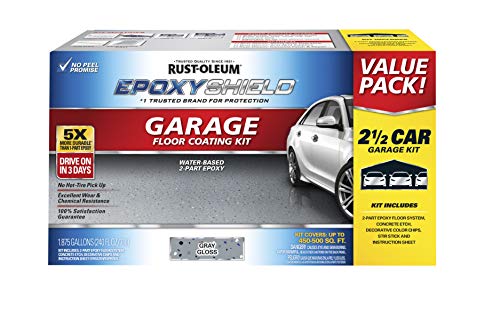
Rust-Oleum EpoxyShield Crack Filler -- Best for Garage Floors
Rust-Oleum's epoxy-based filler delivers industrial-grade bond strength, making it the right pick for garage floors that see vehicle traffic and chemical spills. It bridges cracks up to three-quarters of an inch and cures to a rigid finish that resists oil, gasoline, and road salts. The two-part system requires mixing but the kit includes everything needed. It is not flexible, so avoid it on outdoor slabs where seasonal movement occurs. Pair it with Rust-Oleum's floor coating for a seamless finish.
What we liked
- POWERFUL EPOXY REPAIR SYSTEM: Two‑component, 100% solids, high‑strength, high‑modulus epox
- MOISTURE INSENSITIVE FORMULA: Performs reliably on damp surfaces and can be used in comple
- INDUSTRIAL‑GRADE PERFORMANCE: Non‑sag formula and strong bonding capability suitable for c
- FAST 3‑HOUR CURE: Rapid tack‑free 3-hour cure at room temperature with an 8‑minute working
- VERSATILE AND EASY TO APPLY: Compatible with Rust-Oleum, EpoxyShield, and RockSolid coatin
How to choose
What to consider
Start by assessing the crack type. Hairline cracks under an eighth of an inch wide are cosmetic and any filler works. Cracks between an eighth and half an inch need a flexible polyurethane or self-leveling formula. Wider or structural cracks need epoxy injection or professional evaluation. Location matters too: outdoor slabs need UV and freeze-thaw resistance, basements need moisture barriers, and garages need chemical resistance. Always clean and dry the crack thoroughly before application, and match the product cure requirements to the ambient temperature at the time of the repair.
What to consider
Concrete slab repair is closely related to surface protection. For long-term results, pair your crack filler with a quality sealer -- see our guide to the [best concrete stain and sealer](/articles/best-concrete-stain-and-sealer) products. If you are also dealing with staining on the surrounding concrete, the [best concrete stain remover](/articles/best-concrete-stain-remover) roundup covers the leading options. Our testing methodology is explained at [/methodology](/methodology).
Common questions
For driveways, a polyurethane or epoxy-based filler works best because it flexes with temperature changes and bonds strongly to concrete. Look for products rated for exterior use, UV resistance, and the ability to handle cracks up to half an inch wide. Apply when temperatures are between 50 and 90 degrees Fahrenheit for best adhesion.
Most concrete crack fillers become touch-dry within one to four hours and reach full cure in 24 to 72 hours depending on the product type and ambient conditions. Polyurethane sealants tend to cure faster than epoxy injections. Avoid foot or vehicle traffic until the product reaches full cure to prevent premature failure.
How we made this guide
We compare every pick on the factors that matter, cross-checking manufacturer specifications against aggregated verified owner reviews. We rank independently and never take payment for placement. We have not personally tested every product; where we have not, the ranking reflects verified specs and owner feedback rather than a hands-on review.
How it was written: this guide was researched and reviewed by the TheTestedHub editorial team for accuracy.
Affiliate disclosure: TheTestedHub is reader-supported. When you buy through links on our site, we may earn a commission at no extra cost to you.
More guides

Fix Your Driveway Cracks with the Best Concrete Fillers

Which Drill Accessories Are Best in 2026?

Cordless Drill Systems Built for Real Jobsite Demands

What Makes Concrete Tools Worth Your Money in 2026?

Ghostshield 8505 Review: A Smarter Way to Protect Concrete

Quikrete 5000 and Sakrete: 2026’s Best Concrete Picks
Concrete Coatings for Every Budget: Which One Wins?
